UNESCO recently named an area on the east side of the Jordan River in Jordan as a World Heritage Site (here is an article from the Salt Lake Tribune). It is an area just east of Jericho and near Elijah's Hill where tradition states Elijah was taken to heaven by a whirlwind. As the article in the Salt Lake Tribune notes, quoting archaeologist Jodi Magness, there is no solid archaeological evidence of a sites "that were continuously venerated from the first century on," but UNESCO found that it is a site of "immense religious significance to the majority of denominations of Christian faith, who have accepted this site as the location" of the baptism of Jesus.
Matthew 3 discusses the baptism of Jesus by John: "In those days John the Baptist came, preaching in the wilderness of Judea and saying, “Repent, for the kingdom of heaven has come near.” This is he who was spoken of through the prophet Isaiah: “A voice of one calling in the wilderness, ‘Prepare the way for the Lord, make straight paths for him.’” John’s clothes were made of camel’s hair, and he had a leather belt around his waist. His food was locusts and wild honey. People went out to him from Jerusalem and all Judea and the whole region of the Jordan. Confessing their sins, they were baptized by him in the Jordan River...Then Jesus came from Galilee to the Jordan to be baptized by John. But John tried to deter him, saying, “I need to be baptized by you, and do you come to me?” Jesus replied, “Let it be so now; it is proper for us to do this to fulfill all righteousness.” Then John consented. As soon as Jesus was baptized, he went up out of the water. At that moment heaven was opened, and he saw the Spirit of God descending like a dove and alighting on him. And a voice from heaven said, “This is my Son, whom I love; with him I am well pleased.”'
Matthew 3 discusses the baptism of Jesus by John: "In those days John the Baptist came, preaching in the wilderness of Judea and saying, “Repent, for the kingdom of heaven has come near.” This is he who was spoken of through the prophet Isaiah: “A voice of one calling in the wilderness, ‘Prepare the way for the Lord, make straight paths for him.’” John’s clothes were made of camel’s hair, and he had a leather belt around his waist. His food was locusts and wild honey. People went out to him from Jerusalem and all Judea and the whole region of the Jordan. Confessing their sins, they were baptized by him in the Jordan River...Then Jesus came from Galilee to the Jordan to be baptized by John. But John tried to deter him, saying, “I need to be baptized by you, and do you come to me?” Jesus replied, “Let it be so now; it is proper for us to do this to fulfill all righteousness.” Then John consented. As soon as Jesus was baptized, he went up out of the water. At that moment heaven was opened, and he saw the Spirit of God descending like a dove and alighting on him. And a voice from heaven said, “This is my Son, whom I love; with him I am well pleased.”'
 |
| John the Baptist - a wonderful mosaic in St. George Church in Madaba. Note John's decapitated head to the bottom left. |
 |
| I believe this represents the baptism of Jesus - a mosaic from St. George Church in Madaba. |
 |
| A mosaic near the baptism site. |
 |
| Closer view of the above mosaic. |
The Baptism is also discussed in John 1: "[W]hen the Jewish leaders in Jerusalem sent priests and Levites to ask [John] who he was. He...confessed freely, “I am not the Messiah.” They asked him, “Then who are you? Are you Elijah?” He said, “I am not.” “Are you the Prophet?” He answered, “No.” Finally they said, “Who are you? Give us an answer to take back to those who sent us. What do you say about yourself?” John replied in the words of Isaiah the prophet, “I am the voice of one calling in the wilderness, ‘Make straight the way for the Lord.’” Now the Pharisees who had been sent questioned him, “Why then do you baptize if you are not the Messiah, nor Elijah, nor the Prophet?” “I baptize with water,” John replied, “but among you stands one you do not know. He is the one who comes after me, the straps of whose sandals I am not worthy to untie.” This all happened at Bethany on the other side of the Jordan, where John was baptizing. The next day John saw Jesus coming toward him and said, “Look, the Lamb of God, who takes away the sin of the world! This is the one I meant when I said, ‘A man who comes after me has surpassed me because he was before me.’ I myself did not know him, but the reason I came baptizing with water was that he might be revealed to Israel.” Then John gave this testimony: “I saw the Spirit come down from heaven as a dove and remain on him. And I myself did not know him, but the one who sent me to baptize with water told me, ‘The man on whom you see the Spirit come down and remain is the one who will baptize with the Holy Spirit.’ I have seen and I testify that this is God’s Chosen One.”
 |
| A painting of the baptism of Jesus in St. Peter's monastery in Jaffa. |
The Madaba Mosaic Map is a floor mosaic from the Byzantine church of St. George in Madaba, Jordan. It is the earliest known map of the Holy Land. It was created between 542 and 570 A.D. (because the Nea Church in Jerusalem is shown which was dedicated in 542 and buildings in Jerusalem built after 570 are not included). The original church was destroyed by an earthquake in 746 and the map was rediscovered in 1884 when a new church was being built on the site of the old church. The map has been used to help locate and verify biblical sites, including the site of the baptism of Jesus. On the map, a lion chases a gazelle in Moab. Only the tail and back legs of the lion are clear as the tiles were scrambled during the iconoclastic controversy. The Dead Sea is to the right and a fish in the Jordan River has turned the opposite direction from the Dead Sea. East of the Jordan River (above it) an English translation of the Greek reads "Ainon where now is Sapsaphas." Ainon means "springs" in Aramaic and "sapsas" means willow in Arabic. So it means "willow springs." To the west, below the Jordan River, an English translation of the Greek reads "Bethabara the place of Saint John's baptising." Bethabara means "place of the crossing." Below it is the Monastery of St. John the Forerunner.

 The location of the baptism site of Jesus is based on the archaeological findings of a series churches built in the area from the 5th to the 6th centuries and writings from pilgrims at that time which correspond to the archaeological findings. A small spring known as "John the Baptist Spring," or "Ainon (on the Madaba Map) reached the Jordan River near the John the Baptist Church. There is still a little bit of stagnant water today, although I'm not sure it is from that spring, which I believe has been diverted. A small chapel nearby with remnants of a stone arch is believed to be the spot where Jesus un-robed before entering the water. A marble staircase led up to a site where three churches were built in succession over each other. They had mosaic and marble flooring, some of which still remains today.
 |
| The lion chasing the gazelle is upper left. |
I love the location of the baptism site being so close to the spot where Elijah was taken into heaven by the whirlwind because John the Baptist is associated with the spirit and power of Elijah by an angel talking to his father Zacharias, the high priest of the temple (Luke 1:13-17).
The River Jordan has changed course over the centuries and no longer runs where it presumably did at the time of Jesus. It now has much less flow because much of the water is sucked up by both Israel and Jordan before reaching this point. The River Jordan now runs to the west of the baptism site quite some distance.
 |
| The Jordan River as it looks today (up river from the current baptismal site). |
 |
| A spot on the current Jordan River where pilgrims today can be baptized. This is the Jordan side looking over the the Israel side. |


 |
| A mosaic representation of what the site may have looked like when the church, marble steps and arch were in good repair. |
 |
| The baptismal pool is in the form of a cross. This is where pilgrims would descend the marble steps to be baptized. Plaster was discovered on two of the four piers where thousands of cross marks were still visible, probably left by pilgrims that were baptized there. |
 |
| Arculfus of France, in 670 CE, noted that "...At the edge of the river is a small square church, built, as is said, on the spot where the garments of the Lord were taken care of at the time when He was baptized. This is raised, so as to be uninhabitable, on four stone vaults, standing above the water which flow below." Although this is a view through the small wood structure there now, where apparently Jesus un-robed, the quote makes it sound like there was a chapel actually built over the baptismal site on the four pillars. Note the channel straight ahead where the spring waters flowed into the Jordan River. |
 |
| In 570 CE, Antoninus Martyr of Piacenza wrote, "We celebrated Epiphany by the side of the [Jordan?], and wonders take place on that night in the place where the Lord was baptized. There is there is a mound surrounded with railings, and at the place where the water returned to its bed,...marble steps descend into the water,...the priest descends into the river." |
 |
| Looking through the wood structure that covers the footprint where the John the Baptist Church once stood. Theodosius, in 530 CE wrote, "5 miles north of the Dead sea in the place where the Lord was baptized there is a single pillar and on the pillar an iron cross has been fastened, there too is the church of S. John the Baptist, which the Emperor Anastasius built [491 to 518 CE]: this church is very lofty, being built above large chambers, on account of the Jordan River when it overflows." The pillar marking the spot of the baptism has not been found. |
 |
| Remnants of mosaic flooring in the church. |
 |
| Another view of the cross shaped baptismal pool and the exit for water to flow to the Jordan River. |
 |
| Another view gives a better sense of the cross shaped pool. |
 |
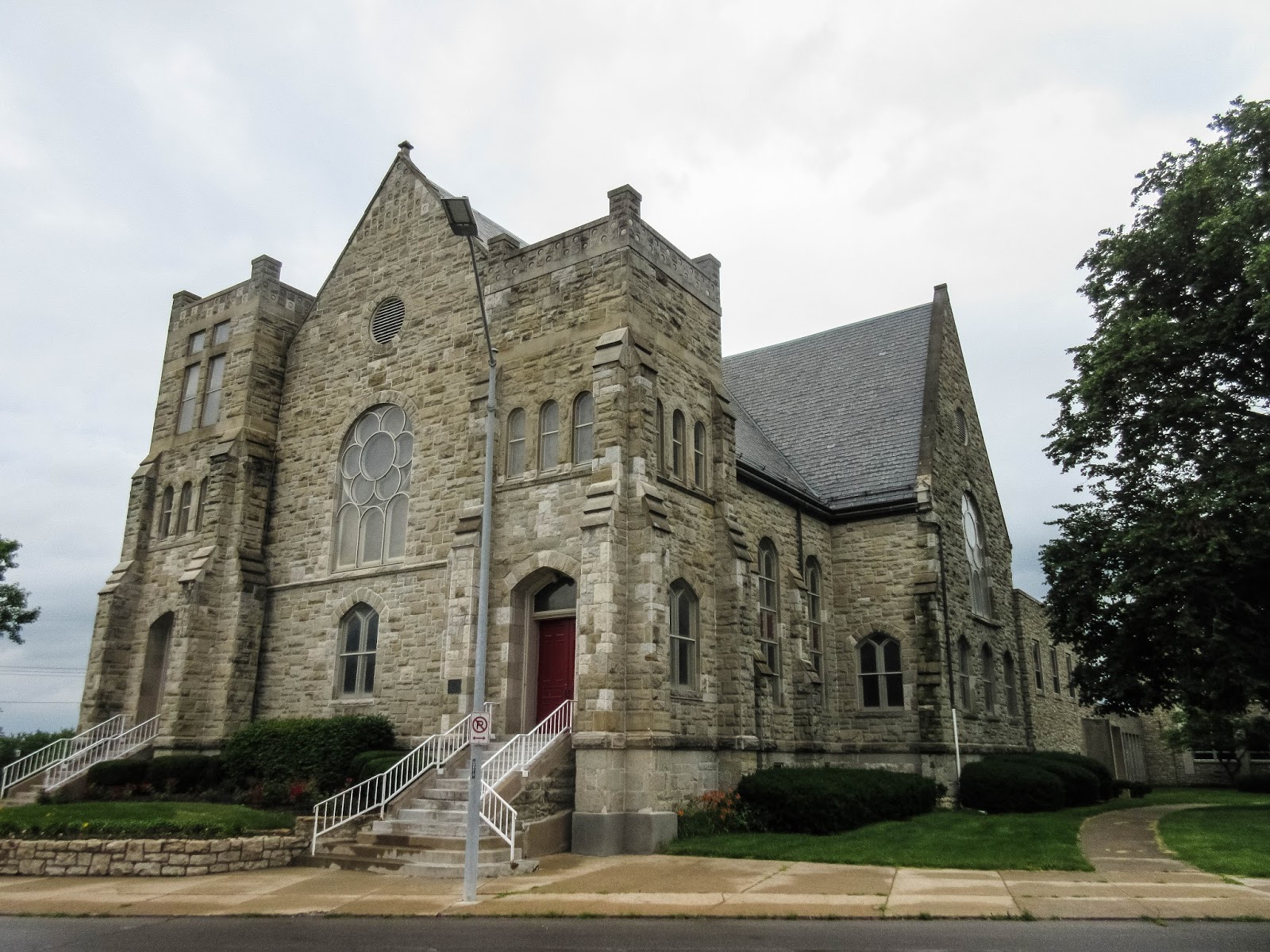
| A modern Orthodox church near the baptism site. It was locked and we were unable to enter. |