Monday, September 12, 2011

Brown-Capped Rosy Finch

After climbing Mt. Sherman outside of Leadville, Colorado in August, Sam and I stopped to take a rest at the Sherman/Sheridan saddle at about 13,100 feet. I ate a little and drank some water and Sam had a bird land near him which was quite bold. 
It walked within a foot of him and stayed with him for about ten minutes while he rested. I tried to get a good photo of it, but it kept shying away from me. Because of my blistered toes, we decided to leave the trail and go straight down the mountain in a spot that allowed me to shuffle down sideways, saving the ends of my big toes which were very sore. This bird continued to follow Sam down the mountain for about 10 or 15 minutes. 
It would land and walk, then fly in circles and land near Sam and walk again. It must have done that five or six times and followed as as we dropped about 500 feet of elevation. 
I have been searching bird books and the internet trying to figure out what kind of bird it is and I think it may be a brown-capped rosy finch. They are found in the high mountains of Wyoming, Colorado and New Mexico, but their very restricted range is almost exclusively the high peaks of Colorado. They are considered rare in Wyoming and rare to uncommon in New Mexico. They breed at a higher elevation than any other North American bird and stay at high elevations even in deeply negative temperatures and heavy snows. Females are duller and and often have little evidence of a crown patch. Juveniles are a drab gray-brown all over, which seems to match this specimen. 
Because of the difficulty in studying this bird at high altitudes, not a lot is known about it. Because of its limited range and drop in population, there is some conservation concern for it. 

Sunday, September 11, 2011

Mountain Thistle

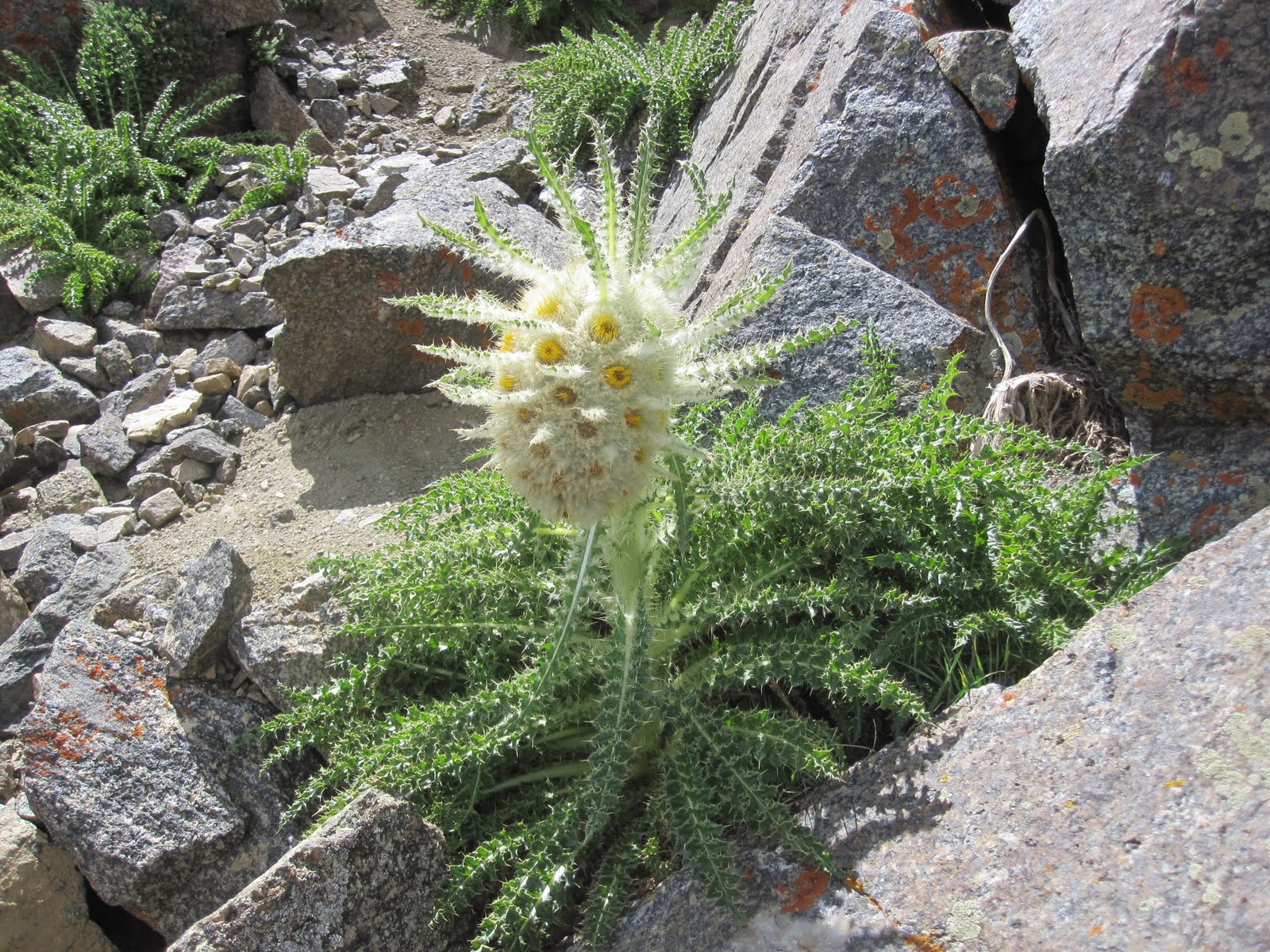
On our recent trip to Colorado we found a wonderful plant known as mountain thistle. 
It is also called frosty ball and woolly thistle for obvious reasons. 
It has lance-shaped leaves with half-inch long spines 
and nodding heads that are very dense and hairy. 
The flowers can be yellow or purple. Those we saw were all yellow. 
They are found on rocky and gravelly slopes on the sunny side of mountains in the alpine and subalpine zones. We found a wonderful grouping of them on the rocky ridge between Mt. Oxford and Mt. Belford at about 13,900 feet. 

Saturday, September 10, 2011

Buffalo Bone Marrow

One of the greatest foods I've ever eaten is buffalo bone marrow. I just recently had it for the second time at The Fort in Morrison, Colorado, one of the most fun restaurants I've ever been to. The buffalo bone marrow appetizer is great on a number of levels. First, it is initially shocking to see how big the bones are, which are sawed in half lengthwise. 
Next, once you dig into the marrow with a spoon, it is shocking to see how much marrow there is in each half-bone. 
Then, once you put a big spoonful in your mouth, or onto a crostini and then into your mouth, the richness and decadence is overwhelming. It is so rich and fatty that you can only eat so much, but those bites are luscious! Finally, it is great because it is so unusual. Where else can you get something like this? Nowhere that I've been able to find. I love exploring new places and I find that exploring new foods is just as fun and thrilling. As a boy I used to love bone-in ham. I would stick my finger in the bone and scoop out as much marrow as I could on my finger. I preferred the marrow from warm ham, but I would also eat it from cold ham. Likewise, I loved (and still do love) cuts of lamb or beef that included a sideways cross-section of bone with the marrow. Put on a little bit of salt and pop it out with your finger, or if the bone is too thin or too long, plug one end with your finger and suck on the other end and release the finger - the succulent, juicy marrow flies into your mouth. The buffalo marrow gives you that same experience, but amplifies it about 100 times. 

Friday, September 9, 2011

Lamb Ribs

The Fort in Morrison, Colorado has an appetizer I've never seen on another menu: lamb riblets tossed in a spicy citrus bbq sauce. 
The only other time I've eaten lamb ribs was when Andrew slaughtered a lamb for his graduation and we ate the ribs from it. The Fort citrus bbq sauce was very strong and spicy and really covered up most of the taste of the lamb. However, it was memorable because it was so unusual and has increased my interest in finding lamb ribs elsewhere. 

Wednesday, September 7, 2011

Cheese: Soignon

Soignon is a goat cheese 
made in the Poitou region of west central France since 1895. After adding a bit of rennet and lactic ferment to the goat milk, it slowly curdles over a day or two. The curd is then put into a mold and salt and enzymes are spread on it which helps it develop a moldy rind. It has wonderfully soft flesh, almost like a Brie. 
I was not able to find a copy of the specific label I had on the internet, 
but by taste I believe what I had was a ripened cheese. Ours had a little mold, not only on the rind, but on the outer flesh as well. 
I was unsure if it was supposed to be that way, or if it was getting old. I flew caution to the wind, decided to treat it as though it belonged, and it tasted great. It was quite strong, not as goaty as we expected, and it had a slightly blue taste, perhaps because of the mold on the flesh. If it wasn't supposed to be there, it was good anyway. It was not as soft as Brie, but close. 
We really liked it, both the texture and the taste. It was our favorite of about six cheeses we were sampling. We will definitely be trying more. 

Tuesday, September 6, 2011

Barbecued Bluefin Tuna: Filet and Belly Meat

My partner, Michael Lewin, went fishing off of San Diego this past weekend and caught five bluefin tuna, the limit. He brought some fresh bluefin into work on Tuesday (the day after Labor Day) and I got a beautiful filet and two large pieces of belly meat, the part of the tuna known as fatty tuna. 
The filet is the piece that is darkest, at the far back, and the belly meat has silvery blue skin on the outside and pinkish flesh on the inside. I decided to take it home for lunch, while it was still fresh, fire up the barbecue, and see how it tasted. 
I did not have any wasabi, but I did have some ginger wasabi teriyaki marinade which I put on it. 
and
I resisted the urge to eat it as sashimi as I do not believe it was flash frozen and I wanted to avoid getting any worms or parasites that are otherwise killed by that process. I put it on the barbecue for several minutes 
and tried it, 
then put it on for several more minutes 
and tried it again. It was seared just a bit on the outside and still quite raw on the inside. 
Michael indicated that the tuna were each about 18 or 20 pounds and that the bellies were just a small portion of the bottom of the fish. The freshness and texture were amazing. It is nice to have really fresh fish. I enjoyed both the filet and the belly meat without a strong preference for one over the other. I wish I'd had some wasabi sauce. There is nothing quite like the saltiness of soy sauce and the heat of wasabi to complement the texture and taste of mostly raw tuna. A while back I bought some fatty tuna from a store and was quite disappointed. At that time I'd hoped to have some belly meat from tuna caught by Michael. This was fulfillment of that wish. I don't have a lot of experience cooking fish and a good chef with the right ingredients could have made something pretty spectacular with this fish. As it was, what I made was quite good. 

Thursday, September 1, 2011

Rocky Mountain Oysters: Buffalo vs. Bull

While in Colorado recently, we stopped to eat at two of my favorite eateries: Buckhorn Exchange in Denver and  The Fort in Morrison. For lunch at Buckhorn Exchange, I was with Andrew and Sam, and my nephew, Scott Jones, son of Judy's sister, Chris Jones, who lives in Denver. Andrew had not eaten Rocky Mountain oysters before and wanted to try them.  
They are bull testicles cut into thin slices, breaded and fried. They came with cocktail sauce and mild horseradish. 
They were actually quite good - better than I recall them being two years ago. I did not notice an organ meat taste I recalled them having before. They were quite popular among our group and we finished the plate. Several days later, when we had dinner at The Fort, Andrew was interested in trying the Rocky Mountain oysters again. We thought it would be fun to see how they differed from the Buckhorn Exchange version. It turned out that they were very different. They were breaded, but they were in much smaller round pieces and did not have as much breading on them. 
They were also much softer, almost like eating soft cheese or butter. They were really excellent. We asked the waiter about the difference. We then learned that The Fort "oysters" are buffalo testicles. Buffalo testicles are each about the size of a baseball. They cut them into small pieces before breading them. I'm not sure if The Fort prepares them differently than the Buckhorn Exchange does theirs, other than the cut, or if the difference is due to buffalo vs. bull, but whatever it is, The Fort buffalo testicles are far superior in taste and texture. We cleaned the plate and could have eaten another one or two just like it. They were that good. They are also far superior to the turkey testicles I've eaten.