Monday, December 7, 2009

Barbeque Goose

Last November I cooked a roast goose which turned out really well, but it took forever to prepare. It involved separating, by hand, the skin from the goose body while leaving the skin still covering the goose, steaming the goose for awhile in the oven in a roast pan to remove part of the fat, then letting the goose stand uncovered in the refrigerator overnight before cooking it. I found a recipe for barbequing a duck that I thought would work with a goose and take much less time to cook, but I found that goose is not available for most of the year. So I've been looking forward to Thanksgiving time again as another time to find goose in the store and try it again. I bought an 11.4 pound Goose at Albertsons.

Thawed and out of the package it oozes fat. The outer layer of skin covers a cushion of fat that must be 1/4 inch thick or thicker of fat. No wonder the goose can stay warm while swimming in very cold water.


The hind end is rolling with fatty tissue that needs to be removed.

The hind end after I've removed most of the loose skin and fat.

After removing excess fat from both ends, you perforate the skin with a sharp knife in a series of sidewise cuts being careful not to cut into the inner meat. This provides avenues for the fat to escape while boiling the carcass to remove additional fat. Then I put the goose in a boiling pot, each end in for 15 minutes (30 minutes total), covered in foil (not shown) to help retain the heat.

The water, after boiling, is saturated with goose fat.

I then put the goose on our outdoor grill. I have four burners. I lit the outer two burners and put the goose over the inner two, unlit, burners. I put a little bit of tin foil over the outer edges because I was concerned that the fat pouring out of the goose during the process would cause a fire that would engulf the ends of the goose.

I cook my barbeque duck this very same way, half the size, for 45 minutes. I figured the goose would take twice as long. However, after 45 minutes I inserted the meat thermometer and it already registered a temperature of 190 degrees, when I only needed 180. So I pulled the goose off, brushed on a coat of Hoisin sauce and put it back on the grill for 10 minutes.

The goose, off the grill, ready for carving.

I let it cook a little long, but because it is so fatty it still came out very well. I suspect it cooks faster than the duck because the goose is longer and skinnier. Below, a plate of carved goose meat. The top pieces are of the inner, much less fatty pieces. The best pieces were the outer slices with a bit of the outer fat and sweet Hoisin covered skin. We had extra Hoisin sauce at the table to add a touch of sweetness to the inner meat.

We ate it Wednesday late afternoon the day before Thanksgiving while Dave and Bonnie Kenison were visiting. It was a very nice lead-up to the big bird the next day. This cooking style was much more simple than my last goose and one I intend to use again. Fun to have an unusual meal with friends and family over the holidays. By the way, I turned on the grill afterwards to burn off the excess fat that dropped from the goose during the cooking process. It turned into a conflagration with flames leaping out from the grill cover. All of the effort to remove excess fat is very necessary and the end result is no more fatty than a regular duck.

Sunday, December 6, 2009

Cane Toad

The cane toad is also known as the marine toad or bufo toad. We found the cane toad below in Haaula, Hawaii at my parent's home one evening.

They are originally native to Central and South America, but have been introduced into other places, such as Hawaii. They can get huge. The largest one recorded was 15 inches long, from snout to vent, and weighed 5.8 pounds. The parotoid glands, below, contain poison. When frightened, they can secrete the poison and can be dangerous, particularly to other animals, and children. Some people actually do "toad licking" with these toads and get a psychadelic high, but it is very dangerous. Many dogs in Hawaii are killed each year in encounters with these toads. They have distinctive ridges above the eyes which run down the snout.
At the time, in 1993, I had no idea they were so poisonous and Sam had this one in his hand. Fortunately, it did not appear to be too bothered.

Another, different, view of the ridges above the eyes and the parotoid glands.

A picture of the cane toad in a bucket.

Finally, this is one of the more impressive pictures I've seen - found it on the internet. Look at the size of this cane toad! It looks like it is big enough to swallow a large rodents.


Saturday, December 5, 2009

Western Hognose Snake

The western hognose snake is found in a vertical band of the midwestern United States, Canada and Mexico with three subspecies: the plains hognose (from southern Alberta and Saskatchewan, down through eastern Montana, Wyoming, Colorado, and New Mexico, on the western edge); the dusty hognose (parts of Texas and Oklahoma), and the Mexican hognose (southeastern Arizona, southern New Mexico and parts of Texas and fairyly deep into Mexico). I have not seen one in the wild, but had one as a pet for a number of years. The distinctions are not great enough for me to be able to tell, from pictures, which subspecies we had.

It is heavy-bodied and somewhat awkward, compared to other snakes. The really distinctive feature is the upturned snout which gives it its name. The snout is used for burrowing and, in the wild, its favorite food is toads, but it will also eat frogs, salamanders, lizards, turtles and reptile eggs.

Unlike many of our western snakes, it is not a constrictor. It has rear fangs that allow it to grab onto pray and gradually swallow it. In captivity, they will eat mice, which is what I fed our hognose. Rather than kill a mouse by constriction before eating it, the hognose just grabs it and starts to eat it while alive. Therefore, they need to be fed small mice that can't bite, or dead mice. Below is the hognose swallowing a small mouse, the tail still hanging out. It provides a good sideways view of the upturned snout.

They have a mild disposition and our hognose never attempted to bite.


In the wild, when encountering danger, they will spread their head and neck and hiss, which earns them the nickname "puff adder" or "blow snake." I don't recall seeing that behavior in our snake. If that doesn't work, they "play possum" or "play dead." They roll over on their backs, writhe around briefly, then lie still with mouth wide open, tongue sticking out and vent opened and discharged. I only saw this behavior once. We had a number of visitors and I brought the hognose out and put it on the carpet.

Note that the belly appears like it is being sucked in. It was really bizarre.

I turned the snake back over, see below,

but then it flopped back over on its back.

Friday, December 4, 2009

Anamaria's Mexican Food

Andrew introduced me to what he calls his favorite meal in Los Angeles - a gordita at Anamaria's Mexican Food in the Grand Central Market, located at 317 South Broadway. Anamaria's is one of numerous food places in this inside market, and Andrew first went there because it had the longest line of any food vender in the market, so he figured it had to be good. Because he can only get there on rare occasions he always eats the same thing, a pork gordita.

A gordita is like a large pita pocket, with much more substantial bread. First it is stuffed with pulled pork, then lettuce, onions, tomatoes and some kind of white sauce.


The first few bites is all vegetables, wonderful juicy lettuce, etc.

Then wonderful, moist pulled pork.

I'll add Anamaria's to my list of Mexican food joints and will attempt to go there when in LA to go to court or some other occasion. It is fun to have Andrew in Los Angeles to identify new food haunts. He has good taste.

Thursday, December 3, 2009

Hot Dog - Santee Alley and the Fashion District

Friday, the day after Thanksgiving, we went to the Garment or Fashion District of Los Angeles to experience Santee Alley. We'd already experienced a big meal, but Andrew told me that they served amazing hot dogs from street carts, wrapped in bacon and smothered in relish, including avocado. Santee Alley is several blocks of streets without cars and stall after stall of people selling shirts, pants, hats, shoes, bras, belts, cds, etc. It was a little culture shock, very fun. Andrew spotted a cart he felt was worthwhile and I looked at the amazing hot dogs wrapped in bacon, fried onions and jalapenos next to them.

Then he pointed out some side relish filled with tomatoes, peppers and other goodies, but sadly lacking the avocadoes he's had before (perhaps not the season?).


The hot dog more than filled the bun and it was very hot. The onion topping was wonderful, as was the relish. I would rate it up there with the best of hot dogs I've ever had. I love the idea of a loaded hot dog, something more than catsup, mustard and some relish or onions. Quite a few carts along the street were selling the same thing, yet I've never seen anything like it elsewhere. Well, I'm all for a good thing.

I looked at a number of Yelp posts about the Fashion District and quite a few mention the bacon wrapped hot dogs. Definitely worth a try.

Wednesday, December 2, 2009

Moose: Hamburger, New York & Sirloin Steak

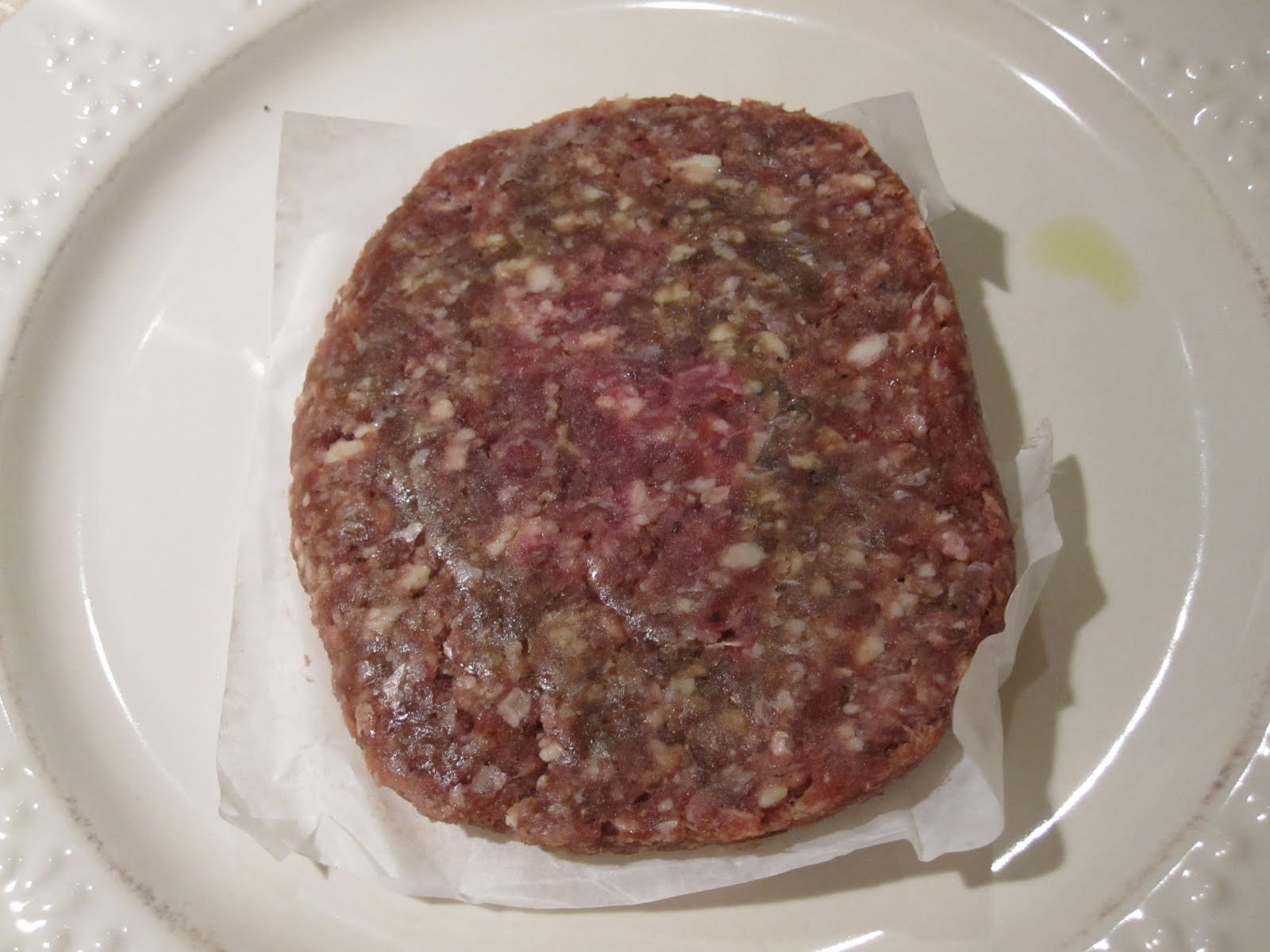
I have wanted to eat moose meat for years (I've had deer, elk, antelope, bighorn sheep, caribou and buffalo, but haven't been able to find any moose). On a number of occasions I've talked with clients in Montana or others with connections to Montana about getting some moose meat. Finally, this past week, it all came together. A client has done some moose hunting in Alberta and had quite a bit of moose meat at home in his freezer. I asked if I could possibly get some from him and he showed up at work later that day with some hamburger patties and some New York and sirloin steak. Dave and Bonnie Kenison were visiting us for Thanksgiving and Sam and Andrew were home, so we had the hamburgers Wednesday evening. Because the moose is so lien, the butcher actually adds about 8% beef fat to it.

Several moose burgers cooking in a little olive oil.


My moose burger with lots of other fixings. It makes a very good burger. Very mild meat and no gaminess at all. Not real juicy, because of lack of fat, but good taste.

Friday, the day after Thanksgiving, we broke out the New York steaks and sirloin. It was privately packaged.


The raw sirloin is to the left and three New York steaks are to the right and underneath. Note the lack of marbling.

I gave them a coating of olive oil, a little salt and pepper and put them on the outdoor grill.

I cooked them medium rare. They looked very good.

Still very juicy and like the hamburger, had a very mild, not gamey taste. Judy felt it had a little of a liver taste, but I didn't think so. Dave, Bonnie, Andrew and Judy all said they liked it a lot. It is juicier and tastes much better than elk and antelope. Venison can be very strong tasting and gamey. Only buffalo is better. Buffalo has a stronger, very distinctive taste, that I like. I'm thrilled to have had this opportunity and hope to have more some day.


Tuesday, December 1, 2009

Red-Spotted Toad

The red-spotted toad is found in eastern Southern California, east to mid-Texas, including southern Nevada, southern Utah, portions of southern Colorado and points south well into Mexico. The toad below, was found near the Whitewater River in Whitewater Canyon. I really struggled with identification: whether it was a red-spotted toad or an arroyo toad. The location charts looked more consistent with an arroyo toad, but I found that the red-spotted toad is found in Whitewater Canyon, as well as the arroyo toad. The arroyo toad is supposed to have a "v" shaped white stripe on the front of the head, light eyelids and parotoid glands lighter toward the front than the back. However, photos of the arroyo toad I found posted on the internet did not seem to have those features, at least no more than the toad pictured below. Ultimately, the more rounded parotoid gland of the red-spotted toad and the more pointed snout and the grayish color seemed to wade in favor of the red-spotted toad.
The rounded parotoid gland, below, is about the same size as the eye and it has horizontal pupils.


It also has some red spots on the back, but not an abundance.


The picture of the next toad was taken near Navajo Falls on the Havasupai Indian Reservation in northern Arizona.


It is a smaller, juvenile, toad, and has more red spots. It is nocturnal, but this particular toad was found during the day.


The next red-spotted toads were found on a dirt road near Supai, above the Havasupai waterfalls. They are in amplexus, where the male grasps the female from behind and positions his vent near hers to assure fertilization.


The toad is olive, brownish or light gray with reddish or orange warts.


A closer view of the red warts.


The final picture of a red-spotted toad was taken at night in Supai.