Tuesday, March 21, 2023

Loggerhead Kingbird

The loggerhead kingbird is found in the West Indies, including Jamaica, and also rarely in southern Florida. 
It is dark gray above, white below, has a black head with white throat and cheeks. It also has an orange or yellow crown patch which is rarely visible. 

I saw a loggerhead kingbird at Rocklands Bird Sanctuary outside Montego Bay in Jamaica. 

Monday, March 20, 2023

Jamaican Mango (Hummingbird)

The Jamiacan mango is another bird endemic to Jamaica. The male has a dull green crown, the neck and cheeks iridescent magenta, the back is dull greenish bronze, the central tail feathers are bronze to dull black and the rest are iridescent red-purple with a thin dark blue band, and the underparts are black (although my photos reveal a dark blue). The female is similar but has faded velvety green flanks and white tips on the outer tail feathers. 


The light caught its tail as it went up to a feeder. 
I never got any good light photos, but even my poor dark photos reveal the color that can emanate from this jewel. Only only saw them at Rocklands Bird Sanctuary 

Sunday, March 19, 2023

Northern Potoo

The northern potoo is a bizarre bird I'd never heard of before preparing for our trip to Jamaica. I saw it on bird lists and looked at photos and it joined my "want to see" list. Wikipedia notes "It is most commonly seen perched motionless in an upright position on branches or posts." That is how I saw photos of it and how I saw it. 
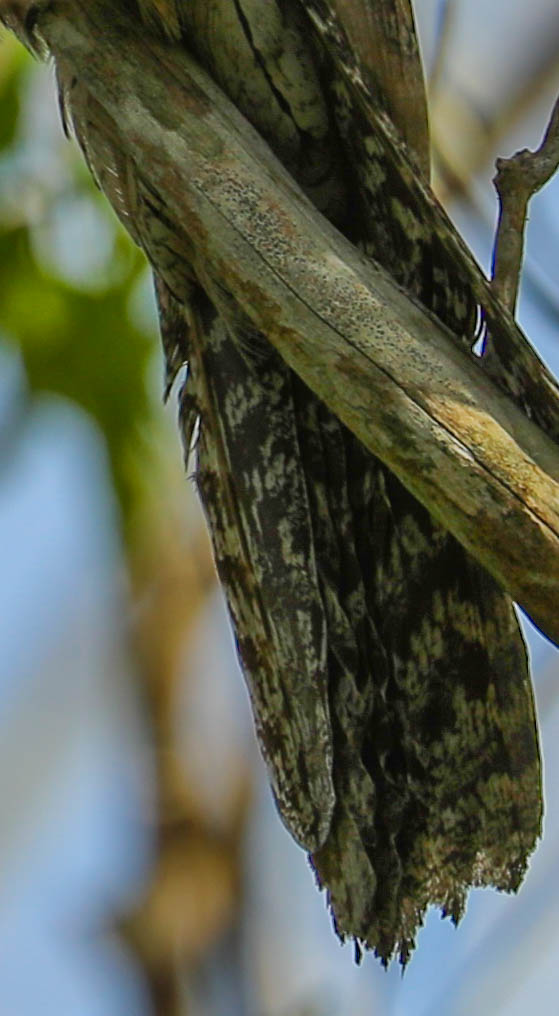
The classic pose. From when I first saw it and started taking photos, it moved slightly and partially opened it eyes to reveal its yellow iris.


It is found from mid-Mexico to Costa Rica and on the islands of Jamaica and Hispaniola. There are five subspecies, including the subspecies only found in Jamaica, which is the nominate subspecies. 

It is very well camouflaged, like the stump of a tree and it is hard to figure out how the bill, mouth and eyes fit in. I've looked at photos and wondered where the mouth is and how it works. 

This last photo revealed its yellow iris, changed how I thought its mouth was configured and reminded by of a yeti. 
It is nocturnal and feeds on large insects like moths and beetles. 

Saturday, March 18, 2023

Ovenbird

I'd never heard of an ovenbird before looking at some bird lists of Jamaican birds. An ovenbird is in the warbler family that breeds in eastern North America and winters in Central America, the Caribbean, Florida and northern Venezuela. 
Ovenbird range - Wikipedia. Yellow is breeding and blue is wintering. 
It has olive-brown upperparts; white underparts heavily streaked with black; the flanks have an olive hue; there is a white ring around the eye; a black stripe runs below the cheek; orange feathers with olive-green tips run along the top of the head, bordered by blackish-brown and the feathers can be erected to form a small crest; the eyes and upper part of the pointed beak are dark, while the lower beak is horn colored; and the legs and feet are pinkish. 

I saw one ovenbird at Rocklands Bird Sanctuary outside of Montego Bay, Jamaica. 

Friday, March 17, 2023

Yellow-Faced Grassquit

The male yellow-faced grassquit is another bird I really loved. I saw them at Rocklands Bird Sanctuary near Montego Bay, Jamaica (where I got photos) and Hotel Mockingbird Hill near Port Antonio and in the Blue Mountains (where I did not get photos). 
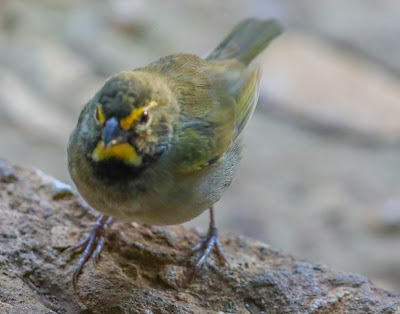
Males: the first three photos are of the same bird.


The male has an olive-green back, a black face and breast with a bright yellow throat, lower eyelid spot and supercilia, a dark conical bill and eyes and gray legs. The female is dull olive-green above and paler gray below, may have some dark breast smudges and the yellow face pattern is weaker and duller or non-existent. 
Female
It is part of the tanager family and related to the Darwin finches. It is found in the Caribbean Islands, the eastern coast of Mexico and much of Central America and portions of Colombia, Ecuador and Venezuela. There are five subspecies. I saw the nominate subspecies (olivaceus) which is found in Jamaica, Cuba, Hispaniola and the Cayman Islands. 

I didn't know what I was seeing when I saw it. When I described it to my bird guide I kept describing it as having green markings on its face. This confused the guide and he wasn't sure what I was talking about. I was actually thinking of the yellow markings, but the yellow makes the green really stand out and that's what stuck in my head. 

Thursday, March 16, 2023

Black-Faced Grassquit

The black-faced grassquit is a tanager and closely related to the Darwin finches which I saw last year in the Galapagos Islands (small ground finch, medium ground finch and small tree finch).  It is found in the West Indies, except Cuba and Trinidad, and along the northern coasts of Colombia and Venezuela. There are eight subspecies and those in Jamaica and Hispaniola are one of those (marchii). 
Males


Males have a black head and breast with an olive green back. Males on the South America mainland have more extensive black underparts that shade to gray.  Females have a dull olive-gray upperparts and head and paler gray underparts that turn to white on the belly. Both have a short conical bill. 
Females


I saw them at Rocklands Bird Sanctuary outside Montego Bay in Jamaica.

Wednesday, March 15, 2023

American Redstart

The American redstart is a warbler that breeds in Canada and the U.S. (mostly the eastern U.S.) and winters in the Caribbean, northern South America, Central America, southern Mexico and the Pacific coast of Mexico and California and small portions of southern Florida. The Latin name, ruticilla, means red (rutilus) tail (cilla). Start is an old word for tail. 
At Rocklands Bird Sanctuary.

Breeding males are black above with large orange-red patches on their wings and tails. The sides of the breast are also orange with the rest of the underparts white. Non-breeding males have green in their upperparts with black central tails and gray heads. Females have yellow in the place of the orange patches on the breast of breeding males.  
Near Konoko Falls.
I saw redstarts at Rocklands Bird Sanctuary near Montego Bay and near Konoko Falls in Ocho Rios, Jamaica. I'd never hear of a redstart before preparing for our trip to Jamaica and looking at bird lists.
Range of the American redstart from Wikipedia.