Sunday, July 22, 2018

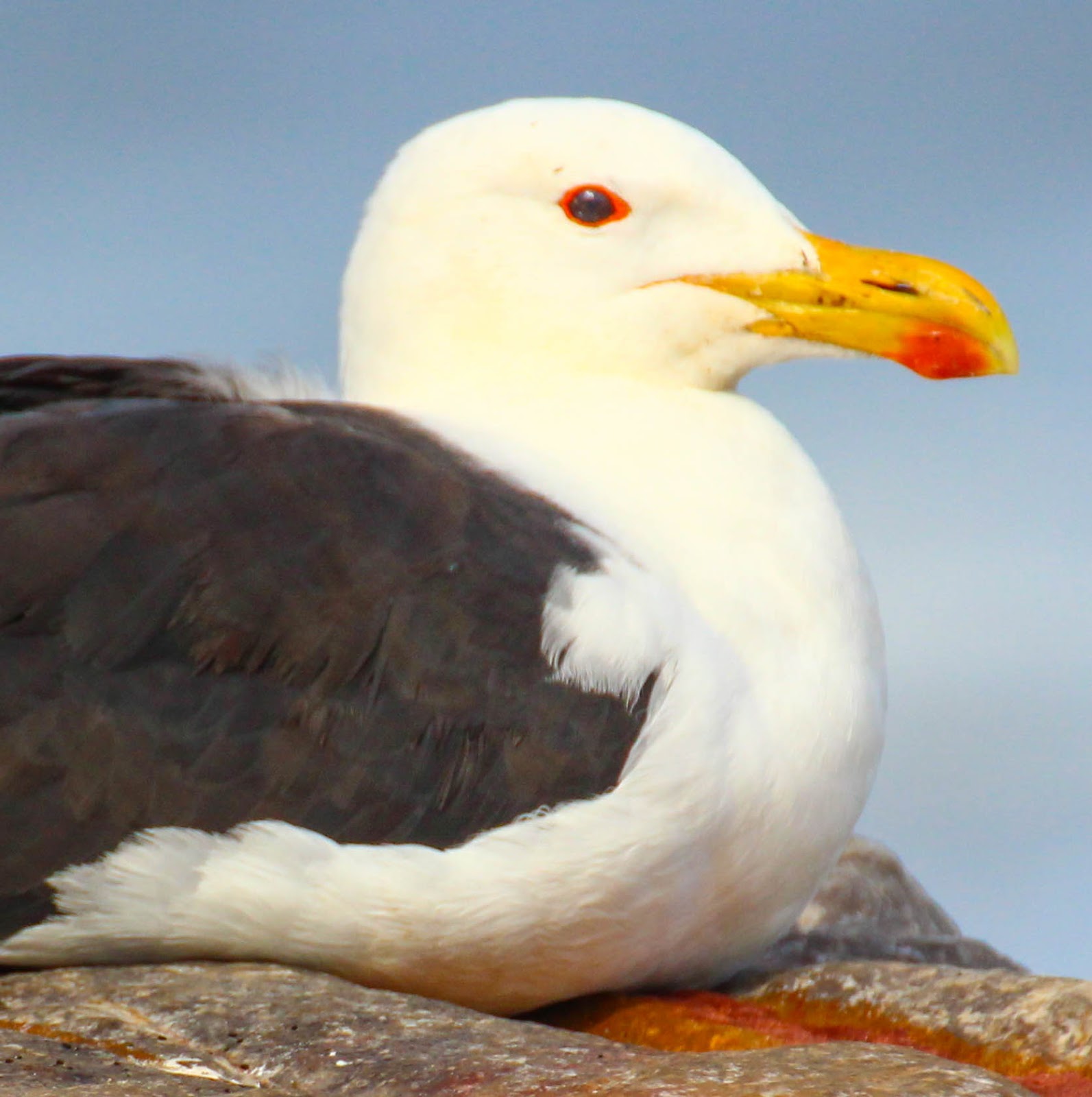
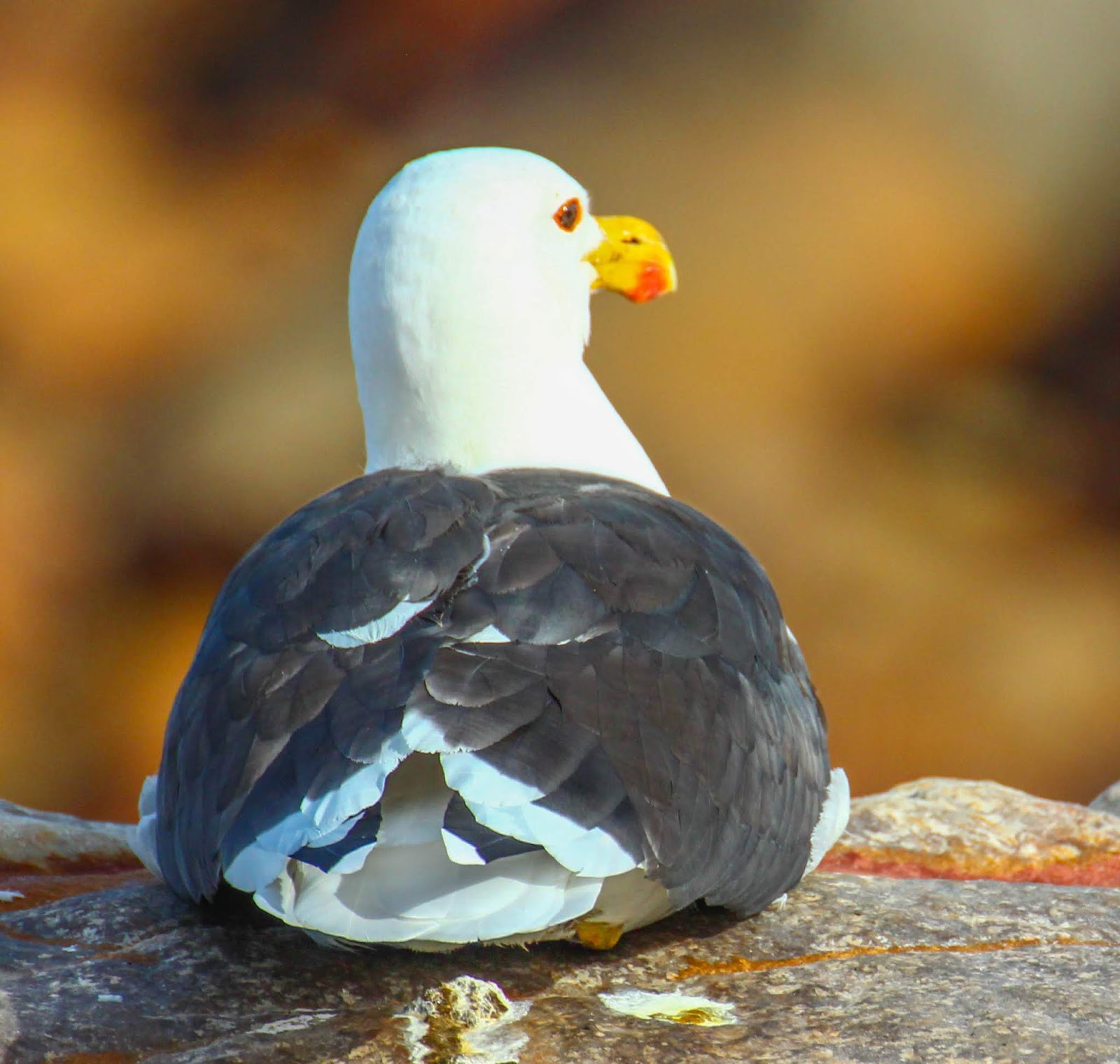
Cape Gull

The Cape gull (L. d. vetula), found in southern Africa, is one of five subspecies of the kelp gull (Laurus dominicanus). I've been struck by how many subspecies are called by "Cape." I assume it relates to the early European influence in Africa and their influence in assigning names to the animals. 
We saw these Cape gulls at the Cape of Good Hope, in South Africa, on rocks right next to the ocean. 
The kelp gull is found throughout much of the southern hemisphere. It has black upperparts and wings. The head, underparts, tail and spots or "mirrors" on the wingtips are white. The bill is yellow with a red spot on the lower mandible and the legs are a greenish yellow. 


The nominate subspecies, sometimes known as the Dominican gull (L. d. dominicanus), is found in South America, Australia and New Zealand. Other subspecies are found in the Indian Ocean, Madagascar and Antarctica. 

Saturday, July 21, 2018

Cape Turtle Dove

Another bird we saw in Kirstenbosch Botanical Gardens near Cape Town was the Cape turtle dove, also known as the ring-necked dove and half-collared dove (Streptopelia capicola). 
Cape turtle dove. 
The Cape turtle dove is darker above than below, with dull grey or brown with a bit of pinkish lavender on the nape and a semi-collar of black on the lower nape. It has white tips on the slate tail feathers. The plumage variation is significant - some are light and some are sooty. The bill is black, the feet are dark purple and the eyes are almost black. They also appear to have a light blue patch on the forehead and a bit of light blue on the upper bill. 

Their are six races. We saw S. c. capicola, the nominate race, found in southwestern South Africa. From pictures, it appears to be darker than the other races. 

This photo captures the white tips on otherwise slate tail feathers. 

Friday, July 20, 2018

Cape Fur Seal

The Cape fur seal (A. p. pusillus), also known as the South African fur seal, is one of two subspecies of the brown fur seal (Arctocephalus pusillus). The other subspecies is the Australian fur seal (A. p. doriferus). 
Cape fur seals at the Cape of Good Hope. There are at least four to the left and one to the right. 
The Cape fur seal is found from Cape Cross in Namibia, down around the Cape of Good Hope, then to Black Rocks near Port Elizabeth, South Africa, on the east side of South Africa.
A mother and pup rest at the wharf in Kalk Bay, South Africa.
The brown fur seal is the largest fur seal and the Cape fur seal is the largest of the two subspecies. Adult males are dark gray to brown with a mane that is darker, which consists of coarse hairs, and a lighter belly. Adult females are gray to light brown with a lighter throat and darker back and belly. The foreflippers are dark brown to black. Pups are born black and molt to gray with a pale throat within three to five months. 
Mother and pup from a different angle. 
We saw them at the Cape of Good Hope, quite a ways away, sunning on the rocks next to the surf. 
The big male is nearby. I assume the visible fur is part of the mane. 
The male has dried out a bit and the fur is showing more brown. 
Note the black flippers and hairy body.
Later we saw them at Kalk Bay when we stopped to eat at a fish and chips restaurant just off the ocean, right next to where stalls of local fishermen were selling fish. Judy encouraged me to get near a large meal for a picture and against my better judgement I did. It whirled around and was inches away from biting me and pushing me into the water. It was really stupid on my part and I was lucky not to get hurt. 
I assume this is mother and pup taking a dip. 

Thursday, July 19, 2018

Egyptian Goose

I've previously done a post on the Egyptian Goose. We saw them in multiple places in Africa, but we got such good photos in South Africa at the Kirstenbosch Botanical Gardens outside Cape Town that I'm just using them. We were there in the late afternoon with light that enhanced the beautiful colors. 
We saw a group of them skirmishing which was a lot of fun to watch. 


I thought this was a female until reading that the sexes look the same. 
Their eyes are haunting. 
To look at the photos you would think that males are a different color than females, but that's not the case. There is a fair amount of variation in plumage tone and some birds are more gray and some are more brown, but it has nothing to do with sex or age. 
This goose was in a tree making a racket. It took us a while to pinpoint it. 

Wednesday, July 18, 2018

Natal Spurfowl

The natal spurfowl, or natal francolin, is the brown form of the virtually identical bird I saw at Kirstenbosch Botanical Center outside Cape Town. Unlike the Cape spurfowl that is limited to the southwestern Cape, the natal spurfowl is found in South Africa, Botswana, Zimbabwe, Zambia, Mozambique and Swaziland. 
Natal spurfowl. 
Aside from brown and white plumage, instead of grey and white plumage, the natal looks like the Cape spurfowl. The legs and bill are more orange than red and the bill appears to have more extensive color on it than the Cape spurfowl. 

Tuesday, July 17, 2018

Cape Spurfowl

I noted with interest as I looked up "cape spurfowl" on Wikipedia that the photo of the cape spurfowl they have was taken at Kirstenbosch National Botanical Center outside Cape Town in South Africa. That is where my photos come from. 
Cape Spurfowl near Cape Town, South Africa.
The morning we arrived in Cape Town we rented a car and visited Cheetah Outreach, then went to Kirstenbosch and spent several hours walking the beautiful grounds. 
As I looked at my pictures of spurfowl, I noted that I had two colors of spurfowl that otherwise looked virtually identical. One was brown and the other was black or grey. It took me awhile, but I eventually determined that the black or grey one was the Cape spurfowl, also known as the Cape francolin and the other was a different species altogether. 
Description: It has legs and feet of dull red; a cere (upper bill) of dull yellow, an upper mandible (beak) that is dark and a lower mandible that is dull orange; its plumage is finely vermiculated (marked with sinuous or wavy lines) in grey and white. It is endemic (unique) to the southwestern cape of South Africa.   

Monday, July 16, 2018

South African Ostrich

The South African ostrich is a subspecies of the common ostrich, and is also known as the black-necked ostrich and southern ostrich. It is found in South Africa, Namibia, Botswana, Zimbabwe, Zambia, Angola, and the Democratic Republic of the Congo. I've previously blogged on the Masai ostrich, also known as the East African ostrich or pink-necked ostrich. 
Our best view of an ostrich was near the Cape of Good Hope in South Africa. We were driving along just a few miles from the end of the Cape when I spotted ostriches off the side of the road near the ocean. I asked the guide to stop and, with his permission, I walked over a little hill to view them, as they'd gone beyond our view. I got some wonderful photos with the ostriches and the backdrop of the ocean. 


Our first late afternoon in Etosha NP in Nambia we drove out to Okondeka waterhole on the edge of the huge pan. There we saw several ostriches, from quite a distance, along with some vultures, a zebra, a giraffe and some jackals.
An ostrich on the pan in Etosha NP. 
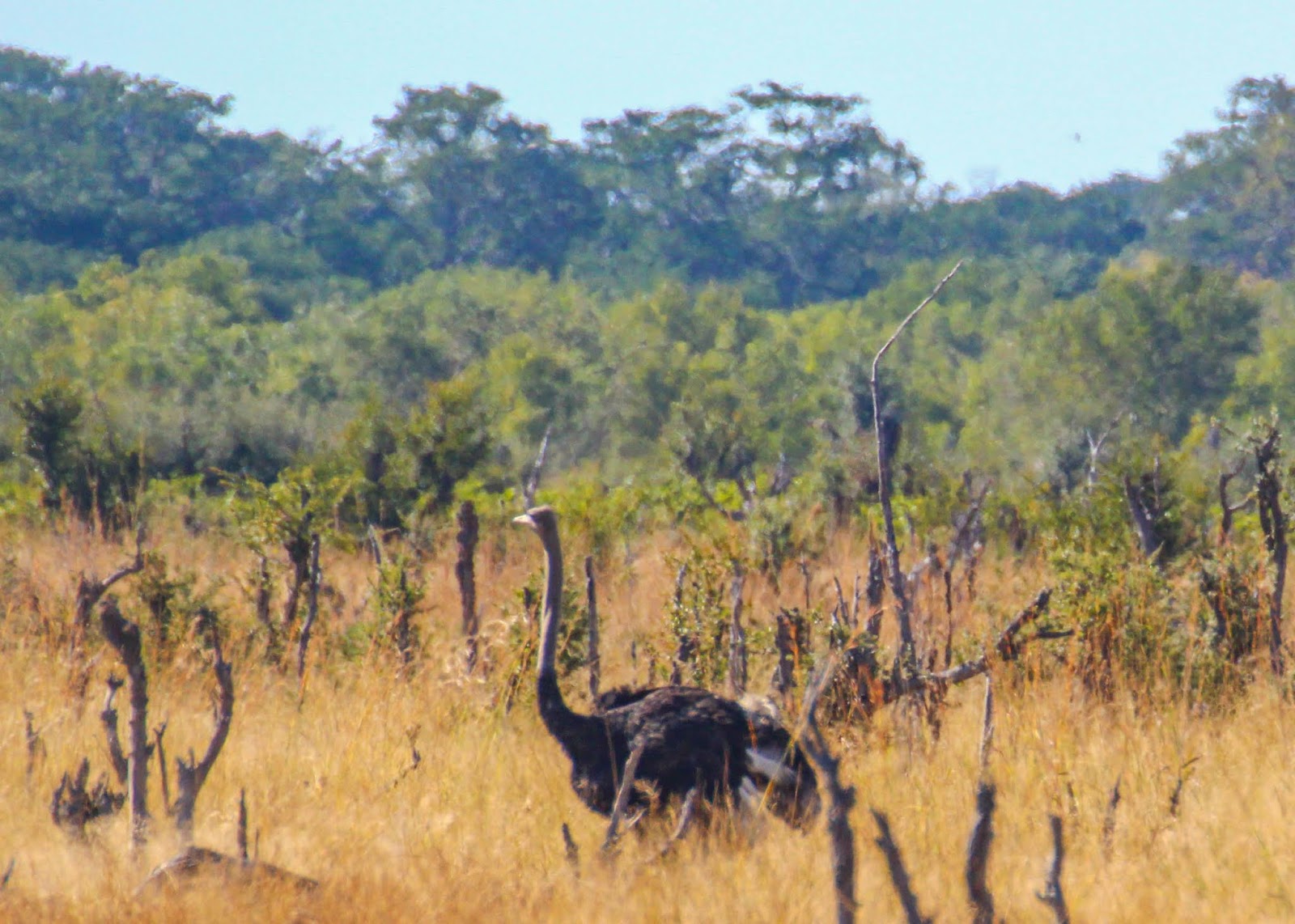
In Hwange NP in Zimbabwe we also saw a group of ostriches from quite a distance.
Ostrich in Hwange NP.