Wednesday, June 17, 2020

Yellow-Backed Spiny Lizard

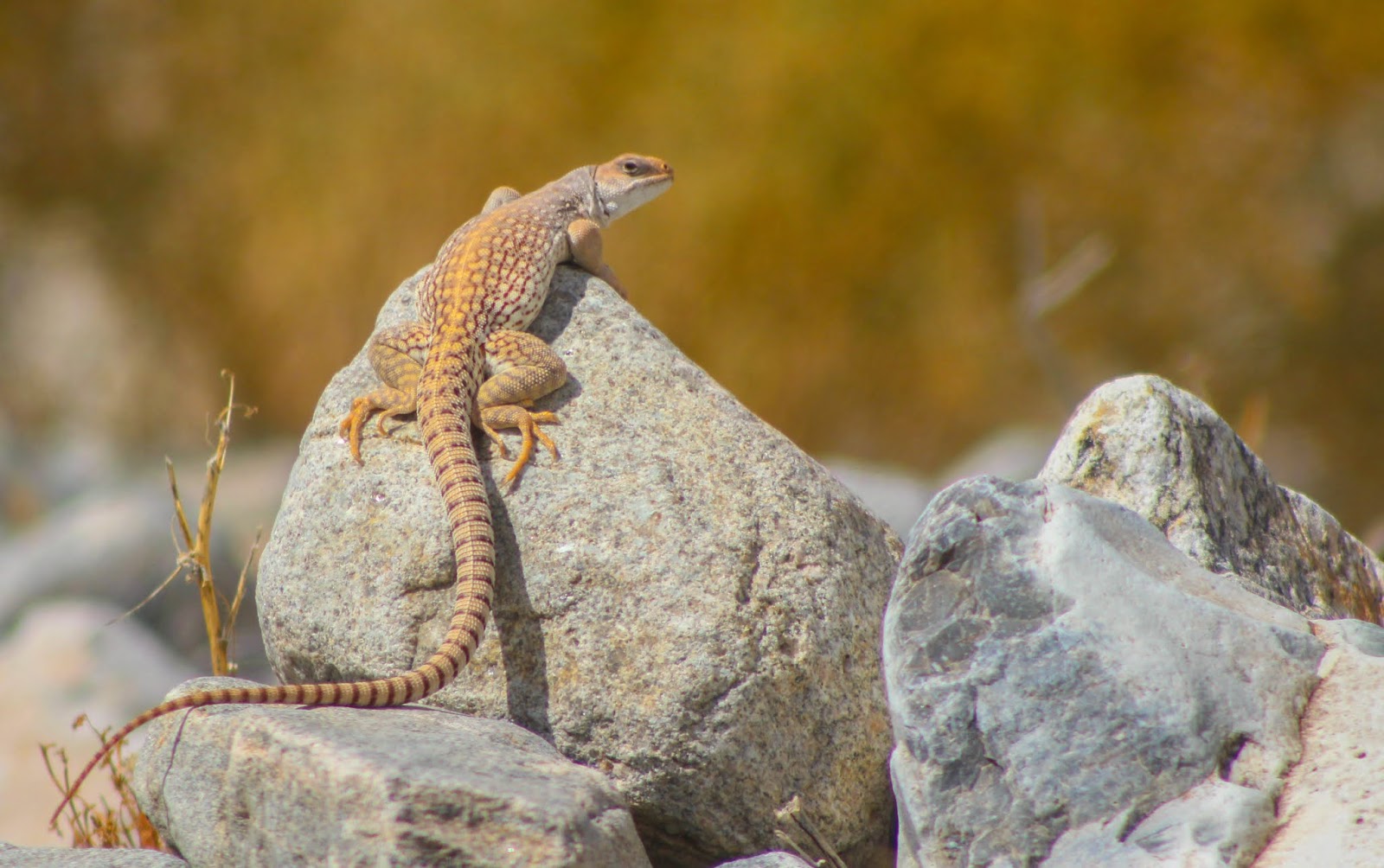
At Corn Springs on June 13 I saw the nicest yellow-backed spiny lizard I've seen all year. It was a big, thick male with nice coloring. It was standing on a rock near the palm tree oasis. I was in my car taking photos through the window, so it was not spooked. 

Nicely differentiated scales with some yellow and bluish/green colors. 


Tuesday, June 16, 2020

Western Chuckwalla - Corn Springs

The chuckwalla has long been one of my favorite lizards. This past Saturday, June 13, I saw four of them near Corn Springs, in the Chuckwalla Mountains, more than I've ever seen in one day before. Of course, I recently did a post on the chuckwalla after seeing three in one day in the same area. 
The first chuckwalla I saw was on some red rock high above me. 
It was in the vicinity of some Native American petroglyphs, visible to the left. 
I got out of my car and walked up the side of the rocks to a vantage point where I was on the same level. The back and belly are red and it still retains stripes on its tail. I walked up very slowly, stopping for long periods and was able to get quite close. 
When I got too close it disappeared for a minute, then emerged again to look at me.
They are quite curious. 
He has a grizzled looking head. 
He eventually settled in this crack.
There are six species of chuckwalla, but the most dominant species in the vicinity to where we live is the common chuckwalla. The common chuckwalla has four subspecies, the most prevalent being the western chuckwalla, found in southeastern California, southern Nevada, extreme southern Utah, western Arizona and down into the eastern Baja California peninsula. 
The second chuckwalla I saw was pretty close to the first one. I could see it while I was looking at the other. He has a beautiful red belly. 
I didn't try to get any closer to this one because I'd spent so much time looking at the first one. 
Here he is looking down at me as I left.
The chuckwalla reaches a length of 20 inches and can weigh up to 2 pounds. Its body is flat, it has a rounded belly and loose folds of skin on its neck and sides. The tail is broad with a blunt tip. When threatened it enters a crevice between rocks and inflates its lungs with air, wedging the lizard tightly in place. They are diurnal and can be active in temperatures up to 102 degrees F. Their color varies by location, between males and females and between adults and young. Adult males usually have a black head, chest and limbs, but sometimes spotted and flecked with gray. The rest of the body is red or light gray, except the tail which is pale yellow. Adult females are more brown with a scattering of dark red spots. Young chuckwallas have four or five broad bands across their body and three or four bands on the tail. Males usually lose all of the bands, but females often retain the tail bands.  
The third chuckwalla I saw was high in the rocks and I did not try getting any closer. Besides, it did not have the beautiful red back or belly. 
The Chuckwalla Mountains are in the Colorado Desert section of the Sonoran Desert. They are about 40 miles long and run in a northwest to southeast direction. I-10 is to the north and the town of Desert Center, and the Chocolate Mountains Aerial Gunnery Range is to the south. The Orocopia Mountains are to the west, Joshua Tree NP is to the northwest (on the other side of I-10) and the Little Chuckwalla Mountains are to the southeast. The Chuckwalla Mountains Wilderness Area was established in 1994 over most of the range. Motorized travel is only allowed on designated roads, including the eight mile dirt road into Corn Springs. The mountains were named after the chuckwalla, prevalent in them. It is also an area with lots of desert tortoises, rosy boas and kangaroo rats. 
The fourth chuckwalla was relatively close to the road and about my height, so I got a good view of it. 

I got out of the car to go closer to it and it made a very aggressive run toward me, as though it was going to jump off the rock, and it aggressively bobbed up and down.

As I got closer it eventually crawled up a rock and into an opening and disappeared. 


Monday, June 15, 2020

Northern Desert Iguana

I've seen several huge northern desert iguanas near Corn Springs, in the Chuckwalla Mountains, recently. On May 23rd I saw the desert iguana below basking on a rock off the side of the dirt road. I saw another one earlier in the day near the beginning of the road which scampered quickly away.
On June 13th I was at Corn Springs again and saw the desert iguana below also basking on a rock off the side of the dirt road. I got out of the car and slowly approached, taking photos as I went along. I got within a few feet of it before it bolted for a bush. 


I did a post on the desert iguana back in 2011 and actually caught one and kept it as a pet before letting it go. They are extremely fast. 

Sunday, June 14, 2020

Smoke Tree

Yesterday I visited Corn Springs in the Chuckwalla Mountains (8 miles off I-10 down a dirt road in the Colorado Desert) and stumbled into a smoke tree (Psorothamnus spinosus) bloom. I've seen individual blooming smoke trees before, but yesterday the large wash near the palm tree oasis was full of smoke trees in various stages of blooming. There were easily 20 bushes or more spread out through the wash. The smoke tree is a plant in the legume family. Many of the plants in the genus Psorothamnus are known as indigo bushes, because of their dark blue flowers, or as daleas, because the genus was once included in the genus dalea.  The smoke tree is also known as the smoketree, smokethorn, smokethorn dalea and I've blogged on it previously as the indigo bush.
Smoke trees in the foreground. Their normal gray/brown appearance is shaded with blue. 
This one has enough flowers to radiate the purple/blue color. 
I like some of my photos that show it with a blurry background. 
This photo illustrates the inconsistent concentration of flowers on the same bush. 
A large concentration of blooms on an outward edge and another blooming bush in the background. The thick pointy branches stick out. 
It is thorny and thickly branched and one of the ugliest of the desert bushes, a combination of ugly gray and dead-looking brown, a bush on its last legs, a 49er in Death Valley, a victim of the harsh desert. It would get my nomination for the iconic desert bush, ugly as dirt most of the year and dangerously beautiful when in bloom. 
A close-up of the beautiful flowers.
Some violet/purple flowers.
I like the straight and diagonal lines in this photo, interspersed with buds and flowers. 
A thick concentration of flowers.
The flowers, which bloom in June and July, emerge from light green/yellow pods with orange glands on them. The flowers are small and pea-like and are dark blue to violet (I saw one bush with violet yesterday). 
Flowers emerging from greenish buds with orange glands. 
Multiple buds, some just cracking open. 
The branch structure, including thorns, with a few buds and flowers. 
Close-up of branches, including sharp thorns. 

Saturday, June 13, 2020

Tarantula Hawk

I've seen quite a few tarantula hawks flying near Hayfield Road. They are distinctively black with red wings. On June 13 I was at Corn Springs looking at a blooming Smoketree and noticed this tarantula wasp walking among the flowers on the bush. I was not sure if it was a beetle or wasp (it was so big that I thought it had to be a beetle), and verified it was a wasp when I got home. 
From this angle, it looked like a beetle. Even the antennae looked like a beetle. 
It is a spider wasp. The female stings a tarantula between the legs and paralyzes it. She then drags it into a hole, lays an egg on the abdomen and covers it up. When the wasp larva hatches it creates a hole in the tarantula's abdomen and enters and fees on it, eventually killing the spider. The wasp emerges from the spider's abdomen as an adult. 
The metallic color shows up here and the abdomen clearly looks like a wasp.
As an adult it is nectarivorous - it feeds on the nectar of flowers such as milkweeds, western soapberry and mesquite. I saw this one among the flowers of the smoketree. 
It is huge - up to two inches long. It has bright red wings and a black/blue/metallic body. It has a stinger up to one-third inch long and has one of the most painful stings of any insect. 

Friday, June 12, 2020

White-Tailed Antelope Ground Squirrel

I got a few more photos of white-tailed antelope ground squirrels on Saturday, May 30th, near Corn Springs, taken from my car window. 


A nut or large seed in its mouth.