Tuesday, August 7, 2018

Southern African Cheetah

The IUCN Red List estimates that there are roughly 6,700 cheetahs in the wild, with 4,190 in Southern Africa, 1,960 in Eastern Africa, 440 in Western, Central and Northern Africa and 80 in Iran. In Southern Africa most of the cheetahs are surviving in a single transboundary population stretching from southwestern Angola, Namibia, Botswana, southern Zambia, and northern South Africa to southwestern Mozambique. 
Cheetah in the Okavanga Delta, Botswana.
Momma is to the right. Her two cubs are to the left. 
Four years ago we saw cheetahs in East Africa. The East African cheetahs tend to be sleeker/leaner and more pale than their South African relatives. 

We recently visited the Okavanga Delta of Botswana and saw a mother cheetah and two of her adult cubs resting in grass in shade beneath a large tree. Our guide, K.T., spotted the mother cheetah peering out at us over the side of a small knoll. He veered off-road and pulled up just about ten yards away and we were able to watch them for about 20 minutes. 

Prior to this, as we first flew into Africa at Cape Town, our first stop, after picking up a rental car, was Cheetah Outreach in Somerset West. 

There we had an opportunity to pet an adult cheetah and an eight month old cub. 


That was fun, but seeing them wild in Botswana was much better. 

Monday, August 6, 2018

Black-Crowned Night Heron

I have been struggling to identify a bird I photographed in the Okavanga Delta of Botswana. It was in a tree full of nesting African darters and also mixed with some cormorants. We saw it while on a small river in a motor boat. 
Juvenile black-crowned night heron. 
I've been looking at striated herons and squacco herons and they were not fitting. I finally googled "heron africa orange eyes" and multiple pictures came up of a juvenile black crowned night heron. 
Juveniles have dull gray/brown plumage with underparts paler and streaked with brown, orange eyes and dull yellowish/green legs. 
Adults look completely different, which makes identifying the juvenile that much more difficult. The adult has a black crown and back, with the remainder of the body white or gray, red eyes and yellow legs. 

They are found through much of the world, including North America and large swathes of Africa. 

Sunday, August 5, 2018

Cape Wild Dog

The African wild dog is also known by names such as the painted wolf, African painted dog, painted hunting dog, Cape hunting dog and African hunting dog. It has become one of my favorite animals. There are five subspecies: (a) The Cape wild dog found in southern Africa with a large amount of orange/yellow fur (this is the subspecies we saw in northern Botswana); (b) East African wild dog with a dark coat and very little yellow; (c) West African wild dog found in West and Central Africa; (d) Chadian wild dog found in Chad; and (e) Somali wild dog, found in the Horn of Africa, which is smaller, shorter and has coarser fur. 
It is listed as endangered by the IUCN Red List with an estimated 6,600 adults in 39 populations, of which only 1,400 are breeding animals (the alpha male and female). Within a pack the alpha male and female are the parents of a majority of the pups. If an alpha individual dies no unrelated breeding animal is available in the pack, so death results in disintegration of the pack and no breeding occurs until a new pack is formed. 
The cause of their decline is almost entirely due to human encroachment: conflict with livestock and game farmers, accidental killing by snares and road kill and infectious diseases. I'm surprised as I look at their status in various countries in Africa and find that they are not protected very closely even in countries where there are very few, if any, left. We were told by our favorite guide, K.T., that they are reviled for how they kill their prey: they do not kill it, but rip it apart while alive. However, the kill actually ends up being more humane as the animal dies much quicker than when it is strangled by a lion or similar animal. 
The wild dog is about 24 to 30 inches high at the shoulder and weighs 44 to 55 lbs. in East Africa and up to 66 lbs. in southern Africa. Females are 3% to 7% smaller than males. Unlike other wolf/dog/jackal relatives, its fur is entirely stiff bristle hairs with no underfur. Older animals gradually lose their fur and can be nearly naked. 
There are geographic variations in color. Those that are in the northeast of Africa are mostly black with small black and yellow patches. Southern Africa wild dogs are more brightly colored with with a mixture of brown, black and white coats. Within a geographic area, color varies a lot and helps them visually identify each other. Most of the patterning is on the trunk and legs. The muzzle is black and shades into brown on the cheeks and forehead. A black line goes up the forehead. It is blackish/brown on the back of the ears. Some have a brown tear-drop shape below each eye. The back of the head and neck are either brown or yellow. There is sometimes a white patch between the forelegs and some individuals have completely white forelegs, chests and throats. The tail is usually white at the end, black in the middle and brown at the base. The coats are asymmetrical, with the pattern on one side completely different then the pattern on the other side. 
This alpha female in the Okavanga Delta has white forelegs and a white chest. 
This pack member also has a significant amount of white on the forelegs and chest. 
Here is a good view of the white tail at the end, with black and then significant brown at the base. 
It hunts during the day and can chase an animal for 10 to 60 minutes at speeds up to 41 mph. During the chase large animals are repeatedly bitten on the legs, belly and anus until it quits running. Smaller prey is pulled down and ripped apart. It eats quickly. A Thompson's gazelle can be eaten by a pack in 15 minutes. 
Northern Botswana, including the Okavanga Delta (where we saw our wild dogs), Moremi Game Reserve and Chobe National Park, has the largest wild dog populations in Africa. In 1992 there were an estimated 42 packs containing 450 to 500 individuals in that area. 
When we visited Kadizora Camp, north of the Moremi Game Reserve in the Okavanga Delta, I told our guide, K.T., that I wanted to see wild dogs. He mentioned that a group of guides in the area had scouted out and found a den of a pack of wild dog with some young pups still in the den. Our goal was to visit a red lechwe kill being used by two young leopards, then go visit the wild dogs. My hopes were severely tested when another guide said that they'd been looking for the pack for several days and not seen them - he thought they'd moved out of the area. K.T. kept waiting and waiting and I figured he'd maybe decided not to even look. But after a long round-about way to the leopard kill, then a view of hippos for lunch, we went to the vicinity of the dog den and voila, there we found the entire pack sleeping in the grass near the den after a successful morning hunt. 
First we spent time looking at the younger pack members, just yards away from them. Then we found the alpha male in the grass and finally the alpha female, all by herself, in the grass. 
Hwange National Park in western Zimbabwe is another area with relatively healthy populations of wild dogs and I'd hoped we could see some there. 
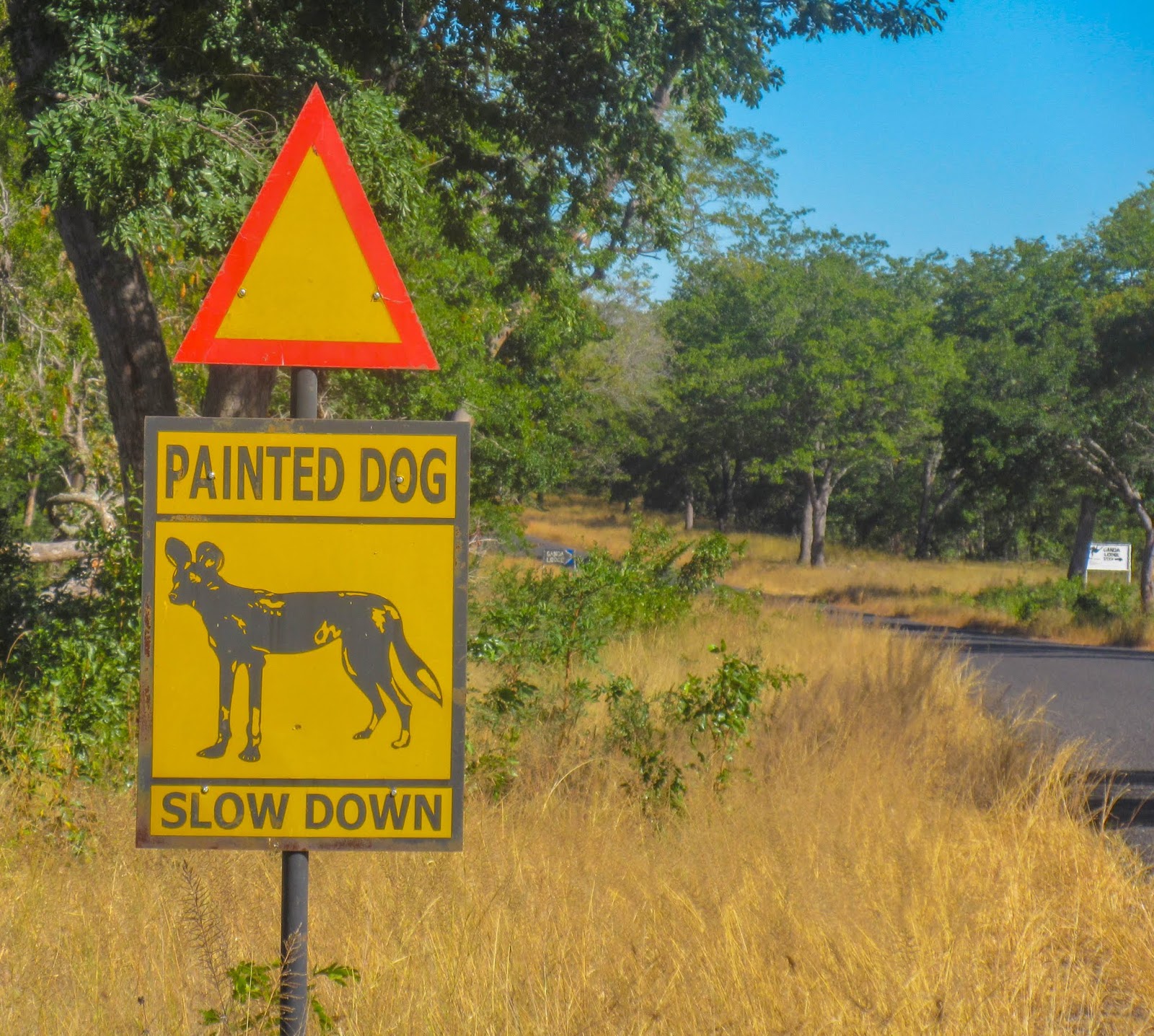
We did see some signs for wild dogs. 
Unfortunately we did not, but our last day our camp (The Hide) arranged for us to make a short visit to the Painted Dog Conservation visitor center in Hwange and we got a short tour of the visitor hall and the rehabilitation center where they had one female wild dog that we got to see.  


The captive female. Note the black stripe up her forehead and white foreleg. 
The light is nice for showing the orange in her coat. The surroundings also show how effective the coat is as camouflage. Note the white on the tip of the tail. 

Saturday, August 4, 2018

Cape Hippopotamus

There are five species of hippo. Four years ago in East Africa we saw the Nile hippo, or great northern hippo (H. a. amphibius) and just recently in the Okavanga Delta of Botswana and along the Zambezi River between Zambia and Zimbabwe we saw the Cape or South African hippo (H. a. capensis) which is found from Zambia to South Africa and has the most flattened skull of the subspecies. 

Our most dramatic sighting was while we were in a motorboat in the Okavanga Delta. Our small boat got surprisingly close to several pods of hippos and we had the thrill and pleasure of watching the hippos snort, grunt, plunge, dive and splash  as they tried to get out of our way. I was a little concerned we might pass over a submerged hippo and have it come up and upend us, but fortunately that did not occur. That experience rates right up there with any animal experience I've ever had for awe and pleasure. 
Hippos with elephants behind in the Okavango Delta.
I love this grouping.
Big hippos and lots of them.

All of a sudden they spooked and we watched a commotion for the ages. 


Later that day, as we docked our boat, we saw a lone hippo in the swamp outside our Kadizora Camp, far from any deep water. 
Hippos outside Kadizora Camp.
The day before, with our guide K.T., we stopped for lunch and watched a small pod of hippos in a pond. We mostly just saw nostrils and ears, but we walked with K.T. right up to the edge of the pool, which seemed rather foolish. However, K.T. assured us that the hippos would try to avoid us and would probably run the other way if we got too aggressive. 
Hippos in a pool while groups eating lunch watch.

As we canoed down the Zambezi we saw some hippos. One was very near where we put in our canoes and a small pod was standing on an island as we rowed past, including a large baby. 

Later that evening as we had our Sundowner cruise on the Zambezi we got very close, in a very large boat, and watched a pod of hippos rise and submerge, rise and submerge, as we sat and watched them. One opened its mouth wide and gave us a good yawn shot. 
Hippos gathered around a tree.
Great view of the tongue and roof of the mouth. 
Our last day in Victoria Falls as we did a flyover by helicopter, we saw some hippos congregated on a small island in the Zambezi. 
Hippos on edge of an island in the Zambezi. 

Friday, August 3, 2018

White-Fronted Bee-Eater

Bee-eaters are very cool and I was hoping to see some when we visited southern Africa. My wish was granted when we saw them in two different groupings on the same day, both along the Zambezi River: one on the Zimbabwe side while canoeing down the Zambezi and one on the Zambia side that evening on a Sunset cruise just above Victoria Falls. Both were hovering near and flying in and out of holes in clay cliffs on the edge of the Zambezi.
White-fronted bee-eater on the Zambia side of the Zambezi River.
I count 27 species of bee-eater. This species was the white-fronted bee-eater, found in the savannah regions of sub-equatorial Africa (the equator runs through Kenya, Uganda, Democratic Republic of Congo, Republic of the Congo and Gabon). 
Bronze hind-neck.
The white-fronted bee-eater has a white forehead, cheeks and chin, a bright red patch on the throat, a black mask, a bronze hind crown and hind neck, buff or cinnamon upper breast and belly, green upperparts, blue tinged wings and tail, blue thighs and hind tail, and a square tail. 
White forehead and cheeks, black mask, red throat, buff or cinnamon chest and blue hind tail.
Blue tinged wings and tail.
They live in colonies of about 200 birds in holes in cliffs or banks of earth. 
True to their name, they eat primarily bees, but also eat other flying insects. 

Thursday, August 2, 2018

Cape Cormorant

The Cape cormorant is endemic to the coasts of Southern Africa. It is found along the coast from northern Namibia, down around the Cape and up along the coast of eastern South Africa. 
Cape cormorant in Kalk Bay, South Africa
It has black, or greenish-black plumage, an orange-yellow bill base and greenish-blue eyes. 
I'm sure I saw more, but I only photographed one, at Kalk Bay, South Africa, on a wharf near where we ate lunch. It almost looks like it is covered in mud or oil, lacking the shiny black sheen it is supposed to have, but the orange bill-base and greenish-blue eyes cement its identification. 

Wednesday, August 1, 2018

Spotted Hyena - Namibia

I've previously blogged on the spotted hyena which we saw in East Africa. 
On our recent trip to Southern Africa we only saw hyenas one day, that was in the eastern portion of Etosha NP in Namibia. The first time we saw them there were at least three of them and they were at quite a distance and going up and over a ridge. 

I was hoping at the time that they might be striped or brown hyenas, but no such luck. Still fun to see them. None of the pictures are great, but I include a number of them because it is still a thrill to see them and remember them. 

The second spotting was going to and from Chudop waterhole: a lone hyena traveling through the trees. I'm not sure if we saw the same hyena both times, or just happened to see two different hyenas in approximately the same place. Unfortunately, none of these pictures turned out well - all too blurry, but I'm going to include one just to reflect that we did see it. It is clearly a spotted hyena.