St. Martin’s Cathedral in Bratislava,
Slovakia
is the Roman Catholic cathedral of the Archdiocese of Bratislava.
It
is at the western border of the historical city center below Bratislava Castle
and was actually built into the 15th century city wall. The church
tower was part of the fortification of the city. A remnant of the city wall is
just north of the front door.
The Danube River is just south of the cathedral. St.
Martin’s became the coronation church of the Hungarian kings and queens in 1563
after the coronation church in Szekesfehervar, in central Hungary, was
conquered by the Ottoman Empire. The Crown of St. Stephen, the Holy Crown of
Hungary (now located in the Hungarian Parliament Building in Budapest)
was
placed on the head of Maximilian II, son of Emperor Ferdinand I of Hapsburg, in
1563, in St. Martin’s. The coronation of
ten other kings and queens and eight of their consorts also took place there,
the latest in 1830. It included the coronation of Maria Theresa of Austria, in
1741, the daughter of the Holy Roman Emperor, Charles VI. Maria Theresa was the
last ruler of the House of Hapsburg. A gold plated replica of the Holy Crown of
Hungary
tops the steeple of St. Martin’s, placed on a gold plated stone pillow.

St. Martin refers to Martin of
Tours, who lived from 316 to 397. Martin was born in Hungary and his father was
a senior officer in the Imperial Horse Guard, a unit of the Roman army. He grew
up in northern Italy where his father was stationed. Martin, himself, joined
the cavalry at age 15 and was stationed in Gaul, at what is now Amiens, France.
While in the Roman army and stationed in Gaul, Martin was approaching the gates
of Amiens where he was met by a scantily clad beggar. Martin cut his own
military cloak in half and shared it with the beggar. That night, Martin dreamed
of Jesus wearing the half-cloak he had given away. He heard Jesus say to the
angels, “Here is Martin, the Roman soldier who is not baptized; he has clad me.”
Martin was later baptized at age 18. In 371 he was named Bishop of Tours. In
372 he founded the Abbey of Marmoutier, just outside of Tours. The church has
an equestrian statue of St. Martin that was added in 1744.

Martin is dressed in
Hungarian hussar garb and rips his cloak to give part of it to the beggar.
Construction of St. Martin’s
began in 1311 and it was roofed and consecrated in 1452. Construction continued
through the 15th and 16th centuries. The presbytery was
built between 1461 and 1497. The chapels of Czech Queen Sofia and St. Anne were
added in the 15th century. The chapel of St. John the Merciful (the picture below shows the chapel from the outside),
serving as a mausoleum, was completed in the first half of the 18th century (the picture below shows the chapel from the inside of the cathedral).
It appears that the body is inside the container hanging just above the heads of the large angels.

It was constructed for 2,000 pieces of gold at the expense of cardinal
Peter Pazmany, an important figure in the counter-reformation in Hungary, who
lived from 1570 to 1637, and is himself buried beneath the cathedral. The body of St. John the Merciful, from the 7th century, is located in the cathedral. St. John was the patriarch of Alexandria. He increased the number of churches in Alexandria from 7 to 70, attacked simony, and was known for his beneficence to the poor. In his old age the Persians occupied Alexandria and he was forced to flee to Cyprus, his native country, where he died (somewhere between 616 and 620). His body was moved to Constantinople, then in 1249 to Venice. His body was later moved to St. Martin’s, sometime after 1526, by Queen Mary, where it lies in the St. John the Merciful Chapel. This painting of John the Merciful, by Titian, is not in the cathedral, but illustrates he was well known in the Middle Ages and Renaissance.

The present-day appearance
of the church is from the period of 1869 to 1877 when it was remodeled after
suffering damage from fire, earthquake and war. The cathedral was built over an
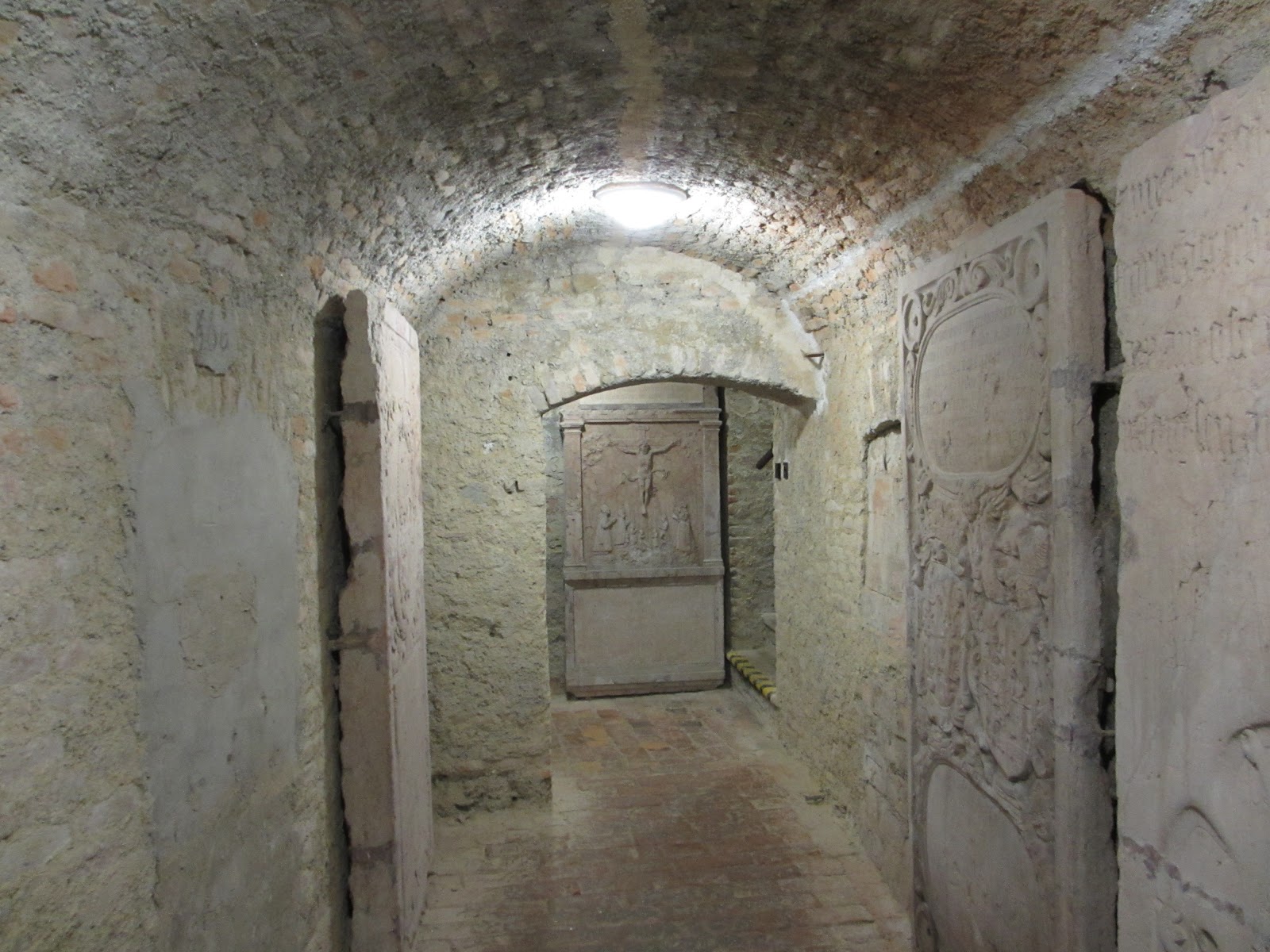
old cemetery and there are catacombs and crypts containing the sepulchers of
many significant historical figures. Three different crypts have been
discovered. The only one that is accessible is beneath the St. Anna Chapel.
It
branches into four hallways
and and contains over 90 graves.
This grave appears to date in 816.
The language barrier made it difficult for me to identify specific items in the cathedral, but I have provided pictures of items that I found intriguing. This stone figure on the outside of the church portrays a man in armor and appears to be many hundreds of years old.
This plaque may also relate to John the Merciful.
The cathedral has some beautiful stained glass.
I am assuming these panels may relate to some of the kings coronated in the cathedral.
This statue likely relates to one of the kings
and this one may relate to Cardinal Peter Pazmany.
The choir seats have beautiful carved animals decorating them.
The cathedral, despite its glorious past, is in need of repair. Bratislava, the capital of Slovakia, in general, looks much poorer than its neighboring capital cities of Vienna and Budapest. But this church is a gem to be seen.