Tuesday, August 23, 2022

White-Faced Ibis

My first post on the white-faced ibis, on September 21, 2014 (but probably seen several years before that) was a solo, indistinct bird feeding near the Rio Grande River in Alamosa Colorado. My second post, on September 8, 2020, was also a solo bird, in poor light and non-breeding plumage, at Tule Lake NWR in northern California, near the Oregon border. So far the white-faced ibis had not elicited any great wonderment from me. That all changed in April 2021 when I was driving through the farming areas southeast of the Salton Sea in the Imperial Valley of California, my third post. I saw hundreds of white-faced ibis, many in breeding plumage, the best-siting I'll probably ever see. How can you not love this bird? In July 2021, my fourth post, I found them in the reclamation marshes in Niland, California, near the Salton Sea. They were still colorful, but past the key breeding season, missing the white-face stripe. My fifth post, in August 2021, included photos of scuffling white-faced ibis in a field near the Sonny Bono NWR near Calipatria, California, also near the Salton Sea. They lacked the white-face lines, but still had the beautiful plumage. 

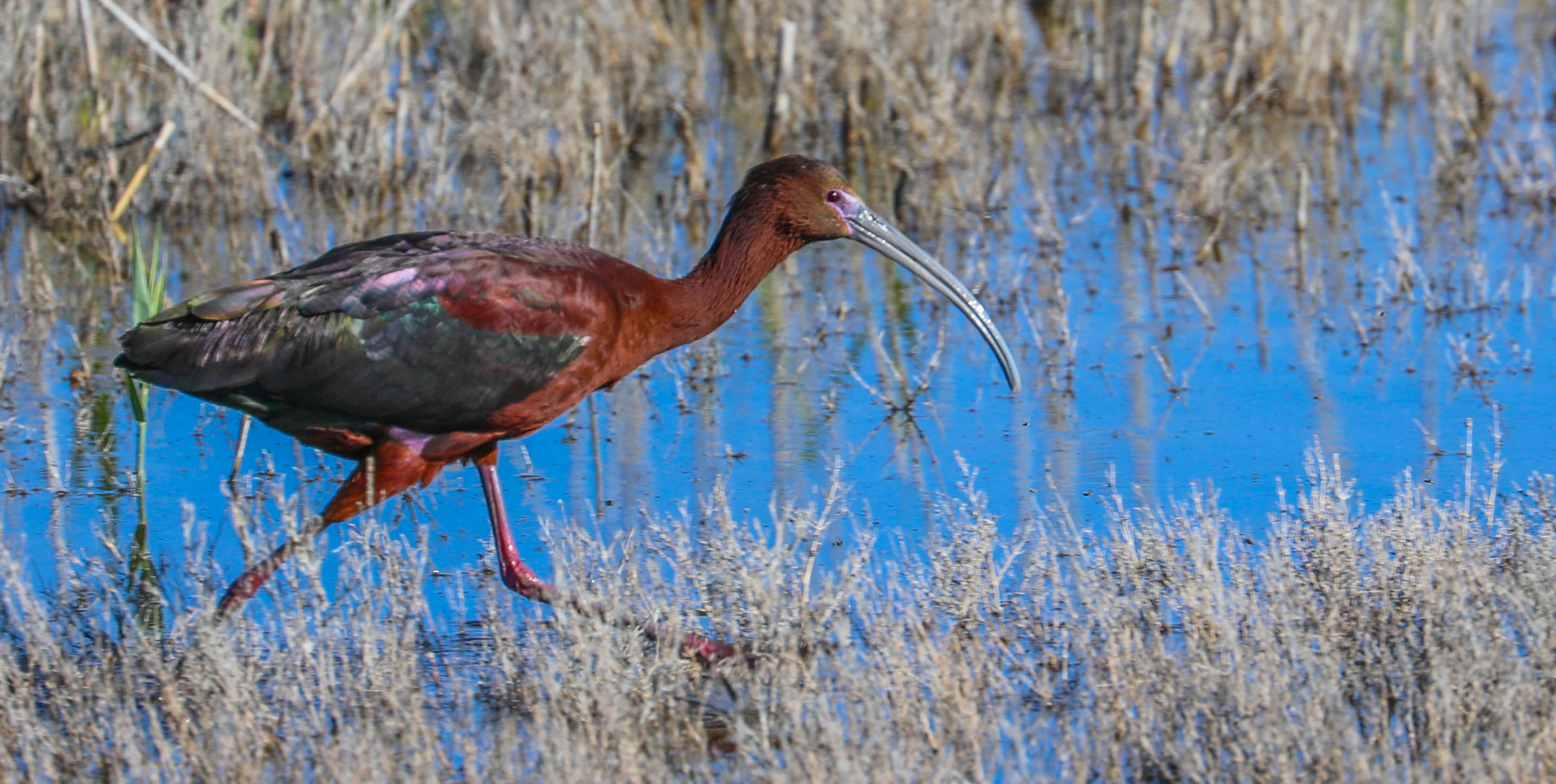
This post, my sixth, with birds in full breeding plumage, has just a few photos from white-faced ibis near the Bear River Migratory Bird Refuge near Brigham City, Utah. They were in flooded fields outside of the 12 mile Auto Route Drive on June 2, 2022. What I really appreciate is the white-lined face and the full color in good light. Much of the head, the neck, belly and part of the back are a beautiful chestnut brown. A white line circles the face, surrounding a red eye with a black pupil, and pink bare facial skin. The curved bill is gray. Then the wings and tail feathers go crazy. They have the purple, pink, blue and turquoise found on the inside of an abalone shell. But that's just a piece of it. They also have the beautiful bronze found on some mint coins and bronze pink, bronze green, followed by some pink legs that are drab by comparison. 
I think this front bird is about as pretty as they get. 

This one is very drab by comparison. 

By August 13, 2022, when I was back at Bear River, I encountered the white-faced ibis again, but the breeding magic is wearing off. No white-lined faces and the vivid colors are fading and blending back into the chestnut brown. 


Six posts on one bird may be the most I've done. I hope there may be some more magic I can encounter with this bird which will result in more posts. 

Monday, August 22, 2022

Yellow-Headed Blackbird

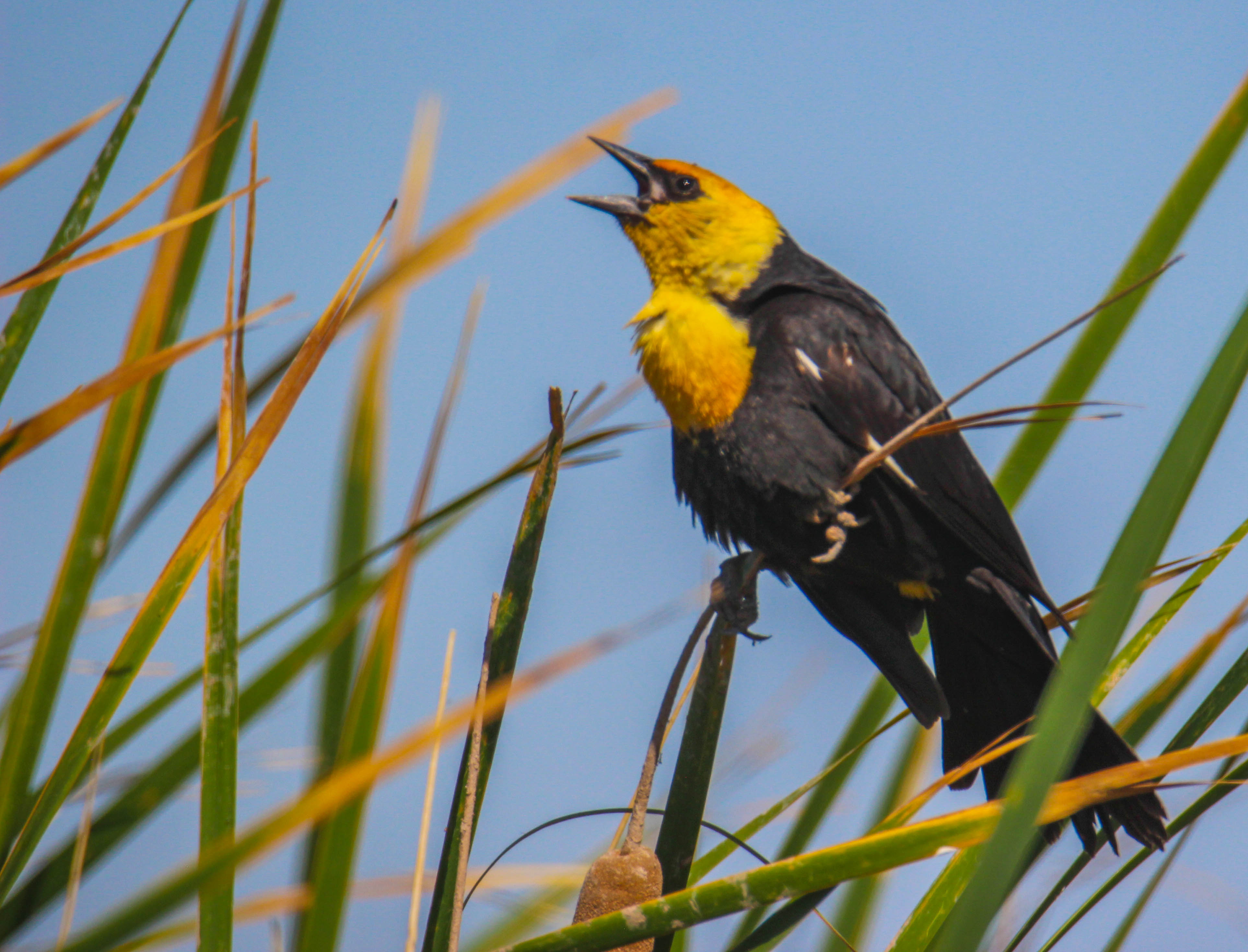
The yellow-headed blackbird is a beautiful bird I've had a few encounters with. I've posted on it here and here. There are a few more recent photos I'd like to share:
These three photos were taken near McDonald Road in Niland, CA, near the Salton Sea. 


This photo was taken at Bear River Migratory Bird Refuge near Brigham City, UT. The mountain range in the background is very near the Great Salt Lake. The next photo is a cropped version of this one. 

Sunday, August 21, 2022

Killdeer

The killdeer is a species of North American plover that I often see, but have a difficult time getting good photos of. They tend to run or fly quickly all-the-while screaming, "baby, baby, baby," or at least that's what I have understood them to be saying from my youth as they try to lead you away from a nest. I've posted one semi-blurry photo in one post. Since that post I've gotten a few better photos that I share.
These first two photos, my best, are from Bitter Lake NWR near Roswell, NM. The killdeer has a distinct black eye with a red rim around it. This photo was taken shortly after some heavy rains. 


These next three photos are from McDonald Road in Niland, CA near the Salton Sea. I've seen many killdeer there and have gotten very few photos of them. 


These last three are my most recent, taken at Bear River Migratory Bird Refuge near Brigham City, Utah in June. 

I like this head-on shot with the wide white stripe between the eyes. 

Saturday, August 20, 2022

Cliff Swallow

Almost a year after I saw my first cliff swallows, I saw them again in the exact same spot, at Bear River Migratory Bird Refuge, on the Auto Route, where there is a dammed up area of the river, used for irrigation, and they congregate in the bulrushes next to the river.  


They are gorgeous birds and appreciated all the more here because they rarely stand still. Even on the bulrushes they flit around, but there are opportunities for some decent photos. 


I share some of the photos. 

Friday, August 19, 2022

Little Grebe

We saw some little grebes in the Tagus River Estuary just south of Lisbon. They are found in much of Europe, the bottom two-thirds of Africa and southern Asia. There are six subspecies and we saw the nominate subspecies. 


In breeding season it has a rufous neck, cheeks and flanks, a black cap, chin and upper throat,  and is bright yellow inside the mouth. I couldn't get any photos and our guide got some marginal photos using Judy's cell phone through his spotting scope. 

Wednesday, August 17, 2022

Common Buzzard

I've always considered the word "buzzard" to be synonymous with vulture.  Even the Merriam-Webster Dictionary gives the second definition as "any of various large birds of prey (such as the turkey vulture"). The vulture of my youth was the turkey vulture. I'm sure I've used the phrase "ugly little buzzard" with a turkey vulture in mind. The first time I learned any different was our first trip to Africa where we saw an augur buzzard, which looked like a hawk, in northern Kenya. 
In Portugal recently our guide pointed out a common buzzard and I was expecting some kind of vulture. Not another hawk-like bird. 
The common buzzard is found throughout most of Europe, in much of southern Africa and fairly large sections of western and central Asia. 
Like our red-tailed hawk, it is highly variable. It is generally dark above, but has both light and dark versions. I'm not going to get into much detail because I didn't get a great look at it. Even my cropped photos don't give great detail. 

Tuesday, August 16, 2022

Sandwich Tern

I saw a sandwich tern for the second time in the Sado Estuary of Portugal while riding the ferry from the Troia Peninsula to Setubal. 


I'd previously seen it on the Padre Island National Seashore outside Corpus Christi, Texas. 


It has a thin sharp black bill with a yellowish tip that can be difficult to see. It has black legs, grayish upperparts, white underparts and a shaggy black crest during breeding. In non-breeding, the black crest just covers the back of he head, giving it a bald appearance on the top, like an aging rocker with long hair.
Sandwich tern range, from Wikipedia.