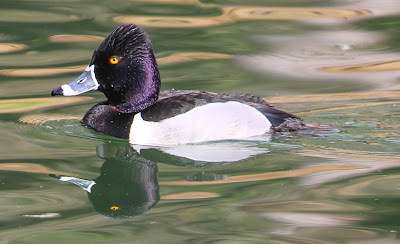
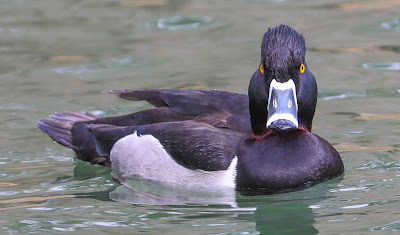
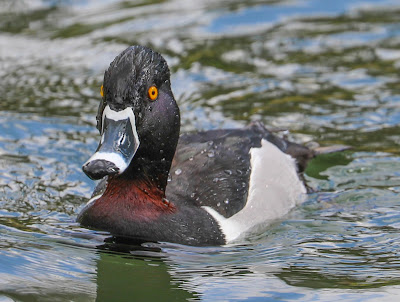
The greater scaup and lesser scaup are ducks that can be very difficult to differentiate.
The Merlin Bird ID app describes the greater scaup as having, a rounded head (or another source says a peak at the front of the head), puffier cheeks; males a black breast, medium gray back, a more extensive white stripe on the wings in flight, white sides, yellow eyes and a larger, broader bill. The head appears black with a greenish sheen in good lighting, but never purplish. Other sources say the male has a larger black nail on the tip of the bill and is larger in size (thus greater). Females are brown overall, grayer on the body in winter, with a white patch at the base of the bill and a yellow eye. They prefer saltwater bays and coves.
The lesser scaup has a tall peak (peak-headed) near the rear of the crown (instead of the front of the head), less puffy cheeks, the black head can have a purplish or greenish sheen (another source said head color is not a great indicator because lighting impacts it so much), the white sides are often slightly dusty looking, a less extensive white stripe on the wing in flight and a smaller, narrower, bill and other sources say a narrower, taller head. They prefer fresh water and are more often found more inland.
I was relying on the green (greater) vs. purple (lesser) head distinction and then was thrown for a loop when I identified a green head scaup as greater and several identifiers came back and said it was lesser. Then I found that lessers can also have green on the head. So it appears that the best indicator is the shape of the head, or purple sheen if you can see that.
Now that I've outlined some of the identifiers, I'll show some photos:
 |
| Greater scaup at Bolsa Chica. More rounded head and peak near front of head. The lighting almost gives it a purplish look which would indicate lesser, but I believe it is the early morning light. |
 |
| Greater scaup at Bolsa Chica. Peak is toward front of the crown and the nail on the front of the bill is large. |
 |
| Greater Scaup at Salton Sea SRA. Peak at front of crown and real greenish head, although I now realize that should carry less weight. |
 |
| Greater Scaups at Salton Sea SRA. Peak at front of crown. |
 |
| I didn't run this one through iNaturalist and struggle with this one. I think it is a greater scaup because the peak appears at the front of the crown and the side appears very white. But it almost appears it is purplish on the head, but it is probably the early morning light creating it. |
 |
| I put greater and one reviewer put lesser on iNaturalist. The head looks pretty round and green, but the sides are not clean white and there is not much of a bullet on the end of the bill. I'm unsure. |
 |
| This and the next two photos are of the same lesser scaup. Note the peak at the back of the crown. |
 |
| A purple sheen is evident in this photo. |
 |
| The bullet on the end of the bill is small. |
 |
| Lesser scaup at Bolsa Chica. Purplish shows through, the side is dusky white, not much of a bullet on the bill, but the crown looks quite high at the front of the crown. |
 |
| I said greater and reviewers on iNaturalist said lesser on this one. It looks like it has a green sheen, which I now know is not definitive, not much of a bullet on the end of the bill, and the peak of the crown appears at the back, particularly on the one behind. |
 |
| I said greater, reviewers on iNaturalist said lesser. I guess the peak looks like it is at the back of the crown, but the side looks quite light, but not much of a bullet on the bill. |
 |
| This one has a nice purple sheen, no question it is a lesser. But look how white the side is. No bullet evident on the bill. |
 |
| Lessers at Bolsa Chica. Peak appears to be at the back of the crown, some purplish, but that may just be early morning light. |
 |
| I initially put greater and reviewers came back lesser. It does have a dusky white side, not much of a bullet on the bill and the peak does appear at the back of the crown. |
 |
| These are lesser scaups at Aransas NWR. I believe the next photo is of the same birds. Here the heads almost look purple, and the peak looks like it is at the back of the crown. |
 |
| But in different light, the heads now look green. |
 |
| This lesser scaup at Salton Sea SRA has a nice purplish sheen. |
As I go through these I realize how difficult I find it to differentiate unless they have a great purplish head.