Monday, April 20, 2015

Bestia - Los Angeles

Saturday we visited Bestia in the Los Angeles arts/warehouse district, near the LA River. It was everything I'd hoped for and more. It is rated no. 30 out of 8,863 restaurants in Los Angeles on Trip Advisor. I don't understand why it is not rated higher. It is rated as the no. 1 Italian restaurant in Los Angeles on Yelp. I'm not a big Italian food fan, but this is not any regular Italian food, not by any stretch. 

We tried to go months ago and could not get reservations three weeks ahead. I was informed that the next available time for a late Saturday afternoon was in 2 1/2 months. I ended up making reservations four months ahead. Bestia opens at 5:00 p.m. We were there at 4:45 and there was a line of about 20 people. I guess the bar is open to the first 13 people without reservations. Some of the people ahead of us were turned away. We parked at the side of the next warehouse over. Valet parking was $7.00 which we were able to avoid. 
While we waited a racket was coming out of the restaurant. We assumed they were having a private luncheon of some sort. The racket continued when we got inside. The staff had the equivalent of a pep rally while we were there. They gathered in the kitchen in a group and raised their arms and shouted. It was like a football team getting ready to battle. Careful of those knives when you do a high-five. 

The inside looks very much like a converted warehouse, which it is. The three of us we were seated at a booth/table for four and pretty much at the beginning the noise started and it only got gradually louder. I read that it is noisy. It was as advertised. Music is pretty loud in the background and all of the speaking, clanging of silverware, laughing, etc. just reverberates off the walls. Judy and Andrew were on the other side of the table. I could only hear them when I bent over toward them and when they were leaning toward me. When they sat back in their seats it was hopeless. 

I started to order and our waiter's eyes got wide and he said, "I think you are getting too much." We were able to finish everything and with only minor discomfort. We shared everything. They brought out the dishes one or two at a time. 

First was butter poached lobster with celery root puree, fava beans, pea tendrils, cocoa powder, squash blossom and basil. I'm not sure what the salty, leafy greens were, a little too tough to be spinach, perhaps mustard greens(?), but a nice taste. It is the second time I've had squash blossom and it is great. The lobster was nice, tender and buttery. A great start. 
Next they brought out the beet & citrus salad, with pea tendrils, nasturtium, taggiasche olives, housemade yogurt and crispy farro. Nasturtiums are related to garden cress and mustard and have a peppery, pungent flavor. Taggiasche olives are also known as Nicoise, which signifies the curing method, and are grown in the Alpes-Maritimes region of France, near Nice. Pea tendrils are the early stems of the pea plant. The citrus was beautiful pink grapefruit and the yogurt had a slightly sweet flavor. The beets were cooked and had a nice beety flavor. The farro was very crisp, kind of like candy cane shards, but without the highly sweet flavor. The grapefruit and beet dominated the flavor and the yogurt provided a nice wetness. 
Vegetables roasted in olive oil and sea salt came next, in a small iron pot. It included yellow carrots, fennel, Brussels sprouts and broccoli. Judy was not thrilled with this dish - I loved it. The vegetables were still quite crisp, but had a nice oily, charred flavor. The fennel was particularly good. I could eat those kinds of vegetables at every meal.
The next dish was perhaps the most unusual. It was pan-roasted chicken gizzards, roasted beets, Belgian endive, and aged Capra Sarda. Capra sarda is a goat milk cheese from Sardinia. To be honest, I don't even remember eating any of the cheese, perhaps Judy and Andrew got it all. The chicken gizzards were amazing. None of the chewiness or gristle I associate with gizzards. They tasted like little sausage pieces and they blended wonderfully with the warm beet pieces. The endive was great, soaked in the gizzard and beet juices. That is a great dish. I'd love to know how they tame those gizzards. 
Farro salad with shaved heirloom cauliflower, pine nuts, avocado puree, pickled chili, mint and Montasio (a cow's milk cheese made in northeastern Italy). We had a farro dish at Meddlesome Moth in Dallas and Judy has been on a farro kick ever since. We just recently had a dish with it at home. So this was one of Judy's requests for dinner and it was a nice variation. I particularly enjoyed the avocado puree with it. 
Toasted brioche with smoked foie gras, seascape strawberries, Robiola, sea salt and wild fennel was next and the only dish I did not feel was up to par. Robiola is an Italian soft-ripened cow, goat and sheep milk cheese. Foie gras is made from the liver of a duck or goose that has been specially fattened, often by forced-feeding corn with a feeding tube. Foie gras became illegal in California as of July 1, 2012, and so I was surprised to see it on the menu. I've since learned that on January 7, 2015, a federal district court judge enjoined California from enforcing the law and that decision is currently on appeal. This dish was expensive and all I could really taste were the strawberries, which dominated. This was the only dish we had that I did not feel was well above average or fantastic. 
Judy got the next dish at the recommendation of our waiter. Agnolotti alla Vaccinara is cacao-flavored pasta parcels with braised oxtail, burro fuso (melted butter mixed with a small amount of stock or wine), Grana Padano (an Italian hard cheese), pine nuts and currants. There was only small serving of this, but it was very flavorful and good. I'm not normally a pasta fan, but this pasta seemed non-existent - very thin and pliable. 
Grilled branzino (a Mediterranean seabass, also known as sea dace) with an herb salad, castelvetrano olives (a large green Sicilian olive), marjoram and shaved carrots. The backbone had been removed and the result was very few bones. It was quite lemony and cooked nicely. A nice fish dish. The olives were large, light green with a flavor not as strong as regular green olives. 

Note that the backbone has been removed from the fish. 
The best dish of the night was the slow roasted lamb neck with pea tendrils, pickled chilies, marcona almonds, mint and salsa verde. It was large, the meat pulled away easily with a spoon or fork and it had outstanding lamby flavor. If you like lamb, you cannot miss this dish. If you don't like lamb, you need to try this and maybe you will come to like it. It had a side salad of spinach that was good and significant. 
The roasted marrow bone with spinach gnocchetti, crispy breadcrumbs and aged balsamic was another of the favorites. The waiter recommended that we scoop the marrow into the gnocchetti and stir it in before eating. We did that and enjoyed it, especially the bits with a heavy dose of the bone marrow. I love bone marrow and this was a nice variation on it. 
Our first dessert was maple ricotta fritters with maple butter ganache, and sour cream and huckleberry jam ice cream. The ganache was not particularly strong and the fritters were okay. Nothing to get too excited about. I quite liked the ice cream which was very different, and better than the fritters.
The best dessert was Valrhona Fair Trade bittersweet chocolate budino tort, with salted caramel, cacao crust, olive oil and sea salt. I was concerned about the bittersweet chocolate tag, I'm a milk chocolate person, but I liked this a lot. Very rich. Judy was over the moon about - she's our chocolate lover. 
Overall, I put Bestia right up there with some of the best restaurants I've been to. The menu is creative and the small dishes are perfect for sharing lots of different dishes. This would have to be considered for my top-ten best meal list. 

Sunday, April 19, 2015

Al Bustan Grill Restaurant - Cairo

While staying at the Intercontinental Cairo Citystars, which is part of the mega-Citystars mall, one of our group had a birthday we needed to celebrate. Al Bustan Grill Restaurant in the Citystars mall was rated no. 10 out of 3,930 restaurants in Cairo on Trip Advisor so we decided to go there. It was a week day and we got there early, around 5:30 p.m., so we did not worry about reservations. 

When we arrived I notified our host that one of our party had a birthday and asked if they had a cake they could provide. He asked me to follow him and we went up an elevator to a bakery in our hotel and I was asked to pick one of the cakes on display. I picked a chocolate cake which they brought down separately and presented later at the end of our dinner.

They brought out a huge three lobed roll cradled in a round wood bowl, along with a circular brass container leveled off with herbed butter. I had not been eating carbs and decided to splurge, so the roll and butter were extra delicious. 

I got several appetizers. One I recognized as veal tongue on a crostini, but I did not realize it was part of a salad. We had been warned to avoid uncooked vegetables in Egypt and I still remember the sad tales of a friend who was cooped up in a Cairo hotel for four days with food poisoning. So I avoided even nibbling the salad, avoided the crostini, and cherry-picked the veal tongue pieces. The tongue was nicely cooked and had a nice flavor, but it did feel like a big waste as most of the dish went un-touched. 
Veal tongue on crostini
Next I got a seafood soup that was packed full of shrimp and snow crab legs. I didn't even try eating the snow crab, too tough to get the meat out of the shells. But the soup was some of the best sea food soup I've ever eaten. The broth was thick and packed with flavor. If I'd had nothing other than the soup I'd have been happy. It was a little bit of a risky choice in a meat grill, but turned out well. 
Judy and I both ordered lamb chops. Lamb may be the most popular meat in the Middle East which works out great as it is one of my favorite foods. Our chops were cooked perfectly medium rare and were juicy, flavorful and tender. 
Lamb chops
We waited quite a while before hearing a canned "Happy Birthday" projected over the speaker system in the restaurant. They brought out the chocolate cake with a single sparkler type candle in the center of it. We joined in a rendtion of "Happy Birthday" when the cake arrived. The cake turned out to be one of our best desserts of the trip. 
Weird coloring because the picture was taken without a flash.
It was a very nice birthday celebration and kind of a nice chance for us to unwind for a number of hours after a hectic series of unrelenting vacation days. 

Saturday, April 18, 2015

Family Restaurant - Jerusalem

One night as we were leaving the Church of the Holy Sepulchre and on our way out to the Damascus Gate, we stopped at Family Restaurant in a little alley. It was quite large inside, clean and has a reasonably varied menu. 
We were offered some mezes which are small salad-type plates. The yellow peppers were extremely hot. Stan and Judy tried them and Chris and I learned to avoid them from their reactions. One plate was a bland salsa, one was a salad with lettuce, tomato and cucumber and the best was an eggplant salad probably unlike anything I've eaten before. 

eggplant salad
I had a pomegranate juice which was quite good. Pomegranate is readily available in the Middle East, and often mixed with orange juice. I wish we had it as an option in the U.S.  
Judy got lamb kebab which was cooked well and had a nice taste. Stan got the mixed grill which was three kebabs, one of chicken, lamb and kibbeh. I got St. Peter's fish which is a whole grilled tilapia. It was kind of bony, not as meaty as many tilapia I've had and just a tad bit overcooked, but a nice flavor. 
mixed grill
lamb kebab
St. Peter's fish
It was not great food or a great atmosphere, but it was late at night (we started eating about 8:00 p.m. - they shut the gate as we left) and it still felt a bit adventurous on our second day in the Middle East while we were till developing our cultural legs. 

Thursday, April 16, 2015

Mount Nebo - Jordan

Mount Nebo was a big disappointment for me. I've been on the name-sake mountain in Utah several times and it is spectacular. Nebo, Jordan, not so much. I envisioned something that stood out, perhaps a rounded top, but one with some elevation rise over its neighbors. Nebo didn't even look like the tallest peak in the vicinity as we were driving toward it. It is one of several bumps, this one 2,680 feet, along a ridge. The view is probably pretty good on a clear day, but it was smoggy. 
In Deuteronomy it says, “Moses went up from the plains of Moab unto the mountain of Nebo, to the top of Pisgah [which is Hebrew meaning “summit” or “peak”], that is over against Jericho. And the Lord shewed him all the land of Gilead, unto Dan, And all Naphtali, and the land of Ephraim, and Manasseh, and all the land of Judah, unto the utmost sea, And the south, and the plain of the valley of Jericho, the city of palm trees, unto Zoar. And the Lord said unto him, This is the land which I sware unto Abraham, unto Isaac, and unto Jacob, saying, I will give it unto thy seed: I have caused thee to see it with thine eyes, but thou shalt not go over thither. So Moses the servant of the Lord died there in the land of Moab, according to the word of the Lord. And he buried him in a valley in the land of Moab, over against Beth-peor: but no man knoweth of his sepulchre unto this day.”  (Deut. 34:1-6)
Looking out toward Jericho and Jerusalem. 
From below looking up at Mount Nebo. It is the bump in the top middle with the white object on it.
A closer view of the building on top of Mount Nebo.
A fourth century church was built on Mount Nebo to commemorate the place of Moses' death. It was enlarged in the fifth century and rebuilt in 597. The remains of the Byzantine church and monastery were discovered in 1933 and beautiful floor mosaics were found. A building was built over the mosaics, but it has been closed for renovation since 2007 and still is, as we found out. There is a tent which serves as a make-shift visitor's center which shows several mosaics. 
Building under renovation which is closed.
A serpentine cross sculpture, created by an Italian artist, was built near the building and symbolizes the bronze serpent created by Moses in the wilderness. Numbers 21:8-9, states: “And the Lord said unto Moses, Make thee a fiery serpent, and set it upon a pole: and it shall come to pass, that every one that is bitten, when he looketh upon it, shall live. And Moses made a serpent of brass, and put it upon a pole, and it came to pass, that if a serpent had bitten any man, when he beheld the serpent of brass, he lived.” The brazen serpent is symbolic of Jesus as those who look to him will live. John 3:14 states, "And as Moses lifted up the serpent in the wilderness, even so must the Son of man be lifted up." 
Brass serpent sculpture. 
For a visit of Pope John Paul II to Mount Nebo in 2000, a sculpture known as the Monolith was created by Vincenzo Bianchi of Italy. The stone is a white limestone block more than 16 feet tall taken from a quarry in Hallabat, Jordan. The sculpture represents a large book placed on the mountain where Moses ended his life after viewing the Promised Land. It represents the Torah to the Jews, the New Testament to the Christians, the Koran to the Muslims, all of them people of the book, all who believe that Moses was a prophet. However, it also represents books on science, love, faith, the fruits of experience, sacrifice, tension, all synthesized together as the message for pilgrims of the Third Millennium in search of the Truth of Love which unites and binds. Thus it is the Book of Love and God is Love. The Latin inscription at the base reads, "Unus Deus Pater Omnium Super Omnes," which is from Ephesians 4:6, which in English is "One God and Father of all, who is above all." I loved this sculpture. It was my favorite part of Mount Nebo. 
Spine of the book. Picture from here. 
Side view. The right side profiles Moses' face.
Closer view of Moses' face.
Pages of the book. 
Individual books are shown: Mark, Virgil and others I don't understand.
Faces emerge from the pages.
More faces.

Wednesday, April 15, 2015

Nazareth - Where Jesus Grew Up

Mary lived in Nazareth at the time of the Annunciation, when the Angel Gabriel visited her and told her she would conceive and give birth to a son, that the son would be called Jesus, and that Jesus would later be given the throne of David and reign over the house of Jacob in a kingdom with no end. (Luke 1). However, Jesus was born in Bethlehem, as recorded in both Luke and Matthew, in order to fulfill prophecy. But some time shortly after the birth of Jesus, Mary and Joseph returned to Nazareth. There Jesus lived, learned, worked and worshiped until he began his public ministry at about the age of 30. 

We know little about Jesus growing up, other than that he "increased in wisdom and stature, and in favour with God and man." (Luke 2:52)

His father Joseph was a "teckton" in Greek, which is a builder. We typically think of him as a carpenter, but he may have been a stonemason. Buildings of that era were constructed of stone. Jewish father's began to teach their sons their trade at age 12, so Joseph probably taught Jesus his trade if he lived long enough to. We don't know how long Joseph lived: the last reference to Joseph in the Bible was when Jesus was 12. Some traditions believe Joseph was an older man when he married Mary. This is particularly so among the Catholics and the Orthodox, who believe that Mary was not only a virgin at the birth of Jesus, but remained a virgin throughout the remainder of her life. The siblings of Jesus are portrayed as children of Joseph from a prior marriage. My tradition generally assumes Joseph was a man nearer to Mary's age and that Mary had children with Joseph. Most, if not all traditions, assume that Joseph was not alive when Jesus began his public ministry. So there are a lot of blanks on the canvas of Jesus' early life. 

Little is written of Nazareth in the Bible, but the majority of the life of Jesus was spent there. So I found it personally very moving when we drove through Nazareth and went up on a beautiful hill and surveyed the area and had some time to contemplate. Unlike the Nazareth of my thoughts, the Nazareth of Jesus is very mountainous and rocky. Archaeologists have estimated the Nazareth was very small, about 400 or 500 people at the time Jesus lived there. I imagined Jesus as a boy roaming those hills, much like the hills I roamed when I was a boy. 
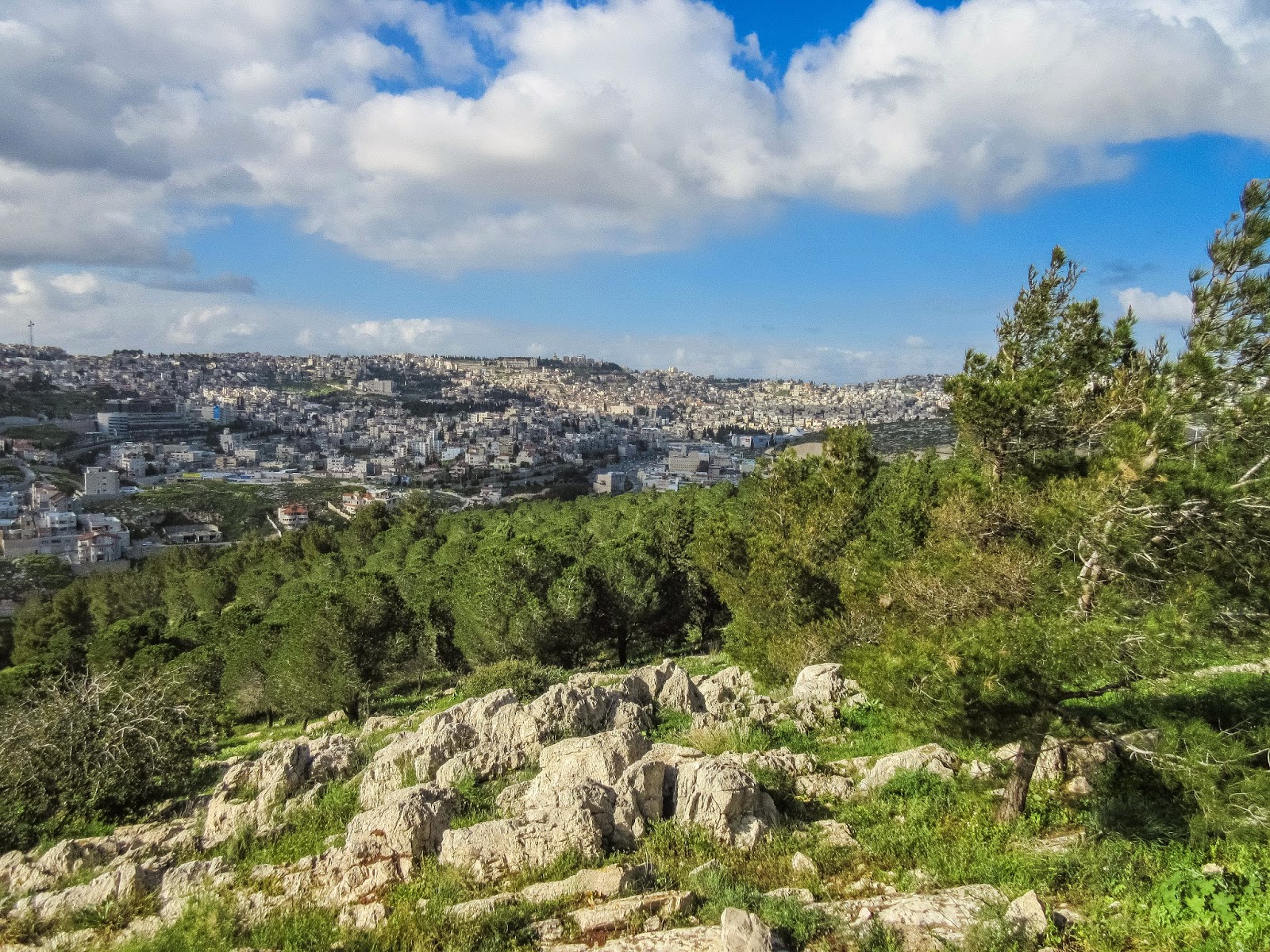
Nazareth as viewed from Mount Kedumim, also known as Mount Precipice. The next picture is a closer view of Nazareth above and just slightly right of center.  
The Basilica of the Annunciation, just a little left and up from center, where the Catholics believe the Annunciation took place. 
A much closer view of the Basilica of the Annunciation. I would have liked to visit, but it was not on our tour agenda.
More of modern Nazareth, to the left of the Basilica, likely just open space at the time of Jesus.
And more of modern Nazareth as the view goes even more left and towards the Jezreel Valley.
It is easy to envision herds of sheep and goats roaming the mountains and valleys, and Jesus watching the shepherds, perhaps even taking a turn. We saw other instances of shepherds watching sheep on hilly terrain. After our visit, it is now easier for me to think of Jesus as a stonemason than a carpenter. We saw so much stonework and so many stones. Nazareth is a relatively short distance from the very flat Jezreel Valley and from Mount Tabor where many believe the Transfiguration took place. Nazareth and nazarite, as in nazarite vow, are derived from the same word. The nazarite vow required the person making the vow to abstain from wine, refrain from cutting his hair and not to become ritually impure by contact with corpses or graves. Samson and Samuel were nazarites and John the Baptist probably was. Was there more than a word connection of nazarite and Nazareth?  Could that vow have originated in that vicinity? Something interesting to contemplate.  

At about age 30, Jesus was baptized by John in the Jordan River and spent 40 days in the Judean wilderness. Then he returned to Galilee and "went to Nazareth, where he had been brought up, and on the Sabbath day he went into the synagogue, as was his custom. He stood up to read, and the scroll of the prophet Isaiah was handed to him. Unrolling it, he found the place where it is written: 'The Spirit of the Lord is on me, because he has anointed me to proclaim good news to the poor. He has sent me to proclaim freedom for the prisoners and recovery of sight for the blind, to set the oppressed free, to proclaim the year of the Lord's favor.' Then he rolled up the scroll, gave it back to the attendant and sat down...[Then Jesus said to them], Today this scripture is fulfilled in your hearing." Some asked, "Isn't this Joseph's son?" Then Jesus went on: "[N]o prophet is accepted in his hometown." Neither Elijah or Elisha were accepted by their own people.  (Luke 4:14-27)

The "people in the synagogue were furious when they heard [Jesus say] this. They got up, drove him out of the town, and took him to the brow of the hill on which the town was built, in order to throw him off the cliff. But Jesus "walked right through the crowed and went on his way." (Luke 4:28-30)

We visited the hill where tradition holds that the Nazareans attempted to throw Jesus off the cliff. It was impressive, beautiful, scenic, a stiff breeze at times. For me, this was one of those little unexpected surprises of our trip. A place of personal significance that I did not anticipate.

From Mount Precipice, looking beyond the hills containing Nazareth into the Jezreel Valley.
Panning to the left, the Jezreel Valley opens up wide.
Panning further to the left.
Panning even further left, Mt. Tabor comes into view, the mountain in the top center.