Sunday, May 23, 2010

Captain John Cannon: Captain George Cannon's Brother?

John Cannon, the second of eight children of Hugh and Eleanor (Nell) Addy Cannon, was christened on June 5, 1768 in the parish of Kirk German, Peel, Isle of Man. He was just two years younger than his older brother, George.

John Cannons abound in the Isle of Man which makes tracing them very difficult. Hugh Cannon’s father was John Cannon, who owned Cooilshellagh in the parish of Kirk Michael. In addition to Hugh, he had a son nine years older, named John, christened February 4, 1728. Hugh, of course, had a son, John, the subject of this blog post, the younger brother of Captain George Cannon. Then Captain George Cannon had a son, John, christened April 21, 1802. I am sure that many other Cannon family members also had John Cannons which all add to the complication in tracing and identifying them.

Captain George Cannon attended the Peel Mathematical School for two years, from April 4, 1781 to August 5, 1783. Just four months later, on December 4, 1783, a John Cannon entered the school. Is this George’s brother, John? He was two years younger than George and he would be following in his brother’s footsteps. There was another John Cannon who attended the Peel Mathematical School for three months in 1774, but he would have been quite a bit older than George.

There are a number of records of a seaman and Captain John Cannon. They may all relate to one John Cannon, or they may relate to several John Cannons.

A John Cannon was ranked 5th (perhaps second mate) out of a crew of 37 on the King Pepple, a 342 ton ship owned by William Boats, Thomas Seaman and James Percival. The King Pepple left Liverpool on May 1, 1790, with Thomas Briscoe as captain, headed for Bonny for slaves. After obtaining slaves, it went first to Dominica, then to Montego Bay, Jamaica, where 444 slaves were delivered on December 29, 1790 and John Cannon was discharged.[1] The King Pepple returned to Liverpool, arriving on March 20, 1791.[2]

A John Cannon is listed as a seaman on the ship Sarah in 1803, with Thomas Cannel as captain [Frances Wilkins, 2,000 Manx Mariners (Wyre Forest Press, Kidderminster: 2000), p. 61].

Lloyd’s List, dated November 3, 1809, indicates that Captain Cannon and the ship Henry arrived in Liverpool from Quebec on November 1, 1809.
Lloyd’s Register – Shipowners, for 1810, lists the brig Henry at 140 tons, owned by Captain J. Cannon, with a projected ship route from Liverpool to Quebec.
Lloyd’s List, dated August 21, 1810, confirms that Captain Cannon arrived in Liverpool on August 16, 1810, from Montreal, Quebec.
On February 9, 1811, Captain John Cannon arrived in Lisbon from Limerick, Ireland, on the ship Henry. [Lloyd’s Listed, dated February 19, 1811] Less than two months later, on March 29, 1811, the Henry, with Captain Cannon, arrived back in Limerick. [Lloyd’s List, dated April 5, 1811] Following this voyage, Captain John Cannon may have made another trip, this time on the ship James, from Dublin, Ireland to Cardiff, Wales and back.[3] Or perhaps this was another Captain John Cannon. In another voyage in 1811, Lloyd’s List, dated November 12, 1811, reported that Captain Cannon and the Henry arrived in New Foundland from Liverpool.[4]

Captain Craik, of the ship James, arrived in Liverpool from Charleston, South Carolina, in July 1815. He reported speaking to Captain John Cannon of the Brig Henry, headed from Liverpool to New York, and that all was well.[5]
Lloyd's Register for 1814 (below). 
The voyages of the ship Henry are of even more interest given the fact that Captain William Cannon and the ship Leander regularly traveled between the same places: Quebec, Ireland and Liverpool.

Finally, we have a probate petition in the parish of Kirk German, Peel, Isle of Man, for Captain John Cannon in 1839. There is a burial record for John Cannon on January 5, 1839 in Kirk German, showing that he was age 77. Captain Cannon’s brother, John, would have been age 70. This John Cannon would have been born in 1761 or 1762, about 7 years older than Captain Cannon’s brother John. So this may perhaps be the other John Cannon that attended the Peel Mathematical School before Captain George Cannon.

From a notice dated January 18, 1839, we learn that this Captain John Cannon was a bachelor and died without a will on January 3, 1839. He had three surviving siblings: Charles Cannon of Peel, the administrator, Elizabeth Cannon of Peel and Thomas Cannon, who no longer lived in the Isle of Man. This definitely is not Captain George Cannon’s brother.

There is a long list of personal items inventoried as of January 7, 1839. Some of them are of particular interest, given Captain John Cannon’s vocation:
a lot of buttens & a pair pistols & lead
scale & compiss & looking glass
2 guns & lot of old clothes & charts
stamp spying glass & scales 3 buckels
2 Quadrants lot of Lace & caps
boatswain call 2 pockot knives

On January 23, 1830, there is an account of the sale of the goods and effects of “Captain John Cannon of Peel Late Dec’d”. Purchasers of items included Captain John Cannon’s three siblings and a Betty Cannon. Some particular items of interest sold were a gun to Mat Cowll (0..5..6), a gun to James Cool (0.14..6), a trunk to Charles Cannan (0..5..3), a Bible to Charles Cannan (0..4..0), a spying glass to Wm Pickle, lots of buckels to Mick smith (0..0..4), a Sword to Mr Crellin merchant (0..0..9), Pistols to John McCoy (0..3..0), Quaderent to Mr Crellin merchant (0..2..6), another Quaderent to James Cool (0..6..6), a looking glass (0..1..5), a chest to Wm Farragher (0..1..7), table and Charts to John Morrison (0..2..6), and a Free Masons arms and box to Charles Cannan (0..6..0).

There was a charge of £6.0 for “washing and laying out Capn. Cannon” It also appears there was a payment of a charge incurred by Captain Cannon for 3 ½ pints of rum. He had a “covered coffin with plate and handles complete.”

We know that two John Cannons in Peel attended Peel Mathematical School. We know that one Captain John Cannon was not Captain George Cannon’s brother. Was this Captain John Cannon the owner of the ship Henry? Or could that have been George Cannon’s brother? The brothers George Cannon and William Cannon of Peel were both captains and both died at sea within less than a year of each other. We don’t have a record for the death of their sibling John. Could he have been a captain? Could he also have died at sea? Someday it would be fun to have all of the pieces and complete the puzzle. We will keep looking for more information to come to light.

ENDNOTES:

[1]  Lloyd’s List, dated February 1, 1791, states that “K. Pepple, Brisoe” arrived in Dominica from Africa. Lloyd’s List, dated February 18, 1791, states that the “King Pepple, Briscoe” arrived in Jamaica from Africa.


[2]  Behrendt Letter (PRO, BT 98/51, No. 127, Liverpool muster roll 1791; Family History Library, Film 870304); Lloyd’s Register 1791, Lloyd’s List February 1, 1791 and February 18, 1791; Cornwall Chronicle (Montego Bay), January 1, 1791, January 29, 1791 and February 5, 1791; Colonial Office 137/91, 60; House of Lords Records Office, MP, HL, 94.03.22; Parliamentary Papers 1792 (768), XXXV, (766-7), XXXV; Treasury 64/286, 21; and craig, 80.

[3]  Lloyd’s Register, Underwriters, 1811, reports that “J. Cannon” was captain of the ship James, from Dublin to Cardiff.

[4]  Lloyd’s Register, Shipowners, 1811, reports that “J. Canon” was captain of the Brig Henry, headed from Liverpool to Quebec.

[5]  Lloyd’s List, dated July 21, 1815 states that the conversation with Captain Cannon took place at latitude 43.54, longitude 46. This was in the middle of the ocean, about due east of Halifax, Nova Scotia and about two-thirds of the way to New York. Lloyd’s Register for 1814 provides the name of the captain of the Henry as “J. Cannon”. The ship was a Snow, of 147 tons, single deck with beams. It was headed to Oporto.

Wednesday, May 19, 2010

Captain William Cannon: Brother of Captain George Cannon

William Cannon was the fifth of eight children of Hugh and Eleanor (Nell) Addy Cannon. He was christened on December 6, 1778 at the parish of Kirk German in Peel, Isle of Man. Hugh was 35 and Nell was 31. William’s two oldest siblings who figure peripherally into this story, George and John, were 12 and 10 respectively. These three sons of Hugh and Nell Cannon all became ship captains.

Just six months after William’s birth, George went to sea on the Jamaican bound ship Rawlinson. When William was 2, on April 4, 1781, George entered the Peel Mathematical School and graduated two years later, on August 5, 1783. Four months after George graduated, John entered the Peel Mathematical School on December 4, 1783 and by that time, George was back out to sea. See the list of students who had attended the Peel Mathematical School as of February 20, 1784, below, obtained from the manxnotebook.

We don’t have attendance records for the Peel Mathematical School during the time William would have attended, but given his two older brothers attendance and William’s later achievements at sea, it is a fair bet that William also attended.

In a letter from Stephen D. Behrendt, dated April 14, 2005, posted on the George Q. Cannon family website, he points out that a William Cannon was on board the slaving brig Alert, which left Liverpool on September 7, 1794, with George Bernard as captain, headed for the Gold Coast of Africa for slaves. The Alert was owned by John Dawson, the same man that owned the ship Eliza that George Cannon had been on for two previous voyages. He pointed out that George may have recommended his relative to John Dawson. On November 16, 1794, slave purchases were begun in Cape Coast Castle, then the Alert went on to Lagos where the majority of slaves were purchased. Ultimately, 329 slaves were delivered to Havana, the Alert arriving there on May 29, 1795. The Alert arrived back in Liverpool on July 31, 1795 [Lloyd’s List, dated August 4, 1795, states that the “Alert, Bernade” arrived in Liverpool from “Havannah.”] Three of the crew died on the voyage. Unfortunately, one of them appears to have been William Cannon. See the Muster Roll dated August 29, 1795.
The magnified version shows the person in sixth position, “annon” (the microfilm copy is cut-off), died.
We know that George’s brother. William, lived as the baptism of his illegitimate daughter, Elizabeth, was recorded on the baptism records of the parish of Kirk German on August 12, 1803. See below.

The transcription is: “Elizabeth illeg[itima]te dau[ghte]r of Wm Cannon & Alice Cowell prev[ious]ly bapt[ize]d. Augt 12th”
Two and a half months later, William, then age 24, married Alice Cowell to make Elizabeth legitimate. Captain George Cannon, William’s brother, was one of the witnesses of the marriage. It is interesting to note that William was able to sign his name, evidence that he may have gone to the Peel Mathematical School. Alice signed her name using a mark. See the marriage record below.
The transcription is: “William Cannon bachelor & Alice Cowel spinster[,] both of this parish [German,] were married in this Church by licence this thirtieth day of Octr in the year one thousand eight-hundred & three By me James Gelling[,] Vicar[.] This marriage was solemnized between us William Cannon [and] Alice Cannan alias Cowel my x In presence of George Cannan Capt’n [and] John Thomas Graves Mercht”

W. Cannon, who I believe was George Cannon’s brother, William, was captain and owner of the ship Leander for about eight years. In Greek mythology, Leander was a youth who swam the Hellespont each night to be with Hero, a priestess of Aphrodite. Leander was drowned in a storm while trying to visit Hero and Hero subsequently drowned herself in despair [dictionary.com under “Leander”]. The namesake ship and its captain likely had an eerily similar fate.

Lloyd’s Register lists “W. Cannon” as the captain and owner[1] of the ship Leander from 1803 to 1810. The Leander was a 170 ton brig, with [SDB] built in Workington. Workington is at the mouth of the River Derwent on the northwest coast of England in Cumbria (well north of Liverpool). The general course of the Leander for each year is indicated below. I have provided a page from Lloyd's Register - Underwriters for 1809 and then a closeup of that same year showing W. Cannon and the Leander.

Year                          Course
1803 Underwriters -- Dublin to Norway
1804 Underwriters -- Dublin to Norway
1805 Underwriters -- Dublin to Norway
1805 Shipowners   -- Dublin to Norway
1807 Underwriters -- Dublin to Norway
                              -- Liverpool to  Quebec
1808 Underwriters -- Liverpool to Quebec
1809 Underwriters -- Workington to Ireland
A closer view of the Leander
1809 Shipowners   -- Liverpool to Quebec
1810 Underwriters -- Liverpool to Dublin

We get a little more detail on some of his voyages from other sources. The Manchester Mercury and Harrop’s General Advertiser, dated April 7, 1807, p. 2, indicates that W. Cannon, was master (captain) of the ship Leander, arrived at Liverpool in late March 1807 from Limerick, Ireland, with 1671 quarters oats consigned to merchants Bennett and Blundell. Lloyd’s List, on September 11, 1807, indicates that the Leander arrived in Beaumaris, Wales, from Quebec, on its way toward Liverpool.[2]
Four days later, Lloyd’s List indicates that the Leander arrived in Liverpool on September 10th.[3]
The Manchester Mercury and Harrop’s General Advertiser, dated September 22, 1807, indicated that the Leander had arrived in Liverpool from Quebec with 5,672 bushels of wheat, 7c 5q staves 5c deal ends, consigned to merchants R and G Hamilton.

Lloyd’s List, dated July 25, 1809, indicates that Captain Cannon and the Leander arrived in Dublin, Ireland from Pictou, Nova Scotia on July 18, 1809.
Finally, family records indicate that William Cannon died about 1810 at sea. It appears that he died during one of his voyages from Quebec on the way back to Liverpool. Lloyd’s List, dated October 9, 1810,
indicates that Captain Cannon and the Leander were “wrecked on Great Manan Island, in the Bay of Fundy.”
See a map of the Bay of Fundy below.
The Bay of Fundy is on the Atlantic coast of North America, between the Canadian provinces of New Brunswick and Nova Scotia, very near the State of Maine. It is known for its giant tides, having the greatest difference in water level between high and low tide in the world. Grand Manan Island is about 15 miles long and 7 miles wide and is located about 22 miles of the New Brunswick coast. The west side of the island is an inaccessible wall and is uninhabitable. Grand Manan Channel, between the coast of Maine and Grand Manan Island, is the most direct passage for vessels headed up the Bay of Fundy from along the coast of Maine. The channel varies in width from 5.5 miles to 10 miles, except for rocks and ledges that lie southwest of Grand Manan Island in the vicinity of Machias Seal Island. The Murr Ledges appear particularly dangerous, with names including Wallace Ledge, Halftide Rock, St. Mary Ledge, Yellow Ledge, Cross Jack Ledge, Long Ledge and White (West) Ledge. Over 300 vessels have been wrecked in the area around the island in the last two centuries.[4]

If William died in the wreck of the Leander, he was age 31 at the time of his death. His death preceded the death of his brother, George, also at sea, less than a year later.

ENDNOTES
[1]  Captain W. Cannon was majority shareholder of the Leander as Lloyd’s Register lists the ship as owned by Capt. & Co (See Infosheet 34 Researching the Earliest Registers, Revised June 21, 2006, Lloyd’s Register, under 1764 Register, Col. 10 – Name of owner.)


[2]  The captain’s name is not indicated, but the entry in Lloyd’s List, four days later, and the destinations of other ships that year with the same name, in Lloyd’s Register, make it clear that it was Captain W. Cannon.

[3]  Lloyd’s List, dated September 15, 1807. The captain is listed as “Carman”, but Lloyd’s Register has no captain by this name listed and the route is the same as that indicated for Captain Cannon and the Leander.

[4]  Wikipedia “Bay of Fundy”; http://www.gnb.ca/cnb/Grand/. A description of some of the wrecks that have occurred there reveals that most were a result of hitting one of the many ledges, jutting out of the sea off the island, in fog and bad weather. The names of some of the ledges that have claimed ships are Old Proprietor Ledge, Yellow Murr Ledge. St. Mary Ledge and Wallace Rocks (http://www.gnb.ca/cnb/grand/ship-e.asp). A ledge is a reef, ridge or line of rocks in the sea (dictionary.com).

Tuesday, May 18, 2010

Large-Spotted Leopard Lizard

The large-spotted leopard lizard is a sub-species of the long-nosed leopard lizard.
It is found in southeastern California, Nevada, large portions of Arizona, western and southern New Mexico, southern Idaho, southeastern Oregon and bits of Colorado and northern California.
It is found in arid and semiarid planes with scattered low plants and gravel, hardpan or sand. It avoids dense grass and brush which intereferes with its running. It oftens waits for prey in the shade of a bush where its spotted pattern blends in.
They eat insects, spiders, other lizards, small rodents, like pocket mice, blossoms, berries and soft leaves. They are capable of marked color change. In a light phase, spots and cross-bars are found on body and tail. In a dark phase, the spots are nearly hidden and the light cross bars are found.
and
and
I saw my first one recently, in early April 2010, just south of Joshua Tree National Park off the Hayfield Rd. exit of the I-10 freeway.
It was found in a gravelly area full of teddy bear cholla, ocotillo, hedgehog cactus and low shrubs. It hid beneath shrubs and ultimately disappeared into a hole beneath a shrub. Then on May 15, 2010, I took a hike to Carey's Castle with my brother, Chris, and saw two more large-spotted leopard lizards. They were both in a small wash with bushes and rocks, one sunning on a rock before it vamooshed. They are very wary and very fast. I got just this poor photo of one of them.
I have seen two leopard lizards previously. One as a young boy at Lake Powell, in a hole in some sandstone. And one much later, when the kids were young and we were visiting Hovenweep National Monument in southeastern Utah. Both of those were a different sub-species, the small-spotted leopard lizard, and looked significantly different. They were green with dark small spots. That is why when I saw my first one recently, I wasn't sure if it was a leopard lizard or a desert iguana.

Monday, May 17, 2010

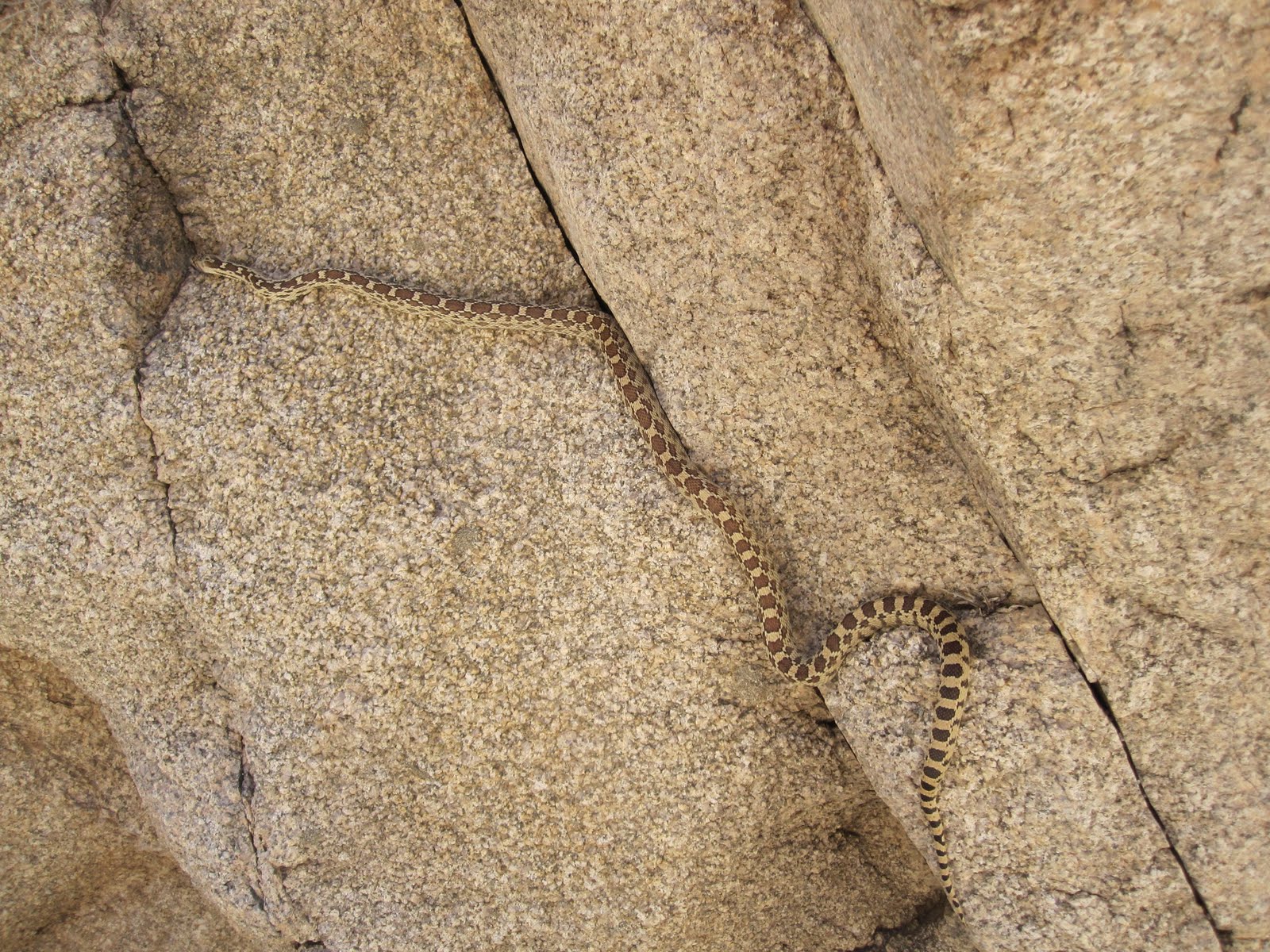
Sonoran Gopher Snake

The Sonoran Gopher snake
is found in extreme southeastern California, northeastern Baja California, all but a piece of northern Arizona, most of the western half of New Mexico, the tip of west Texas and Sonora and Chihuaha, Mexico. My brother, Chris, and I found one near Carey's Castle in the Eagle Mountains north of the Hayfield Road exit off the I-10. It had virtually all brown markings,
except for some light black outlining on some dorsal blotches.
One of the distinguishing features of the Sonoran gopher snake is that the dorsal blotches toward the front of the body are brown,
unconnected to other blotches. The blotches are connected on this one,
but in the Great Basin and San Diego gopher snakes I've seen, the upper blotches were black. Botches darken toward the rear.
A couple of more pictures. This gives a partial view of the belly.
A view of the side markings.

Sunday, May 16, 2010

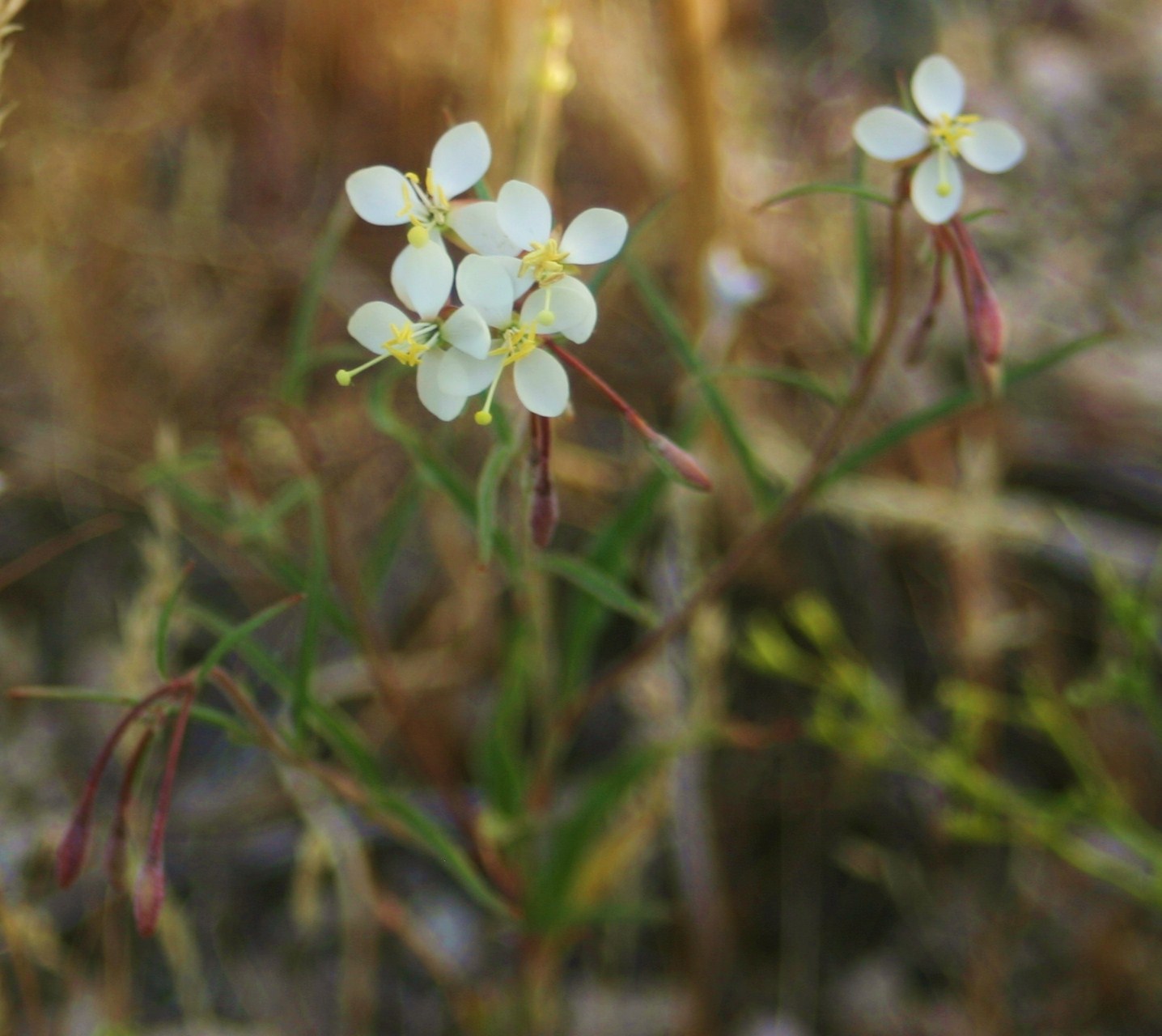
Narrowleaf Suncup

Narrowleaf suncup or narrow leaved primrose (Camissonia refracta)
is a species of evening primrose which blooms at night. It has a hairy red or reddish green leafy stem.
It has white flowers with four petals which turn reddish as they wither.
The ones I found were very, very small, in the same vicinity as the browneye primrose, another night blooming flower. They were on the bajada south of the Eagle Mountains off the Hayfield Road exit of the I-10.

Saturday, May 15, 2010

Parish's Poppy

Parish's poppy,
or pygmy poppy (Eschscholzia parishii)
is very similar in appearance to the desert golden poppy or Mojave poppy (Eschscholzia glyptospema), also found in the southern portion of Joshua Tree National Park. These were found off the Hayfield Road exit of the I-10 on the bajada south of the Eagle Mountains.
This next picture was taken early in the morning before the flowers had unfolded.
This flower was in the process of unfolding.
The difference is that Parish's poppy has branched, leafy stems,
while the Mojave poppy has a leafless stem. It has a a yellow to orange flower with four petals.
It took me quite a bit of time and looking, particularly at pictures of the two types, to make this determination.

Friday, May 14, 2010

Desert Starvine

Desert starvine,
also known as brandegea and white starvine (Brandegea bigelovii)
is a sprawling vine in the squash family native to the deserts of southeastern California, southwestern Arizona and northern Mexico. It has distinctive dark green leaves,
variable in shape, but usually deeply lobed and long fingered and heavily speckled with white oil glands.
The vine has tendrils,
small five-pointed white flowers
and small, dry, prickly fruits which hold a single seed.
The plant grows from a single taproot.