Sunday, May 24, 2009

Zebra-Tailed Lizard

The end of May 2009, I went to Organ Pipe Cactus National Monument in Southern Arizona. I had been there four or five times previously but had never seen a zebra-tailed lizard. This time I saw many. I determined the reason for this was I was there later in the spring, when it was warmer. I was amazed to see them very active in the heat of the day, in the Estes Wash, when it was 95 degrees. They must really like heat.

I have only seen them a few times previously anywhere. Yet they are apparently quite common. I saw a couple of them on a very warm day in the Mecca Hills and I have seen them at the Desert Tortoise Refuge near California City. So I've determined that the reason I've not seen more of them is that I tend to go to the desert in the spring, when it is not as warm.


They are very thin and appear quite frail and wispy. They move around alot and appear quite acrobatic. At times, perhaps when more relaxed, they will have their bodies against the ground
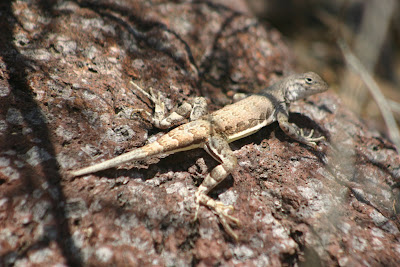
or against a rock.
At times, their bodies are raised high off the ground, their legs extended
and sometimes with their tails in the air.
When about to run, they curl and wag their tails. They run with their tails curled backward over their backs. The underside of their tails are white with black stripes.
Some, like the one below, have an orange spot on their throats.
I found them very wary, and difficult to get close to. However, if patient, and moving closer to them slowly, I found I could get fairly close to them. I did not try to catch one, but I assume that doing so would be difficult.
Seeing them there, and so prevalent, was perhaps my biggest surprise in Organ Pipe.

On April 3, 2010, I went to Carey's Castle with Andrew and Lauren in the southern portion of Joshua Tree National Park. It was pretty warm, about 85 degrees, and we saw quite a few zebra-tailed lizards.
My experience was similar to Organ Pipe. When I was there earlier, but cooler, I did not see any. Those we saw were all in sandy washes.
They are very difficult to see because they blend in so well.
I saw several running on their hind legs with their back tail coiled and up in the air. They are very fun to watch, at least to the extent you can see them. I love the black strip on the back of the thigh on their hind legs.
In April 2011 I actually caught a zebra-tailed lizard in the Hayfield Road area. I examined it for a minute or two before putting it into a pillow case 
and the second I put it into the pillow case it zipped up the sides and jumped out and skeddadled into the distance. I am in awe of their quickness and speed. Here are a few photos I got while holding it, including the colorful underside of the belly, 
the underside of the tail
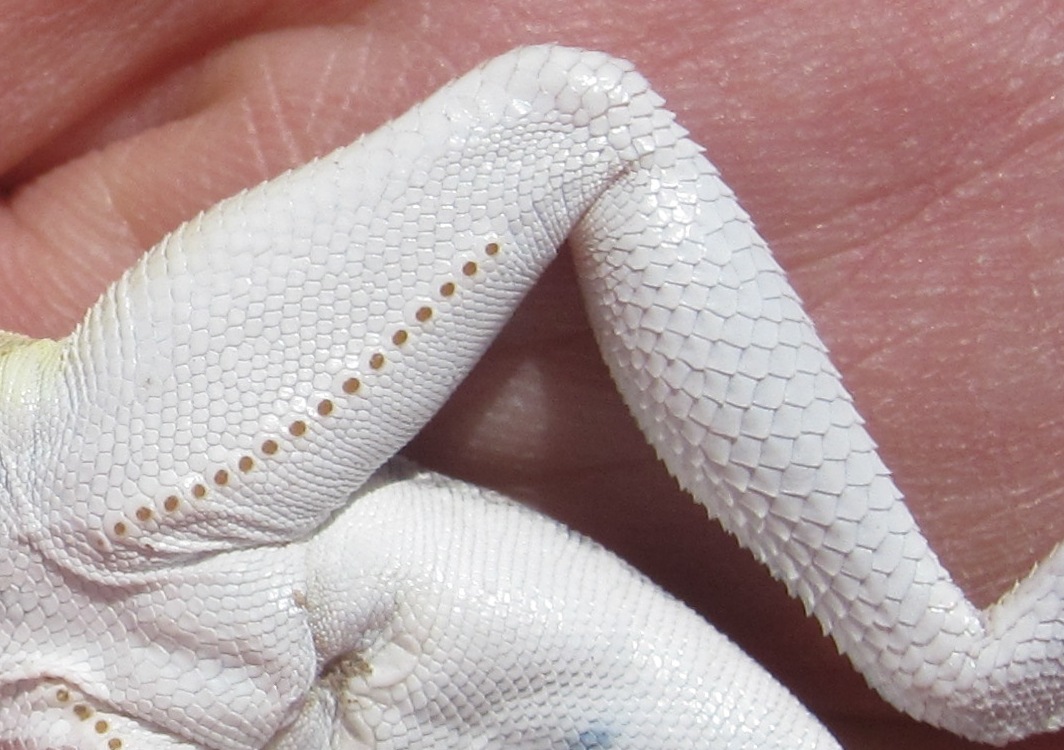
and curious markings on the underside of the thighs and leg scales.  

Friday, May 22, 2009

Coyotes

In contraposition to the mule deer, which I saw lots of in Utah growing up, but then have seen very few in California; I never saw a wild coyote in Utah and see them regularly in California.

As a boy in Utah, I do recall hearing coyotes howling in City Creek Canyon on an early morning walk toward Little Black with my cousin, Pat Barnes, and his Irish setter, Red. I was mesmerized by the haunting, eery, high pitched howl. I also recall seeing baby coyotes in a pen at a home near our ranch near Oakley. They were very cute and I harbored the desire for a long time to have a coyote as a pet.

At our home in Redlands, California, right off Live Oak Canyon, we hear them howling almost nightly. For several years I took an almost daily morning walk into the canyon (before the housing development took over). I saw them so often that it became almost routine. I became familiar with their trails. I saw them in bunches, including as many as five at a time. We often heard and still do hear, them in choruses, with an occasional soloist yip, yapping a different tune. In the summer, sleeping with our bedroom slider open, and only a screen, I have heard a chorus on the street beyond our backyard so loud that it has woken me up. And last year, for the first time, I watched a coyote wander from our front yard into our backyard and then down our hill.

I believe the first coyote we may have seen in California was on a Saturday morning trip in 1989 to Joshua Tree National Park. A car in front of us was stopped, then we saw the coyote and stopped, much like we used to do for bears in Yellowstone National Park. As bad park tourists, we tossed the coyote some Danish sweet roll. The kids named the coyote "Joshua."
Over the years in visiting Joshua Tree, we have come to view the coyote there much like the bear in Yellowstone. They are very tame and you usually see them. One afternoon, we were having a picnic lunch in the rocks in Hidden Valley and had several coyotes come so close we could almost touch them.


In August 1994, we camped in Round Valley with the Haws family on a Friday night and hiked to San Jacinto Peak the next day. Friday evening as we ate, we had coyotes strolling through camp. That evening we were treated to a chorus of coyote voices within 50 yards of our tents. We had more coyotes streaking through camp in the morning. See below.
Another Round Valley coyote.


The coyote below was nonchalantly hunting mice in a field across the street from our church on Wabash and Fifth Avenue in Redlands. It was fun to see it hop in the air and pounce on the mice, seemingly oblivious to our presence.

In March 1996, I took a group of young men to Corn Springs. Early in the morning, with Gregg Palmer, we went off some distance and hid in the rocks while Gregg used his predator call, the sound of a squealing rabbit, to try and call in some coyotes. I figured there was no chance any coyotes would respond, particularly with a group of about 10 antsy boys waiting in the rocks. I was completely shocked when, within about two minutes, two coyotes came running in. Gregg had his bow and shot one of the coyotes with an arrow. It looked mortally wounded, as it was bleeding heavily. See below.

We tracked it quite a ways, following the blood, but eventually lost the trail, after looking for several hours.

Lots of people are troubled by the coyotes wandering our streets at night, and sometimes even brazenly during the day, catching the occasional cat and small dog for a meal. We too, have lost a couple of cats, likely to coyotes (our outside cats learned to sleep in the protective sanctuary of our garage rafters at night). I personally love to have them nearby and view the loss of an occasional dog or cat as the price we pay for the privilege of having wild neighbors.

Mule Deer

Growing up in Utah I saw lots of mule deer. I was with my father and brother, Layne, when my father shot a four-point buck in Tooele. I went hunting for them myself a number of times: in Hoyt's Canyon near Kamas at least twice, where I was with Bear Backer when he shot a buck; and in the City Creek Canyon area several times, but I have never shot one myself. At the national parks, Zion's and Bryce Canyon in particular, they are very plentiful.

In California, it is a different story. For all of the time I've spent hiking, I have seen relatively few. As a scoutmaster going on monthly outings, I didn't see a deer for a year and a half, until I saw one at a distance near Deep Creek in the San Bernardino Mountains. I have seen a few near Mount San Jacinto, in Round Valley and in nearby Tamarack Valley. The young buck in velvet, below, was seen in Tamarack Valley in July 1993.

With all of the hiking I've done in the Sierras, I've only seen a few deer there and I have no good pictures of them. The only ones I actually recall seeing were in the Cottonwood Lakes Basin the several times I have been there. Below is a picture of a doe I saw with my brother, Matt, in the Henry Fork's area of the Uinta Mountains in northeastern Utah.
Perhaps the best view of a deer I've had since living in California came on a trip with the family to the North Rim of the Grand Canyon. I got these pictures of a beautiful buck in velvet:


But my favorite experience came close to home. One morning I was in our canyon on a walk and happened to have my camera. I may have been on my way to see the Cooper's hawk nest (the subject of a prior blog). Something alerted me to look closely in the bushes. I was scanning for a coyote, which I commonly saw on my walks. All of the sudden, I picked out a beautiful buck mule deer, in velvet, blending in to the live oaks. I was stunned. I was within a quarter to half mile of my home.
I have seen one other buck near our home, crossing the street early in the dark hours of the morning near Alta Vista, and several does. What once was taken for granted, while living in Utah, is now deemed a privilege and relished.

In July 2009 while on a backpacking trip from Mammoth to Yosemite Valley, we had a number of great mule deer sightings. This buck walked right through our camp early one morning at Thousand Island Lake.
While hiking through Tuolumne Meadows we saw a number of different deer.


In June 2013, while hiking Mt. Baldy (outside of Los Angeles) I ran across this beautiful doe not too far from the summit.
In August 2013, in downtown Buena Vista, Colorado, we found three large buck mule deer feeding on a lawn. The first picture is of the largest buck. We were just feet away and they mostly ignored us.
Mule deer buck in Buena Vista, Colorado
Three bucks all feeding in Buena Vista.
In November 2013, while visiting my daughter in Lehi, Utah, I drove up into Alpine with my granddaughters. We saw a group of at least ten mule deer feeding near the road.  
A small buck in a herd of deer in Alpine, Utah
Buck in Alpine, Utah
In August 2014, about nine miles east of Buena Vista, Colorado, I see a number of mule deer grazing, including the first fawns I believe I've ever seen.
Doe near rented cabin outside Buena Vista.

What looks like a very young fawn.


Thursday, May 21, 2009

Grilled Buffalo: New York Steak

While visiting Andrew at UCLA we stopped at Whole Foods as is now customary. I couldn't resist buying some buffalo meat, a New York steak cut. On the same trip I purchased some Kobe style beef at a Japanese market and later cooked both the Kobe style beef and buffalo, side-by-side on the grill.

Buffalo is much leaner than even a regular New York beef steak.

I like well-marbled meat and I like it moist. From that standpoint, I would think I generally prefer beef to buffalo.

However, I was kind of surprised to find that I preferred the much leaner buffalo, to the very moist and juicy Kobe style beef. I preferred the distinctive flavor, even though it was not as moist and juicy.

I still prefer the buffalo ribeye, which has more marbling, than the New York cut, but the New York was very good. Even better, are buffalo ribs, which I had the opportunity to eat at a restaurant in Estes Park, Colorado last year.

Wednesday, May 20, 2009

Captain George Cannon

I lived for two years in the midlands of England while serving in the England Birmingham Mission of the LDS Church. Before leaving for the U.S., I had the opportunity to travel with another missionary, Elder Felton, to the Isle of Man, an island in the North Irish Sea between England and Ireland, where my Cannon ancestors are from. Elder Felton also had ancestors from the Isle of Man. In preparation for the trip, my father sent me the Cannon Family Historical Treasury, which gives some detail on my Manx ancestors, including the particularly fascinating Captain George Cannon, who was the captain of a slave ship and who was later killed in a mutiny on his own ship in 1811. Captain Cannon lived in Peel, Isle of Man.

On August 11, 1978, Elder Felton and I were in Peel and visited Peel Castle. I told the caretaker that I was interested in a Manx flag and asked if he knew where I could get one. The caretaker said that he had just pulled down the Manx flag that had flown over Peel Castle for the last year and that I could have it. The flag was frayed at the end, the three legged symbol in the middle was coming undone and it was faded and had seagull droppings on it. It had real character. It has been a valued treasure ever since, now adorning a wall in a small room in our garage known affectionately as the "scout room," where I keep my camping equipment and similar items.
A close-up of the three-legged symbol of the Isle of Man.
Elder Felton and I also found Captain Cannon's home in Peel, located at #7 Michael Street. It was owned by a Felton and was an ironmonger's shop. This was kind of a fun connection for Elder Felton and I. We learned that Michael Street is "the" street in Peel.

A number of years ago I stumbled on the George Q. Cannon website (George Q. Cannon was the grandson of Captain Cannon) and found a copy of one of Captain Cannon's ship logbooks on the site, which gave some detail on two of Captain Cannon's slave voyages. The site also had a letter from Stephen Behrendt, an expert on the history of the slave trade, detailing some voyages of Captain Cannon. These resources were intriguing to me. I transcribed the logbook and began my own research on Captain Cannon and the slave trade.

In July 2006, Judy and I traveled to the Isle of Man and I got to visit Peel Castle for the second time. Below, Peel Castle as seen from the harbor in Peel. The castle sits on a prominent peninsula.
Judy at the castle with some "lower case c" Peel cannons.
Remnants of a church and turret.
The 2006 version of the Manx flag flies over the castle below, above the remains of the church.
Peel, as seen from the castle. On both trips, I stayed in the large brown buildings on the waterfront to the far left of the picture. In 1978, at the Creg Malin and in 2006 at the Fernleigh.
A different portion of the castle.

Judy and I also visited Captain Cannon's home on Michael Street. In the interim, from when I first visited Peel, the home was refurbished by a developer into separate condominiums. The street level was the U.S. equivalent of a thrift shop. We were able to go into the underground cellar which was full of clothes for sale, mostly. On the front of the building is a garish sign proclaiming "Captain Cannon's House."

A closer look at the sign. Michael Street is so narrow that it is difficult to get a good, straight on, photo of the building or sign.

I have learned a fair amount about the life of Captain Cannon. So far, I have been unable to find any particulars about the mutiny that took his life, or whether there really was a mutiny. In future posts I'll share some of the things I've learned about Captain Cannon and this fascinating time in history.

The following are the posts, so far, on Captain George Cannon:

Ship Rawlinson (May 1779 to March 1780), which also gives his parents, birth and siblings;

Peel Mathematical School (April 1781 to August 1783);

Ship James: (Two Voyages (1787 to 1789), which also has a general discussion of a seaman's duties, rank, wages, food, sleeping arrangments, personal items, leisure and sterotypes;

Ship Eliza - Liverpool to the Gold Coast, from March to May 1790, which discusses the Liverpool docks and Liverpool's role in the slave trade, looking at slavery through a historical lense, equality of Europeans and Africans in trade negotiations, the duties and wages of 1st and 2nd mates, surgeons and boatswains, and an overview of the Gold Coast of Africa.
 
George Cannon in Lisbon, notes that the Ship Eliza docked in Lisbon in the spring of 1790 after leaving Liverpool on the way to the Gold Coast. It is a viewed through the lens of what George Cannon might have seen that can still be seen in modern Lisbon.

Ship Eliza - Fort St. Anthony in Axim, Ghana, a Dutch fort at the beginning of the Gold Coast which provides perspective on how significant the slave trade was along the Gold Coast.

Ship Eliza - Elmina Castle in Ghana, the Dutch administrative headquarters for the slave trade on the Gold Coast for additional perspective on the Gold Coast slave trade.

Ship Eliza - Cape Coast Castle in Ghana, the British administrative headquarters for the slave trade on the Gold Coast. George Cannon spent significant time here over the course of three years, from 1790 to 1793, as a first mate, obtaining slaves and possibly even sleeping at the Castle.

Ship Eliza - Anomabu Fort in Ghana, working with gold-takers and the Fante. 

Ship Eliza - Fort Amsterdam in Ghana, British traders vs. the Fante. 

Captain George Cannon in Jamaica, a visit to Jamaica in search of insight on Captain Cannon. 

Family Matters and the Ship Good Intent,  brother John on the Ship King Pepple, loan to George's parents, marriage to Leonora Callister, birth of son George and ship Good Intent in Angola and Grenada from July 1794 to July 1795.

Ship Helen, June 1796 to May 1797, to Angola, Barbados, Antigua and capture by French privateer, then re-capture by British warship. It also views the situation through the modern lens of what George Cannon may have seen on St. Kitts that can still be seen today.
 
George Cannon in St. Kitts, discusses the legal rules and practices of capturing ships as prizes and how those might have impacted the Ship Helen when it was captured by the French privateer and then re-captured by the British warship and taken to St. Kitts.

George Cannon compared to Hugh Crow;

Nautical Terms; 

Sails, Masts and Yards; 

Logbook of the Iris;

Transcription of the Iris Logbook:
     Part 1    (June 9, 1798 to July 6, 1798)
     Part 2    (July 7, 1798 to September 27, 1798)
     Part 3    (September 28, 1798 to October 19, 1798)
     Part 4    (October 20, 1798 to March 2, 1799)
     Part 5    (March 3, 1799 to March 24, 1799)
     Part 6    (March 25, 1799 to August 21, 1799)
     Part 7    (August 22, 1799 to September 19, 1799)
     Part 8    (June 19, 1800 to July 22, 1800)
     Part 9    (July 23, 1800 to November 24, 1800)
 
Voyage of the Ship Iris:
     Part 1    (May 12, 1798 to June 8, 1798)   
     Part 2    (June 9, 1798 to September 5, 1798)
     Part 3    (September 6, 1798 to October 6, 1798)
     Part 4    (October 7, 1798 to November 2, 1798)
     Part 5    (November 3, 1798 to November 9, 1798)
     Part 6    (November 10, 1798 to March 2, 1799)
     Part 7    (March 3, 1799 to April 9, 1799)
     Part 8    (April 12, 1799 to August 8, 1799)
     Part 9    (August 8, 1799 to June 19, 1800)
     Part 10  (July 12, 1800 to May 22, 1804)

Family Matters and the Ship Minerva, death of father Hugh Cannon, purchase of home in Peel, house of his parents in Peel, birth of 4th child John, Ship Minerva from September 1802 to August 1803, visiting Bonny and Nassau.

Later Years and Family Matters, birth of son John, Peel Company of Northern Manks Volunteers, public house owner, various births and deaths, and life after the death of Captain Cannon.

Death of Captain George Cannon: By Mutiny? 

Captain William Cannon: George's brother who died at sea in the shipwreck of the Leander;

Captain John Cannon: Is the Captain of the ship Henry George's brother?;

Redemption of a Slave Trader: Captain George Cannon and Edwin Q. Cannon, Jr.; and