Monday, February 14, 2011

Pears: Asian, Korean, Ya, Fragrant, Bartlett, Red Bartlett, Comice, D'Anjou, Red D'Anjou & Bosc

I've recently noticed quite a few varieties of pears in stores. I decided to purchase a number of each kind so that I could compare and contrast them. It has been fun and illuminating. The differences between varieties can be dramatic. After trying about ten different varieties, there does seem to me to be two categories that separate the pears. One category I call the crispy pears, which include the Asian, Korean, Ya and Fragrant pears. The other category I call the mushy pears, which include the Comice, Bosc, D'Anjou and Bartlett pears. The mushy pears are more flavorful than the crispy pears, but the crispy pears have a nicer texture and a juiciness that is very refreshing. 

Asian or Nashi Pear:   I had my first Asian pear about six or seven years ago when a member of the San Bernardino County Bar Association board brought me one from a tree in her yard. 
I'd never heard of an Asian pear previous to that. It looked kind of like an apple, but with a brownish/yellowish skin. 
It was amazingly crispy, and very, very juicy. In fact, I found that I either needed to eat it with a napkin, or over a sink, as the juice from the pear was so significant it would drip from the partially eaten pear. The taste is a cross between an apple and a pear, but not as strong as either. The real enjoyment is not so much the taste, but the crispness and the juiciness. 
I enjoyed it so much that we planted an Asian pear tree in our yard a while later, the water source to it malfunctioned and it did not survive. 1001 Foods You Must Eat Before You Die includes the nashi or Asian pear on the list and says they come in a variety of colors, shapes and sizes. 
Unlike Western pears that must be picked while underripe, Asian pears ripen on the tree and remain firm for weeks. They can be eaten right after picking.Although I have pictures of an Asian pear that is peeled, I generally eat them like an apple, without peeling them. Judy just brought home a package of California grown Asian pears called "apple pears" which seems to be a perfect name for the Asian pear.
Korean Pear:   I purchased a Korean pear from a Korean market in Los Angeles recently. 
Aside from being a slightly lighter color than the Asian pears I normally see, 
it seemed the same in the essential characteristics of taste, texture and juiciness. From reading I have done, it appears that there is little or no difference between Asian and Korean pears. 
Ya Pear:   The ya pear is also known as the yali pear, ya li pear and Chinese white pear and is native to northern China. 
It is claimed that the taste is a cross between a rose and a pineapple, but we found it not to be as sweet or as juicy as other crisp pears. 
Judy said that the taste did nothing for her and it was probably my least favorite of all the pears. Judy found a different brand of ya pears
and brought them home and we had the same experience. 
I also read literature that confirmed it. 
They are not as sweet or as juicy as other crispy pears and are probably my least favorite of all the pears. 
Fragrant Pear:   I purchased some fragrant pears from a Thai market in Los Angeles. 
They are grown in the Xinjiang region of Western China where they have been cultivated for over 1,300 years. 
They have just recently been introduced into the U.S. The name comes from its "floral scent" and even I, with a horrible nose, can appreciate the nice fragrance. 
One produce supplier states that they have been, "Revered by the Chinese for centuries as the finest pear of all varieties." They are smaller than any of the other crispy pears I have tried. It does have a very nice sweet taste, the most sweet of any of the crispy pears, and is my favorite of the crispy pear varieties.
Comice Pear:   The other pear listed in 1001 is the Comice pear which looks quite similar to the Bartlett pear, the pear I am most familiar with. 
It was developed in France in about 1849 and is very popular in Europe. 
It has thin, greenish yellow skin, sometimes with a rosy blush. It bruises easily, but the bruising does not mar the taste. It must be used when perfectly ripe. 
When under-ripe, it is hard and when over-ripe, it is mushy. It is used in cooking because it retains its taste and shape when cooked.
1001 says that the flavor is "ratafia-almond" and a buttery texture. I found that it bruised more than all of the other pears. It did not soften up as much as the Bartlett or D'Anjou, but it was easier to peel. Only the Bosc peeled more easily. They get woody or pithy spots that have to be cut out, similar to those found in a potato. I found the texture more woody than buttery, and I believe the ones I ate were perfectly ripe. They have a delicate taste, kind of mellow, not deep, and not real sweet. It was less sweet than the Bartlett, D'Anjou and Bosc and a little more mushy than the Bosc. It was probably my least favorite of the mushy pears. I usually eat a half cup of whole boiled wheat for breakfast with yogurt. As part of my taste test, I added pear to the mixture which was very good. 
I am finding a description that says they are among the "sweetest and juiciest of all varieties of pears, and are a favorite in holiday gift boxes and baskets...For many pear lovers, Comice is the pinnacle variety of pears." The person who wrote the description had different pears than I did, but I may have to try and find more and see if the ones I ate were not fully ripe. Although you can see from the pictures, the ones I ate looked plenty ripe. 

Bosc Pear:   Bosc pears are very distinctive in their elongated neck, 
full rounded base and brown russeted skin. 
There is something about the brown skin, perhaps the similarity to a potato, that makes them seem less juicy and appetizing. 
They tend to be harder than the other mushy pears and are the easiest to peel. 
They tend to be a little crunchier than the other mushy pears, but are quite sweet. I prefer them, taste-wise, to all of the pears other than the Bartlett and D'Anjou. 
Bartlett Pear:   The Bartlett pear is known as the Williams' Bon Chretien ("Williams' good Christian") pear in England. 
Some trees were imported to the U.S. and Enoch Bartlett, not knowing the origin, named the pears after himself and introduced them to the U.S. 
It wasn't until years later that Bartlett and Williams pears were determined to be the same variety. By that time they were so popular in the U.S. that they are still generally known in the U.S. and Canada as Bartlett pears.
 The fruit has a bell shape and is considered the traditional shape of a pear and the "pear flavor" in the West. 
Its green skin turns yellow when ripe. They are the usual choice for canned pear halves and were 80% of U.S. pear production in 1985. In 2004, they dropped to 50% of U.S. pear production, due to the growth of the market for d'Anjou and Bosc pears. 
The Bartlett is the second sweetest pear after the D'Anjou. It seemed to get a little more soft and mushy than the other pears, thus a little more difficult to peel, and has a very distinctive deep taste, almost a tinge of woodiness to it. The skin tends to turn ugly with black marks, although not as bad as the Comice. 


Red Bartlett Pear:   The red pear or red Bartlett is very similar to the Bartlett, 
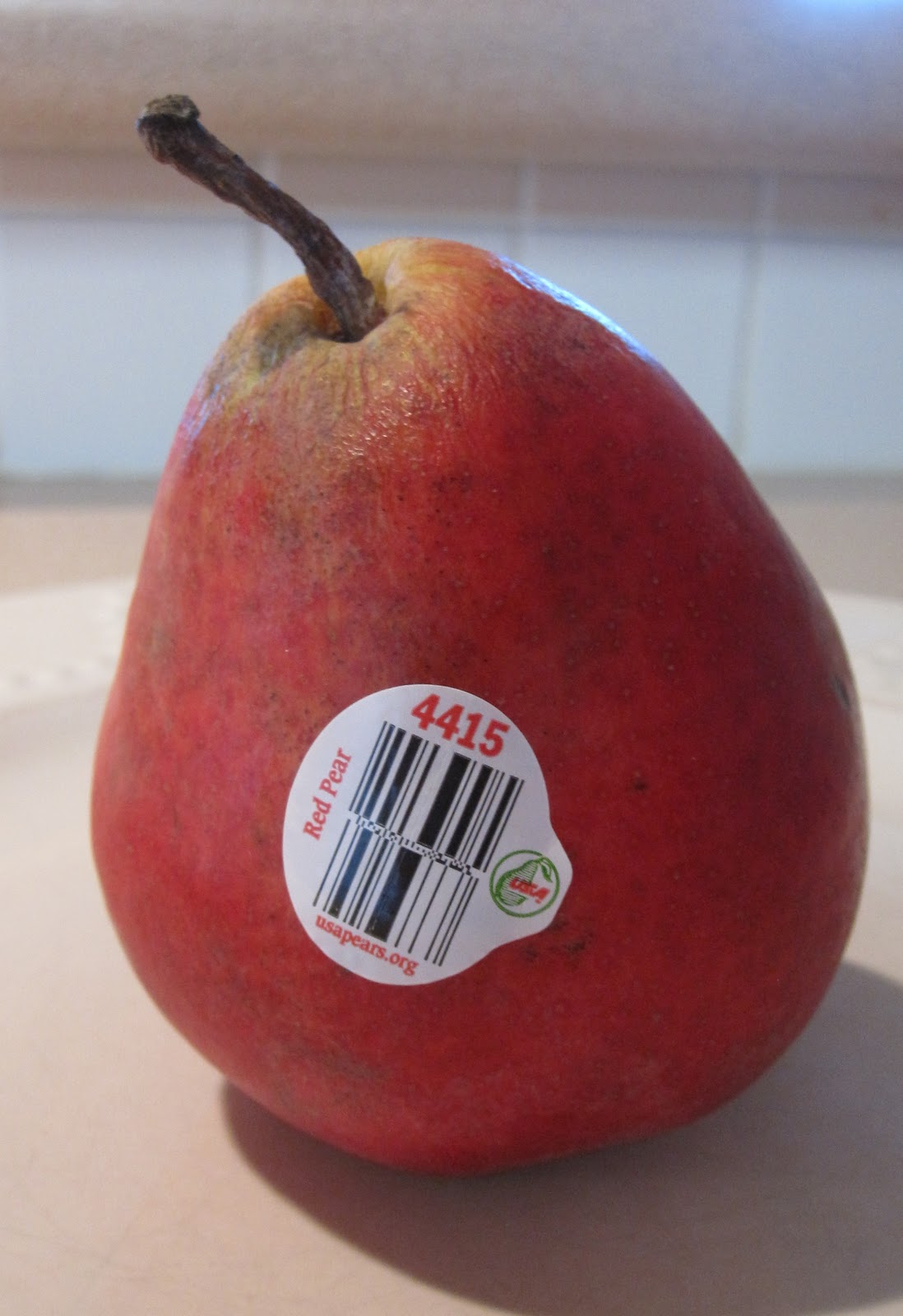
other than that it ripens to a reddish color rather than a yellow color. 
When I purchased the red pears 
and had not read up on them, I knew it was a form of Bartlett immediately upon eating it. 
It had the very sweet, deep, semi-woody taste. 
D'Anjou Pear:   The D'Anjou or green Anjou, 
also called the Beurre d'Anjou, has more of an egg shape and a skin color that is bright green,
 sometimes with a red blush. 
The skin color changes very little when ripening. 
D'Anjou pears are used for the juicy pear flavor of jelly beans for Jelly Belly's. 
In 2004 they were 34% of U.S. pear production and Oregon is the primary pear producing state. I found the D'Anjous to be the sweetest of the pears by far, and they did not have the deep woody taste that the Bartlett's have. For pure taste, the D'Anjou pear is my first choice. 
Red D'Anjou Pear:   Red D'Anjou or red Anjou pears are very similar to green Anjous 
other than the color. They have a very deep red color and really stand out. 
Like the green Anjou they are difficult to determine when ripe. 
The best indicator of ripeness is a softness near the stem when ripe.
 Because of the beautiful color and great taste, these are perhaps my very favorite of all the pears. 

Fried Plantains

While in Koreatown with Andrew and Lauren I bought some plantains. 
Judy and I recently had plantains at Dhat Island, a Caribbean restaurant in Redlands, and we'd also had some at Versailles, a Cuban restaurant in Los Angeles. I wanted get more familiar with them. 1001 Foods You Must Taste Before You Die says that plantains area a "kind of banana that can only be used for cooking." 
They have a "starch level that renders them unappealing until heat converts it into sugars." 1001 states that frying brings the sweetness out best, fried plantains being a Latin American and Caribbean side dish, usually with rice and beans. The peel is more difficult to get off then our traditional banana, 
but I was surprised when I took several tastes of the raw plantain that it wasn't too bad. 
I tried some unripe manzanos banana the day before and it was horrible - I had to spit it out. I was expecting this to be similar. It was relatively sweet and moist. What surprised me was the color of the inside of the plantains. It had some darkness in the center, but a hue of pink and yellow that was quite pretty (the picture below does not bring it out very well). 
A number of recipes I looked at called for frying the plantain in boiling oil. However, I found one that suggested that frying it in a little bit of oil worked just as well, then to add some brown sugar and water. I sliced the plantains into quarters, widthwise, then shortened the length. I fried them in olive oil and they started to turn a deep yellow and get some browning on them. 
I then poured a mixture of a half cup of brown sugar and half cup of warm water into the wok 
and fried the plantains until most of the moisture was gone. 
I thought they turned out very well. In fact, I liked them better than those we'd eaten at the restaurants - probably because of the added sugar. 

Sunday, February 13, 2011

Skate Wing

Yesterday I visited Andrew and Lauren in Koreatown and found some fun new foods to try. On my way home, I stopped briefly at Zion Market near their home and bought a cooked skate wing which was in soy sauce, sesame seed and red pepper. 
Skates look much like rays, flattened fish with wings, closely related to sharks. The wing is where most of the meat is and is the part of the fish most commonly eaten. This skate was so smothered in sauce that it was difficult to see what it even looked like. 
I dug in with my fingers and started to pull out fish bites and encountered long cartilaginous strands which I chewed on and then pulled out of my mouth. After a couple of those bites I was about ready to give up. Then I found some beautiful flesh underneath the cartilage which was lined in long strands, very soft with a pleasing texture. In the picture below, note the cartilage on the top layer and the flesh underneath.
I figured out that the cartilaginous strands must be part of the outward structure of the wing. 
The sauce was very hot and I think it would have been better with a little bit of sweet in it. I later found that skate is one of the 1001 Foods You Must Taste Before You Die. It appears that a common preparation for skate is poached with parsley, lemon and capers, which actually sounds very good. The texture and taste of the meat would lend itself very well to that preparation. 1001 gives a nice description when it states, "delicate-textured flesh of the wings lies in strands over a weblike cartilage". Below, some of the beautiful flesh, in strands, in my fingers. 
Looking on-line, I'm seeing some other preparations that look quite good. This may be a fish I need to try cooking myself at some time in the future. 

Friday, February 11, 2011

Pomegranate

Up until recently, I'd tasted pomegranate a few times, but had never been much impressed by it. 
The fruit was difficult to extract, it was very messy and stained easily and the bitterness and seeds detracted from the otherwise sweet/ tart fruit. However, Rachael was invited by POM to visit their pomegranate groves near Fresno last October. She came home with some coupons for free pomegranates, showed us how to cut them to extract the fruit, and she started making recipes with pomegranates. After learning more about them, and having eaten quite a few of them, I now love them. I regularly eat a half cup of boiled whole wheat for breakfast mixed with yogurt and I found that adding pomegranate arils to the concoction made it divine. I could eat it every day.

Pomegranates are one of the 1001 Foods You Must Taste Before You Die and they go way back. In Greek mythology, when Persephone was kidnapped by Hades and taken to the underworld as his wife, her mother, Demeter, goddess of the harvest, went into mourning and all green things ceased to grow. Zeus commanded Hades to return Persephone, but Hades tricked her into eating six pomegranate seeds while she was still his prisoner, thus condemning her to spend six months in the underworld each year and the reason for the seasons. In the Hebrew Bible, Exodus 28:33-34, speaking of Aaron's robe, "upon the hem of it thou shalt make pomegranates of blue, and of purple, and of scarlet, round about the hem thereof; and bells of gold between them round about: A golden bell and a pomegranate, a golden bell and a pomegranate, upon the hem of the robe round about." 
The Spanish word for pomegranate is "granada" and the city of Granada in Spain was named after the fruit during the time of the Moors and the city's coat of arms has a pomegranate on it. The Jews have said that pomegranates have 613 seeds, the number of commandments or mitzvot of the Torah. 
The forbidden fruit eaten by Eve in the Garden of Eden has also been referred to as a pomegranate. Pomegranates are native to Iran and the Himalayas in northern Pakistan and India and are now grown extensively in portions of the Middle East, Asia, southern Europe, California and Arizona. They were introduced to California in 1769 by Spanish settlers.

There are many different varieties of pomegranate and the outer skin can range from yellow to purple (evident from the verse in Exodus), with pink and red being the most common colors. Each pomegranate has about 600 seeds, each surrounded by a watery pulp, called the aril, which can be white to deep red or purple. 
The taste depends on the variety and its ripeness, from very sweet to sour. The sour comes from acidic tannins in the aril juice. The seeds are embedded in a white pulp.
Grenadine syrup is thickened and sweetened pomegranate juice. The name comes from the French word grenade which means pomegranate. It was traditionally used in many Iranian dishes until it was overshadowed by the new world tomato. 
I love the burst that comes from biting into the arils, both because of the physical sensation, kind of like eating caviar, and because of the strong tangy taste that results from the burst. When we visited Istanbul last summer, we found that the best tasting Turkish Delight was pomegranate flavored. 
It is a flavor and a fruit that will be showing up more and more in our dining. Much of the information for this came from Wikipedia.

In the Summer 2011 issue of BYU Magazine there was a poem by Kimberly Johnson, a professor of English, called "Pomegranates" on page 31, which I love, as follows:

Fabulous, red desire! - these
could keep me here forever. Hours
bent at the basin you spent
breaking the casings burnished
and woody, stripping off pulp,
pith, and papery veil to reveal
where they lay in tight rows
snug as eggs in a wasps' nest,
as perennial bulbs beneath ice.

Furious in the windowsill jar,
they glint the glass scarlet, like garnets,
your finger gone scarlet from touching,
juiced in the scratch and ransack.
Flagrant you fumble a few to my lip.

No fruit for romantics, this...the first
sweet thrill, honeyed bacchanal,
wet story of clustered orchards, -
inside, an underworld of stone.

Monday, February 7, 2011

Red Banana

Red bananas are supposed to have superior flavor to yellow bananas and cost substantially more. 
They are more frail and short-lived than the yellow varieties and most don't make it to the United States, they are generally found in the Caribbean and Asia where they are grown. 
The color of the banana skin can go from orange or reddish brown to maroon or purple. 
The flesh is cream to light pink 
and the flesh is supposed to have a strawberry or slight-raspberry taste. 
They are shorter and more plump than the yellow Cavendish banana. They are one of 1001 Foods You Must Taste Before You Die. I have tried them on one or two occasions in the past and have had a horrible experience with them, they have been under-ripe and the consistency of cardboard. Recently, given their inclusion in 1001, I decided to try them again. I have tasted a number of them over the course of several days as they got progressively riper. 
I find that I prefer yellow bananas, particularly yellow bananas that have just recently graduated from being green bananas. I am not fond of bananas with any darkness or over-ripeness in the flesh. The red bananas do have a stronger taste and a more dense texture.I prefer the lighter texture and and more mild flavor of the yellow banana. 
If there is a hint of strawberry or raspberry, it is very small and I didn't get the hint.  I can eat the reds, but I don't love them. Given a choice, I'll take a yellow. 

Sunday, February 6, 2011

Grilled Elephant Garlic

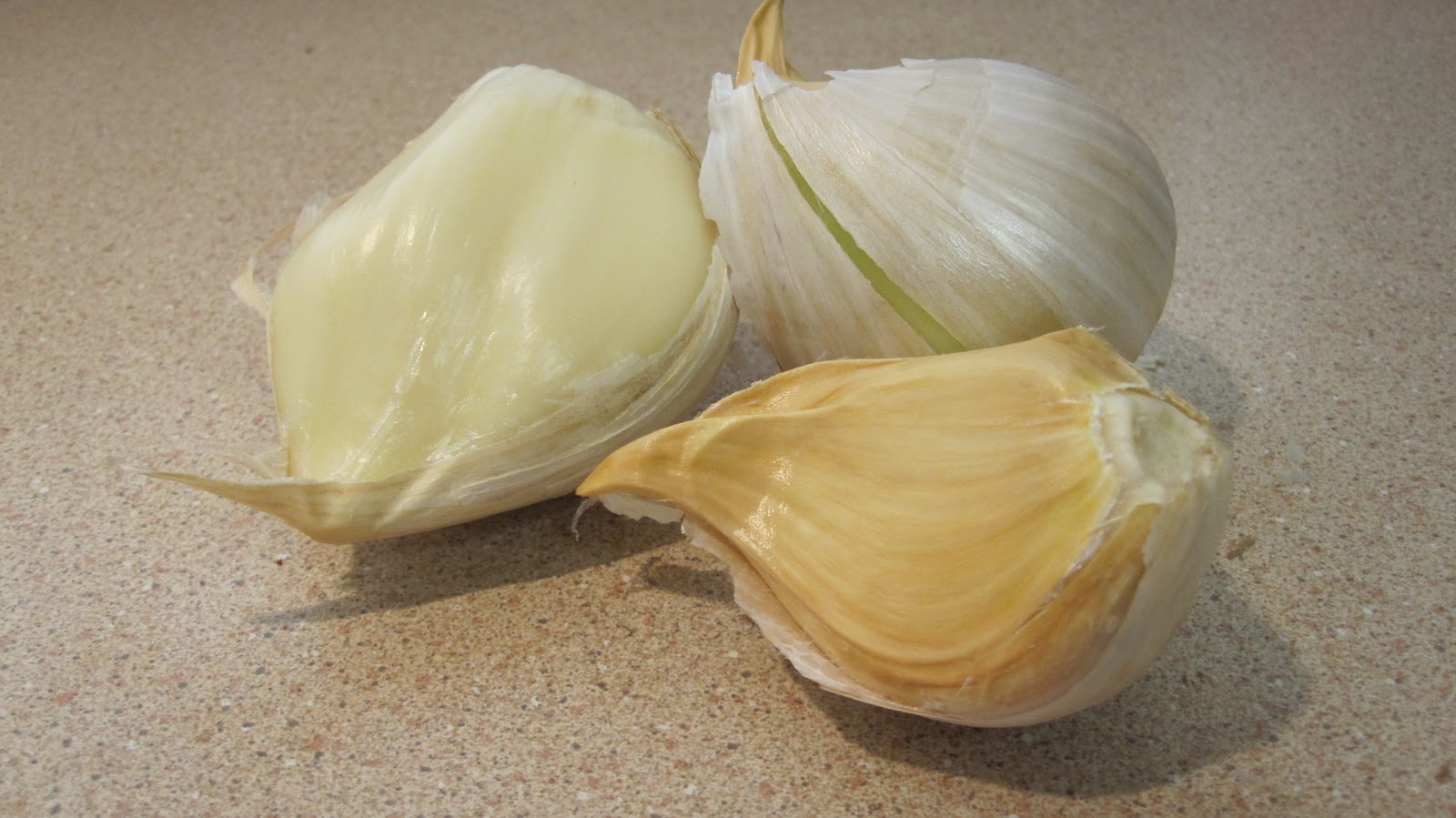
Elephant garlic is not true garlic, but more of a leek. However, it has a bulb with garlic-like papery skin, cloves and a flavor very similar to garlic, although much milder. According to 1001 Foods You Must Taste Before You Die, which lists elephant garlic as one of such items, they are best slow roasted which "reinforces their mild character." The roasted flesh can be spread on toast or used as a dip. I recently visited Sam in Utah and picked up some. 
One "clove" was generally larger than a whole head of garlic, 
and of course, easier to peel than many small cloves. 
I had three cloves and completely peeled two and left the skin on one, putting olive oil on all three. I then put them on indirect heat on my outdoor grill. The peel acted somewhat like a small furnace and the clove with it on actually cooked more quickly and thoroughly. 
The consistency of the grilled elephant garlic is very similar to regular garlic, but there is substantially more of it. 
The taste is a very mild garlic taste and very pleasant and good. I put salt on them and ate them. If we'd had some good bread, I would have toasted it and spread it on (I looked for bread and we did not have any). 
I was originally thinking that it did not have the same ill effects on me that garlic does, or at least to the same extent, that is a horrible garlic smell emanating from my pores and gas. Judy did not complain about smelling it on me, so that was a plus, but I did find myself all night and into the morning passing gas, so it is still potent in that way. I would definitely like to have it again. 

Thursday, February 3, 2011

Hass Avocado: Guacamole

I was introduced to avocados as a little boy and I have loved them ever since. My mother used to put them in salads and I still vividly recall, about 45 years ago, driving to San Diego, before the freeway existed, near Pala, buying a bag of small avocados from a roadside stand, and eating them in the car after peeling them and adding some mayonnaise and salt. For a boy who grew up in Utah, seeing acres of avocado trees off the side of the road was one of the reasons I loved Southern California. Over the years I have eaten many, many avocados, of many different varieties, and by far the best are Hass, also sometimes spelled Haas.  If I had to pick ten foods I really love, Hass avocados would probably be one of them. 
They are included in 1001 Foods You Must Taste Before You Die. We have tried to plant several Hass avocado trees in our yard, but all of them have been killed by cold weather due to their low intolerance for cold. In our area, they generally need to have a year or two of growth before they can survive a cold winter. 

The original Hass avocado tree was grown by Rudolph Hass, a mail carrier and amateur horticulturist. He purchased the avocado seed from a tree grown by A. R. Wideout of Whittier, California from a Guatemalan avocado tree seed planted in 1926. 
Hass planted the seed in a grove in La Habra Heights, California. Hass obtained the first U.S. patent for a tree in 1935 for his tree. The Hass avocado trees had more fruit, bigger fruit, a richer flavor and longer shelf life than the Fuerte avocados which were the main commercial avocado at that time. Unfortunately, growers were able to use grafts from a single tree to plant entire orchards and Hass ended up making very little money.  The original tree died and was cut down on September 11, 2002, but La Habra Heights still has an Annual La Habra Heights Avocado Festival in May. 

The Hass avocado has a dark green, bumpy skin which darkens to almost black as it ripens. I prefer to eat them before they get that dark. I like them just after they soften up, before they develop any darkness in the flesh or any stringyness. 1001 describes the taste as "a sweet and nutty flavor" and "the subtle taste of room-temperature butter with a creamy aftertaste." 

Last summer when Sam, Andrew and I went to Colorado to do some climbing, we discovered Carlos Miguel's Mexican Bar & Grill in Frisco, Colorado. There we had the best guacamole I've ever had. I've now re-created it at home several times. Take two avocados and mash them with a fork. 
Partially mashed.
Chop up a tomato, some scallions, a whole jalapeno (removing the seeds), and mix them into the mashed avocado along with a generous helping of sea salt and pepper. 
The result is amazing, chunky, guacamole. 
Then dig in and enjoy. 
Most of the information for the post came from Wikipedia and 1001.