Tuesday, May 23, 2023

Scarlet Tanager

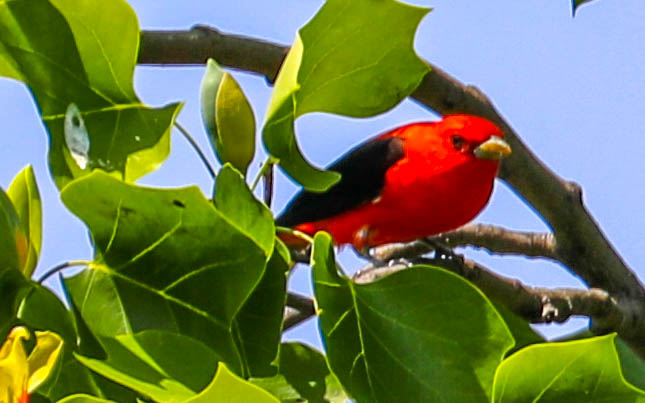
In New York's Central Park on a bird walk in May 2023 we encountered several scarlet tanagers. I was thinking "been there, done that" as I was watching them, thinking of the summer tanagers I've seen at Big Morongo in California and in Colombia. Then, afterwards, I got thinking about it and realized that our guides had pointed out the black wings which a summer tanager does not have and that this was a new bird for me. 
The scarlet tanager breeds in the eastern U.S. and Canada and winters in lower Central America and into South America in Venezuela, Colombia, Ecuador and Peru and portions of the Caribbean. 
Scarlet tanager range from Wikipedia.
Breeding males are scarlet red with black wings and tail and a horn-colored bill. Although it looks a lot like a summer tanager, it is in the same family as a cardinal. Females, which I did not see, are olive with yellowish underparts and yellow-olive wings and tail. Non-breeding males are a similar color to the female, but have darker wings and tail. 


In Colombia I also saw the crimson-backed tanager which is also red with black wings, but has a darker head. 

Monday, May 22, 2023

Lawrence's Goldfinch

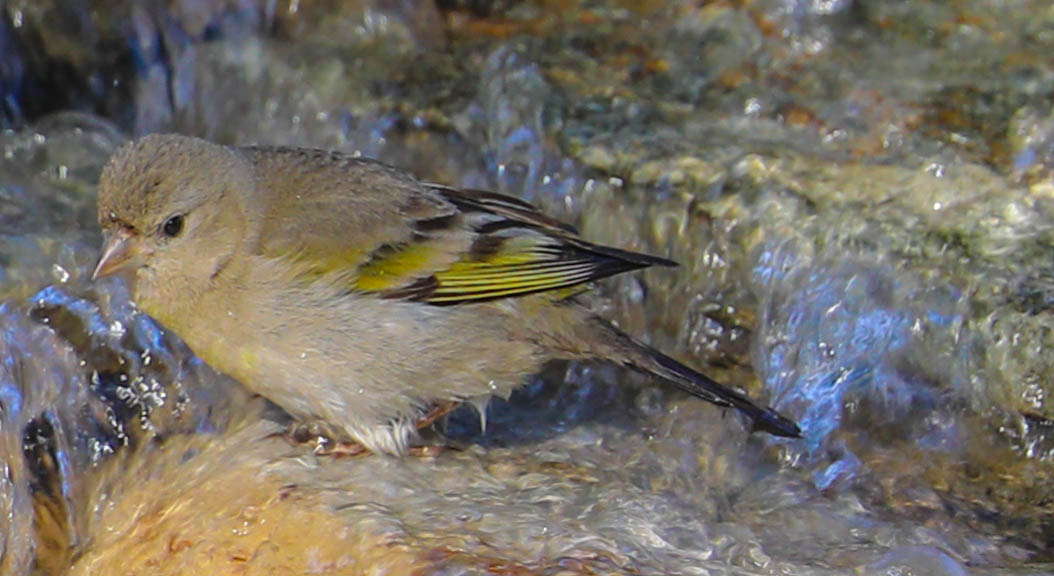
I've been wanting to see a Lawrence's goldfinch for some time and finally got my wish yesterday at Big Morongo. 


I did not realize that its range is so limited. It only breeds in California and Baja California and winters in California, Arizona, New Mexico, a sliver of Texas and a portion of Mexico (Baja California, Sonora and Chihuahua). 
Lawrence's goldfinch range from Wikipedia. 
Males are gray with a black face, yellow belly patch, and yellow wing patches. 


Females are grayish-brown with a faint yellow wash on the belly.


It was named in 1850 by John Cassin for George N. Lawrence, a businessman naturalist. 

Sunday, May 21, 2023

Black-Throated Green Warbler

In the North Woods of Central Park in New York City, taking part in Birding Bob's Friday morning bird walk, I saw a number of warblers I've not seen before, including the black-throated green warbler. 
It breeds in portions of Canada and along portions of the east coast of the U.S. and winters in portions of eastern Mexico, Central America, northern South America and portions of the Caribbean. 
Black-throated green warbler range from Wikipedia. 
The most distinctive pattern on males is a black chin, throat and upper breast with black streaking on the sides. The belly is white and the back is green. In my photos, the belly looks yellow and what I have of the back looks yellow. However, I think the throat is definitive and two identifiers on iNaturalist have confirmed its identity. 


I didn't realize I'd photographed this warbler until I worked on my photos. I keep hearing one of the birders in our large group shouting out, "black throated green, black throated green." I wash wishing I could see one. Fortunately, I did. 

Saturday, May 20, 2023

Chestnut-Sided Warbler

We were in New York City visiting our son and his girlfriend over the Mother's Day weekend and my son suggested I do a three hour bird walk in Central Park with Birding Bob. Judy came along with me, meeting in the northeast side of the park near the North Woods. Deborah Allen was substituting for Birding Bob. We paid a modest $10.00 each and joined about 30 other people. It was a particularly good day for migrating warblers. 


One of the warblers I saw was the chestnut-sided warbler, a bird I'd never heard of before. It was a male and gorgeous. It has a white face and black eyestripe that goes down the neck, like the stripe on a peregrine falcon. It has a yellow cap, white underparts with chestnut flanks and black wings streaked with white wing bars and some yellow. Females and non-breeding males look different, but I'll save that for another day when I see them. 


They breed in eastern North America and southern Canada west to the prairies. They winter in Central America and northern Colombia in South America. 
Chestnut-sided warbler range from Wikipedia.

Friday, May 19, 2023

Russet-Backed Oropendola

The second oropendola we saw was also at Montezuma Rainforest Lodge. The russet-backed oropendola was much less interesting; it lacked the goofy bill of the chestnut-headed oropendola which extended over the forehead and it had a lower and upper mandible of the same length. This subspecies, salmoni, is found in the West and Central Andes and is more brown and much less olive-green than the other subspecies. It has a bright yellow forehead, an orange-yellow bill, is mostly dark brown with black on the wings and tail and some of the tail feathers are yellow. 


It is found in northwestern South America.
Russet-backed oropendola range from Wikipedia.

Thursday, May 18, 2023

Chestnut-Headed Oropendola

The chestnut-headed oropendola was one of my favorite surprise birds. I'd never heard of an oropendola and it is relatively large with a goofy, cartoonish, Bigbird type bill. We encountered several at Montezuma Rainforest Lodge. 


The male has a slight crest, a chestnut head, neck, partial breast and hindquarters, bluish-black wings, back, belly and most tail feathers (several are yellow), light-blue iris, an ivory colored bill that extends up over the forehead and a lower mandible that only goes two-thirds of the length of the upper mandible. Females are similar, but smaller and duller. 


Its range extends from lower Mexico down to Colombia and northeastern Ecuador. 
Chestnut-headed oropendola range from Wikipedia.
It eats large insects, fruits and berries. 

Wednesday, May 17, 2023

Red-Headed Barbet

The male red-headed barbet is a beautiful bird with a red head and neck, an orange to yellow breast, a white belly, an olive-green back separated from the head by a white collar and a horn colored bill. It has a black area around the eye and a red iris. The female looks quite a bit different: her crown and nape are dull orange to green, some subspecies have a black forehead, a gray-yellow throat, a yellow to orange band below it and a white belly. 
This subspecies male has an orange-yellow breast and the belly and flanks are yellow with green streaks looking similar to my Oregon duck pajamas. 


There are six subspecies and I believe we saw occidentalis which is found on both slopes of the Western Andes. 
Red-headed barbet range from Wikipedia. 
We saw one at Montezuma Rainforest Lodge at one of the feeders at the lodge.