Monday, April 25, 2022

Rose-Faced Parrot

My last post focused on the black-chinned mountain tanager and mentioned that there was only one paragraph on it in Wikipedia and one paragraph on eBird. Ditto for the rose-faced parrot, another Choco-endemic bird found only in the Andean cloud forests of Ecuador and Colombia. Of the four best photos on eBird, two were taken at Amagusa Preserve in Mashpi where I was. 


It is: mostly green with a golden-brown crown, neck and chest; a light-blue iris, a dark blue pupil with a dark circle around the eye; a flesh-colored bill; a reddish-pink cheek with a black border; a dark brown cap; flesh colored feet; and tinges of dark blue in the tail and wing feathers. 


Sergio Basantes, who runs the Preserve, put out several large bunches of bananas in a tree near a clearing which brought the parrots in in droves. They squawked and made lots of noise.  

Sunday, April 24, 2022

Black-Chinned Mountain Tanager

The black-chinned mountain tanager is Choco-endemic, that is, limited to the Andean cloud forest found in a small sliver of Colombia and Ecuador. As I look it up I find several telling pieces of information. First, the entry in Wikipedia is a paragraph (less than 30 words, fewer words than I have written here thus-far). Second, the entry in eBird is a longer paragraph, but still a paragraph, with geographic information and photos. The four top photos were all taken in Mashpi, Ecuador, three of them where I also took my photographs, at Amagusa Reserve. This lack of information is not because it is not spectacular - it is - it just has very limited geographic presence. 


It has a black head, neck, chin (which gives it its name), eye, beak, legs and feet. It has a golden-yellow crown-stripe, an orange-yellow breast and underparts, a greenish-yellow back, blue wings and tail of varying shades.


I find an article about it in The Guardian of October 10, 2011 which refers to it as the "Ecuadorian mystery bird" and points out that 60% of all tanagers are found in South America and 30% are found only in the Andes. 

Saturday, April 23, 2022

White-Whiskered Hermit

The white-whiskered hermit has a great name and a great look. It also doesn't stand around much. I looked for opportunities to photograph it while standing and I never saw it not-flying, although I admittedly did not see a lot of them. I only saw it at the Amagusa Preserve in Mashpi. It appears to be Choco-endemic + a bit. It has a bronzy crown, iridescent bluish green upperparts and green to dark gray underparts. It has a black mask, a buffy supercilium (or eyebrow) and a white gular stripe. The males bill is almost straight. The female has a shorter bill that is more curved, shorter wings, a longer tail and more grayish underparts. 


It is of "least concern" by the IUCN even though it has a decreasing population. I would like to have obtained better photos than I did. 

Friday, April 22, 2022

Velvet-Purple Coronet

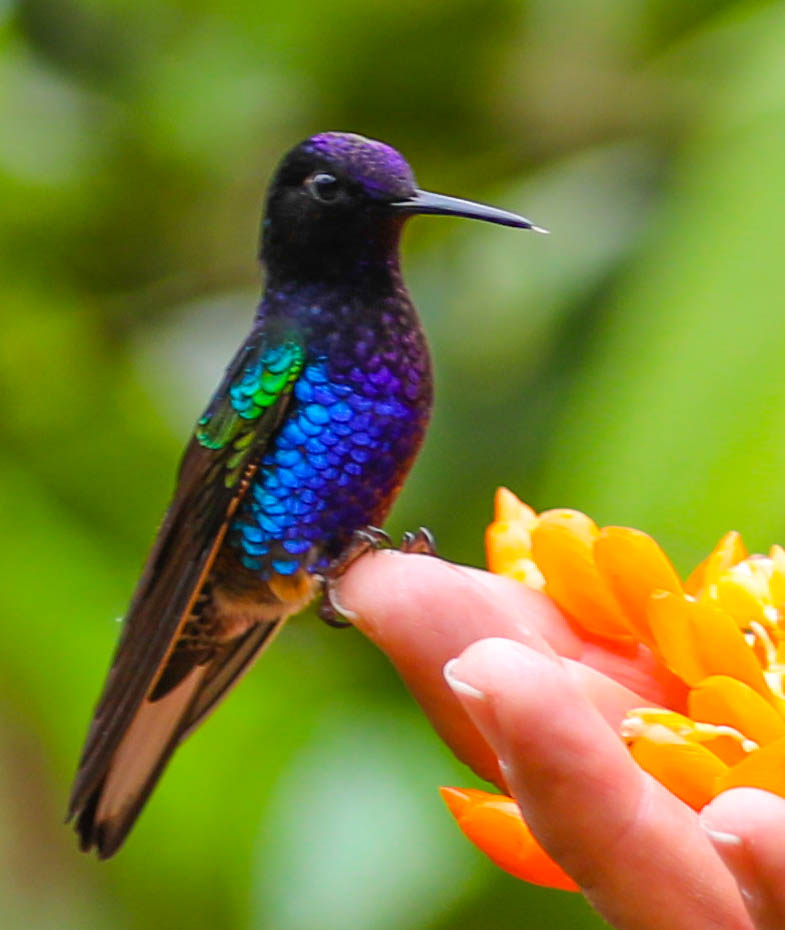
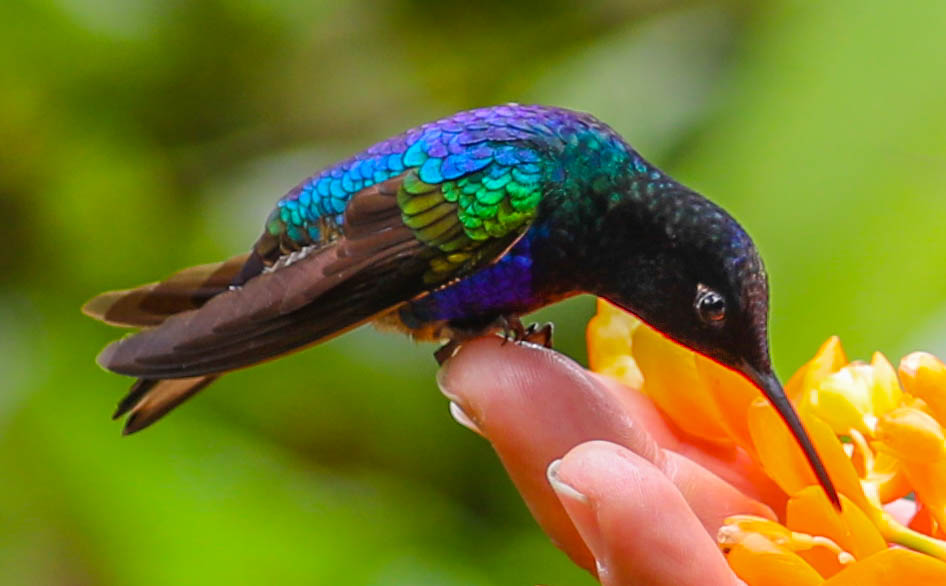
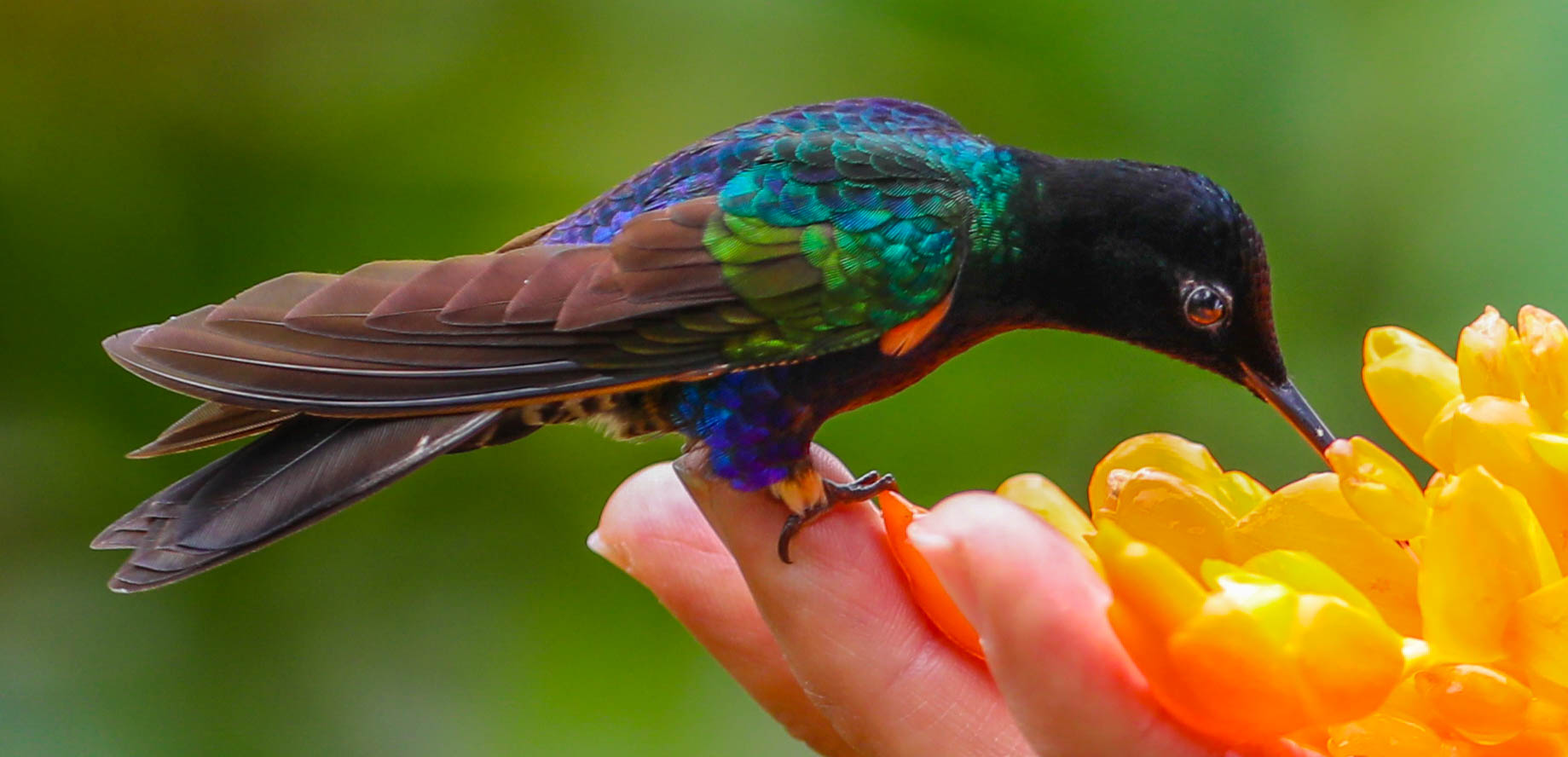
One of the wonderful finds in Ecuador at both Amagusa Preserve in Mashpi and the Milpe Bird Sanctuary outside Mindo, was the velvet-purple coronet, a "Choco-endemic" hummingbird limited to the cloud forests of Ecuador and Colombia. Even within that limited area, eBird notes it is "generally uncommon."  


In poor light it looks all black. But in good light it is a "dazzling gem with a purple belly and crown, turquoise sides, and greenish wing coverts...and bright white flashes in the tail." When it lands it "holds its wings up for a few seconds...exposing rich chestnut underwings." 


My friend Terry, who accompanied me, loves hummingbirds. Learning that, Sergio Basantes, the proprietor of the Preserve, picked an orange orchid, dipped it into sugar water, and put it into Terry's hand. Terry had multiple hummingbirds come to his hand and rest on it, including a number of velvet-purple coronets. 


Thursday, April 21, 2022

Green-Fronted Lancebill

After visiting the Amagusa Preserve in Mashpi, my bird guide, Julia, suggested we walk down the dirt road to look for birds until we reached what turned out to be the apparently very fancy Mashpi Lodge, with a huge barrier across the road and a large locked gate. Our driver picked us up and we started back up the road, when Julia suddenly told the driver to stop and Julia jumped out of the vehicle. There was a small waterfall coming down the side of the mountain and Julia told me there was a hummingbird standing on a branch in front of it. I couldn't see it and edged closer and closer to the waterfall until I finally saw it. How she saw it I'll never know. 

The green-fronted lancebill has a glittering green patch of feathers on its forehead, which my photo does not show well, and a very long straight bill which is the "lance." Overall it has a "drab gray-green breast and belly" and a "coppery patch extends from the nape and down along the sides of the neck." The back and tail are a rich green that alternates in the light between green, teal and turquoise. It also has a very tiny white patch just to the back of the eye. Its distribution covers the cloud forest region of Ecuador and Colombia and goes as far south as Bolivia and as far north as Costa Rica. Research and conservation for this hummingbird are minimal, but it is rated of "least concern" by the IUCN. 

Wednesday, April 20, 2022

Golden Tanager

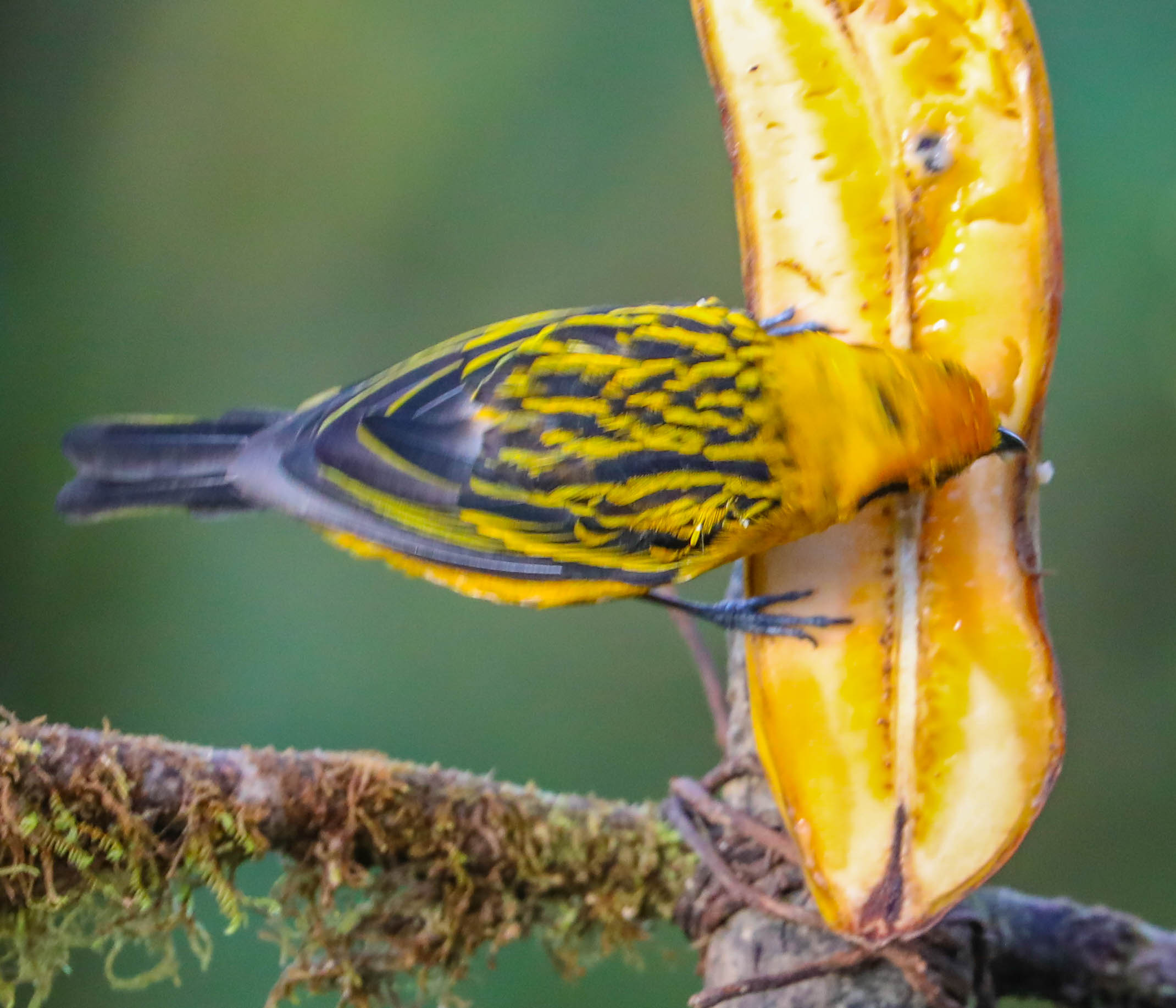
The golden tanager is found in the Andean foothills and subtropical zone from Bolivia up through Venezuela. It is golden-yellow with a black ear patch, black and yellow streaked back, mostly black wings and tail, black bill and gray legs. Northernmost birds have a chestnut breast-band and flanks. There are nine subspecies, based on differences in plumage, which the IUCN treats as separate species. 


The birds we saw, found on the western slopes of the Andes in Ecuador (at Amagusa Preserve in Mashpi and in Mindo), sometimes had some light orange on the forehead, crown and even belly.