Friday, July 10, 2020

Wild Horses - Onaqui Mountains, Utah

The Onaqui Mountains are in southeastern Tooele County, Utah, in between Dugway on the west side and Vernon on the east side. There is an HMA (Herd Management Area) that includes the foothills between Rush Valley and Vernon, going 30 miles southwestward to the Simpson Mountains. The Onaqui Mountain herd is about 450 horses. I had some friends that posted pictures on Facebook of these horses and then looked up information about the herd here
This is my favorite photo, near Simpson Springs. The vast unoccupied background with two beautiful horses in the foreground. This first string of photos were my favorites with nice backdrops. 
An array of beautiful horses near Simpson Springs. The black and white horse, to the left, was particularly striking. 
Another nice mountain backdrop with a colorful, though bedraggled, horse in the foreground. 


I took two of my granddaughters, Squirrel and Bug (their internet names) on this adventure. We drove through Tooele, Stockton and Rush Valley on Hwy 36, going south, then took the Fish Springs Wildlife Refuge and Pony Express Route to the west (right), about one-half mile beyond mile marker 27. We then drove the gravel road 25 miles to Simpson Springs. Sightings were said to increase through the final half of the trip. 
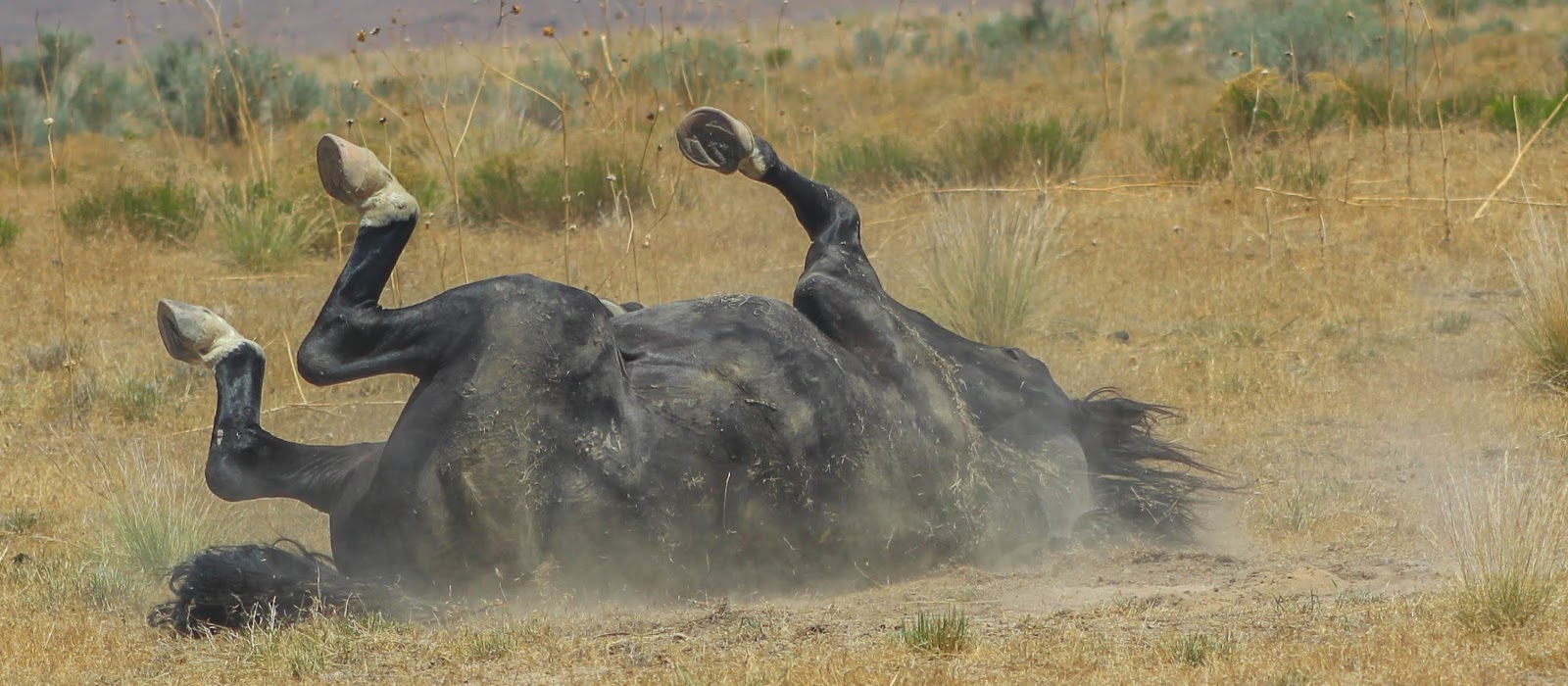
This next grouping of photos are of this horse rolling around on the ground. 


We saw a group of about 10 or 15 horses about 100 yards off the road about five miles from Simpson Springs. At Simpson Springs we saw horses everywhere, I'm guessing there were probably about 75 spread out. It was over 100 degrees and I'm sure the heat drove them to the springs. 
Here are my granddaughters at Simpson Springs. 
I was impressed with how healthy the horses looked and the beautiful colors. I'm going to let the photos do most of the talking. 
Something about this photo I like. 

A beautiful stallion. 

This may be the same horse above with a beautiful mountain in the background. It is also featured in several other photos below. The horse was part of a group of three that I thought of as the trinity, or the first presidency. They just kind of seemed to be in charge. 


This horse stood in front of the car and raised its head and whinnied in an apparent challenge to us. He did it quite a while and prevented us from moving along the road. 


Thursday, July 9, 2020

Western Spotted Orb Weaver

I'm not usually into insects and spiders, but I was with two of my granddaughters last Monday, known on-line as Squirrel and Bug, and we visited Antelope Island in the Great Salt Lake. As we crossed the causeway to the island I stopped to look at some Franklin's gulls and the girls' eyes focused on large spiders suspended between sagebrush bushes on large webs. While I took photos of the gulls, the girls went gaga over the spiders, looking at them and photographing them. The spiders were everywhere. 
As I confessed to Squirrel later, I'm not a fan of spiders. I really dislike them. She was surprised. She is fascinated by them. I looked at those horrible-looking large spiders, sometimes three or four to a web, stretched between most of the sagebrush bushes and it chilled any desire I had to walk through the sagebrush. 

She pulled out her phone and connected to inaturalist and identified the spiders as western spotted orb weavers. 

The western spotted orb weaver spins a circular web in open areas with sparse vegetation. The spider sits in the center of the web upside down, waiting for insects. The legs of the spider may be red or yellow and they have black bands near the feet. The abdomen is brown with yellow speckles on the side. It has a light central band with a wavy border. 
Females are about twice the size of males and both contain brown, yellow, white, purple and red coloration, but females are brighter and have stronger contrasts. They are venomous and the bite can sting, but it won't hurt humans. 

Wednesday, July 8, 2020

Franklin's Gull

The Franklin's gull is a fairly small gull, with a relatively slim short bill, long wings and a short tail. Breeding adults have a black head, white crescents above and below each eye, dark gray upper parts and a reddish bill and legs. Non-breeding adults have a gray half-hood or mask and the bill and legs are dark. In both breeding and non-breeding adults, a white crescent separates the gray upper wing from the black wingtip. 


The breeding laughing gull is distinguished by a longer bill that may droop at the tip (the Franklin's gulls bill is straight), and when folded, the wings are almost fully black (without the large white spots of Franklin's). 


It breeds in central Canada and the adjacent northern U.S. states. It migrates to Argentina, Chile, Peru and the Caribbean where it winters. It is named after the arctic explorer John Franklin who took the first specimen in an 1823 expedition. 
I took these photos at Antelope Island in the Great Salt Lake on July 6, 2020. They were lined up along the aqueduct near where it connects to the island. 

Wednesday, July 1, 2020

California Barrel Cactus

There have only been a few barrel cacti in my study area off Hayfield Road. I only got a few photos of flowers in bloom and only saw a few fruits that resulted from flowers. I was able to extract one fruit from a cactus using tongs and was surprised to find it had no spines on it. Little hard black bb-like seeds fell out the bottom. When I got it home and cut it open, it was empty in the center. 

The flowers are on top and are yellow. Buds are to the left and are yellow and red. A partially opened flower is bottom left. 
The flowers are really quite beautiful. 
The fruit grows when the flower dies. On the barrel cactus, the dead flower adorns the top of the fruit. The fruit have no spines because they are so well protected by the spines of the cactus. 
The bb-like seeds fell out of the hole in the bottom of the fruit. Unfortunately, the fruit is not edible like the hedgehog or some of the cholla fruits. 

Tuesday, June 30, 2020

Branched Pencil Cholla

The branched pencil cholla, also known as the diamond cholla (Cylindropuntia ramossisima), has many narrow branches made up of cylindrical segments that are green, but then dry to gray. 


The surface is made of diamond shaped patterns. The diamond shaped patterns either have no spines or one long straight spine. 
The flowers are small (about a 1/2 inch in diameter) and are variously described as orange, pink, salmon or brown.   


Finding the flowers is a challenge. The best time to find the flowers is in the late afternoon of the hotter months (May to July) when most people have stopped visiting the desert. That is why very few people ever see them flowering and one source says "many botanists confess they have never seen one." If you do see one, "consider yourself lucky." 

I have had a goal all spring/summer to see the flowers. Each week I look at the pencil cholla and try to decipher when they are going to bloom. I'd been noticing that the ends of many of the branches were growing bulbous and getting lots of tiny spines on the end. 
A photo on June 13th.
Photo on June 20th. The bulbous ends are getting larger. 


Then this last weekend, June 27th, the bulbous ends look like they are starting to dry out. 
I figured that is where the flowers would emerge. Then I started noticing remnants of what I assumed were dried flowers. I then read in a source that the best time to see them was later afternoon (I was always looking for them in the morning). So this past Monday I took a later afternoon visit to the area, having already visited Saturday morning. I was very disappointed to look at a number of the pencil cholla plants and find no flowers. Eventually I surveyed about 50 separate cacti and find exactly two with flowers, one with three flowers and one with one flower. I was excited to see those flowers, but now as I'm thinking about it and reviewing my photos, I'm realizing I've been wrong all along. My photos start showing dead flowers on May 23rd. 
Photo from May 23rd. In hindsight, these are clearly drying flowers. 
In hindsight, that is the beginning of the bloom. I believe the ends expanding are the fruit of the dead flower growing, just like the fruit of the hedgehog cactus that gets lots of spines on it. My later photos are showing the fruit drying up. So the flowers I saw on June 29th are probably some of the last of the season. I needed to do a late afternoon visit in late May or early June.