I've been a customer of
Exotic Meat Market for many years and I've tried a lot of the products that they sell. I've gotten to know the owner, Anshu Pathak, and his wife, C.c. Claudia, and they have become friends. My grandgirls were visiting in August and I asked Anshu if I could bring them to his farm, a place I had not visited. Anshu graciously said, "yes," and he and Claudia met us there one early evening, in Perris, California, near Lake Perris, about a 30 minute drive from our home. It was following a recent thunderstorm and things were pretty muddy, so Anshu invited us back a few days later, to spend some more time when conditions were better at the farm.
While Anshu and two of his workers provided grass and corn to the animals and water for the geese to preen in, Claudia took the grandgirls under her wing and encouraged them as they stalked various birds to try and catch and hold them. With the patience of Job she taught them how to hold the birds safely and encouraged their crazy ideas, like their desires to ride an emu.
Following are an abundance of pictures that chronicle just a small portion of what we did at the farm. The girls had a great time, as did their mother (my daughter), and I.
Perhaps the girls' favorite animal at the farm, and probably mine too, is the emu. I don't know the exact number, but Anshu must have about 60 of them, held in several different enclosures with other animals as well. The emus are about the height of the girls and bold enough to come in for an occasional peck at a hand, or some hair, the back of a shirt, or for my youngest grandgirl, a piece of her foot. Their course gray and brown feathers look like feather-dusters and their blue necks and faces look like old ladies that have done a horrible job of applying their blue eye shadow. Claudia even assisted my grandgirls' desire to ride an emu, hoisting each one of them on to the back of an emu and holding them up as the emu immediately lurched forward, trying to leave the grandgirl behind and the grandgirl shaking with laughter.
 |
| The odd and amazing looking emu. |
 |
| Emus lined up at a trough eating corn, along with an alpaca. |
Anshu raises
ayam cemani chickens, an Indonesian breed of chicken that is totally black, including the meat and bones inside. They also raise
blue foot chickens which they get a considerable amount of eggs from.
 |
| Here my grandgirls victoriously hold two chickens in the air. Bug (an online nickname), on the left, holds a blue foot in the air, and Squirrel (an online nickname), holds an ayam cemani in the air. |
 |
| Squirrel with an ayam cemani. |
 |
| And with a blue foot. She was in heaven. |
Anshu just started raising Emden geese this year, a large goose raised for its meat. They hung around each other squawking loudly. Anshu brought out clumps of long grassy sod for them and filled large tubs with water and watered the ground around the tubs. The geese luxuriated in the water and snipped at the grass.
 |
| Squirrel and Bug both captured Emden geese. Most of these photos, particularly the ones in the dark, are from Claudia, who was patiently watching the girls and encouraging their escapades. |
Anshu has a good number of
chukar partridges, a Eurasian gamebird that has been introduced to the U.S. These were the first birds the girls set out to capture. They were a little less intimidating, given their small size.
Anshu also raises lots of turkeys, particularly "heritage turkeys" or
Eastern wild turkeys, the kind of turkey the pilgrims ate. They were a challenge to capture. The girls started with small ones, then Squirrel finally captured a large one and held it proudly.
 |
| Bug and a small turkey. |
 |
| Squirrel with a big one. I think it was about as much as she could handle. |
Another of my favorite birds is the
Guineafowl, a bird we saw wild in Africa and which is also fantastic eating. Squirrel finally caught and held one of these elusive birds, but we have no photos of it.
 |
| The Guineafowl's head is weirdly fantastic. |
 |
| I'd never noticed before how their protruding cheek flaps make them look like they have huge jowls. |
We did not spend a lot of time with the llamas and they were quite skittish and difficult to get close to.
 |
| Here a combination of llamas, Dorper lambs and Boer goats feed on hay. |
The Dorper sheep, white with a black head and neck, was bred in South Africa as a meat animal. There was a young Dorper lamb that the girls fell in love with and spent considerable time trying to catch and hold. One fun moment was when Claudia almost had it and then slipped and fell on her back, causing all of us, including Claudia, to laugh. Finally, Joe, one of Anshu's workers, caught it and the girls each got to hold it. They also took turns riding on one of the larger sheep.
 |
| Bug struggles to hold this lamb aloft. |
Anshu has the most beautiful goats I've ever seen,
Boer goats, also bred in South Africa for their meat. Unfortunately, I did not get any good pictures of them. He has some absolutely huge, beautiful rams.
There are a few
muscovy ducks at the farm that the girls were able to feed corn to. They were such easy pickin's that I don't think they tried holding any of them.

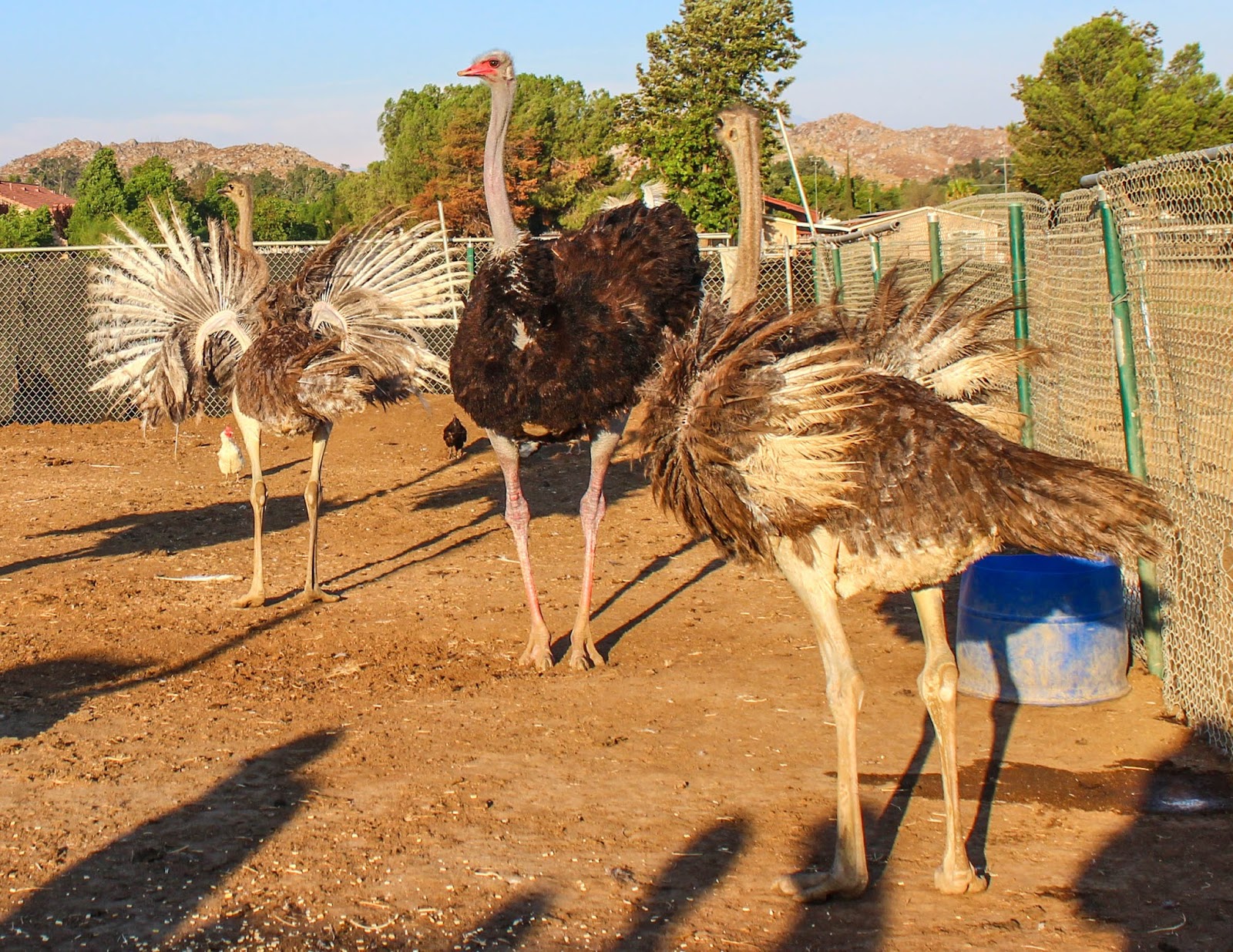
The real stars of the farm are the ostriches. I can think of at least six ostriches, but there may be more. In particular, there are four segregated in their own pen, one huge male and three females. The male is quite an intimidating force and he can be quite dangerous when he's feeling territorial. We walked in to their pen with Anshu, Claudia and Joe running interference and feeding them hay and grass turf. The girls got to touch the females. At one point Squirrel wandered further into the pen than she should have and the male puffed up and started to charge her. Claudia threw herself in front of the male to stop him, in a show of bravery that impressed all of us. The most fun thing about the male ostrich was when the girls neared the pen and he went into a mating dance, stooping almost to the ground, waving his feathers and showing off for them. There were more than a few laughs over this.
 |
| The male flapping his wings. |
 |
| The females flapping their wings, something they did not do nearly as often as the male. |
 |
| Anshu encourages Bug to pet the female ostriches. They were mighty intimidating. |
 |
| She gained confidence and reached out for their necks. |
 |
| Claudia gave the girls an ostrich egg and they stand in front of the large male. |
 |
| Bug loves the male who is doing his mating dance. |
Anshu has three or four large water buffalo. They are too large and dangerous to go in and interact with. He also has quite a few Canada goose. Squirrel finally managed to catch one, in fact, she caught it after Joe tried and failed. It was quite dark by that time and my pictures of her holding it must not have turned out because I can't find them.
Claudia sent the girls home with a box full of eggs: ostrich, emu, ayam cemani, and other types I'm not sure of, probably turkey and goose. Also a large gallon jar full of quail eggs, which the girls love, and some blue foot chicken eggs which we had for breakfast with Chinese pancakes.
The girls had a blast. Anshu and Claudia know how to put on a good show.