Saturday, June 11, 2016

Comparison of Joseph Smith and Muhammad

As I have been reading about Islam recently I have been struck many times by the impression that many of the experiences of the Islamic prophet Muhammad were mirrored by the Mormon prophet Joseph Smith. As I read I sometimes put "JS" or "Joseph Smith" in the margin when similarities between their experiences jumped out at me. Here are some similarities I noted:

Scripture as Evidence of Prophetic Calling

"Muslims regard the Quran as the most important miracle of Muhammad, a proof of his prophethood..." (Wikipedia, Quran)

"The most singular evidence in support of Joseph Smith's claim to being a spokesman for Almighty God was the publication of a scriptural record, the Book of Mormon." (Ezra Taft Benson, October 1981 Ensign, "Joseph Smith: Prophet to Our Generation")

Each was Uneducated

The Koran says that Muhammad was illiterate: "Those who follow the Messenger, the Prophet [Muhammad] who can neither read nor write..." (7:157) "Muhammad's illiteracy was taken as a sign of the genuineness of his prophethood." (Wikipedia, Quran)

"Joseph Smith had an elementary school education and wasn't known for having great writing skills. Did he write [the Book of Mormon] on his own? Could you, even with the help of your college education and the Internet write such a book?" (Mormon DNA)

Sites of First Revelations are Holy Sites

"Often overlooked because of its proximity to the great shrines of Mecca, the Cave of Hira is nevertheless one of the great if underappreciated holy sites of Saudi Arabia. It was in this tiny cave...that [the Prophet] received his earliest divine revelations that would ultimately lead to the founding of the Islamic faith. Although a stop at the Cave of Hira is not a mandatory part of the traditional pilgrimage to Mecca...[it is] nevertheless a very popular detour for visitors to the Holy City." (The Complete Pilgrim)

"Every year thousands of Mormons make a pilgrimage to Palmyra, to...visit the historic places where their religion originated. The most holy of those sites is the Sacred Grove, a wooded patch adjacent to the Smith family farm where Smith had what is known as the First Vision." (Business Insider)

Challenge to Write a Revelation

God, through Muhammad, challenged the Arabs to produce a work of similar caliber as the Koran. The challenge came in three stages. First he challenged them to create a whole book: "Say: 'If all mankind and the jinn would come together to produce the like of this Koran, they could not produce its like even though they exerted all and their strength in aiding one another.'" (17:88) Then he challenged them to write ten chapters: "Or do they say that he has invented it? Say [to them], 'Bring ten invented chapters like it, and call [for help] on whomever you can besides God, if you are truthful." (11:13) Then he challenged them to write a single chapter: "And if you all are in doubt about what I have revealed to My servant, bring a single chapter like it, and call your witnesses besides God if you are truthful." (2:23)

William E. McLellin was not impressed with the revelations in the Doctrine and Covenants. He attempted to write one and the attempt "was a miserable failure." It also resulted in a revelation [D&C 67:5-8] "Your eyes have been upon my servant Joseph Smith, Jun., and his language you have known, and his imperfections you have known; and you have sought in your hearts knowledge that you might express beyond his language; this you also know. Now, seek ye out of the Book of Commandments, even the least [revelation] that is among them, and appoint him that is the most wise among you; Or, if there be any among you that shall make one like unto it, then ye are justified in saying that ye do not know that they are true; But if ye cannot make one like unto it, ye are under condemnation if  ye do not bear record that they are true."

Book of Scripture is Unmatched

"In Islam, i'jaz or inimitability of the Quran is the doctrine which holds that the Quran has a miraculous quality, both in content and in form, that no human speech can match." (Wikipedia, I'jaz)

"I [Joseph Smith] told the brethren that the Book of Mormon was the most correct of any book on earth, and the keystone of our religion, and a man would get nearer to God by abiding by its precepts, than by any other book." (History of the Church, 4:461)

Angel Gabriel

Muhammad's first and subsequent revelations came from the archangel Gabriel. (Wikipedia, Muhammad's first revelation)

Joseph Smith heard the voice of the angel Gabriel. (D&C 128:21)

Initial Instruction for Sacred Book Repeated Multiple Times by an Angel

The angel Gabriel visited Muhammad and asked him to "Recite" three times before Muhammad finally did recite what Gabriel asked him to. Then Gabriel voiced, "O Muhammad thou art the Messenger of God, and I am Gabriel" twice while Muhammad was leaving the Cave of Hira. (Martin Lings, Muhammad: His Life Based on the Earliest Sources, pages 44-45)

The angel Moroni visited Joseph Smith and told him there was a book written upon gold plates giving an account of the inhabitants of the Americas and means prepared for him to translate them. This same message was repeated to Joseph two more times that night and a third time the next morning (Joseph Smith History, 1:30-49)

Each is named in their Sacred Book

"But those who believe and do righteous good deeds, and believe in that which is sent down to Muhammad [the Koran], for it is the truth from their Lord, He will expiate from them their sins, and will make good their state." (47:2)

"...I the Lord,...called upon my servant Joseph Smith, Jun., and spake unto him from heaven, and gave him commandments;...And after having received the record of the Nephites, yea, even my servant Joseph Smith, Jun., might have power to translate through the mercy of God, by the power of God, the Book of Mormon." (D&C 1:17, 29) "For Joseph [in Egypt] truly testified, saying: A seer shall the Lord my God raise up, who shall be a choice seer unto the fruit of my loins...Wherefore, the fruit of thy loins shall write and the fruit of the loins of Judah shall write; and that which shall be written by the fruit of thy loins, and also that which shall be written by the fruit of the loins of Judah, shall grow together, unto the confounding of false doctrines and laying down of contentions , and establishing peace among the fruit of thy loins, and bringing them to the knowledge of their fathers in the latter days, and also to the knowledge of my covenants, saith the Lord....And his name shall be called after me [Joseph]; and it shall be after the name of his father [Joseph]. And he shall be like unto me; for the thing, which the Lord shall bring forth by his hand by the power of the Lord shall bring my people unto salvation" (2 Nephi 3:6, 12 and 15)

Words are Collected

Muhammad's words, actions and habits are collected in the hadith, and along with the Koran, helped develop Islamic jurisprudence, practice and theology. (Wikipedia, Hadith)
The Joseph Smith Papers or Project is a project with the goal of collecting and publishing all of the manuscripts and documents created by or under the direction of Joseph Smith. (Wikipedia, The Joseph Smith Papers) Joseph Smith's words and actions, along with the Book of Mormon, Doctrine and Covenants and Pearl of Great Price, are the foundation for Mormon theology and practice.

Description of Angels

"Gabriel came to the prophet. He was splendidly dressed, his turban rich with gold and silver brocade, and a cloth of brocaded velvet was thrown over the saddle of the mule he was riding." (Muhammad: His Life Based on the Earliest Sources, by Martin Lings, page 237, hereafter Muhammad) Muhammad "heard a voice above him saying: 'O Muhammad, thou art the Messenger of God, and I am Gabriel.' He raised his eyes heavenwards and there was his visitant, still recognizable but now clearly an Angel, filling the whole horizon,.." (Muhammad, page 45) "[T]here came unto us a man whose clothes were of exceeding whiteness and whose hair was of exceeding blackness, nor were there any signs of travel upon him, although none of us knew him. He sat down knee unto knee opposite the Prophet, upon whose thighs he placed the palms of his hands...Then the stranger went away, and I stayed a while after he had gone; and the Prophet said to me: 'O Umar, knowest thou the questioner, who he was?' I said: 'God and His Messenger know best.' He said: 'It was Gabriel. He came unto you to teach you your religion.'" (Muhammad, pages 346-347)

"[A] personage appeared at my bedside, standing in the air, for his feet did not touch the floor. He had on  a loose robe of most exquisite whiteness. It was a whiteness beyond anything earthly I had ever seen;...His hands were naked, and his arms also, a little above the wrist; so, also, were his feet naked, as were his legs, a little above the ankles. His head and neck were also bare. I could discover that he had no other clothing on but this robe, as it was open, so that I could see into his bosom. Not only was his robe exceedingly white, but his whole person was glorious beyond description, and his countenance truly like lightning....He called me by name, and said unto me that he was a messenger sent from the presence of God to me, and that his name was Moroni." (Joseph Smith History, 1:30-33)

The Greatest of Prophets

"...[W]e shall be the leaders on the Day of Resurrection...Abraham is the intimate friend of God, Moses is the purified of God, and I [Muhammad] am the beloved of God. With me is the banner of praise on the Day of Resurrection." (The Book of Hadith: Sayings of the Prophet Muhammad, from the Mishkat al-Masabih, by Charles Le Gai Eaton, pages 137-138) "Muhammad is given a higher position [among the Prophets] since he was the last of all the Prophets and [the[ Quran as the final word of God was revealed unto him which completed and compiled all the commandments and guidelines set for humankind by Allah. Also Muhammad's way of life has been made by Allah as an example for all human beings to follow upon."  (Quora.com: Who are the 5 highest prophets according to Islam?)

"Joseph Smith, the Prophet and Seer of the Lord, has done more, save Jesus only, for the salvation of men in this world, than any other man that ever lived in it." (D&C 135:3)  "...Joseph Smith was...one of the greatest prophets that has ever lived on the earth. He was the instrument in God's hand in ushering in the present gospel dispensation, the greatest of all, and the last of all in preparation for the second coming of the Master."  (Ezra Taft Benson, October 1981 General Conference)

A Prophet is Not Always a Prophet

Muhammad "passed by while people were fertilizing palm trees and asked them what they were doing. When they told him, he said, 'Maybe it would be better if you did not do this.' So they stopped and as a result the fruits were reduced. When they mentioned this to him, he said to them, 'I am only a human being. When I command you regarding your religion, accept it; but when I command you based on my own opinion, I am merely a human being.'" (The Book of Hadith, page 9)

"This morning I...visited with a brother and sister from Michigan, who thought that 'a prophet is always a prophet;' but I told them that a prophet was a prophet only when he was acting as such." (History of the Church, 5:265)

Theocracy

"The term theocracy signifies belief in governance by divine guidance, a form of regime in which religion or faith plays the dominant role. It denotes thus a political unit governed by a deity or by officials thought to be divinely guided." (Encyclopedia.com, Theocracy)

"In Islam, the community established by the prophet Muhammad (c. 570-632) in Medina (622-632) was a theocracy in which Muhammad served as both temporal and spiritual leader."  (Encyclopedia.com, Theocracy)  "The Prophet...was certain that God would open up Syria to his armies of Islam...[H]e announced an expedition against the Byzantines, and set about mustering by far the largest and best equipped army that he he had led...[T]he army was thirty thousand strong, with ten thousand horse...[T]he Prophet himself rode forth and took command....[L]et it be known that they would put to death any man of Thaqif who fell into their hands unless he abandoned his polytheism...[I]f they entered Islam their territory would be under the protection of the Islamic state...Christians of Najran...sought to make a pact with the Prophet. They were of the Byzantine rite...[T]he Prophet made with them a favorable treaty according to which, in return for the payment of taxes, they were to have the full protection of the Islamic state for themselves and their churches and other possessions." (Muhammad, pages 330-331, 335 and 338-339)

"The Council of Fifty...was a Latter Day Saint organization established by Joseph Smith in 1844 to symbolize and represent a future theocratic or theodemocratic 'Kingdom of God' on earth. Smith...hoped to create this Kingdom in preparation for the Millennium and the Second Coming of Jesus." (Wikipedia, Council of Fifty)  "Joseph established thriving cities in Ohio, Missouri, and Illinois; produced volumes of scripture; sent missionaries throughout the world; orchestrated the building of temples; served as mayor of Nauvoo, one of the largest cities in Illinois, and as general of its militia, the Nauvoo Legion; and was a candidate for the presidency of the United States." (Pbs.org., American Prophet Joseph Smith)

Multiple Wives

Muhammad was married to 13 wives. His first was at age 25 to the 40 year old Khadija. They had two sons and four daughters. They also adopted a slave as a son. His youngest wife was Aisha, daughter of his close friend, Abu Bakr, who was age 7 when they married (the marriage was not consummated until she was age 9). He had one other child, Ibrahim ibn Muhammad, from his marriage to Mariyah al-Qibtiyya, an Egyptian Coptic slave who was gifted to him by the Christian ruler of Egypt. (Wikipedia, Muhammad's wives and Children of Muhammad) The "ruler of Egypt sent [Muhammad] a rich present...[which included] two Coptic Christian slave girls...The girls were sisters, Mariyah and Sirin, and both were beautiful, But Mariyah was exceptionally so, and the Prophet marveled at her beauty. He...lodged Mariyah in [a] nearby house...[and] would visit her both by day and by night; but his wives became so openly jealous that she was unhappy, and he then lodged her in Upper Medina. Aisha and the others [wives] were at first relieved, but they soon found that they had gained nothing. For the Prophet did not visit Mariyah any the less often...They well knew that he [Muhammad] was altogether within his rights - rights that had been recognized from the time of Abraham and before. Were they not all...descended from the union of Abraham with the bondmaid Hagar? Moreover, the law revealed to Moses had corroborated such rights, and the Koran itself expressly allowed a master to take his bondmaid as concubine on condition of her free consent." Muhammad received a revelation which is now chapter 66 in the Koran. "O Prophet! Why do you ban [for yourself] that which God has made lawful to you, seeking to please your wives?...If you two [Aisha and Hafsah - both wives] turn in repentance to God [it will be better for you], your hearts are set upon the ban; but if you aid each other against him [Muhammad], verily, God, even He, is his Protector, and Gabriel, and the elect of the faithful; and beyond these, the angels are massed to help him. It may be, if he divorce you, that his Lord will give him wives in your stead who are better than you, submissive unto God, believing, devout, penitent, inclined unto worship and fasting, widows and virgin maids." (Muhammad, pages 286-287; Koran chapter 66)

Joseph Smith's wives are more difficult to determine because the marriages took place secretly. Joseph was legally married to one wife, Emma Hale, and they had 11 children (2 were adopted and 5 died at birth or before attaining age 2) [Wikipedia, Children of Joseph Smith].  It appears he had about 33 additional wives, 11 of which were married to other men at the same time. The youngest was Nancy Winchester, age 14 or 15. (wivesofjosephsmith) It appears that he may have fathered as many as 5 children from these marriages: Sylvia Sessions Lyon, whose recognized father was Windsor Lyon; Frank Henry Hyde and Orson Washington Hyde, whose recognized father was Orson Hyde; John Reed Hancock, whose recognized father was Levi Hancock; and George Algernon Lightner, whose recognized father was Adam Lightner (Children of Joseph Smith and DNA Research).  The revelation on plural marriage, Doctrine and Covenants Section 132, says, "let mine handmaid, Emma Smith, receive all those [wives] that have been given unto my servant Joseph...But if she will not abide this commandment, then...I will...give unto him an hundred fold in this world, of...wives...And if he have ten virgins given unto him...he cannot commit adultery..." Emma allowed several of Joseph's wives to live in her home, but then reneged and Joseph arranged for them to live elsewhere. In August 1843, Joseph told William Clayton that Emma had totally resisted plural marriage "and he had to tell her he would relinquish all for her sake...He however told me he should not relinquish anything." (Emma Hale at wivesofjosephsmith)

Contested Succession Through Family Line

After Muhammad's death his succession became an issue. He had no adult sons who survived to adulthood, so his close friend, Abu Bakr succeeded him as the first caliph. This was disputed by some who believed that Ali, Muhammad's cousin and son-in-law, who was married to his daughter, Fatimah, was his designated successor. Ali and Fatimah had two sons, Hasan and Husayn, both direct descendants of Muhammad. Ali later became the fourth caliph, after Abu Bakr, Umar and Uthman. After Ali died, a dispute as to succession arose between Hasan, Ali's son, and Muawiya, who was to become the first of what became known as the Umayyad Caliphate. Hasan ultimately ceded the caliphate to Muawiya, but later Muawiya, concerned that Hasan would be an obstacle, arranged to have Hasan poisoned by Hasan's wife to ensure that his own son, Yazid, would succeed to the caliphate. Many expected the caliphate to return to Ali's line upon Muawiya's death. So Husayn, Hasan's younger brother, rejected a request for allegiance by Yazid and Yazid killed Husayn and about 72 of his family at the Battle of Karbala. Ultimately, the Shia Muslims, now about 15% of Muslims, believe that succession comes down through Ali and his line. The much large Sunni Muslims, about 85% of Muslims, do not believe in that succession. (Wikipedia: Shia Islam, Umayyad Caliphate, Fatimah, and Succession to Muhammad)

After Joseph Smith's death his succession also became an issue. Several church leaders claimed that Joseph had indicated his oldest son, Joseph Smith III, would be his successor, but Joseph III was only 11 years old at his father's death. Joseph's younger brother, Samuel, was also a potential candidate, but he died about a month after his brother.  At a conference about 1 1/2 months after Joseph's death, the majority of church members decided to follow Brigham Young, who was president of the Quorum of Twelve Apostles, over Sidney Rigdon, who was a member of Smith's First Presidency. The Reorganized Church of Jesus Christ of Latter Day Saints was formally reorganized in 1860, 16 years after Joseph's death, with Joseph III as the leader. He was supported by Emma Hale Smith, his mother and Joseph's wife; Joseph's son and Joseph III's brother, David Hyrum Smith, who was one of Joseph III's counselors; and later by Joseph's brother William Smith. Some time later William Smith himself claimed succession and claimed that Brigham Young had had Joseph's brother Samuel poisoned (no evidence exists for this claim). The Reorganized Church, which until recently had a successor of Joseph as its prophet and leader, was later named the Community of Christ and now has about 250,000 members. The Church of Jesus Christ of Latter-day Saints which recognizes Brigham Young as Joseph's successor, currently has about 15 million members. (Wikipedia: Succession crisis (Latter Day Saints); Community of Christ; Emma Smith; William Smith (Latter Day Saints); David Hyrum Smith)

As I started to research this topic I found that the comparison of Joseph Smith and Muhammad and Mormonism and Islam started early and has been noted by many people. The New York Herald referred to Joseph as "the modern Mahomet" shortly after Joseph's death. Other similarities noted by others include: (1) both believed their faith represented the original religion of Adam and the prophets thereafter; (2) both believed the Bible was adulterated from its original form; (3) both believed Christianity did not conform to the original religion taught by Jesus; (4) neither believe in the Trinity or Original Sin; (5) both believed their faith to be the only completely true religion on the earth; (6) both believed good deeds are required for salvation, not just faith; (7) both emphasized charitable giving; (8) both emphasized chastity; (9) both required fasting at specified times; (10) both discouraged the use of alcohol and gambling; (11) both recognized a form of ablution (Joseph Smith as part of the temple rites); (12) both believed in plural marriage and the possibility of a continuation of marriage into the next life; and (13) both believed there were varying degrees of reward and punishment in the hereafter. (Wikipedia, Islam and Mormonism; Islamic and Mormonism Similarities; The Muhammad - Joseph Smith Comparison: Subjective Metaphor or a Sociology of Prophethood?; A Latter-day Saint Perspective on Muhammad)

Wednesday, June 1, 2016

Chile, Onion and Cheese Sandwich

Our kitchen is being remodeled and so I've been eating lots of sandwiches the last few weeks. I've discovered a combination that I find incredible.

Start with potato bread. It has large slices and is very moist. Spread a layer of butter on each piece of bread and then a layer of Best Foods mayonnaise on top of the butter layer. 

Get the sweetest onion you can find, a Vidalia or similar, preferably one without a lot of bite. Cut it into thin slices, enough for two full layers on the sandwich. Salt and pepper each layer. Put one layer on one of the slice of bread. 
Cook four Anaheim chiles on the grill until they are blistered and then put them into a plastic bag. The hot moisture inside the bag will make it easier to peel off the blistered outer layer. 
Then open up a chile and clean out most of the seeds and spread it on one piece of bread over a layer of onions. Add salt and pepper. Then while the chile is still hot, add a large slice of cheese - I used Tillamook Colby Jack. Then add another peeled and opened chile on top of the cheese, salt and pepper. Then add another layer of cheese, a layer of chile, salt and pepper, a layer of onion and the final layer of chile, salt and pepper, followed by the other piece of bread. 
The combination of salty, buttery mayo mixes in with the sweet and crunchy onion, the melting cheese and the denser, more bitter chile, for a wonderful flavor and texture combination. Thinner onions are better than thicker onions and four Anaheim chiles are better than three. 

Sunday, May 29, 2016

The Koran or Quran

Two incidents in Morocco got me thinking about reading the Koran. The first incident was with our guide, Hassan, in Fes when the topic of Moses and Abraham came up. Hassan expressed surprise to learn that both were in the Bible. I was surprised by his surprise, given the significant amount of his interaction with Christian tourists, and was intrigued to find how Moses and Abraham are presented in the Koran. Hassan also talked about his desire to do the Hajj, the pilgrimage to Mecca. He said that once you do the Hajj you add that to your name, so for example, he would be called Hajj Hasan. The second incident was on our third day traveling with our driver, Aziz, while we were in the midst of a long drive. He asked if we believed Jesus was a prophet or a God? Judy responded that as Christians we believed Jesus was a God. Aziz, obviously primed, played a talk from his cell phone explaining why Jesus was just a prophet. The talk went on for about 20 minutes, then afterwards Aziz asked us what we thought about what we'd heard and whether we would think about becoming Muslims. This was jolting to me for several reasons. It breached the boundary between driver and client and it was perhaps only the second time since my Mormon missionary days that I have been evangelized. However, during the remainder of our drive that day we asked Aziz about other Islamic topics, including, why Muslims don't eat pork and Muslim attitudes about women. Aziz found these topics addressed by the same person and we probably listened to an hour or more of this type of discourse. All of this got me intrigued to learn more about Islam.

After an internet search for the best translation of the Koran, which is written in Arabic, I purchased a translation by A.J. Arberry which is claimed to best convey the "impression made on Muslims by the original." It covers about 700 pages, but the pages are loosely packed and have wide margins. It is divided into 114 chapters, called suras, and each chapter is divided into verses, called ayat. For comparison, the New Testament has 7,956 verses and 138,020 words. The Koran has 6,236 verses and 77,439 words (just a little less than the four gospels plus Acts which has 83,207 words). Each chapter of the Koran has a title, derived either from a name or quality discussed in the text, or from the first letters or words of the chapter. Except for the first chapter, titled "The Opening," which is only seven verses, the chapters are pretty much arranged from longest to shortest. Chapter 2, "The Cow," has 286 verses and covers all or portions of 42 pages. Chapter 114, "Men," is six verses and covers about a quarter of a page. While writing this post, I found an internet version of the Koran that I like, The Noble Quran. It has an index that allows a quick click to the text of each of the 114 chapters, each verse is numbered and set apart from each other verse, and insertions into the text in parens ( ) give helpful information for greater comprehension.

Chapter 78, The Tiding
My biggest surprise has been how little doctrine is found in the Koran. It seems primarily devotional, for praise and worship, like Psalms. Large portions made little sense to me, not surprising given my lack of cultural and doctrinal background. But even when discussing familiar topics, the language and structure is more poetic, not my strong suit. The parts I found most interesting were those that dwelt with familiar figures, like Abraham, Moses, Noah, Lot and Jesus, or the few places that did deal with doctrine I have some awareness of. I'll briefly share some of those parts. I find that the translations I have looked at vary greatly. Sometimes I feel like the Arberry translation I used is better at catching the rhythm and poetry of the Koran, but is less clear in conveying the meaning. It also does not clearly delineate the verse numbers, making it very difficult to find specific references. So below I use a number of different translations and sometimes even combine portions of different translations that I feel convey a clearer meaning.

Jesus

"The Messiah, Jesus, son of Mary, is only a messenger of Allah...And say not, Trinity. Desist. it is better for you. Allah is only one God. Far be it from His glory to have a son." (4:171)

"Allah will say: 'O Jesus the son of Mary! Didst thou say unto men, worship me and my mother as gods in derogation of Allah?' He will say: 'Glory to Thee! never could I say what I had no right [to say]...Thou knowest what is in my heart, Thou I know not what is in Thine. For Thou knowest in full all that is hidden." (5:116)

"The Jews say, 'Ezra is the Son of God': the Christians say, 'The Messiah is the son of God.' That is the utterance of their mouths, conforming with the unbelievers before them. God assail them! How they are perverted! They have taken their rabbis and their monks as lords apart from God, and the Messiah, Mary's son - and they were commanded to serve but One God; there is no god but He..."(9:30-31)

"And for their saying: We have killed the Messiah, Jesus, son of Mary, the messenger of Allah, and they killed him not, nor did they cause his death on the cross, but he was made to appear to them as such. And certainly those who differ therein are in doubt about it. They have no knowledge about it, but only follow a conjecture, and they killed him not for certain: Nay, Allah exalted him in His presence." (4:157-158)

The Koran has two references to Jesus bringing to life a clay bird as a youngster, an event from the apocryphal Infancy Gospel of Thomas. First, in 3:49, "And will make him [Jesus] a Messenger to the Children of Israel [saying]: 'I have come to you with a sign from your Lord, that I design for you out of clay, as it were, the figure of a bird, and breathe into it, and it becomes a bird by God's Leave...'" Second, "When God said, 'Jesus, Son of Mary, remember My blessing upon thee and upon thy mother, when I confirmed thee with the Holy Spirit, to speak to men in the cradle, and of age;...and when thou createst out of clay, by My leave, as the likeness of a bird, and thou breathest into it , and it is a bird, by My leave..." (5:110)

Eating Pork

"These things only has He forbidden you: carrion, blood, the flesh of swine..." (2:173)

Ablution

"O believers, when you stand up to pray wash your faces, and your hands up to the elbows, and wipe your heads, and your feet up to the ankles. If you are defiled, purify yourselves; but if you are sick or on a journey, or if any of you come from the privy, or you have touched women, and you can find no water, then have recourse to wholesome dust and wipe your faces and your hands with it. God does not desire to make any impediment for you; but He desires to purify you, and that He may complete His blessing upon you..." (5:6)

Moses

Moses is mentioned more in the Koran than any other person and there is even proportionally more detail about his life than any other person. Many events from his life are narrated, but conspicuously missing is his receiving the ten commandments. The Moses portions of the Koran were probably my favorite.

"...We did send down the Torah to Moses, therein was guidance and light, by which the Prophets, who submitted themselves to God's Will, judged the Jews. And the rabbis and the priests too judged the Jews by the Torah for to them was entrusted the protection of God's Book, and they were witnesses thereto." (5:44)

"Moses...observed on the side of the Mount a fire. He said to his household, 'Tarry you here; I observe a fire. Perhaps I shall bring you news of it, or a faggot from the fire, that haply you shall warm yourselves.' When he came to it, a voice cried from the right bank of the watercourse, in the sacred hollow, coming from the tree: 'Moses, I am God, the Lord of all Being. Cast down thy staff.' And when he saw it quivering like a serpent, he turned about retreating, and turned not back. 'Moses, come forward, and fear not; for surely thou art in security. Insert they hand into thy bosom, and it will come forth white without evil; and press to thee thy arm, that thou be not afraid. So these shall be two proofs from they Lord to Pharaoh and his Council..." (28:29-32)

"And We (God) brought the Children of Israel over the sea; and Pharaoh and his hosts followed them insolently and impetuously till, when the drowning overtook him, he said, 'I believe that there is no god but He in whom the Children of Israel believe; I am of those that surrender.' 'Now? And before thou didst rebel, being of those that did corruption. So today We shall deliver thee with thy body, that thou mayest be a sign to those after thee. Surely men are heedless of Our signs.'" (10:90-92)

Muhammad

Muhammed is mentioned by name four times in the Koran. Three of those passages refer to him as the Messenger. For example, "Muhammad...is the Messenger of Allah and the last of the Prophets." (33:40) The fourth refers to his messenger role: "But those who believe and do righteous good deeds, and believe in that which is sent down to Muhammad [the Koran], for it is the truth from their Lord, He will expiate from them their sins, and will make good their state." (47:2)

Muhammad received the first revelation of the Koran in 609 CE, at the age of 40. He was in spiritual contemplation in a cave on Mount Hira, about three miles outside Mecca, when the Angel Gabriel appeared to him in the form of a man and said, "Recite." Muhammad responded, "I am not a reciter." Gabriel then embraced Muhammad so hard that he could endure it no longer, at which time Gabriel released him and said again, "Recite." It played out the same way two more times, except that the third time Gabriel went on to recite what is now a portion of chapter 96 of the Koran, which reads in part: "Recite: In the Name of thy Lord who created, created Man of a blood-clot. Recite: And thy Lord is the Most Generous, who taught by the Pen, taught Man that he knew not. No indeed; surely Man waxes insolent, for he thinks himself self-sufficient." (96:1-7) Muhammad then recited all of the words back to Gabriel and Gabriel left him. Muhammad left the cave for home and was half way down the mountain when he heard Gabriel above him say, "O Muhammad, thou art the Messenger of God, and I am Gabriel." Muhammad looked upward and saw Gabriel filling the horizon and Gabriel repeated the same message again.  (Muhammad: His Life Based on the Earliest Sources, Martin Lings, pages 44-45, hereafter "Life of Muhammad")
On an internet search for the best books on Muhammad, this was at the top of most peoples list. 
Muhammad received more revelations from Gabriel over the course of 23 years until shortly before his death. Those revelations now make up the Koran. Here is a list of the chapters of the Koran in the order they were received and whether the revelations were received in Mecca or Medina (Muhammed moved to Medina in 622). The earlier revelations are shorter, so tend to be toward the end, and they contain more repetition and rhyme.

Chapter 53, verses 4-11, allude to that first visit from Gabriel: "This is naught but a revelation revealed [the Koran], taught him [Muhammad] by one terrible in power [Gabriel], very strong; he stood poised, being on the higher horizon, then drew near and suspended hung, two bows-length away, or nearer, then revealed to his servant that he revealed. His heart lies not of what he saw.."

I like the following story because it shows Muhammad was not beyond reproach from God. Muhammad was speaking to one of the leaders of the Quraysh, a non-believer and someone he had wanted to connect with, when a recent convert who was blind approached him and asked Muhammad to recite some of the Koran to him. Muhammad told the blind man it was not a good time and asked him to be patient and wait. The blind man persisted and Muhammad finally turned away from him. Shortly afterwards Muhammad received this new revelation: "He [Muhammad] frowned and turned away, because the blind man came to him...As for him who thinks himself self-sufficient [the Quraysh leader], to him you attend; What does it matter to you if he will not become pure. But as to him who came to you running and is afraid [of Allah and His punishment], of him you are neglectful and divert your attention to another..." (80:1-2, 5-10; Life of Muhammad, page 66)

The Koran

One of the meanings of the word "Koran" is to recite which fits in well with Gabriel's first revelation to Muhammad mentioned above. The Koran makes reference by name to itself about 70 times. For example, "God has bought from the believers their selves and their possessions against the gift of Paradise:...that is a promise binding upon God in the Torah, and the Gospel, and the Koran..." (9:111) Further,  "Say: 'I follow only what is revealed to me from my Lord...And when the Koran is recited, give you ear to it and be silent; haply so you will find mercy." (7:203-204)

Muslims believe the Koran was written by God and Gabriel was merely reciting to Muhammad that which had already been written. This was alluded to in the first revelation which said God taught by the pen. Someone asked Muhammad about the pen. Muhammad responded, "The first thing God created was the pen. He created the tablet and said to the pen: 'Write!' And the pen answered: 'What shall I write?' He said: 'Write My knowledge of My creation till the day of resurrection.' Then the pen traced what had been ordained." (Life of Muhammad, page 46) The Koran refers to this heavenly Koran as the "Mother of the Book" (13:30) and the "glorious Koran, in a guarded tablet." (85:21-22).

Abraham

The Bible recounts the story of Abraham and Sarah. Sarah offered Abraham her hand maiden, Hagar, so that Abraham could father a child. Hagar bore him Ishmael. Later, Sarah bore a son, Isaac, and Sarah then wanted Hagar and Ishmael to leave. They were guided to what is now Mecca where Ishmael was about to die of thirst. Hagar stood on a nearby prominence to look for help. Then she rushed to another prominence for the same purpose. She went back and forth between these two prominences seven times. Meanwhile, Ishmael, laying in the sand, cried out to God. An angel called to Hagar and told her not to be afraid, "God has heard the boy crying...Lift the boy up and take him by the hand, for I will make him into a great nation. Then God opened her eyes and she saw a well of water. So she went and filled the skin with water and gave the boy a drink." (Genesis 21:17-19) This well was known as Zamzam. Abraham later visited Hagar and Ishmael in Mecca and God showed Abraham a site, near the well of Zamzam, where the Kaaba, a sanctuary, must be built and how it should be built. Abraham and Ishmael then built the Kaaba. The Koran states: "We [God] appointed the House to be a place of visitation for the people, and a sanctuary...We made covenant with Abraham and Ishmael: 'Purify My House for those that shall go about it and those that cleave to it, to those who bow and prostrate themselves.' And when Abraham said, 'My Lord, make this a land secure [Mecca], and provide its people with fruits, such of them as believe in God and the Last Day.' ...And...Abraham, and Ishmael with him, raised up the foundations of the House." [2:125-127]).

Abdul Mattalib, Muhammad's paternal grandfather, was responsible for feeding and watering the pilgrims to the Kaaba and levying a tax on them. He spent lots of time at the Kaaba, sometimes having a couch brought to the northwest side of the Kaaba, over the tombs of Hagar and Ishmael, where he would sleep at night. One night he had a vision and was told to dig for Zamzam. By this time the well was covered over and lost to memory. Abdul followed the directions given him in the vision and uncovered the well. He was thereafter given the added responsibility over Zamzam as he already had charge of watering the pilgrims. After both of Muhammad's parents died, his grandfather raised him for two years until his own death. During that time, Muhammad spent lots of time at the Kaaba with his grandfather. As his grandfather was dying, he arranged for Muhammad to go live with another of his grandfather's sons, his uncle, Abu Talib. (Life of Muhammad, pages 7-11,27-28)

The Koran, in a chapter titled "Pilgrimage," says: "And when We [God] showed Abraham the site of the House [Kaaba]: [saying] 'Associate not anything [worship] with Me [none has the right to be worshiped but God], and sanctify My House for those who circumambulate it, and those who stand up for prayer, and those who bow, and make prostration; and proclaim to mankind the Pilgrimage [the Hajj]. They will come to you on foot and on every lean camel, they will come from every deep and distant mountain highway, that they may witness things that are of benefit to them and mention God's Name on appointed days, over such beasts of the flock as He has provided them [for sacrifice]. Then eat thereof and feed therewith the wretched poor. Then let them complete the prescribed duties for them, and perform their vows, and circumambulate the Ancient House.'" (22:26-29) Kaaba means cube and its four corners are towards the points of the compass. The most holy object at the Kaaba is a celestial stone given to Abraham by an angel. Muhammad taught that it "descended from Paradise whiter than milk, but the sins of the sons of Adam made it black." The black stone was built into the east corner. (Life of Muhammad, pages 1-3) The circumambulation of the Kaaba is symbolic of Hagar's seeking help for her dying Ishmael.

"And when Abraham said, 'My Lord, show me how You will give life to the dead.' He said, 'Why, do you not believe?' 'Yes,' he said, 'but that my heart may be at rest.' Said He, 'Take four birds, and twist them to thee [and cut them into pieces], then set a part of them on every hill, then summon them, and they will come to thee running." (2:260)

There are two references in the Koran to Books of Abraham: (1) "This is in the former Scriptures, the Scriptures of Abraham and Moses." (87:18-19); and (2) "Nay, is he not acquainted with what is in the Books of Moses, and of Abraham who fulfilled his engagements" (53:36-37). Muslim scholars believe these are references to a lost scriptures. (Wikipedia, Abraham in Islam)

Islam is sometimes referred to as the "religion of Abraham" (2:135)

Violence

I've mentioned that I read the Koran to a number of people and at least two have asked me about the verses of violence, or the verses of jihad. I wasn't really looking for those kinds of verses when I read, but in general I did not feel it was any more violent than the Old Testament, or even a number of passages of the New Testament. Historically, the Christians have been much more war-like than the Muslims.The Christians have a very poor record for their treatment of the Jews, for their treatment of the Muslims and Jews during the Crusades, and even the treatment of the eastern Christians by the western Christians. Even the Mormons have their Danites and Mountain Meadows Massacre. I don't really have much interest in this aspect of the Koran, but provide a link to the 164 jihad verses in the Koran and the verses of violence in the Koran.

Compilation of the Koran

The revelations were received by Muhammad orally and Muhammad and his followers memorized them. Within a few years after Muhammad's death, the first caliph, Abu Bakr, directed that the revelations be collected into a hand-written book. Zayd ibn Thabit was directed to head that task. Zayd contacted men who knew the Koran by heart and also reviewed portions that had been written down on parchment, palm-leaf stalks, thin stones and animal bones, such as the shoulder blade of the camel. The third caliph, Uthman, started to notice pronunciation differences as Islam spread. Zayd was called upon again, this time to destroy variant forms of the revelations so that there was only one standard copy of the Koran existed. 

Tuesday, May 17, 2016

Riad Badi - Marrakech

Riad Badi in Marrakech, Morocco was the third of our three great Moroccan riads. The riads have forever changed how we will think about lodging. They are a combination of a nice room, a very nice common area, a good breakfast and an optional evening meal, all for a very reasonable charge. Riad Badi, including the room and breakfast, was less than $80.00 per night, is inside the medina very near the Badi Palace and about a ten minute walk from the Jema el Fna, the main market square of Marrakech. It is a windowless three story building, recently restored, with a covered courtyard and a rooftop area with a great view of storks nesting on the Badi Palace walls.

Isabelle and Christian, the owners, are very accommodating. They offered to show us around the medina (we already had a guide arranged), walked us out to meet up with our transportation to a cooking class we took and early one morning when I was taking pictures of storks on the roof, Christian brought me up a pot of warm milk with sugar. For all of these reasons and more, Riad Badi was ranked no. 1 out of 1,126 hotels in Marrakech on Trip Advisor when we made reservations and it is currently no. 9 out of 1,174.
This is as showy as the front of the riad gets. 
The entrance is down a narrow, non-descript, corridor. The ground floor has the kitchen, several rooms for guests to relax and lounge around, and I believe games and t.v. (we never visited this part of the riad - we had too much else to do).
A couch and some chairs downstairs.
Judy sits at a table downstairs waiting for dinner.
A view of part of the downstairs from the second floor.
We also had dinner in the riad our first night after driving in from the southeastern side of the High Atlas Mountains. For a starter we had a pastilla which was a combination of bread filled with raisins and chicken. Our main course was a tagine of chicken with olives and couscous. I find that in general most chicken is overcooked for my taste and that held true in Morocco. The olives were quite large and a little more bitter than many we had and we had way more couscous than we could handle. We ate a lot of tagine cooked food in Morocco and lamb was always by far the best, followed by beef, a distant second, and chicken a more distant third. Finally, for dessert we had fresh strawberries in a cup with a sprig of mint and some whipped cream. Isabelle went to the market daily to get fresh fruit for the meals.
Pastilla with slice of orange on top.
A look inside the pastilla.
Tagine of chicken and olives.
Couscous
Strawberries.
The guest rooms are on the second floor arranged around the outside of the atrium. In addition to our bed, we had a nook with a coffee table and a couch, and a nice-sized bathroom with a walk-in shower.
The second floor and doors for some of the guest rooms.
Our bed
The nook with the couch.
Door into our room and bathroom off to the left. A beautiful wall hanging near the door.
Bathroom
On the third floor, which is the roof, there is a covered area as well as lounge chairs and a little hot tub. We had all three of our breakfasts there, outside and in the morning sun.  For breakfast Judy always got a pot of hot chocolate and I got a pot of warm milk with sugar (which I'd never had before Morocco and learned to love there). We always had fresh orange juice, some other fruit - an orange, strawberries or dates and several kinds of bread or cake along with butter, honey and fresh jam. We also had plain yogurt which I did not eat, but Judy did eat every morning.
Lounge chairs and a hot tub just visible to the left.
The covering over the atrium and the stork wall to the back.
Breakfast one morning.
Breakfast another morning.
Breakfast the third morning.
Best of all, we had a view of at least six white stork nests nearby on the wall of the Badi Palace. Two mornings I went up with my camera and watched them and took pictures. This was a very fun vantage point.
Four of the stork nests are visible in this photo.
Storks on their nest.
Taking flight.
Leaving the wall.
Overall, our three riads in Morocco were all marvelous. I would rate Riad Laaroussa in Fez and L'Ma Lodge in Skoura as the best, each being wonderful for different reasons, and I would rate Riad Badi a little behind the other two (the physical facility was not as large or as open and the food was not on the same level, but it was still fantastic and cheaper - in a more expensive city). 

Sunday, May 15, 2016

Red Rooster - Harlem, New York

When in New York recently, Judy had on her "have to do" list a visit to Red Rooster, a restaurant in Harlem owned by Marcus Samuelson. In her classes at Crafton Hills College she has been using the book, Yes, Chef: A Memoir, by Samuelson. Samuelson was born in Ethiopia, but adopted to a family in Goteborg, Sweden after his mother died. He got interested in cooking through his adoptive grandmother, went to culinary school in Sweden, did apprenticeships in Switzerland and Austria, then apprenticed at the Restaurant Aquavit in New York where he got a three star review from the New York Times at age 24. In 2004 he got the James Beard Award as Best Chef in New York City and started a restaurant Ringo in New York. There is much more to his resume, including guest-chef for the first state dinner of President Obama in honor of the Indian Prime Minister and many appearances on various food shows. He opened Red Rooster in Harlem in December 2010. Several months later Red Rooster hosted a fundraiser for the Democratic National Committee attended by President Obama which raised $1.5 million at $30,800 per plate. This is by far the most celebrity restaurant we have visited. Fortunately, our brunch cost substantially less than $30,800 per person. 


We visited Red Rooster on a cold Saturday morning, arriving right when it opened about 10:00 a.m. We'd been told it was virtually impossible to get reservations in the evening without substantial advance notice, but that we would be able to walk-in if we arrived early for the brunch. We may have been the first two customers in the restaurant as we waited for Andrew to meet us. It was slow to fill, but by the time we left it was packed. 


The decor was fun, had kind of an eclectic, home-grown, feel to it. For example, the bench we sat on had swaths of colorful fabric attached to it, including a piece with a sphinx. On one wall was a beautiful star-shaped quilt and there were photographs, collages and other items that made it fun to survey the room. Many of the people, both staff and customers, were even more interesting than the decor. Wild looking hats, hairstyles and clothing that I don't normally see. 
Judy's scarf fit the decor.

For starters we ordered deviled eggs with duck salame. The egg yolk filling greatly expanded its volume so that it towered above its hard-boiled egg-white base. The eggs were held in place by what appeared to be peanut butter (or perhaps cashew butter) and each had a chunk of bacon on top. The eggs were good, certainly visually different, but the taste was not significantly better or different than other deviled eggs I've had.
We also ordered cornbread with honey butter and tomato jam. I'm not sure I even tried the jam. I did use the honey butter. The corn bread was good, but not great or memorable.
Andrew ordered "the bird and the egg," consisting of fried chicken, an egg, a waffle and red eye gravy. I might've ordered this if he hadn't. The fried chicken was very nice, but I've had very good chicken at KFC. And I love an egg with anything. Very good - yes, spectacular -no. 
Judy ordered "el jefe," a short rib, black kale, eggs and grana padano cheese. This is the other item I might've ordered if Judy hadn't. Two eggs are better than one and I always love eggs with beef. It was good, I look at the picture and it looks good, but it was not memorable. I had no angst for not ordering it.
My top two choices taken, I went for "shrimp & grits," which was cheddar grits, "piri piri" and "frogmore stew." Frogmore stew is a Low Country (South Carolina) dish also known as "low-country boil" and "Beaufort stew." Frogmore is the mailing address for the residents of St. Helena island off the South Carolina coast and has nothing to do with frog legs, or any other part of the frog. The two main ingredients are fresh shrimp and freshly-shucked yellow corn. Piri piri is a chili pepper that grows in parts of Africa and then was taken to India by the Portuguese. It is also called African bird's eye chili. The shrimp was tender and the frogmore stew, with just a tad bit of piri piri spiciness, inundated the grits like a heavy rainfall swamps our back lawn. The grits were creamy, but I focused on spoonfuls of frogmore and left the less saturated grits mixture behind. This was creative, different and good - but you've got to really love grits to put that much away.
For dessert, yes dessert, even though its not yet near noon, Judy got "music roots" pie with hot fudge and marshmallow ice cream. It was visually different, like a combination waffle iron, wash basin and coon-skin cap. I took small tastes of the different elements and nothing tempted me to go on beyond that.
But, the dessert I ordered, the "creme de coco" with coconut panna cotta, mango and pistachio was incredible, probably the best of our menu items. It was smooth and creamy and the fresh mango taste dominated it wonderfully.
I'm a little conflicted about this restaurant experience. The setting is wonderfully fun and the clientele is even more interesting. So many stories I'd love to hear from backgrounds so different than mine. Judy was excited to be there and her excitement rubbed off. Having Andrew and his take on the world also added to the mix. The food was good, very good, but aside from one of the desserts, I didn't really feel like it was world class - President Obama, $30,800 per plate class (although I know the menu of that night had to be substantially different than what we were eating). I don't feel any particular need or desire to go back, although I would certainly do so. The dinner menu does look like it has more pizzazz. I give it a five (of five), but among the subset of five it would range in the middle, not toward the top. I also may be biased because of the chicken theme. If it was the golden calf, the black sheep, the galloping goat, Pilate's pig, or the magi's camel, I probably would have had more of an affinity for it. 

Friday, May 13, 2016

Lala's Argentine Grill - Los Angeles

I recently had a young friend return from an LDS mission to Argentina. I wanted to take him out for an Argentine meal and hear about his mission, something I've done with some other returned missionaries. They get a meal with food from where they have been living and I get to hear about the mission and ask questions, a mutually beneficial situation. 

I did some research on Argentine restaurants in the Los Angeles area and chose Lala's Argentine Grill in Los Angeles (we went to the one at 7229 Melrose Ave). It gets four stars on Yelp with 1,427 reviews and is rated number 355 our of 8,017 in Los Angeles on Trip Advisor with 134 reviews. 
I loved it. I give it five stars. Taylor (my friend) also enjoyed it and he said it was very authentic. The drive into and back from Los Angeles gave us some good time to talk and now I'm looking for an excuse to go back. 
We were seated outside under a patio.
First, we started with some nice bread and a chimichurri dipping sauce. Wikipedia says it is used for grilled meat, but we found it also makes for a nice dipping sauce. It appears that chimichurri has many different variations, but one recipe I am looking at includes Italian parsley, thyme, scallions, peeled garlic cloves, crushed chili flake, apple cider vinegar, lemon juice olive oil and salt and pepper. Another recipe uses oregano leaves and sherry wine or red wine vinegar instead of apple cider vinegar. Wikipedia credits Argentina for originating it and says it includes white vinegar and oregano and sites Uruguay for the addition of red pepper flakes. I found that in dipping the bread, it made a big difference if you got mostly olive oil verses a big smattering of the added ingredients. The olive oil by itself was bland, but the mixture made it quite exceptional. We finished our bread and chimichurri and ordered another round of it. 
For starters we got morcilla, two grilled traditional blood sausages. Taylor saw blood sausage in Argentina but never tasted any. I like to taste the boundaries and Taylor was a good sport and tried some with me. Morcilla is similar to what is called "black pudding" in England. It is pig's blood and ground up pieces of pork or pork offal. It may also include seasonings like salt, pepper, garlic, onion, paprika and other fillers like rice, breadcrumbs and nuts. I've eaten blood sausage before, at least once, but my experience is limited. This blood sausage had a higher ratio of blood to filler than what I've eaten previously which made it a little more difficult to deal with mentally. It tasted fine, nothing off-putting, but I do prefer more filler. Taylor courageously ate quite a bit of it.
morcilla
Taylor was excited to eat some empanada. Lala's had a choice of beef, chicken, spinach, cheese and onion or ham and cheese. We chose ham and cheese. The empanada originated in Portugal. Wikipedia notes that in Argentina, the dough is made with wheat flour and beef drippings and that fillings differ from province to province. They can be baked (Salta-style) or fried (Tucuman-style). I'm guessing the one we shared was fried and it had a generous filling of white cheese and ham. It was good, but had a pretty high ratio of bread to filling. 

We also shared a chorizo sausage which Taylor was excited to try. He really learned to love chorizo. Chorizo originated in Spain and Portugal and is usually a pork sausage with an intestine casing. Argentine chorizo is usually made of pork, but can be made of beef, but tends to be less spicy than Spanish, Portuguese or Mexican chorizo. It was good, but I do like spicier chorizos. 
chorizo
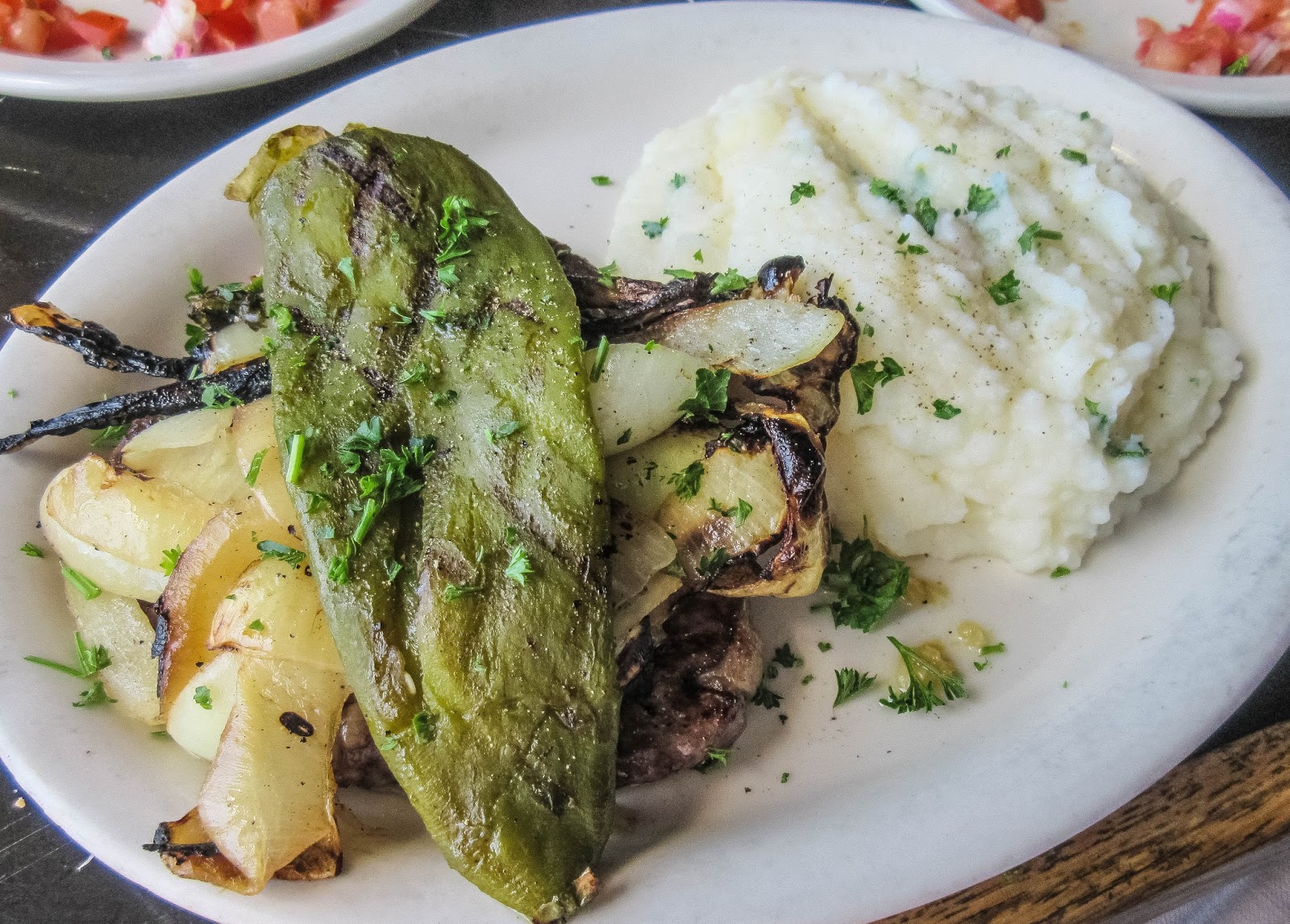
Argentina is known for its beef, so I had to try the "gaucho," a ribeye steak with grilled onions and an Anaheim pepper. The menu says the steak is aged at least 25 days. It came with a choice of french fries, mashed potatoes or salad and I chose the mashed potatoes. Taylor comes from a family where his father eats his steaks well done and we were going to be sharing. So I went for medium rare rather than rare. This item was worth the drive. The potatoes were some of the best I've had at a restaurant, I was wishing Judy could be there because she adores mashed potatoes. The Anaheim chili and onions were a very nice complement and the steak was fantastic. Nicely cooked, nice flavor. Taylor even voiced, when it was all over, that he usually ate his meat well done, but that he'd really enjoyed it medium rare. 

Here the steak is uncovered to reveal it is liberally peppered with garlic. 
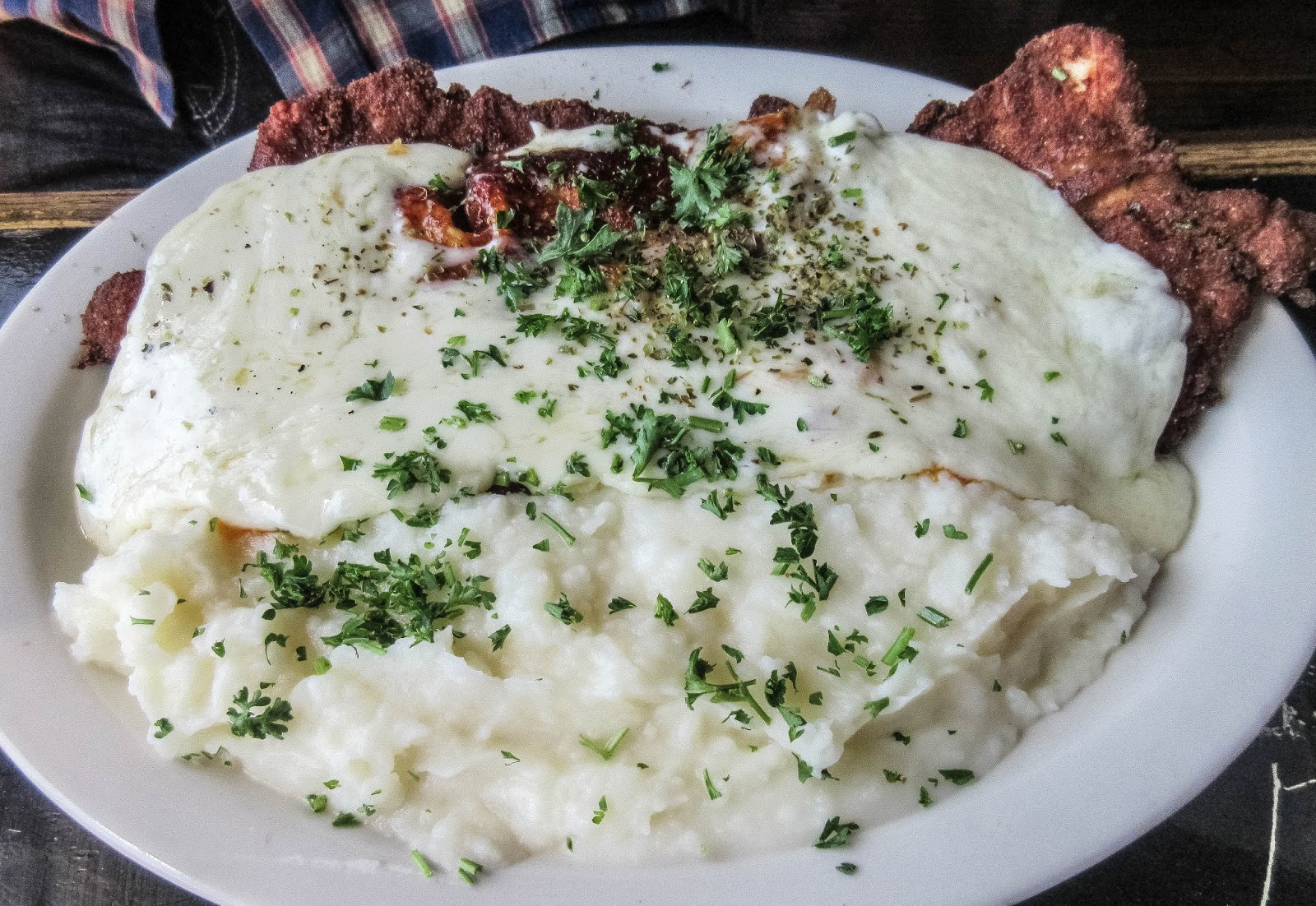
Taylor ordered the suprema napolitana. It is boneless chicken breast, breaded and lightly fried, topped with basil tomato sauce and melted cheese, like a pizza. It was huge, nearly filled the plate. This dish was created in Buenos Aires and is not named after Naples, but after the restaurant Napoli in Buenos Aires where it was first sold in the late 1940s. Taylor was particularly excited about this dish, something he really loved there and he loved this. I'm not a major fan of pounded and breaded chicken so I had some and thought it was fine, but nothing I would order on my own. It did have a very large quantity of melted cheese on top of it. It also came with mashed potatoes.  
Finally, we got panqueque de banana condulce de leche, a pancake with warm caramel and diced bananas and caramelized sugar. Dulce de leche is made from whole milk, sugar and sometimes vanilla bean. It gets its taste from the Maillard reaction,  a chemical reaction between amino acids and reducing sugars that gives browned food its caramelized flavor. It looked good and was very good, although it did have somewhat of a burnt flavor. 

The caramelized milk of the dulce de leche.
Overall, I loved Lala's and would like to go back again.