Sunday, March 27, 2016

L'Ma Lodge - Skoura, Morocco

In Morocco we discovered a new type of place for travelers to sleep and eat - the riad. The word "riad" comes from the Arabic word, "ryad," which means garden. Riad architecture began in the city of Volubilis, originally a Roman town (now a ruin which we visited), but later conquered  by Idris I in the late 8th century who established Muslim rule and the Idrisid Dynasty and riad architecture. A traditional Moroccan riad is a house with two or more storeys around an Andalusian-style courtyard. The riad is typically sparse looking on the outside, with walls made of clay or mud brick and few, if any windows. This was primarily for privacy. The dull outside was more than made up for by the beautiful interior garden or courtyard, which often had  lemon or orange trees and a fountain.

We stayed in three riads in Morocco: in Fez (3 nights), in Skoura (1 night) and in Marrakech (3 nights). We ate our breakfasts there (the cost of which was included with the room) and dinner at least one night in each (dinner was an extra charge). 

In many ways L'Ma Lodge in Skoura was my favorite. Skoura is on the desert side of the High Atlas Mountains. It is about a 6 hour drive from Merzouga, where we spent the previous two nights in the Erg Chebbi Dunes, and a 5 hour drive to Marrakech, which was our next major destination. It is quite close to the spectacular Dades Valley and Dades Gorge. 

When we pulled up about 6:45 p.m. after a long day of driving, Judy looked at me like "yuck, what have you gotten me into." She said something to the effect of, "I hope it is nicer on the inside than on the outside." The next morning as we prepared to leave she was wishing she had more time there and giving me a little bit of a hard time for our excursion up the Dades Gorge the day before which kept us from arriving earlier. 
Judy outside L'Ma as we left. Vanessa, one of the owners is to her right, one of the help is to her left, as well as Cacao the dog. The mud wall and dirt parking area in front were what sparked her initial lack of enthusiasm.
L'Ma Lodge is surrounded by a large mud wall (which largely provoked the "yuck"). Inside is a main house with lounges and tables, a fireplace, piano and kitchen. This is where we had dinner and breakfast. 
The main house is behind Judy, as well as part of the garden. 
A fun painting inside one of the eating rooms.
Another painting and beautiful lamps on a lounge wall.
Judy eating breakfast, viewed from one of the other rooms.
The fireplace in the main house. The kitchen is through the door on the left. We ate dinner on the other side of the fireplace.
A lounge area just beyond where we ate dinner.
The fire place with a fire while we ate.
The kitchen.
Immediately outside was a huge garden with a swimming pool, lots of trees and a garden where they grow many of the vegetables they serve with their meals. It also includes benches and rugs to sit or lay down on. 
One of a number of benches in the garden.
Rugs and pillows under an olive tree in the garden.
Part of the garden.
The swimming pool.
A very fun sign post in the garden.
The riad is a separate building which has seven lodging options for visitors: 4 bedrooms and three suites. We were up on the second floor in a nice-sized room with a double bed, a separate toilet and a walk-in shower. It had a screened window that opened to the outside and a nice ceiling fan which we used that night to provide circulation while we slept. 
The riad where the guest housing is located.
Stairs going up to our second level room. I loved the wooden slats.
Part of our bedroom. Morocco has wonderful lamps.
View toward the bathroom from the bed. More of the wonderful wood slats.
Walk-in shower.
View of palm trees and the wall outside our window.
For dinner we started with both black and green olives grown and cured on site and some almonds and another kind of nut. Then came three of the most creative and unusual dishes we had in Morocco and the reason I would love to go back some day and take cooking classes there. First, we had a Moroccan hot salad, that included onion, carrot and some hot chile pepper. I believe it may also have had some pastry in it. Very creative and unusual.
Wonderful place setting for dinner.

Hot Moroccan salad.
Next was one of the best dishes we had in Morocco, a tagine of lamb and sweetened apples. We had some better lamb on the trip, this was good but a little bit more tough than other lamb we had, but the apple was the best cooked apple I've ever eaten, very soft and sweet. At least part of the cooking of the apples involved coating it with honey and the sweet apple with the savory lamb was extraordinary.
Lamb and apple tagine. I will never view cooked apples in the same way.
Finally, desert was a very unusual and very funky texture dessert drink of mint and lemon, created by Vanessa, one of the owners, which involved lots of trial and error to develop. The foamy top was a sort of gelatinous mixture of lemon and lime topped by lime zest and the liquid mixture below was also a mint and lemon mixture of sweet and sour. A perfect drink for the desert as well as dessert. I would have loved that drink in the Erg Chebbi Dunes, very refreshing and light. A killer dinner.
Lemon and lime dessert drink.
Breakfast was highlighted by jams and other spreadables made on site, much of it from fruits and vegetables grown on site. They included the following: chocolate curve; honey; ipomee cream (made from sweet potatoes); strawberry & citron; orange & spices; fig; stewed apple; banana, vanilla & rum; almond & olive oil; carrot and orange flowers; pomegranate; pumpkin & cinnamon; and strawberry. I took a piece of flat bread/crepe and put a dollop of each on it and in that way sampled them all. All were good, but the pomegranate and chocolate were particular favorites. I also had a more traditional French crepe which I used as a base for some sliced hard-boiled egg and cheese, one of the few times on the trip we found cheese.
Breakfast jams lined up on a table.
A few of the varieties.
French crepe with cheese and egg.
That morning I discovered cacao the dog, a puppy, recently adopted after it was found homeless at their doorstep several weeks below. Cute, cute, stole my heart.
Cacao the dog.
Loved L'Ma Lodge. Would love to go back and to recommend it to anyone traveling to Morocco.

Friday, March 25, 2016

Camel Milk

We visited the Erg Chebbi Dunes in eastern Morocco, just inside the western border of the Sahara Desert, after crossing over the Middle Atlas Mountains from Fez, an approximate 8 hour journey by car. After spending two nights in a luxury desert tent camp and a full day in and around the sand dunes,  Aziz, our driver, was taking us again back toward the Middle Atlas Mountains to our next destination of Skoura. I reminded Aziz that we wanted to stop for camel's milk. We'd passed several places that sell camel's milk in Rissani on our way in.  Aziz passed at least one place selling camel milk before pulling up in front of a walled compound with an open gate. A sign advertising camel milk was placed in the dirt right next to the road outside the compound. We got out of the car and started walking toward a large tent inside the compound which was open on one side. 
"Le lait de chamelle" is "camel milk" in French. I'm assuming that the Arabic writing says the same thing.  
The large tent inside the compound. The Berbers who own this place keep the camels at the back end just barely visible to the back left. They also raise goats that they let loose out of their enclosure so that Judy and I could see them.
We walked into the tent and found several Berber men seated on cushions placed on carpets that covered the ground. Aziz spoke to the men in Arabic or Berber, and then motioned for us to sit at a small round table inside the tent. The table was covered with a colorful yellow and black cloth. An older man disappeared for a minute or two and then reappeared holding a 1.5 liter plastic bottle full of milk and a silver tray with empty glasses. He placed three empty glasses on the table, right-side up, then poured milk into each glass, nearly to the top. I wondered if drinking the milk would make us get sick. The plastic bottle was obviously used and the glasses did not look particularly clean. But I couldn't pass up an opportunity to try camel milk.  
Camel milk inside the 1.5 liter bottle. Another Berber man in the background is pouring himself some tea. 
I took some pictures. The milk looked a little frothy. I took a sip and was surprised to find the milk nice and cool. It had a slightly sweet taste and I commented that it tasted like a cross between skim and whole milk. The texture was more like skim milk, more watery than whole milk, but the milk fat was noticeable and good. I had no problem drinking down the glass and the man, through Aziz, asked us if we wanted more. He poured more into each glass, about one-quarter full. We drank it and then declined any more - we did not want to take the remaining milk with us. 
My glass of camel milk.
Through Aziz we asked the man about his camels. His camels were out foraging for plants in the desert at that moment. They were able to get as much as 5 liters of milk from each camel each day. The milk we'd drunk had not been heated or pasteurized. He sold his milk to far away towns, including Marrakech and Fes on the other side of the Atlas Mountains. He also raised goats which he sold outside the area as well. Through Aziz the man asked us if we would like to see his baby goats and we responded affirmatively. This got us out of the tent so that presumably Aziz could be left alone with the other men to collect his commission for bringing tourists to the compound for milk. We paid 100 dirhams for the milk, about $10 U.S. dollars, a steep price in a country where a glass of fresh-squeezed orange juice is sold for the U.S. equivalent of 40 cents a glass. I gladly paid the amount. I would not have been surprised if they'd asked for more. I would have been thrilled at even double the price. 
Two camels we saw in the nearby Erg Chebbi Dunes.
Another camel we saw in the dunes. 
After we visited the goat pen and the empty camel pen, we got back in our car with Aziz, who was surely a little bit richer after this act of commerce. Life in Morocco is hard and we found the people to be very enterprising and creative in their efforts to earn money. Judy whispered to me that they'd made a killing on the $10.00 milk sale and I agreed, but was still very happy with the experience.

As I look on-line at camel milk in the U.S., I find that we got a pretty good deal. Desert Farms, which sells camel milk from camels raised in Amish communities in the Midwest, sells 8 ounce cartons for $10.00 with a minimum order of $60.00 (48 ounces). We got about five times that amount for our $10.00 in Morocco. An article on camel milk in Wikipedia indicates that until recently it was a felony to sell camel milk in the U.S., although an individual owner of a camel could consume the milk. Now, apparently, farms can sell it to customers who buy it directly, but it must be tested for antibiotic residue if it crosses state lines or is commercially sold in stores. Camel milk has more fat, protein, vitamin C and iron than cow milk, but less cholesterol, vitamin A and B2. Some camels in other parts of the world can produce as much as 30 to 40 liters of milk daily. 

Tuesday, March 22, 2016

Snail Soup in Morocco

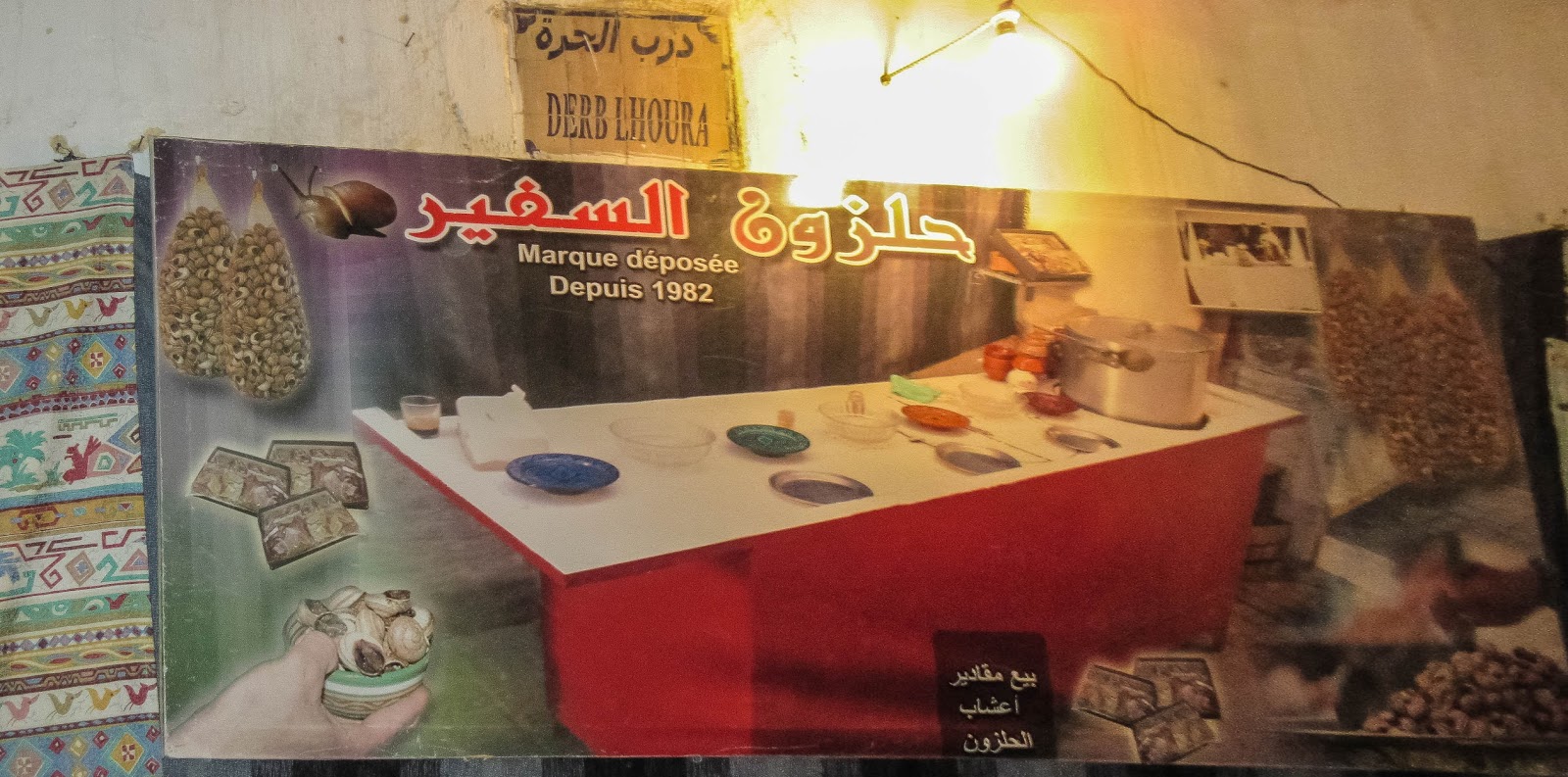
On our recent trip to Morocco some of my most memorable experiences had to do with food. Our first full day in Morocco we were walking through the medina in Fez (Fes in French and pronounced "Fess" when speaking to locals who speak English) with our guide, Hassan. We came across a vendor selling snails. I was gob-smacked - the vendor had snails hanging in net bags from the top of his stall and two large baskets full of snails on the stall counter. On closer inspection, I saw what looked like regular, slimy, garden snails, grouped in bunches of hundreds, many with their familiar-looking antennae stretched out of their shells. Hassan told us that snail soup is very popular and we told him we would love to try it. The vendor allowed us to take pictures but made sure he was safely out of the way so he did not appear in any of them. 
This side view of the stall shows hanging snails, snails in baskets and posters about snails that were unintelligible to us. Between the vendor sitting in front and the narrowness of the passage-way, we were not able to get a good front-on photo. 
Posters on the snails. It looks like the poster is showing different snail varieties. 
Basket of snails and a plastic scoop.
Many bags of  hanging snails, both in front and back in the stall. 
A closer view of the snails shows many of them venturing their bodies out of their shells. 
The next day after a tour of Volubilis, Moulay Idriss and Meknes, Hassan was showing us back to our riad (small hotel) and stopped at a stall selling snail soup. For six dirhams each, about 60 cents in U.S. currency, we each got a cup of snails with soup (mostly cooked snails in their shells filling the cup and some broth in the bottom) and a separate cup of the broth. The snails were fully cooked in their shells and we were instructed to use accompanying tooth picks to spear the snails and get them out of their shells. I quickly got tired of that process and found it much quicker to fish them out with my fingers. 
The vendor selling snail soup - his large pot in front.
The poster above his stall shows the snail pot as well as bags of hanging snails.
Two bowls of snail soup and a container of toothpicks.
I  hold up a cooked snail.
Judy spears a snail out of the shell with a toothpick.
The broth was from the big pot the snails were cooking in. Hassan showed us a bag of the spices used in the broth and the vendor scooped a bowl full of shells out of the pot, using a large ladle, so that we could take a picture. 
A ladle of shells from the big pot of snails and broth.
To the back left are discarded shells with snails removed. The closest bowl shows the remaining snail shells in my bowl along with the broth. The other bowl is a separate bowl of broth we each got. The plastic bag is full of the spices (about 15) used to spice the snail soup. 
The snails were a bit earthy, but not off-putting. Hassan said something about taking just the top end of the snail and avoiding the stomach, but I ate whatever pulled out of the shell and it was fine. The broth was quite strong, I choked and started to cough on my first swig, but got used to it and found it quite fine. I think it would be really good for a cold or someone with the flu (see the link to a CNN article on street food in Morocco and the segment on snail soup). 

This was one of the memorable adventures we had in discovering local culture and much more fun than the tagine after tagine we encountered in the riads and local restaurants. 

Tuesday, March 15, 2016

Yuzu

Some time back we had some friends over for dinner and one of them, Claudia, brought us a gift box with some yuzu fruit she grows at her home. I'd never seen yuzu before, or even heard of it. So I went to 1001 Foods You Must Taste Before You Die and found it included there (p. 105). 1001 notes that yuzu is about the size of a mandarin and the most cold resistant of all citrus fruits. It grows wild in Korea and Tibet, but is associated more with Japan where it was introduced more than 1,000 years ago. Some believe it is a hybrid of the mandarin. 
Box of yuzu
Yuzu has an amazingly fragrant peel and is often added at the last minute to soups, salads and simmered dishes. Ponzu sauce is often made with yuzu juice. The juice is quite tart, resembling the grapefruit somewhat, with hints of mandarin. 
Inside of the yuzu. Quite tart and with lots of seeds.
Judy made a bundt cake using the yuzu zest and the yuzu aroma was still quite pronounced after the cake was cooked. 
Yuzu being grated for zest.
Yuzu zest in the batter.
Bundt cake
Inside of bundt cake that carried the yuzu fragrance.
Claudia has quite a green thumb and grows a number of fruits I've never heard of. She is also very artistic. The box she brought the yuzu in also had some keffir limes and it was decorated with an ostrich feather, what look like quail feathers, and a beautiful white flower and red berries. 
Beautiful gift box.
Yuzu and keffir lime.