Saturday, August 17, 2013

Ted's Montana Grill - Denver

While in Colorado recently I wanted to try some buffalo meat. There are a number of restaurants there that serve it and it is one of my favorite meats. I've previously been to The Fort several times, one of the best restaurants I've ever been to, and the Buckhorn Exchange, a restaurant that oozes history and the old west. Both serve many different kinds of courses of buffalo. The Fort was not open for lunch, the time we had available, so I Yelped buffalo meat and found a reference to Ted's Montana Grill.

Ted's Montana Grill was founded by Ted Turner. The first one opened in 2002 in Columbus, Ohio and there are now about 44 of them in 16 states, although I'd not heard of it before.  I read about Ted Turner and buffalo a number of years ago. He is now the largest private landowner in the U.S., owning more than a dozen properties and totaling more than 2 million acres, larger than the size of Delaware. He owns large land holdings in Montana, Nebraska, Kansas, South Dakota and New Mexico (the New Mexico holdings totaling more than 1 million acres). He now has about 55,000 buffalo roaming on this land, so it makes sense that he would open a chain of restaurants to market the buffalo that he's raising.
There are a number of his restaurants in the Denver area. We went to the one located downtown, at 1401 Larimer Street (303-893-0654). The prices for the buffalo cuts appeared cheaper than those we've had at The Fort and the Buckhorn Exchange, but the atmosphere is not as fun. The Fort is located in a re-created fort and has lots of memorabilia to take you back to the 19th century. The Buckhorn Exchange has walls covered with animal heads and hides and oozes the old west. Ted's Montana Grill on Larimer Street has one mounted buffalo head on a wall and is filled with people in dark suits, white shirts and ties - much more formal, not as folksy. But ultimately, I was looking for good buffalo meat, and was excited to try this out.  
We started with an appetizer of bison nachos, with pepper jack cheese, bison chili, raw jalapeno slices, scallions, a little bit of diced tomato and sour cream. The bison taste did not really stand out in the chili and the condiment to chip ratio was rather skimpy. They were different than any nachos I've had before, but did not really stand out. Good, but not great. 
bison nachos
I got an appetizer, Ted's chopped salad, with iceberg lettuce, artichoke hearts, roasted corn, garbanzo beans, tomatoes, green peppers, red onion, cucumbers and salami with basil vinaigrette. It sounded so good, but was extraordinarily ordinary. The only ingredient that really stood out was the salami and there were only a few chunks of it.  The most disappointing item we got. 
Ted's chopped salad
Andrew got bison meatloaf covered in gravy, with garlic mashed potatoes and squash casserole. I got a taste of the meat loaf and it, too, was very ordinary. It tasted much like regular meatloaf and was kind of soggy and whimpy, like it was packed with bread crumbs. By contrast, I had buffalo meatloaf at Whoa Nellie Deli, connected to a gas station in Lee Vining, and it was fabulous. I found it thicker than regular meatloaf with the signature buffalo taste. 
bison meatloaf
Judy got the braised bison short ribs which were basted in bbq sauce, along with garlic mashed potatoes and green beans. The texture of the short ribs was wonderful, very soft and tender. But the taste was mostly bbq sauce. 
bison short ribs
The 14 ounce Delmonico bison ribeye was what got me there. I ordered it medium rare. It was cooked nicely and it was good, better than a normal steak, but it it just wasn't outstanding. I keep thinking back to a buffalo ribeye Judy had at The Fort which is one of the best pieces of meat I've ever tasted. This ribeye, the short ribs, the meatloaf, the chili, it just doesn't seem buffaloey enough. I read that Turners does grain feed the bison at the end, and perhaps the grain fed buffalo don't have as strong a taste as the grass fed buffalo. I don't know what the difference is, but I'll take The Fort and the Buckhorn Exchange and their buffalo over Mr. Turner and his bison.  
14 oz. bison Delmonico ribeye


Friday, August 16, 2013

Boreal Toad

The boreal toad is a subspecies of the western toad and found in wet habitats at high altitude (8,000 to 12,000 feet) in south-central Wyoming, through the mountainous regions of Colorado to extreme north-central New Mexico. I have previously done a post on the California toad, also a subspecies of the western toad. Aside from its geographical distribution, it is distinguished by its belly which has a considerable number of dark blotches. They can be gray to green, have considerable dark blotching on the back, have a white middorsal stripe, warty skin and oval parotoid glands. It is an endangered species in Colorado and New Mexico and protected in Wyoming. 
boreal toad - white middorsal strip, warty skins, parotoid glands and dark blotching
I had hiked up to the summit of Mount Yale, outside Buena Vista, Colorado, in the Collegiate Peaks Wilderness Area and was hunting for mushrooms with Judy and Andrew in an area of pine trees right near Denny Creek at well over 10,000 feet in elevation. We found two of the toads hopping through long grass in a swampy area bordering the pine trees. Incidentally, it was also within yards of the area we found the most king bolete mushrooms. 

I had no idea of its status at the time we found them. It looked very similar to the common California toads we find in our area, except that it seemed smaller and gray. 

Thursday, August 15, 2013

Pine Grosbeak

The pine grosbeak is the largest finch and found in the boreal (snowy winters and short summers) conifer (reproductive structures in cones, such as pines, firs, spruces, junipers and redwoods) forests of the northern hemisphere. It has a stubby curved bill, dark wings with two white cross bars, and a plump chest. Males have a pinkish to rose-red head, breast, back and rump. Males also have blackish brown wings and tail and white tertial (flight feather) edges and gray thighs, flanks and undertail coverlets.  
pine grosbeak in the Colorado moutains
They have a reputation of being very tame and approachable. When alarmed, they often stay hidden in foliage rather than flushing. This was my experience. I had climbed Mount Yale in central Colorado and was following the trail down through a pine forest at 10,000 to 11,000 feet of elevation when this beautiful red bird flew into a pine tree right in front of me. I pulled out my camera and the bird stayed within the tree, even as I changed positions trying to get better camera angles. 
In the U.S. they are found in the higher altitudes of the Sierra Nevada, eastern Arizona, northern New Mexico, Colorado, Wyoming, Idaho, Montana, parts of Washington, the Dakotas, Minnesota, New Hampshire, and Maine. They are also found in large parts of Canada, northern Europe and Russia.  

Monday, July 29, 2013

Sadrvan - Mostar, Bosnia & Herzegovina

We had lunch at Sadrvan in Mostar, Bosnia & Herzegovina on a Monday afternoon and I was surprised at how crowded it was. Unfortunately, all of the outside tables were filled and we were led upstairs, out of the way, and even then, all of the tables were full. Not surprisingly, it took us awhile to get our food, but the waiter was obviously hustling under a big work load. 
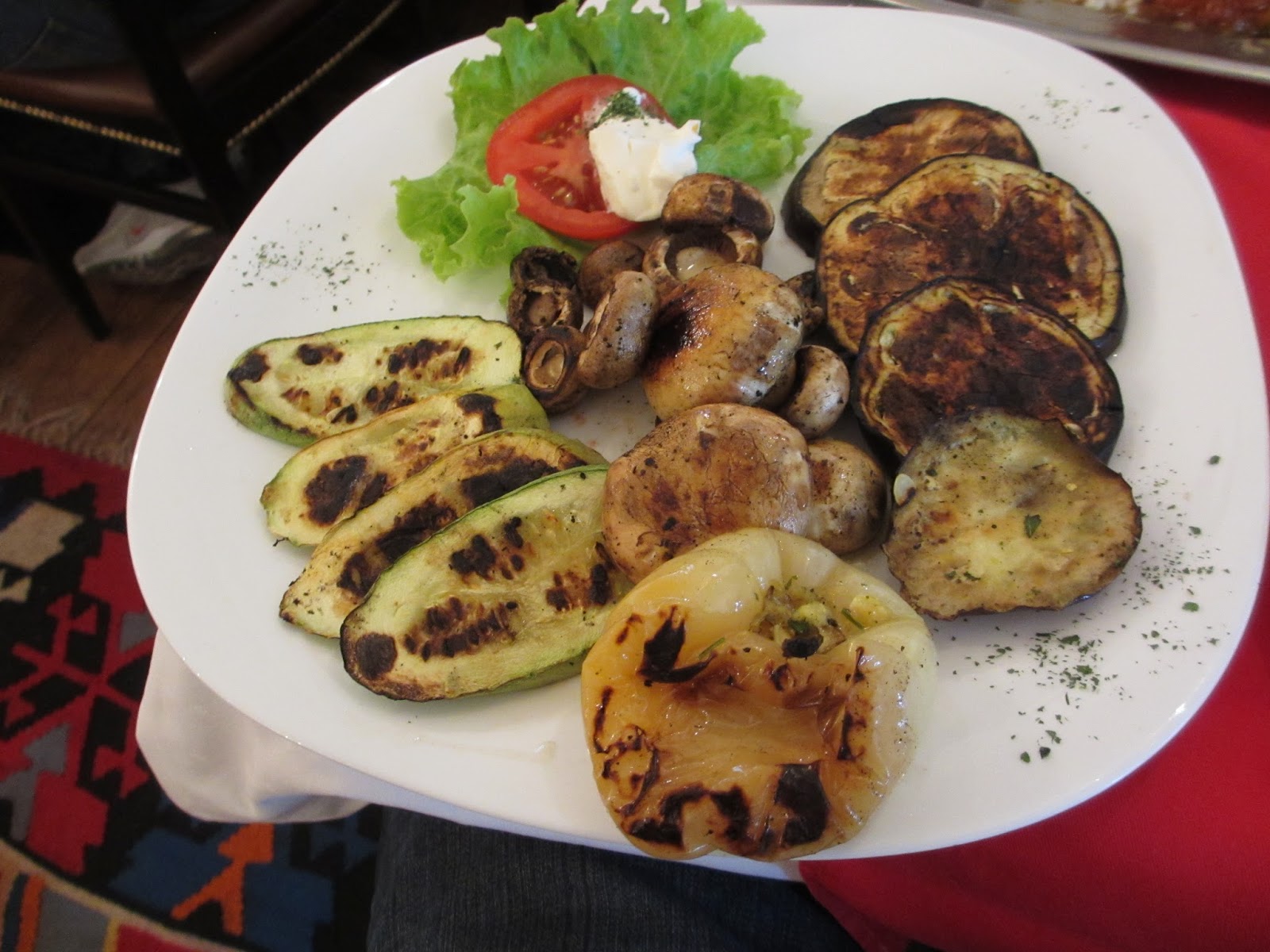
Judy and I shared a plate of grilled vegetables and the National plate on a large platter that was recommended (I think they recommend it so that the kitchen can cook volumes of the same thing and push the food out faster). The grilled vegetables were similar to what we had several times elsewhere in the Balkans (obviously what's in season): eggplant slices, a whitish pepper, small mushroom caps, slices of squash (similar looking to zucchini) and a leaf of lettuce with a tomato slice and sour cream. The vegetables were all fresh and cooked and seasoned well. 
The National platter for two was huge. It included several filovana paprika, four japrak, several sogan-dolma, Bosanski lonac, four cufta, and the fixings for cevapcici (all described below). 
Cufta, or kofta, is a Balkan meatball of minced meat and spices and I believe these were also mixed with vegetables. These were my least favorite of all the items on the plate. They were rather hard, did not have much flavor and did not provide much reason to eat more than a bite or two. 

Cufta
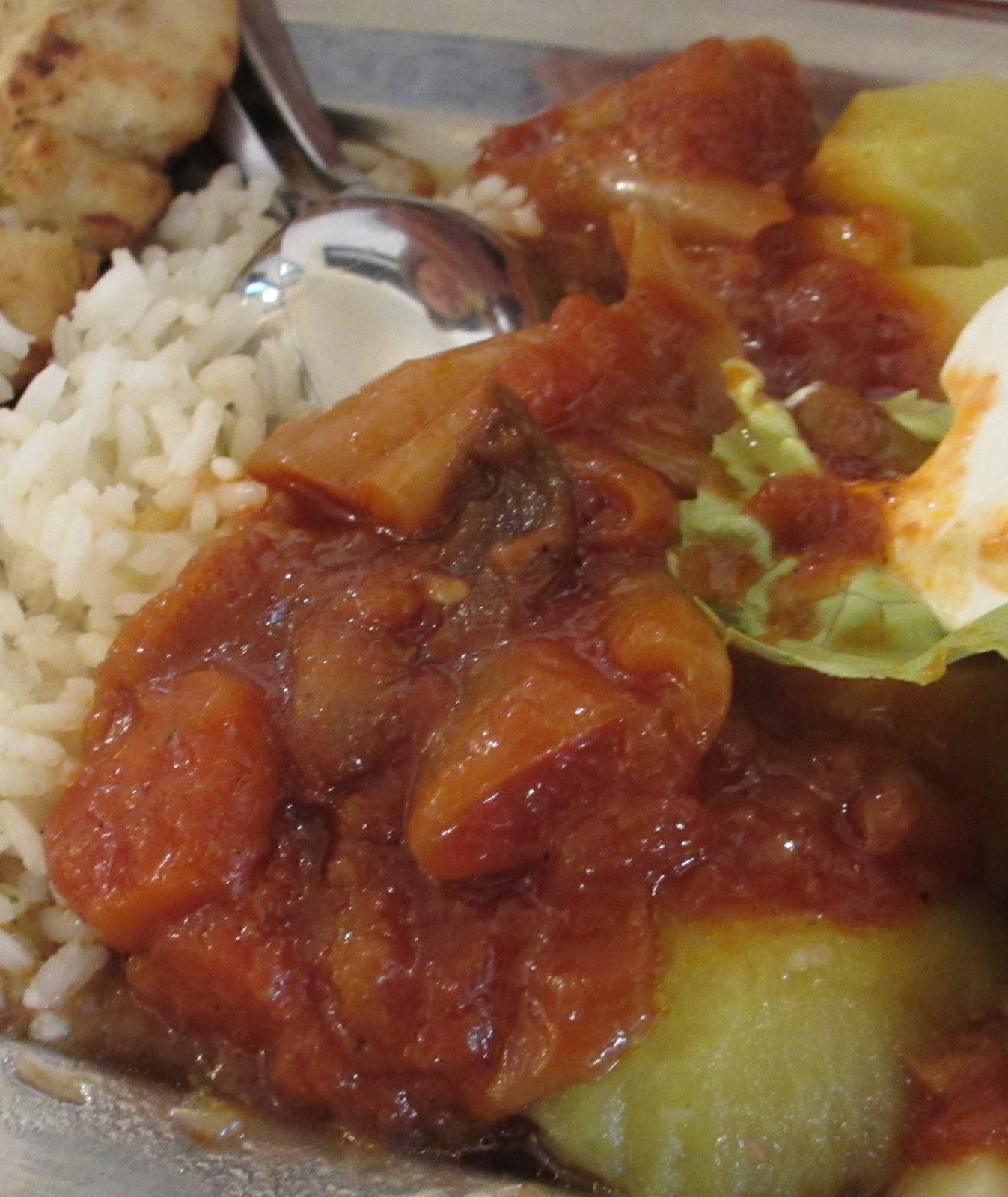
Bosanski lonac is Bosnian meat stew and consisted of boiled potatoes, carrots, onions, some sort of meat chunks, cabbage, and perhaps other vegetables in a tomato sauce. 
Bosanski  Ionac

Filovana paprika is peppers stuffed with minced meat, rice, tomato, eggs and spices. These peppers appeared white instead of the green or red peppers we normally see. 
Filovana paprika
Japrak is grape leaves stuffed with rice and meat. The stuffing is predominantly rice and the meat does not modify the taste much from traditional dolma, which is stuffed grape leaves. 
Japrak - similar to stuffed Greek grape leaves, but with meat and rice.
Sogan-dolma means stuffed onions in Turkish and is a specialty of Mostar. These sogan-dolma appeared to include minced beef, rice, and spices, in addition to the onion. I love these and they went quickly. 
Sogan-dolma
Cevapcici or cevapi, considered a national dish in Bosina, is Bosnian pita bread (somun) filled with minced lamb and beef that looks like grilled sausages, sliced onions, sour cream, lettuce, and ajvar (an orange colored relish made from red bell peppers, garlic and often eggplant as well). The cevapcici was by far my favorite item and we ate all of it as well. We saw it a number of times in the Balkans. It was usually served with all of the ingredients stuffed in the pita bread. We could not finish much of the rest of the food. 
Cavapcici
We had the same or similar food on a number of occasions and so we know it was traditional Bosnian, or at least traditional Balkan. Although it was pretty good, it is not the reason to travel to Bosnia. There was nothing that really stood out and cried for more. 

Sunday, July 28, 2013

Cathedral of the Assumption - Zagreb, Croatia

Cathedral of the Assumption, or Zagreb Cathedral, is Roman Catholic and the tallest building in Croatia.
Cathedral of the Assumption of the Blessed Virgin Mary
Side view of the cathedral.
King Ladislaus (Ladislav in Croatian) of Hungary (who later extended his rule over Croatia), was born in 1045 and King from 1077 until his death in 1095. Ladislaus founded the Archdiocese of Zagreb, appointed the first bishop and started to build a small church in 1093. It was added to and completed in 1217, when it was consecrated by King Andrew II of Hungary and Croatia (who reigned from 1205 to 1235) when he came through on the Fifth Crusade. The cathedral was destroyed by the Mongols and Tartars in 1242. Rebuilding of the cathedral began later in the 13th century, using part of the remains of the old cathedral, and building a central and two lateral apses. It was dedicated to St. Stephen, King of Hungary, from 1000 to 1038.  The Ottomans invaded at the end of the 15th century and defensive fortifications were built around the cathedral, some of which still exist. The last of the fortifications were finished in 1517. In the 17th century a watchtower was built on the south side and used as a military observation point. 
Watchtower and fortifications around the cathedral.
Fortifications.
In 1880 an earthquake collapsed the entire ceiling, smashing the main altar. The cathedral was thereafter restored in Neo-Gothic style, particularly evident by the two spires built on the western end (one of which is now undergoing restoration) and the front facade.
The front facade.
The Holy Trinity (Father, Son and Holy Ghost - in the form of a dove)
King Stephen, Christ the King and King Ladislaus?
Statues next to the front entrance.
Statues on the other side of the front entrance.
An angel.
Angels above the statues next to the front door. 
The cathedral is dedicated to the Virgin Mary and her Assumption. It is also dedicated to King Ladislaus and to King Stephen.  
A large painting of the Assumption of the Virgin.
A closer view of the Assumption.
Cardinal Aloysius (Alojzije in Croation) Stepinac was the Archbishop of Zagreb from 1937 to 1960. During World War II he objected to the persecution of the Jews and helped the Jews and others to escape. After the war he publicly condemned the Yugoslavian government and its actions during the war, including the murders of priests by communists. He was indicted by the Yugoslav leaders of war crimes, collaboration with the Ustase movement and complicity in forced conversions of Orthodox Serbs to Catholicism. He was convicted in October 1946 of high treason and war crimes and sentenced to 16 years in prison. His trial was depicted as a "show trial" in the west and pressure, both foreign and domestic, gained his release from Lepoglava Prison after five years. Tito allowed his release under the condition that he retire to Rome or be confined to his home parish of Krasic. He chose the latter. In 1952 he was appointed a cardinal by Pope Pius XII. He died while confined in his parish and perhaps by poisoning from his communist captors (traces of poison were found in his bones during an autopsy).  He was beatified by Pope John Paul II in 1998. His sarcophagus containing his embalmed body is near the main altar and a relief of Cardinal Stepinac with Christ is nearby, made by the Croatian sculptor Ivan Mestrovic, who knew Stepinac. Mestrovic wrote: "Archbishop Stepinac was not a man of idle words, but rather, he actively helped every person - when he was able, and to the extent he was able. He made no distinctions as to whether a man in need was a Croat or a Serb, whether he was a Catholic or an Orthodox, whether he was Christian or non-Christian. All the attacks upon him be they the product of misinformation or the product of a clouded mind, cannot change this fact." I do find a different point of view from Chris Agee, in "The Stepinac File (2000)" examining the writings of Hubert Butler. In Butler's "efforts to find out the details of the vast campaign in Croatia in 1941 to convert two and a half million Orthodox to Catholicism" he talks about "often good and kindly men, who believe that at all costs the ecclesiastical fabric, its schools and rules, its ancient privileges and powers, should be preserved." He refers to Stepinac as "an avatar of the Organization Man...[whose] fatal respect for orderliness becomes integral to the vastness of the criminal enterprise." 
The embalmed Stepinac, in his red and gold vestments and gold miter, lays at rest near the main altar of the cathedral.
Stepinac with Christ by Mestrovic.
The beautiful crucifixion scene has an inscription in glagolithic script, first put into writing by Cyril as a means to help convert the slavs to Christianity. It was a fore-runner to the modern Croat language. True to the church tradition, Jesus's hands and feet are nailed to the cross and the thieves' hands and feet are tied to the cross. I guess this is one way of distinguishing the divine Jesus from the mortal thieves, although in actuality the Romans would not have distinguished between them. 
Crucifixion scene. Mary and John flank Christ while the thieves are to his right and left.
Close-up of Christ - note his wrists and feet are nailed to the cross. 
One of the thieves on the cross - not that his arms and legs are tied, not nailed, to the cross.
The other thief on the cross, also tied, not nailed, to the cross.
There are many other beautiful and interesting elements in the cathedral that I don't have much specific on. I share them as photographic snippets. 
Interesting tiled floor.
Looking toward the main altar of the cathedral from the back.
Looking into the apse beyond Cardinal Stepinac.
Looking sideways at the main altar in front of Cardinal Stepinac.
Chandelier
Looking back at the front of the church - the organ up high.
Pulpit
An altar with a silver and gold relief.
The gold relief on the altar appears to depict a modern adoration of the magi.
Sculptures above an altar.
More sculptures above an altar.
More sculptures above an altar. I'm thinking that King's Stephen and Ladislaus have to be represented in many of these.
Another portion of one of a myriad of altars.
A Last Supper relief on an altar.
Virgin and Child.
One of the evangelists.
I love the statues featuring old garb.
From the side of the apse near Cardinal Stepinac.
Finally, some examples of the stained glass: