Tuesday, June 21, 2011

Baked Purple Yams or Okinawa Purple Potatoes

I recently did a post on the differences between sweet potatoes and yams and, as part of that post, featured purple yams, which are really Okinawa purple potatoes, a sweet potato. I boiled the purple yams in that post and found that I did not like them as well as the jewel yams or Nancy Hall sweet potatoes. However, I read that boiling, as opposed to baking, takes much of the sweetness out of the sweet potato, so I decided to give the purple yams another try - this time baked. Below, the two larger purple yams. 
I pre-heated the oven to 400 degrees and put on three purple yams. 
Note the difference in size and color between the two not wrapped in foil. As with the last time I had purple yams, I found the smaller ones to have a more vivid and concentrated purple color. Two were stabbed several times with a fork, but otherwise just placed on a baking sheet. One was placed in foil and stabbed with a fork. Some website Judy looked up said that the sweet potato cooked in foil really cooks differently and that it takes longer for them to cook, thus the reason for trying it both ways. I pulled out the smallest purple yam after about 15 minutes. 
It was cooked, but was still pretty firm. I added butter and some salt and, Wow!, it was so much better than boiled it was hardly the same creature. 
Even with the thick texture it was wonderfully sweet and good. I left the other uncovered purple yam in for another 15 minutes and then pulled it out. 
It was more cooked and mashed easily (and note the less uniform purple color). I put on butter and salt and it was just pure heaven. 
It was sweet and had a pleasing texture, something I could eat regularly. I cooked the yam in the foil for another 15 minutes. 
Note the moisture leaking from the fork holes after removing the foil. It was much more moist and smashed very easily. 
It did have a different texture and a different taste. I didn't like it as well as either of the other baked yams without foil, no matter how long cooked, although it was still good. 
You can tell, just from looking at the pictures, how the texture changed from baking without foil, shorter to longer, and baking with foil. I am now converted to the idea of baking sweet potatoes, I am converted to the purple yams, which I did not care for when boiled, and I plan to eat them again in the future. 

Monday, June 20, 2011

Cheese: Emmentaler or Swiss

Emmentaler or Emmental is a cheese from Switzerland which, among some other cheeses, is known in the U.S. as Swiss cheese. 
It has a taste that is hard to describe, but immediately recognizable, that I am not fond of. Wikipedia describes it as having a "piquant, but not very sharp taste." 1001 Foods You Must Taste Before You Die, of which Emmantaler is one, describes the taste as "sweet, nutty, fruity..., like a less buttery Gruyere." I agree that it is not sharp, but piquant implies heat and spice. It has some spice, but spiciness is not an attribute that really describes it to me and it certainly is not hot. To me sweet, nutty and fruity are all nice attributes that do not grab the essence of the taste. As I tasted and thought, the words that came to me were "sweet and like soft water," which you might assume correctly I am also not fond of. It has an overwhelming taste that distorts and detracts the other sub-tastes which otherwise would be quite good. It is originally from the Emmental region in west central Switzerland, part of the canton of Bern. 
However, unlike some other cheeses that have been protected, Emmentaler is made in other areas such as France, Bavaria and Finland. It is a yellow, medium-hard cheese made out of raw partially-skim cow milk. 
Three kinds of bacteria are used in the cheese-making process: Streptococcus thermophilus, Lactobacillus and Propionibacterium freudenreichii. In the late stage of production, the characteristic holes, or eyes, are made when P. freudenreichii consumes the lactic acid excreted by the other bacteria and releases carbon dioxide gas which forms the bubbles that make the holes. 
It is aged from 2 to 14 months. There is an Emmentaler Switzerland which is an AOC  (Appelation d'origine controlee) with different age profiles. Classic is aged four months, reserve is aged eight months and Premier Cru is aged 14 months. The Emmentaler I got from Trader Joe's was made in Switzerland, was aged only a little more than three months. 
Generally, the older cheese has larger eyes and more pronounced flavor, because the longer aging time gives the bacteria more time to act. I need to try some older, holier, cheese to see if the "Swiss cheese" taste gets more pronounced with age. With the older cheese, the "piquant" description may be more applicable. Gruyere is another Swiss cheese which differs from Emmentaler in that it uses cows milk with more fat. It also does not have the holes that Emmentaler does, leading me to believe it must not use the P. fredudenreichii bacteria in the production process. Emmentaler and Guyere are often combined for use in fondues. I ate some Gruyere right after eating the Emmentaler and found it to be texturally softer and more pleasing, more mild, less sweet and to my taste, much better. 

Sunday, June 19, 2011

Cheese: Gruyere

Gruyere cheese is named after the town of Gruyere in Switzerland and is one of the 1001 Foods You Must Taste Before You Die. As I'm finding with other cheeses, its flavor varies widely with age. It is creamy and nutty when young, the Gruyere cheese I recently ate fit this description, but with age it gets stronger, more earthy and complex. 
It is fully aged after five months and starts to develop small holes and cracks and graininess with age. It is often used in quiche, fondue, ham and cheese sandwiches and one of my favorites, French onion soup. 
Gruyere is made with raw, unpasteurized milk, heated to 93 degrees in a copper vat, then curdled by the addition of liquid rennet. The whey is strained, the curds put into molds and pressed, salted in brine and smeared with bacteria and ripened for two months at room temperature. It can be cured for 3 to 10 months, the longer curing producing more intensely flavored cheese. Gruyere is made and popular in Greece and also in the United States.  Gruyeres in Switzerland must be made following certain rules. It must mature in a cellar with a climate close to that of a natural cave, with humidity between 94% to 98% and a temperature between 55 and 57 degrees. It appears that my Grand Cru Gruyere was made in Wisconsin and aged a minimum of four months. I really love Gruyere and particularly versions that are a little stronger in taste, with more of a bite.  Most of this information came from Wikipedia.

In August 2011 I went to Trader Joe's and picked up two packages of Gruyere: one was a Swiss Gruyere aged at least six months and the other was a Swiss Gruyere cave aged for at least a year. The six month Gruyere
was very mild and pleasant, just a little stronger than some Jarlsberg cheese we also had. 
It had a little background taste, something you would readily put on a sandwich or use in a fondue. 
The one year Gruyere, on the other hand, 
was much stronger and had a richer taste. It was a little harder, a little tangy, 
like it was going to have a bite, but the bite never developed. 
I could taste the age. We had a family party and I gave everyone a piece of the six month first, then the one year. Without fail there was a very pronounced positive reaction to the one year aged Gruyere. I liked it much more, just by itself, as a tasting cheese, but as I indicated, would probably prefer the six month on a sandwich or in a fondue. By itself, the one year Gruyere is special. What a difference a little age makes. 

Saturday, June 18, 2011

Cheese: Roquefort

Roquefort is a blue cheese made out of sheep milk. Like Blue Stilton, another well known blue cheese, it is a PDO (protected designation of origin) under European law. Only cheese aged in the Combalou caves of Roquefort-sur-Soulzon, located in the Aveyron department of southern France, may use the name Roquefort. 
As a boy growing up, I knew blue cheese salad dressing as Roquefort, which is what my parents called it. Then as I grew up and moved away from home I ate a lot of blue cheese and blue cheese salad dressing, but never encountered the Roquefort name. I wondered many times if Roquefort was different than blue cheese and what had happened to it. It was not until recently, while on my cheese kick, that I discovered the differences in blue cheeses and their names. That blue cheese, Blue Stilton, Roquefort, Gorgonzola, Bleu d'Auvergne, etc. are all blue cheeses, with differences that are sometimes more in name than product, but also due to the type of milk that is used and how they are made and aged. Roquefort, out of the package, is wet and slimy and strong. 
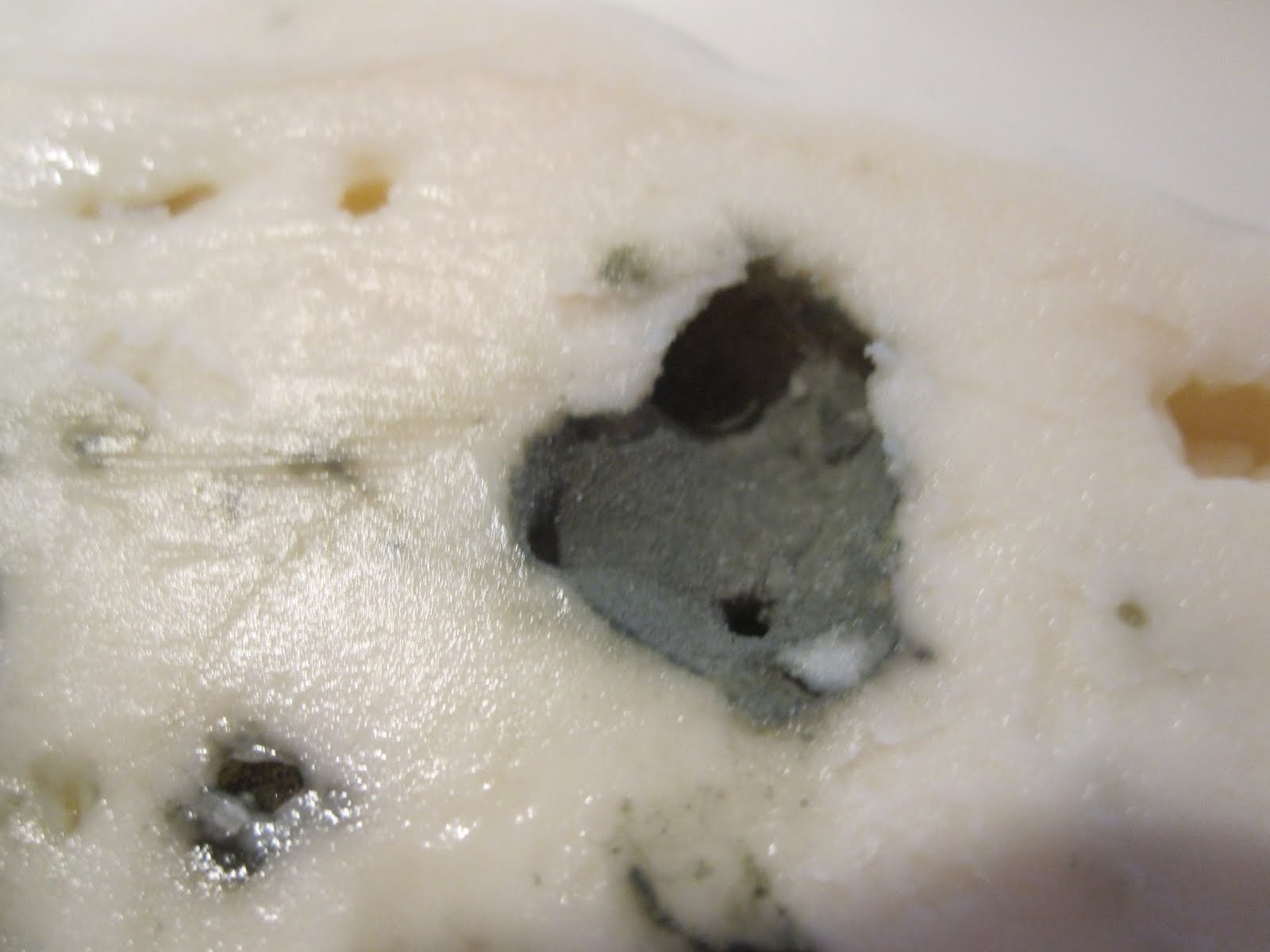
More than any other blue cheese I've tried, it is moldy throughout 
and contains pockets of air filled with mold. 
These pockets of mold ooze the strong, overwhelming, 
tangy taste that just permeates Roquefort. 
For blue cheese, this is as good as it gets. The Cheese website says that Roquefort is the "King of cheeses."
Penicillium roqueforti, the mold that gives Roquefort its tangy taste, is found in the soil of the local caves. It was obtained by putting bread in the caves and leaving it for six to eight weeks until it was covered in mold (see the moldy bread at the Roquefort Papillon website). The bread was then dried and powdered. Today it is produced in a laboratory and either added to the curd or put into the cheese as an aerosol through holes poked into the rind. It is made from the milk of Lacaune, Manech and Basco-Bearnaise breeds of sheep and there are seven producers. The largest, the Roquefort Societe, which made the cheese we ate, has several of its own caves and is responsible for about 60% of all Roquefort production (visit the Societe website to see the caves). The other producers are Roquefort Papillon, Carles, Gabriel Coulet, Fromageries occitanes, Vernieres and Le Vieux Berger, each with one cave each. Wikipedia notes that not much of the Roquefort is exported to the U.S. In 2008, only 450 tons of the 3,700 tons exported came to the U.S., compared to Spain which took 1,000 tons. Then I found an article in the Washington Post titled "Bush War on Roquefort Raises a Stink in France" and dated January 29, 2009, which may give at least part of the explanation. In the final days of the Bush Administration, a 300% tariff was imposed on Roquefort cheese, "in effect closing off the U.S. market." This was in response to European Union bans on U.S. beef containing hormones. The article also notes that a 100% tariff was imposed on Roquefort in 1999 (I checked to see if this was a Bush dislike for blue cheese, similar to broccoli, but no, that was under Clinton). In order to use the name Roquefort, the following regulations must be complied with: the sheep milk must be raw and delivered at least 20 days after lambing; the sheep must be pastured in the area around Aveyron and at least 3/4s of the feed grain must come from that area; the addition of rennet must occur within 48 hours of milking; the Penicillium roqueforti used in production must be produced in France from the natural caves of Roquefort-sur-Soulzon; the salting process must use dry salt; and the process of maturation, cutting, packaging and refrigeration of the cheese must take place in Roquefort-sur-Soulzon. 

Friday, June 17, 2011

Cheese: Tintern

Tintern cheese is a creamy Cheddar flavored with chives and shallots. It is a rindless cheese made of cow's milk, with a protective layer of green wax 
which highlights the green flecks of chives inside the cheese. 
I see it referred to as a "pub cheese," a cheese with "something in it," like garlic, onions or chives. 
It is made by Abergavenny Find Foods located in Abergavenny, Monmouthshire, Wales. It is said to be named after Tintern Abbey, which was established in 1151, in Tintern, on the River Wye, also in Monmouthshire, Wales. Apparently monks at the abbey farmed shallots in the abbey gardens and the packaging shows a monk in front of an abbey, working in the abbey garden. Despite the apparent ancient connections, I can't find any history of the cheese and assume it is of recent origin and the connection to the abbey a marketing gimmick. I recently did a post on Cotswold Cheese  which is Double Goucester cheese with chives and onions. Enough time has elapsed between eating the two cheeses that I can't give them a fair comparison, but they are two cheeses I would like to eat side-by-side.  

In December 2011 I got some Tintern 
and some Cotswold from Trader Joe's and had an opportunity to do the taste test between them. They are quite different from each other. The Tintern has a strong taste of chives and sour cream and is much stronger. 
I didn't love the Tintern on its own, but liked it much better when combined with a cracker. The Cotswold is much milder, somewhat nutty, and I like it much more. 

Thursday, June 16, 2011

Cheese: White Stilton

There are two types of Stilton cheese: Blue and White. Both are trademarked and have the status of a PDO. And they could hardly be more different. The main difference between them is that Penicillium roqueforti mold is not introduced into the process of making White Stilton, so White Stilton does not have the blue veining of Blue Stilton and it does not have the strong pungent blue cheese flavor. 
White Stilton also does not take as long to make, four weeks as opposed to nine weeks. However, the basic cheese is the same. White Stilton is a dessert cheese. It is a hard cheese, and by itself, tangy. But like plain yogurt, White Stilton is unfinished all by itself. It is best complemented by fruit. 
At the website of Clawson Dairy, one of the six makers of Stilton cheeses, they offer White Stilton with Cranbery; with Blueberry; with Lemon; with Mango & Ginger; with Apricot; with Apricot and Valencia Orange; and with Pear & Apple.  We have the Clawson White Stilton with Pear & Apple 
and it is very, very sweet and dominated by the fruit. In fact, eating Blue Stilton and White Stilton back-to-back, the thing that jumps out about White Stilton is "SWEET." White Stilton is just really heavy cheesecake. It would also go real well in a fruity salad. I can eat a lot of it. I can only eat a small amount of Blue Stilton before its powerful taste overwhelms my mouth.

We had some White Stilton with Cranberries from Trader Joe's. 
I don't know which of the English dairies made it. I did not like the cheese itself as well as that above. I'm not sure if that was because the pear and apple is better suited to it for my taste, or just because something about the process or aging of the cheese was different. The pear and apple is sweeter and like eating dessert. The cranberry is not anywhere as sweet and, for me, it blurs the line between regular pub cheese and dessert cheese. 
The cranberry will not be on my purchase list again. 

Wednesday, June 15, 2011

Baked Gray Squirrel

Some time back I saw a gray squirrel in the street dart in front of a car and get hit. It laid like a lump in the center of the street while the car continued onward. I went over to inspect the dead squirrel and found that any damage to the squirrel was internal, there was no external bleeding. 
So I picked up the squirrel by its long, bushy tail, 
and within five minutes was opening up the front of the squirrel with kitchen shears, 
exposing the pink flesh inside. 
It was still very warm. I've never been real close to a gray squirrel and I was impressed by the beautiful fur and by how large it was. The skin clings tenaciously to the torso and it takes real effort to get it to come off. 
Above the back hips I found the internal bleeding where the car had done the damage. I was reminded of the first time I ever cooked anything. I was about eight years old, about 1965, and a quail was killed when it flew into one of the back windows of our house. I plucked it, found a recipe with the help of my mother, and then baked it in the oven. I remember it was very good. I was channeling this inner-child when Judy came out and found what I was doing. She was as mad at me as I've seen her in a long time, or ever. She was disgusted that I had my hands in that disease-laden squirrel and there was no way I was going to eat that thing. Well, I figured that I had already encountered whatever parasites, ticks or plague that might be inhabiting the squirrel and decided I might as well finish the job. 
I figured if I froze the squirrel and waited awhile to see if I survived the skinning, I would have survived the most ominous risk of encountering this rodent. 
Then if I cooked it, later, anything in the meat would most likely be killed by the cooking. The squirrel was actually quite beautiful. It had lots of nice flesh, and after removing the tail, head and ends of all four legs, I put it in multiple layers of plastic bags. I was going to take it to work and put it in the freezer there, but Judy assured me she would not throw it away if I put it in our outside freezer. 
and
To find a recipe for squirrel, I looked in the 1964 edition of Joy of Cooking by Irma Rombauer and Marion Rombauer Becker. This dated to about the same time as the cookbook out of which I got my quail recipe. It said that when cooking squirrel, "Gray squirrels are the preferred ones." So far so good. It suggested you can "Stuff and roast squirrels as for Pigeons..." So I turned to the recipe for "Potted Pigeons or Squabs" and found that I needed to preheat the oven to 350 degrees, then dredge the squirrel with seasoned flour, which was in another part of the book and consisted of one cup flour, 1 teaspoon of salt, 1/4 teaspoon of pepper and 1/8 teaspoon of nutmeg (which I used) or ginger. Then melt the butter and saute the squirrel slowly in the butter until it is just seared. After searing the squirrel, add to the butter in the pan, 1/4 cup of chopped onion, 1 diced carrot and 1/4 cup of celery. We didn't have celery so I just used a 1/2 cup of chopped onion instead. I stirred these ingredients for 3 minutes. I realize now that I should have stuffed the squirrel with the vegetables, but instead, I cut the squirrel in half 
and 
and then dredged the halves in flour 
and sauteed them briefly
and then added the vegetables to the left over butter and flour in the pan.
I put the squirrel halves in a cooking dish, 
put the sauteed vegetables over the top, then poured a cup of boiling chicken broth (at least it was very hot after about 2 1/2 minutes in the microwave) over it. 
I covered the cooking dish with tin foil and put it in the oven (it suggested 45 to 60 minutes). I pulled it out after 45 minutes, then thought of all the things I was going to die of if I didn't cook it properly and put it back in for another 10 minutes. 
As an aside, I might mention that this took place while Judy was out of town. I'd even asked Andrew if he was interested in trying it and his response had something to do with not eating an animal that had been living in a city where it was ingesting toxic asbestos insulation from attics (this coming from a kid who was eating frogs from a filthy looking tank from a shop in Chinatown). Well, this must be really over-the-top stuff. Back to the cooked squirrel. It looked good. I put half on my plate with some of the vegetables, 
let it cool down, cut off a bunch of the meat and went at it. 
Wow, it was really good! There was no gaminess at all. There was no fat. It was thoroughly cooked, but it was not stringy or tough. 
I guess there is good reason that the Joy of Cooking went through so many editions. I promptly went back and ate the other half, then polished off the rest of the vegetables and chicken broth flavored with squirrel. I cleaned the bones. This was all very reminiscent of an 8 year old boy 46 years ago extracting all the meat off of some tiny quail bones. I still felt the same excitement, the same sense of wonder. I'm glad that all of life does not always all have to change, at least all the time. For a few moments on a Saturday night I was a boy again. And it was good.