Monday, June 21, 2010

Paperbag Bush or Mexican Bladder Sage

Paperbag bush, also known as Mexican bladdersage and bladdersage (Salazaria mexicana)
is member of the mint family, the only member of its genus, and is found in Southern California, southern Nevada, extreme southwestern Utah, western and mid-Arizona, a small part of west Texas and into northern Mexico. It is a rounded shrub that is distinctive for its lobes
that develop into small bag or bladder-like shells around the fruits.
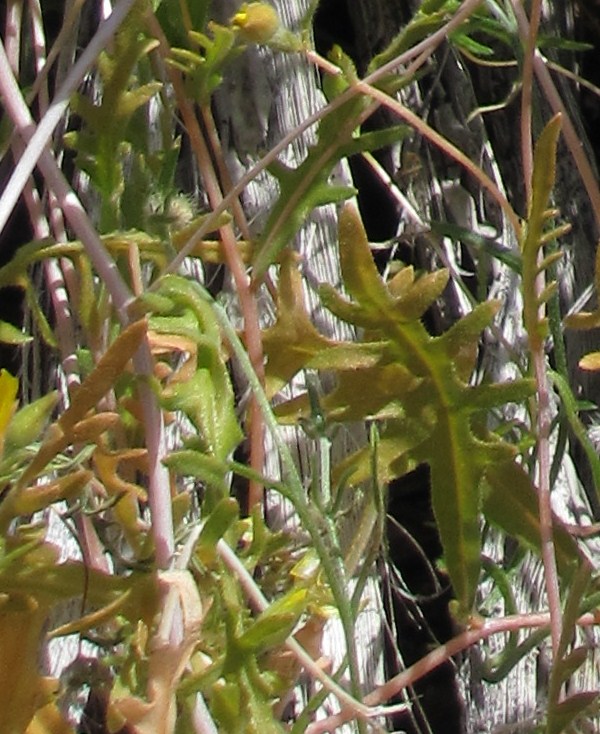
The stems form a spreading rigid patter, with the tips often spine-like. The leaves are small.
Two-lipped flowers develop in pairs facing away from each other:
the upper lip is white to light violet and hairy,
while the lower lip is three-lobed and intense dark violet.
The leaves and flowers are sparse, but the bags makes them easy to spot from a distance. The calyx starts out as a base to the flower, reddish-purple in shade, and then as the flower ages, it expands into its distinctive bag shape. The dried flower eventually falls out the hole in the end.
and
Flowering is generally April through June, but the bags may last into winter, becoming dry and papery. The genus is named for Jose Salazar y Larregui, Mexican commissioner for the United States and Mexican Boundary Survey of 1848-55. The first time I saw it, on April 17, 2010, I only saw one bush, in a dry wash in the Eagle Mountains on the way to Carey's Castle. On a subsequent trip to the same area, on May 15, 2010, I saw them everywhere. I realized that the one I'd seen on my earlier trip was one of the early bloomers. It took me a long time to identify the plant, primarily because I was focused on the white bags, which I thought were the flowers. The information for this post has come from Wikipedia, Salazaria.

Sunday, June 20, 2010

White Tidytips or Whitedaisy Tidytips

White tidytips,
also known as whitedaisy tidytips and white layia (Layia glandulosa) is found in the western United States from Washington to Arizona and New Mexico. It has an erect stem and grows to a height of about 18 inches
and has white ray flowers wipped with three equal sized teeth.
The flower has a yellow disk in the center. It has green, narrow leaves with sticky hairs.
I found these in May 2010 along Cima Road in Mojave National Preserve.

Saturday, June 19, 2010

Cooper's Goldenbush

Cooper's goldenbush (Ericameria cooperi)
has yellow flowers that bloom from March to June
with a head at the end of the inflorescence that is narrowly bell-shaped.
It often does not, but can have up to two ray flowers and has four to twelve disk flowers. 
It has green leaves, narrow, linear and ending in a point. 
It is found in southern Nevada and portions of southern and eastern California.  
I found them along the Baker grade off an offramp of the I-15 short of Halloran Summit in May. They really stood out (both the green leaves and the yellow flowers) among the surrounding plants that, for the most part, had very little color.

Friday, June 18, 2010

California Evening Primrose

The California evening primrose
(Oenothera californica) flowers with four white petals,
fading pink.
The flowers droop in bud and become erect as they bloom.
Young plants have a basal rosette of leaves and older ones have leaves along the stem, lance-shaped to nearly oval in shape.
It is found in Southern California, southern Nevada, southeastern Utah, and portions of northwestern and central Arizona.
I found these in May 2010
along the lower portions of Cima Road
in the Mojave National Preserve.

Thursday, June 17, 2010

Indian Paintbrush


Indian paintbrush (Castilleja affinis)
is found through large portions of California.
Castilleja is a genus with many species
of Indian paintbrush which I have not tried to differentiate in this post. The flowers are edible and sweet
and were consumed by American Indians
as a condiment with fresh greens.
They absorb and concentrate selenium in their tissues from the soils in which they grow, so it can be very toxic if the roots or green parts are consumed. It should be avoided as food if found growing in highly alkaline soils. Some Indian tribes in Nevada used it to treat venereal disease. It has an erect stem which is greenish to purple in color. The leaves are variable in shape and the inflorescence is a series of bracts in shades of bright red to yellowish.

Wednesday, June 16, 2010

Spiny Hopsage

Spiny hopsage,
also known as hopsage (Grayia spinosa)
is a low growing, brushy shrub with pointed stems that become spines. It is dioecious, which means that there are male plants and there are female plants. Male plants have spike-like staminate inforescences. It has a flower with four lobes and four stamens. I did not get pictures of any male plants. Female plants produce seeds attached to leaf-like bracts (those below just starting to turn red)
that turn red with age.
These were the plants I focused on because of their beautiful color. I was driving through the Mojave Desert recently, on the way to Utah, and stopped along the road along the upper Baker grade. I saw quite a few of these bushes and was attracted to the red leaf-like bracts which I thought were flowers. On the way back from Utah, I took a detour off the I-15 along Cima Road, into the Mojave National Preserve. I saw a few hopsage there as well, but nothing like what I saw along the Baker grade. The leaves are variable on the same plant.
Some leaves are small and fleshy.
On the same plant, other leaves will be larger and flatter.

Tuesday, June 15, 2010

White Stemmed Blazingstar or White Stemmed Stickleaf

The white stemmed blazingstar or white stemmed stickleaf (Mentzelia albicaulis)
is very similar to the Jones blazingstar or Jones stickleaf (Mentzelia jonesii) and I ultimately decided this was the former, rather than the latter, but I'm not completely sure.
I ultimately made the decision based on the prominent white stems of the plant
which I photographed very near Carey's Castle in the south portion of Joshua Tree National Park, as well as the flowers which I think are a little smaller than the Jones blazingstar.
There are a number of members of the Mentzelia genus in Riverside County and some of the differences between species are very small.  The plant I found was intermeshed with the dead fronds of a Mojave yucca.
The beautiful yellow flower has five petals. Some have orange at the base
and the flowers are followed by s-shaped seed capsules. The leaves are green, hairy, and elliptic to lanceolate (shaped like the head of a lance, narrow and tapering toward the apex) in shape, as well as pinnately lobed (leaflets arranged on each side of a common stock).
The white stems are mostly hairless.