Sunday, June 19, 2022

Sally Lightfoot Crabs

Sally Lightfoot crabs were the color, the spice, the accent to the other wildlife we encountered in the Galapagos Islands. They were rarely the star of the show, but always added to whatever we were viewing. They are not limited to the Galapagos Islands, but are found along the west coast of Central and South America. 
At Bachas Beach on Santa Cruz Island. 

At Elizabeth Bay, Isabela Island.
Adults are a deep blue and red with a white or pale blue underbelly. Younger crabs are darker with red spots. As the crabs moult their shells the spots get larger until they obtain adult coloration. 
At Espinoza Point on Fernandina Island. They seemed to be everywhere on Fernandina. 


They eat ticks off of the marine iguanas. 

At Tagus Cove with penguins. 
Charles Darwin collected them on his voyages of the Beagle and John Steinbeck wrote about how difficult they are to catch: "they have remarkable eyes and an extremely fast reaction time...They seem to be able to run in any of four directions; but more than this, perhaps because of their rapid reaction time, they appear to read the mind of their hunter." 

They were even more ubiquitous than the sea lions. 

Saturday, June 18, 2022

Galapagos Sea Lion

The Galapagos sea lion is endemic to the Galapagos Islands and is the smallest species of sea lion. For quite a while it was considered a subspecies of the California sea lion, but genetic testing supported treating it as a separate species. 
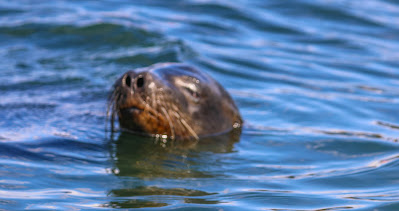
Showing its head at Elizabeth Bay while we were looking at marine iguanas, penguins and blue-footed boobies. 
Males have a thicker neck, chest and shoulders compared to their abdomen. The male also has a sagittal crest (a line running lengthwise along the skull) which creates a bump-like projection on the forehead at sexual maturity. Females have a longer, more slender neck and a thick torso and females and juveniles have a nearly flat head and little or no forehead. 
They were everywhere at Espinoza Point on Fernandina Island. This very large male made huge noise as it paddled around in a pool surrounded by marine iguanas. Note the bump on the forehead. 


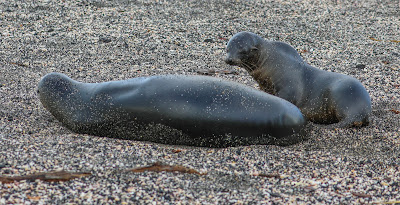
A mother nursing her pup got lots of attention. 


We saw them virtually everywhere. While we were waiting to be initially transported to our yacht by panga in Puerto Ayora, Santa Cruz Island, they were sleeping on nearly every bench at the dock. It was common to sea them while snorkeling, including a number of very close encounters. 
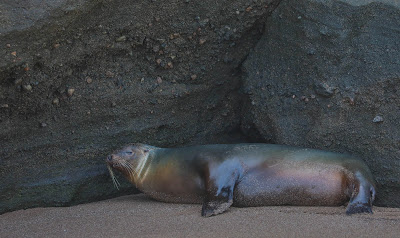
We saw lots of sea lions along the shore of Santiago Island. 


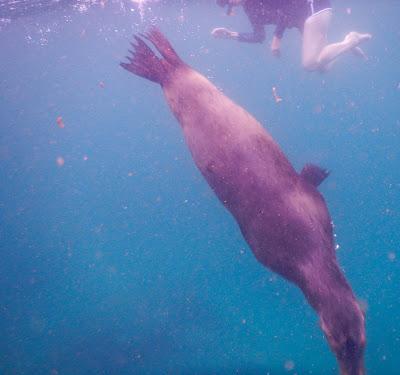
As well as snorkeling. Note this big sea lion swimming between me and Judy (above back). 


They were popular with the passengers to the point where our guides would focus on them rather than other rarer sightings of birds, etc., to my chagrin. For example, we had only one sighting of a few nazca boobies near Vicente Roca Point, Isabela Island, and our guide immediately moved to a group of sea lions nearby and focused all of his attention on them, although we'd only looked at the boobies for 15 or 20 seconds. 

They were fun, but they were everywhere. 

Friday, June 17, 2022

Galapagos Fur Seal

Sea lions and fur seals make up the family Otariidae: the eared seals. There are seven species of sea lion (Steller's, Australian, South American, New Zealand, California, Japanese and Galapagos)  and nine species of fur seal (Antarctic, Brown, Galapagos, Guadalupe, Juan Fernandez, New Zealand, South American, Subantarctic and Northern). Of note, two of the sixteen, one species of sea lion and one species of fur seal, are endemic to the Galapagos Islands. 

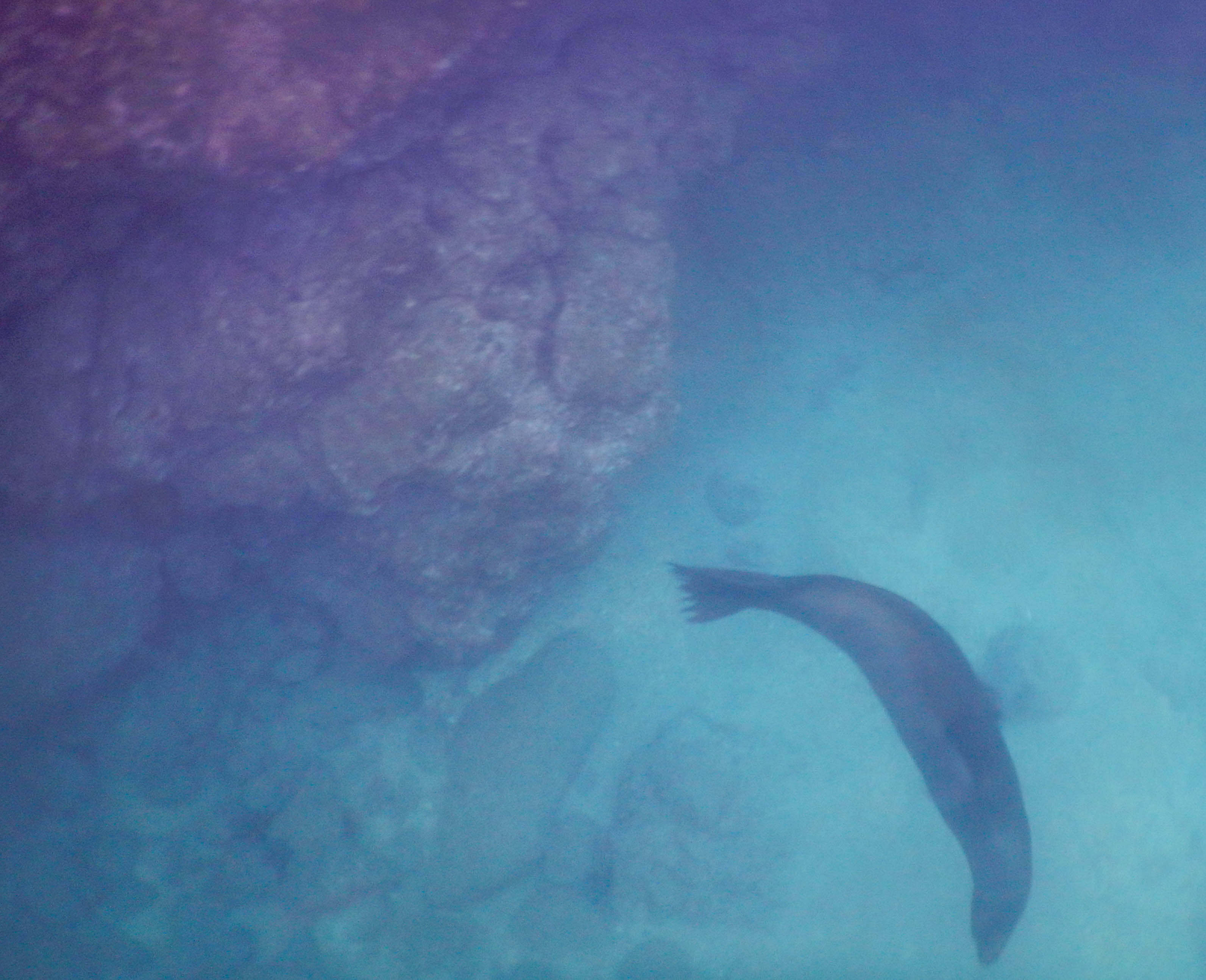
The Galapagos fur seal is the smallest eared seal and there are an estimated 10,000 to 15,000 of them. Males are twice as heavy as females and 1.3 times longer. They are usually found along rocky shorelines on ledges or in crevices. They primarily eat at night, because their food is easier to catch then, and thus they have developed large eyes. They are listed as endangered by the IUCN. 
We saw them only once while in the Galapagos Islands. We were on Santiago Island and in a panga heading northeast from Espumilla Beach. A parent and pup were wedged under a huge boulder just yards away from the ocean.  


Thursday, June 16, 2022

Magnificent Frigatebird

The frigatebird is a bird I've wanted to see since a child, the male's huge red gular sac enveloping its breast during breeding season is an image once seen, not forgotten. 

We encountered the magnificent frigatebird, one of five species of frigatebird, first in Panama as we took a motor boat out to the monkey islands, part of the Panama Canal complex. They were large and very distinctive flying high above us and I got photos of one eating a fish. 
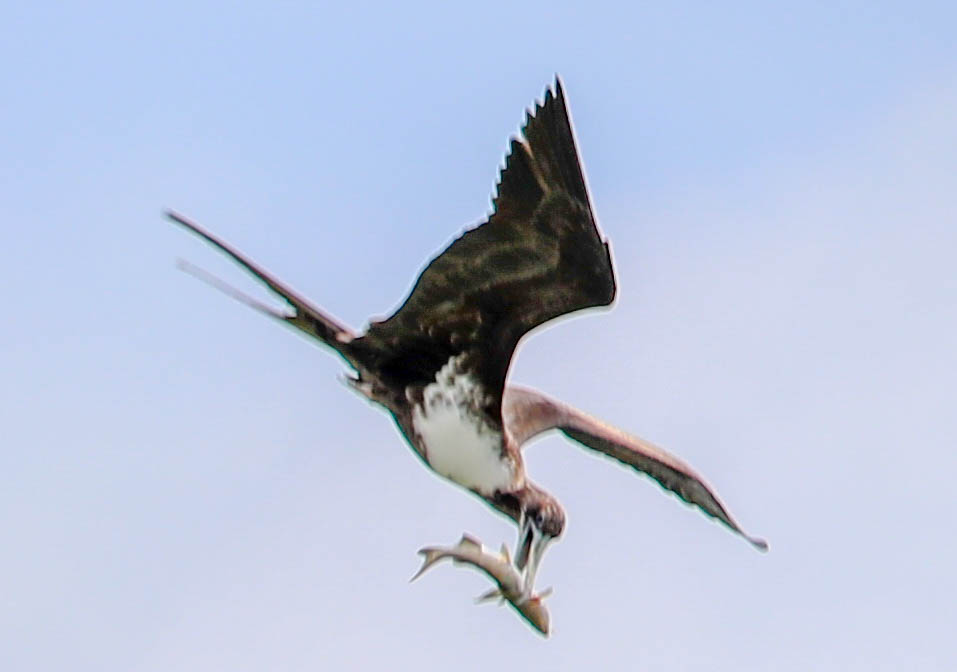
This series of photos captures a female in flight, trying to get a fish it has caught turned and headed into her stomach. 


One other female flying overhead. 
Later that day we visited Miraflores Locks, actual locks in the Panama Canal, and they were continuously flying above the locks. I never did sea one dive after a fish and I watched them quite awhile. 
The only photo that I have which captures the male and its deflated gular sac. This was above the Miraflores Locks. 

These other photos are of females. 


We also encountered them in the Galapagos Islands. In particular, we saw them outside Elizabeth Bay on Isabela Island. In fact as we took our small boat back to the yacht one afternoon I saw two huge black birds standing at the top of the boat that I didn't recognize. The guide told me they were frigatebirds. Once we landed I went up to try and get a photo and they flew: I did get flight photos, but none while they were standing. 
These photos of a male from our yacht outside Elizabeth Bay do not show the gular sac. 


Male magnificent frigatebirds are all black with a red throat patch that it inflates like a balloon during breeding season. Their shoulder (scapular) feathers have a purple iridescence in sunlight, one of the few ways of distinguishing the "magnificent" from the "great" frigatebird (which has green iridescent shoulder feathers in sunlight). Females are mostly black, but also have a white breast and lower side neck, a blue eye-ring and a brown band on the wings. Juveniles have a white head and underparts.