Wednesday, December 23, 2015

Church of the Holy Spirit - Heidelberg

The Church of the Holy Spirit is in the middle of the market place in Heidelberg, not far from Heidelberg Castle.
Heidelberg Castle is in the background. The Hercules statue on the Hercules Fountain in the market place is in the foreground. The Church of the Holy Spirit is to the right of Hercules.
The Church of the Holy Spirit viewed from Heidelberg Castle. The Neckar River is in the background. 
The Church of the Holy Spirit. The Hercules Fountain is in front of and just to the right of the church. 
It houses the Evangelical Church in Baden, a united Protestant church which is a union of Lutheran and reformed Protestant churches, but there have been times in its history when it housed both Catholic and Protestant churches (from about 1706 to 1936), with physical dividers inside the church that allowed both groups to meet at the same time. 
View of the altar from the front of the church.
The altar.

Organ
Front of the church from near the altar.

Ceiling ornament.
Ceiling mural.
The current church is the third on the site. The foundations of the church were laid in 1398 on the site of a Romanesque basilica. That basilica was erected over the site of an even older church. Construction took over 150 years. The choir was finished in 1411, the nave in 1441. Then work stopped until 1508 and the tower was finished in 1544. In 1633 it was set on fire by the French army of King Ludwig XIV in the Palatine War of Succession. The damage required reconstruction of the roof in 1709, including a new spire, in a baroque style.
Baroque spire
The Palatine Library, or Bibliotheca Palatina, numbered 5,000 printed books and 3,524 manuscripts and was the most important library of the German Renaissance. The library began in the 1430s because the Church of the Holy Spirit had good light for reading. The library included: (a) The Lorsch Gospels, an illuminated Gospel Book written between 778 and 820, coinciding with Charlemagne's rule over the Frankish Empire. The manuscript and the carved ivory panels from the cover were rare and important from the art of that period. (b) On The Art of Hunting with Birds, a treatise in Latin on ornithology and falconry written in the 1240s by the Holy Roman Emperor, Frederick II of the House of Hohenstaufen, who dedicated it to his son Manfred. (c) The Codex Manesse, a medieval songbook which was written and illustrated between 1304 and 1340 in Zurich for the Manesse family. It is the single most comprehensive source of Middle High German Minnesang poetry. (d) The Survey of Saxon Law, the most important law book and custumal of the German Middle Ages, written in 1220 as a record of existing customary law. During the Thirty Years War Heidelberg was sacked by the Catholic League in 1622. The majority of the Palatine Libratry was presented to Pope Gregory XV as a sign of loyalty and esteem by Maximilian of Bavaria. Pope Gregory incorporated the manuscripts into the Vatican Library where the majority of it remains today.

The "Physics" window was one of a number of stained glass windows that had to be replaced when bomb blasts set off to destroy the bridges on the Neckar River by the departing German troops during World War II destroyed them. This replacement window is by Johannes Schreiter. The date the atom bomb was dropped on Hiroshima is inserted (August 6, 1945) as is the equation developed by the German scientist (Alfred Einstein) that made the atom bomb possible.  Two scriptures are also inserted: 2 Peter 3:10 ("the elements will melt with fervent heat; both the earth and the works that are in it will be burned up") and Isaiah 54:10 ("Though the mountains be shaken and the hills be removed, yet my unfailing love for you will not be shaken"). Schreiter developed this window as one of a series of windows to honor the Palatine Library. He had other proposed windows on music, literature, philosophy, chemistry, biology, medicine, physics, economics, media and traffic. The designs were too radical for the church so they opened up a competition for the remaining windows and selected another artist. There is also a bronze model of an atom in the church. I have to assume that the fact these two items are together in the same church is not a coincidence.
Physics Window


Other stained glass in the church.


Gargoyles on the outside of the church have a trough cut in the back to channel rainwater through an open mouth away from the side of the building to keep it from eroding the mortar. The elongated shape gives greater distance to the water.


Outside the Church of the Holy Spirit in the Market Place (Marktplatz), the largest square in Heidelberg, is the Hercules Fountain, built between 1706 and 1709 by the Hungarian sculptor Heinrich Charrasky as a reminder of the immense efforts required to rebuild the city after its almost total destruction in the War of Palatinate Succession from 1689 to 1693. The original statue is in the Kurpfalzisches Museum, what is there today is a copy.


The Hotel Ritter is across the street from the Church of the Holy Spirit.
Fun carvings in the stone of the Hotel Ritter.

Tuesday, December 22, 2015

Ghana

On a Wednesday in May 2014, after completion of the East Africa portion of our trip, we flew from Nairobi, Kenya at 9:30 a.m. to Accra, Ghana where we arrived at 12:10 p.m. (it was a 5 hour, 40 minute flight). We were met by my cousin, Russ, who was an LDS missionary in Accra. Russ and his wife, Shelley, lived in LDS Church owned housing in Accra right next to the LDS Temple. We slept in an empty apartment in the same complex and were able to wash our clothes and then go to a session of the Ghana Temple that evening.
     Africa: Ghana Overview  (Judy)

Thursday morning we set out in Russ and Shelley's car for the Gold Coast. Our first destination was an unplanned stop at the old slave trading Fort Amsterdam, previously owned by both the Dutch and the English. It is currently abandoned and open without restriction. We looked for Anomabu Fort and were unable to find it, so we continued on to Cape Coast Castle, a slave trading fort previously owned by the English, where we took a tour. We ended the day with a swim (in a pool and in the ocean), a meal and a good night's rest at Coconut Grove Beach Resort in Elmina.
     Africa: Ghana, Fort Amsterdam  (Judy) 
     Africa: Coconut Grove Beach Resort in Elmina, Ghana  (Judy)

Friday we had a 180 mile round-trip drive from Elmina to Axim, partially along a dirt road in a downpour that produced copious amounts of mud on our car. Winding roads, carts pulled by animals, woman walking with packages on their heads, local produce for sale along the side of the road, all were fun images as we spent quite a bit of time driving. In Axim, we visited the Portuguese and then Dutch owned Fort St. Anthony, in one of the most beautiful beach-front settings I've ever seen. We had a very nice breakfast and dinner at Coconut Grove Beach Resort and also enjoyed the resident wildlife: vultures in the trees above the pool, caged monkeys, a walled enclosure with crocodiles and agama lizards basking on the walls.
     Africa: Ghana Driving, Elmina to Axim  (Judy)
     Africa: Ghana, Fort St. Anthony  (Judy)
     Fort St. Anthony - Axim, Ghana  (Bob)
     Hooded Vulture  (Bob)
     Red-Headed Rock Agama  (Bob)

Saturday we drove to nearby Elmina and visited Elmina Castle and Fort St. Jago (built to defend Elmina Castle), Portuguese and then Dutch forts. We had a leisurely lunch at the Coconut Grove Bridge House, situated between the two forts, then walked through the local market which was both a little scary and fascinating. Another night at Coconut Grove Beach Resort.
     Africa: Elmina Castle (aka St. George of the Mines)  (Judy)
     Elmina Castle - Ghana  (Bob)
     Bats at Elmina Castle in Ghana  (Bob)
     Africa: Elmina, Ghana  (Judy)
     Food in Ghana  (Bob)
     Northern Red Bishop  (Bob)

Sunday we had a remarkable visit to Cape Coast. Russ's parents were the first LDS missionaries to West Africa. So the day was steeped in significance as we went to Sacrament Meeting at the LDS Green Hills Branch, then visited the shed where the Reverend Billy Johnson held LDS meetings before there were any LDS members. We visited the home were Russ's parents lived during their stay in Cape Coast and we visited the beach where the first LDS baptisms took place in Ghana. This was a wonderful convergence of our slave trading great great great grandfather who visited the Gold Coast to obtain slaves and Russ's parents who visited the same place on decidedly more friendly and constructive terms. Afterwards we visited Anomabu Fort where our ancestor slave trader had visited and soaked in the sights and sounds and beauty and horror of our family's divergent experience in this land. We drove back to Accra and had a flight out at 10:10 p.m.
     Africa: LDS Church in Ghana, Part I  (Judy)
     Africa: LDS Church in Ghana, Part II  (Judy)
     Pied Crow  (Bob)
     Africa: Ghana, Fort William (aka Anomabu)  (Judy)
     Redemption of a Slave Trader: Captain George Cannon and Edwin Q. Cannon, Jr.  (Bob)
     Africa: Driving Back to Accra, Flying Home, and a Few Final Thoughts  (Judy)

Monday morning we landed at LAX at 10:10 a.m. after a three hour layover at JFK in New York and 17 hours of total flight time.

Sunday, December 20, 2015

Great St. Martin Church - Cologne, Germany

The history of Great St. Martin Church in Cologne is complicated. 
Great St. Martin Church in Cologne, Germany.
The site was originally an island in the Rhine and had a building on it dating from the 1st century CE. No similar structures from this time period north of the Alps have been found and so no one knows what the use of the building was. In the 2nd century CE additional buildings were built and they appear to have been used as a storage for market goods shipped on the Rhine. Then it appears that a church was built on the site by Bruno the Great between 953 and 965. In 989 the church was turned into a monastery for Benedictine monks from Ireland. The local archbishop, Pilgrim of Cologne, did not want the presence of the Irish monks and he pushed for their removal. The last Irish abbot, Arnold of St. Martin, died in 1103. In 1150 a fire burned most of Cologne and the entire church was probably destroyed. The Archbishop of Cologne, Philipp I. von Heinsberg, directed the building of a new church and a form of what the current church looks like was built: three round apses meeting in the shape of a cross. Bits and pieces were added to it over the years until it was completed in the 13th century. A fire in 1378 destroyed the roofs of the four towers. A storm in 1434 blew down three of the four gables on the towers. 
It looks massive from well below ground level.
During the French Revolution, in October 1794, Cologne was captured by the revolutionary army and occupied for 20 years and an anti-clerical movement began. The archbishopric in Cologne ended in 1801 and the cloister at Great St. Martin was disbanded in 1802. In 1808 the abbey building was a living quarters for French veterans and it was later demolished for use as building materials in other parts of the city. In 1843 the city of Cologne decided to finance the restoration of the church. It was completed in about 1875. 

During World War II Great St. Martin was virtually destroyed by bombing. After the war significant thought was put into whether to rebuild Great St. Martin or to leave it as a war memorial. It was decided to restore it and restoration efforts began in 1948. It was completed in 1985 and opened to worshipers, after an absence of 40 years. 
Glimpses of the church loom above narrow alleys.
As of 2009, Great St. Martin is being used by a branch of the Monastic Fraternities of Jerusalem which promotes the spirit of the monastic desert in the heart of cities.  

When we visited a mass was going on and we did not get to visit parts of the church. Parts that we visited are extremely barren. It has the sense of an abandoned warehouse. I suspect that may be part of the program of the monastery now with its emphasis of a desert in the heart of a city. 
The outside of the structure is very impressive. It has one main spire surrounded by four smaller ones. It reminds me of an Apollo moon launch with booster rockets attached to the sides. 
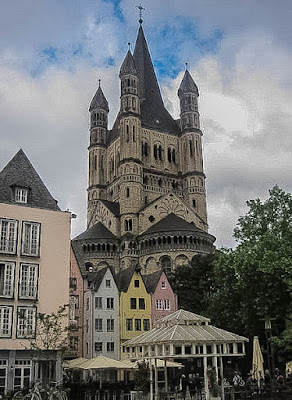
It dwarfs the buildings around it. 
The most interesting part of the church is a section of the stained glass windows that are haunting. I may be interpreting them completely wrong, but they are very modern, very stark and seem anti-war. They seem skeletal and bloody, perhaps a commentary on Germany's involvement in the war? 

This is a section of the window above. 
Another section of the window two above.
The darkened eyes convey an image of sadness.
More dark eyes.

This is a segment of the window above. It appears a large knife is in one hand and on the other side is a severed arm.
This is also a segment of the window. 

This is a segment of the window above. At least this one has some color in it other than black and red - some blue and several shades of green. This is not as haunting, a little more upbeat. Perhaps rebuilding from the ashes?
I also ran across several German versions of the Stations of the Cross with the participants in medieval German garb. 

Finally, there were several mosaic floor decorations that were kind of fun.

Friday, December 18, 2015

St. Thomas Church - Strasbourg, France

St. Thomas Church (Thomaskirche in German or Eglise Saint-Thomas in French) is located in Strasbourg, France and is the Lutheran cathedral for Lutheran Protestantism in the Alsace Region of France (which stretches along the French side of the Rhine from Basel almost to Karlsruhe). Its nickname is the "Protestant Cathedral" or the "Old Lady." 
St. Thomas church as viewed from the platform of Strasbourg Cathedral.
The narrow streets of Strasbourg make it difficult to get a comprehensive view of large structures like churches. 
Another partial view from another narrow street.
The same view from a different direction.
Beautiful clock between columned arches.
The church site has been a place of worship since the 6th century when Scottish monks arrived here. Bishop Adeloch, the first bishop of Strasbourg, who lived from 786 to 823, built a Carolingian Church on this site, but it burned down in 1007, was rebuilt and burned again in 1144. In 1196 another church was started. The present front of the church is from 1230 to 1250. The inside was begun between 1260 and 1270 and was completed in the 14th century. In 1524 it converted to Protestantism under Martin Bucer, the pastor from 1524 to 1540. Martin Bucer was an important reformer. He acted as a mediator between Martin Luther and Huldrych Zwingli in their debates over the Eucharist and worked with other reformers including Philipp Melancthon and Thomas Cranmer in England. The church has remained Protestant ever since, despite the town being predominantly Catholic since the annexation of Strasbourg by France in 1681. Under the Treaty of Westphalia, signed in 1648, each prince had the right to determine the religion of his own state, but Christians living in principalities where their denomination was not the established church were guaranteed the right to practice their faith in public during allotted hours and in private at their will.  
Looking toward the altar.
The altar as viewed from near the choir.
Typical of Lutheran churches, the inside of the dome is unadorned.
It is known for it organs. Its 1741 Silbermann organ was played by Mozart in 1778. In 1908, Dr. Albert Schweitzer started a tradition of concerts for remembrance of the anniversary of the death of J.S. Bach. He also played this organ. There is also a 1905 organ following a design by Albert Schweitzer. 
The pipes of the 1741 organ.
The original keyboard of the 1741 organ which was played by Mozart and by Schweitzer. The keyboard has been replaced and we heard the church organist, Professor Daniel Leininger playing it. It was amazing. 
A tribute to Schweitzer who started the Bach concerts. In 1906 Schweitzer wrote an extremely influential book, The Quest of the Historical Jesus, which summarized prior efforts toward and legitimized efforts in the historical criticism of the New Testament. 
And a tribute to Bach.
It has a number of monuments that are fabulous. One is the sarcophagus of Bishop Adeloch, the founder of the church and the first Bishop of Strasbourg. He lived from 786 to 823. The Romanesque sarcophagus rests on four crouching lions and has figures carved in the side, including one representing Bishop Adeloch.  
The sarcophagus of Bishop Adeloch.
Bishop Adeloch holds a shepherd's staff and faces Chris, his hand in the airt. 
Christ faces toward Bishop Adeloch and acknowledges him. 
A man riding a fish is on the far left-side of the sarcophagus. 
An angel (holding the burial linens?) is to the right of Christ.
Another great monument is the tombstone of Nikolaus Roeder von Tiersberg (who died in 1510). The tombstone depicts his decaying corpse. It reminds me of some of the men found alive in concentration camps of Nazi Germany. 
Nikolas Roeder von Tiersberg
Then it is hard to beat the late-Gothic (15th century) fresco of St. Michael. 
St. Michael
The Baroque mausoleum of Marshall Maurice de Saxe dominates the choir behind the altar. Marshal Saxe lived from 1696 to 1750 and had an amazingly distinguished military career. Among other things, he was made Marshal of France under King Louis XV and commanded a French invasion of Britain at Dunkirk in 1744 and defeated the Duke of Cumberland at the Battle of Fontenoy in 1745. King Louis XV initially tried to bury Maurice at St. Denis outside Paris, but because he was Protestant, no Catholic church would accept his remains. So in 1751 a procession accompanied his remains to another church in Strasbourg where civil and military leaders, including the king, all gathered together for a magnificent funeral. Louis XV arranged for J.B. Pigalle, a famous French sculptor, to do a monument for him. When it was finished, the remains of Marshal Saxe were transferred to St. Thomas in 1773. The mausoleum is one of the most amazing tributes I've ever seen. 
At the back of the monument is a pyramid. It symbolizes immortality. 
Marshal Saxe stands in the middle, balancing the composition, oblivious to the agitation going on. To his right is a lion (Holland), a leopard, although it looks more like a hyena (England), and an eagle (the Holy Roman Empire - Austria) which are beaten and placed on their broken flags. To his left are the flags of France which is victorious. At his feet, a skeleton (death) has opened the tomb of death which Marshal Saxe is moving toward. Hercules, representing the French army, is filled with pain. The woman (France) holds Marshal Saxe's hand and simultaneously pushes away death, which holds an hourglass. Behind the woman is a crying child (love), with the flame of her torch extinguished. 
A close-up of Marshal Saxe advancing toward his tomb, France pushing away death, and love crying in the background. 
Death beckons, holding an hourglass.
The French army is in mourning and defeated England, on its back, looks on. 
The rose window at the front is an original medieval leaded window. Many of the other stained glass windows were destroyed by Protestant iconoclasts in the 16th century. 
The rose window on the outside.
The rose window from the inside.
What appears to be the tombstone of a knight.
What appears to be another very old tombstone.
I would love to know what this represents.
This appears to be very old. Perhaps from the outside of the 13th century church.
I believe this is medieval stained glass. 
More medieval stained glass.
A modern painting that seems out of place, but I love it. I'm not sure what it represents, but it looks like it has layers that could represent some sort of burial. 
Another modern painting that appears to be from the same artist. This appears to represent fabric and may have something to do with the death of Christ. 
Strasbourg Cathedral dwarfs St. Thomas on the outside and in the magnificence of the architecture. Although Strasbourg Cathedral does have some wonderful inner monuments, nothing compares to the mausoleum of Marshal Saxe or the sarcophagus of Bishop Adeloch. St. Thomas Church is another treasure of Strasbourg.