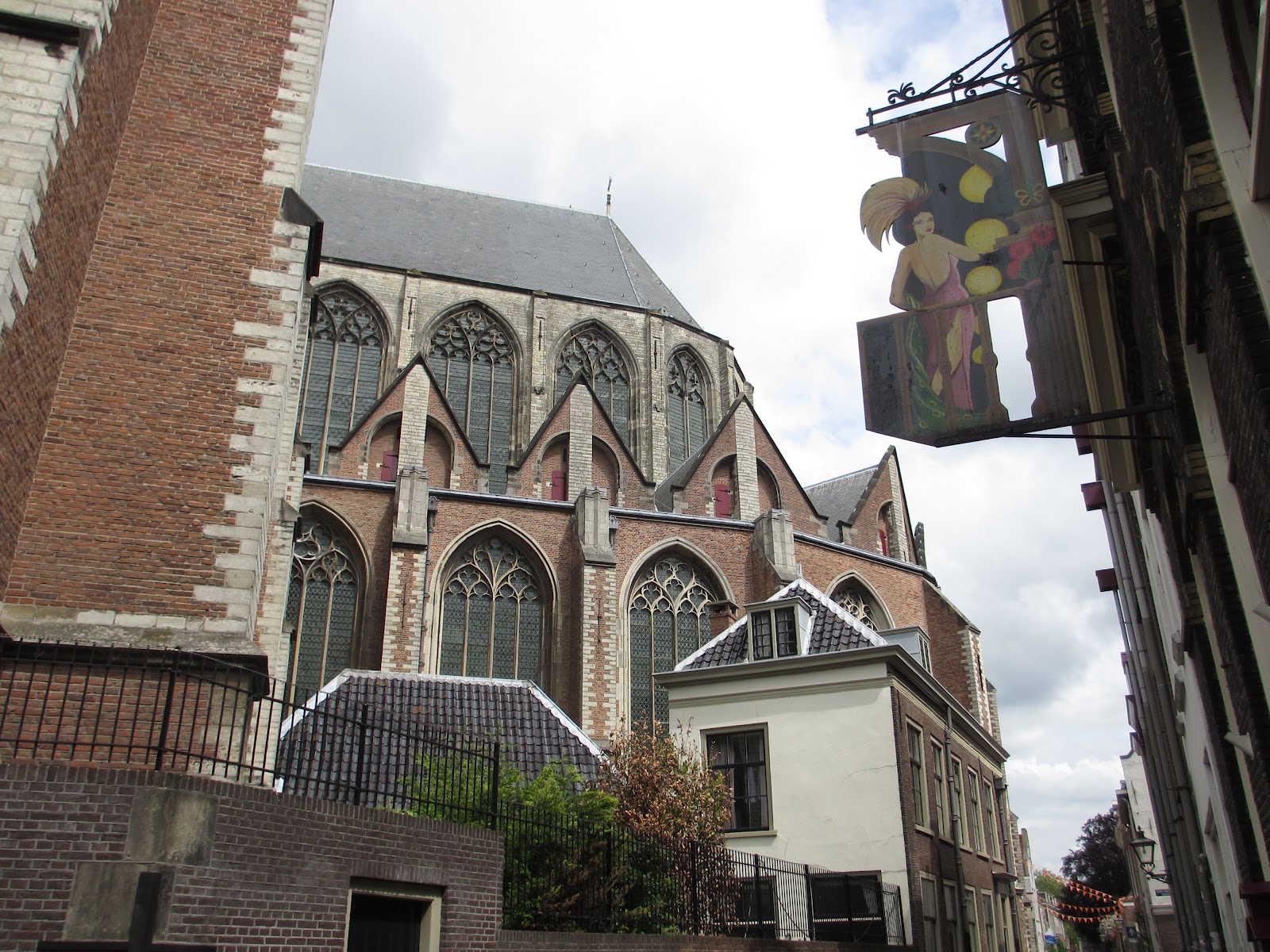
The Highland Church, known as the Hooglandse Kerk in Dutch, but called that even in the church brochure written in English, and St. Pancras Church, is in Leiden, Netherlands. It is built in the form of a cross, but it is very difficult to see the cross without some real examination. The red entrance doors below are at the end of the right side of the cross bar. The bottom of the cross is to the left and the top of the cross is partly visible to the right.
The picture of Saint Pancras below is taken from the Citadel of Leiden, a fortress on a small hill erected in about 1150. It shows the building from a higher vantage point on the other side. The high, closest end, is the left side of the cross bar.
The next picture, also taken from the Citadel, shows the bottom of the cross, at the right side, with a tower jutting up from the bottom. Lower outer layers of red brick project out from the higher silver gray brick and roof.
The portion of the church that is the bottom of the cross blends in with the houses on the street and it is difficult to tell where the houses end and the church begins. The red door, just visible toward the right side, is the entrance at the bottom of the cross.
House fronts connected to the church going up the right side of the bottom of the cross and under the right side of the cross bar. This is one of the unusual elements we found in Dutch churches: houses attached to the churches. I still don't have a good explanation for them.
The upper right side of the semi-rounded top of the cross. Note again, buildings connected to the church and obscuring the outlines of it.
The origins of St. Pancras began in 1314 when the bishop of Utrecht gave the people of the area permission to build their own church. The first structure was made of wood and was completed in nine months. A stone structure, to replace it, was started in 1377. Over the years, additions were made. In 1470, Pope Paul II put the church under his direct authority, exempting it from jurisdiction of the Archdiocese of Utrecht. With the increased status, expansion of the structure began in 1480, continuing to 1535, which brought about the current form. A bronze plaque on the side of the church shows its dimensions at various stages.

In its heyday in the Middle Ages, it had 24 altars dedicated to 54 different saints. In 1525, there were discussions about making the Highland Church the third bishopric in the Netherlands, which would have made it a cathedral, but a church in Haarlem was named in its stead. In August 1566 during the "beeldenstorm" (the "statue storm") Calvinist iconoclasts ransacked the church, destroying the furnishings, artworks and archives almost entirely. The organ, built in 1565, was also badly damaged. This was part of the Dutch Revolt against the militant religious policies of Roman Catholicism pushed by Philip II of Spain. Later, in 1572, St. Pancras was officially named a Protestant church. The Protestant rebels surged again, in 1574, and while Leiden was under siege by Spain, St. Pancras was used for grain storage which further damaged the interior. In 1582 the organ was repaired, then in 1629 it was moved from the chancel to the nave and then enlarged in 1637. On January 12, 1807, a ship carrying 369 barrels of black powder on a canal in the center of Leiden exploded. Over 227 houses were destroyed and 154 killed, with about 2,000 wounded. St. Pancras was badly damaged and its demolition was considered. The painting below, shows Louis Napoleon, King of the Netherlands, appointed by his brother (French Emperor Napoleon), in Leiden the day after the explosion, in rescue efforts.

However, from 1840 to 1903 the church was rebuilt and restored. After World War II damage, the roofs and windows were repaired, and then it became apparent that a another complete restoration was required. That took place between 1950 and 1980, including restoration of the organ between 1970 and 1980.
Of all the Protestant churches I've been to in Europe, I think Saint Pancras is the most stark. It is so large and cavernous inside,
yet devoid of art and decoration,
that it feels unfinished, hollow.
It was obviously made to house great art and images and without them it almost has the feel of an empty warehouse. I normally love the simple Protestant churches, and this is an absolutely beautiful structure, but for me, this one does not work well.
Saint Pancras of Rome was a Roman citizen who converted to Christianity and was beheaded in 304 at the age of 14 during the persecution of Diocletian, about nine years before Constantine issued the Edict of Milan. He was brought before the authorities and asked to perform a sacrifice to the Roman gods. He refused and Diocletian was impressed with his determination and promised him wealth and power. But Pancras still refused and Diocletian ordered him decapitated on the Via Aurelia.
My favorite thing in the church was some art (I wish there was more of it): a series of three oil paintings which the artist painted while listening to radio coverage of the Hungarian Uprising in November 1956. A student demonstration in Budapest had led to the fall of the People's Republic of Hungary and the new government declared its intent to withdraw from the Warsaw Pact and have free elections. After the Politburo indicated a willingness to withdraw Soviet troops, it reversed course and sent Soviet troops into Budapest and other parts of Hungary to crush the revolution. Over 2,500 Hungarians were killed and 200,000 Hungarians fled as refugees. The first painting shows a man, woman and child in freezing cold, the woman barefoot, seeking refuge while the city burns behind them.

The second painting shows a television and newspaper with images of war and hunger. A clown cries, a man of science holds a dead owl, the symbol of wisdom, in his hands. A man with raised hands screams and next to him is a man in a German helmet with hands outstretched in the form of a cross. The Bible is opened to Matthew with verses predicting events in a troubled world and an image of Jesus sits on the television, on a red robe. Perhaps it is symbolic of the time before the second coming when Jesus will return in a red robe.
The third painting shows death playing a violin with broken strings. Above death is a white, heavenly, throne, perhaps also symbolizing that the end is near and the earth will be renewed.
Clockworks from 1607 that were restored in 2003.
A tombstone from the inside floor dating to 1688.
What appears to be another tombstone, this one on the side of a pillar.
The Netherlands is one of the most secular countries in Western Europe. About 23% of the people are Catholic (down from 40% in the 1970s) and 11% belong to the Protestant Church in the Netherlands or PKN (down from 60% in the early 20th century), about 1.8 million people. The PKN was formed in 2004 as a merger between the Dutch Reformed Church (which was about 8.5% of the population), the Reformed Churches in the Netherlands (about 3.7% of the population) and the Evangelical Lutheran Church in the Kingdom of the Netherlands (about .1% of the population).