Saturday, April 24, 2010

Woolly Daisy

The woolly daisy, also known as Wallace's woolly daisy and woolly easterbonnets (Eriophyllum wallacei)
 is a small, squat member of the daisy family which grows in clumps on short, erect stems.
The plant is covered in white cotton candy-like wool.
The flowers, which bloom from March to May, are yellow, but can also be a cream-white.
It is found in California east of the Sierra Nevada Mountains, in the San Gabriel, San Bernardino and Peninsular Mounts and in the Southern California deserts. It can also be found up to southwestern Utah, northwestern Arizona and into northern Baja. I photographed these near Carey's Castle in Joshua Tree National Park. They are so small that they can easily be missed. It appears that these were just barely coming up and I assume the plant gets larger later in the season. A number of my photos could not be used because they are out of focus, a problem when trying to photograph small subjects using a small, digital camera.

Friday, April 23, 2010

Chia

Chia (Salvia columbariae),
a member of the mint family,
grows in California, Nevada, Arizona, New Mexico and Sonora and Baja, California. The above photos were taken on the bajada just north of the I-10 freeway near the Cottonwood entrance of Joshua Tree National Park on April 3rd. Other photos were taken two weeks later, on April 17th, further east, off the Hayfield Road exit, on the bajada right before the Eagle Mountains.
It can grow to 20 inches tall
and has one or two dark purple spiky balls (flower clusters)
on a square stem.
Tiny two-lipped flowers
are pale blue to blue and purple tipped.
The lower lip is about twice the size of the upper lip.
The foliage rosette is gray-green, 2 1/2 to 3 1/2 inches in diameter and the leaves are quilted and deeply lobed.
It has edible seeds that were used by Indians in bread and for medicine.
Below, a mixture of living chia and last year's dead chia.
A close-up of some dead and dried out chia.

Thursday, April 22, 2010

Desert Princesplume

Desert princesplume, also known as prince's plume (Stanleya pinnata), is a member of the mustard family. It grows to five feet tall and has a long plume of yellow flowers that bloom from the bottom of the stalk upwards.
Each flower is about an inch long and the stamens extend even further.
The dried stems persist for a year or two. Stem leaves are lance-shaped.
It is conspicuous as its flowers generally stand above any nearby shrubs.
It thrives on selenium rich soils, so crushed stems or leaves can have an unpleasant odor and it can be toxic to livestock, although they rarely eat it unless other forage is available. It is found throughout the western and midwestern United States. I recently saw one only on an embankment above the California fan palms at the Cottonwood grove in Joshua Tree National Park.  

Wednesday, April 21, 2010

Desert Canterbury Bells

Desert Canterbury Bells,
also known as desert bells and desert bluebells (phacelia campanularia)
 have a blue, tubular flower with five broad lobes.
 It has dark green, heart-shaped, coarsely toothed leaves with a dark red border.
I was recently near the Cottonwood entrance to Joshua Tree National Park and off the Hayfield Road exit of the I-10 where we hiked to Carey's Castle.
 The desert Canterbury bells were one of the most prominent and common flowers we saw.

Tuesday, April 20, 2010

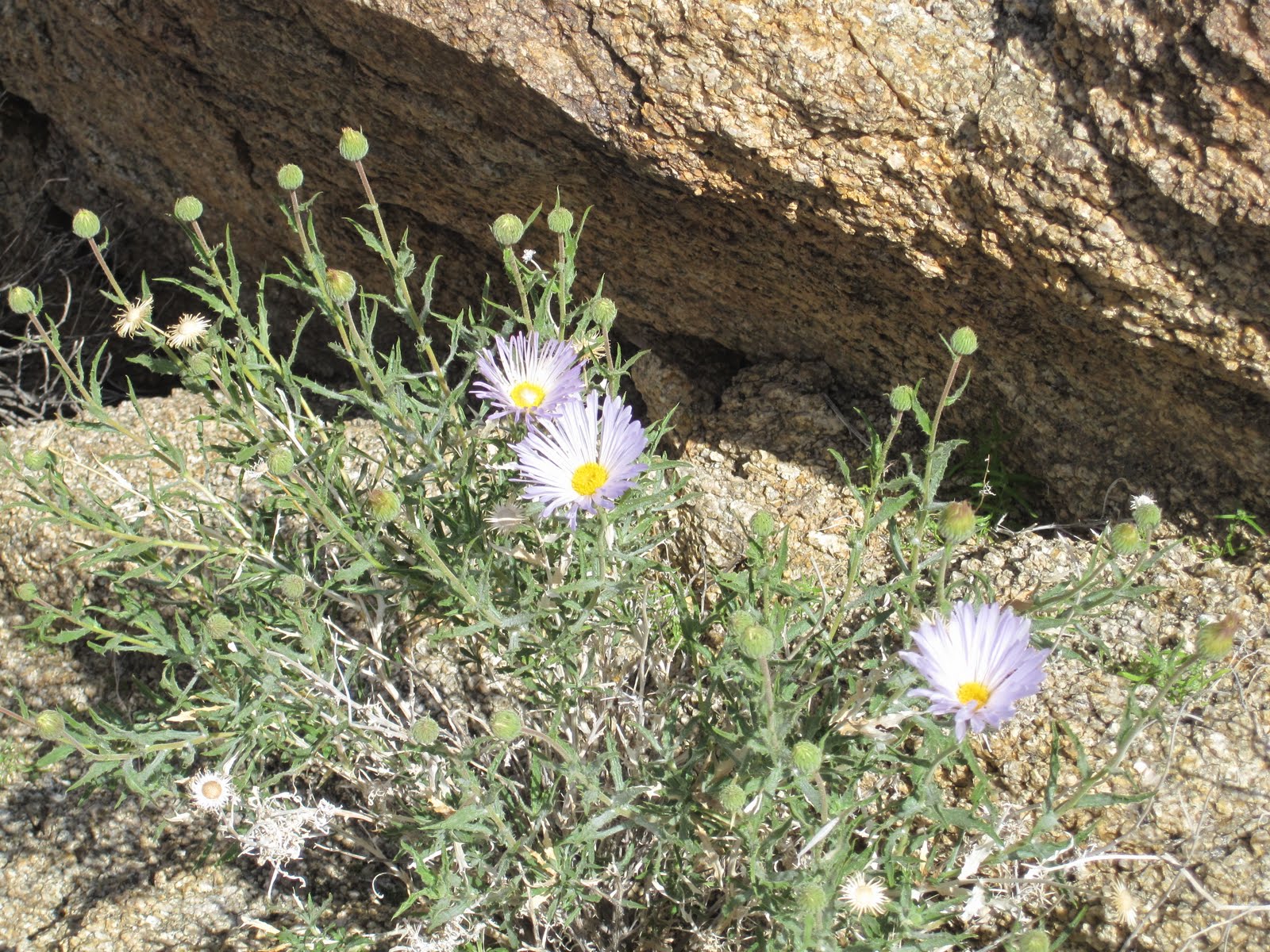
Mojave Aster

The Mojave aster (xylorhiza tortifolia),
a member of the sunflower family, is found in the Mojave, Great Basin and Sonoran Deserts of southeastern California, southern Nevada, southwestern Utah and western Arizona.
The Great Basin Desert is colder than the Mojave and the Sonoran is hotter and drier.
It grows in all three deserts, but grows more abundantly in the Mojave.
The flower consists of many whitish-purple to whitish-lavender narrow rays or petals that surround a yellow disk.
The flowerhead grows up to two inches in diameter.
It usually blooms in March to May and after flowering, the plant dies back. It has long gray-green stems that remain leafless near the top.
It has hairy leaves that grow from the base.
A plant can have as many as 20 flowers.
I saw quite a few of them recently in Joshua Tree National Park.

Monday, April 19, 2010

Yellowdome or Yellowhead

Yellowdome, yellowhead, yellow dome and yellow head
are all names for trichoptilium incisum, a small plant with yellow fluffball-type flowers found in California, Nevada and Arizona.
Yellowdome seems the most descriptive to me
as the fluffballs are dome-shaped.
It is a very small plant. I found this particular one in the southern portion of Joshua Tree National Park, the only one I saw in an entire day of hiking.
It was in the vicinity of Carey's Castle.

Sunday, April 18, 2010

Bigelow's Monkeyflower

Bigelow's Monkeyflower (mimulus bigelovii)
is a small pink flower
with yellow splotches in the middle
that I recently found near the Cottonwood entrance to Joshua Tree National Park.
I was near the California fan palms in the Cottonwood grove when I came across them and I was blown away by how beautiful they are.
Their only drawback is that they are so small, you really have to get down close to examine them to appreciate their beauty.
We found them later in the day off the Hayfield Road exit of the I-10 freeway, on our hike into Carey's Castle, but these were very, very small, just showing above the ground, more like purple mat.
They are one of my favorite wildflowers so far.