Tuesday, July 5, 2022

Elizabeth Bay, Isabela Island - Galapagos Islands

The afternoon of Tuesday, March 22, 2022, we visited Red Mangrove Cove in Elizabeth Bay, on the west coast of Isabela Island. Elizabeth Bay can only be visited by panga, no hiking is permitted. It is an area of mangroves surrounded by lava fields, small islets and rocky reefs. It contains one of the largest and most important penguin colonies in the Galapagos Islands. 
Elizabeth Bay is underlined in red. 
We saw penguins, sea lions, green sea turtles, brown pelicans, blue-footed boobies, frigate birds, striated herons and sharks. Our  broker that we worked with on the trip said that this is one of his places in the Galapagos Islands. Perhaps my expectations were up, but I was a little disappointed that we did not see more wildlife. 

Following are some photos:
One of the pangas on the way back to the Alya, moored in the distance. 

One of our pangas at a rocky islet with a blue-footed booby. 

This small island was near where our boat was anchored. 

Another yacht with Isabela in the background. 

Blue-footed boobies flying past the Alya.

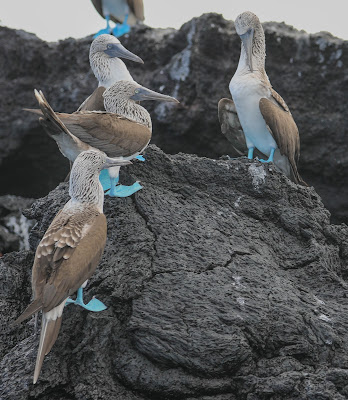
Blue-footed booby on rocky islet.


Galapagos brown pelican.

Galapagos sea lion. 

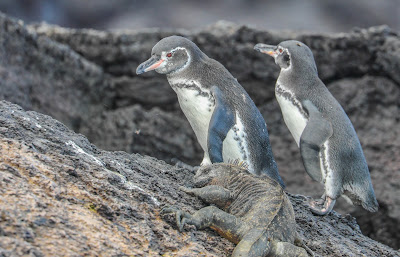
Galapagos penguin


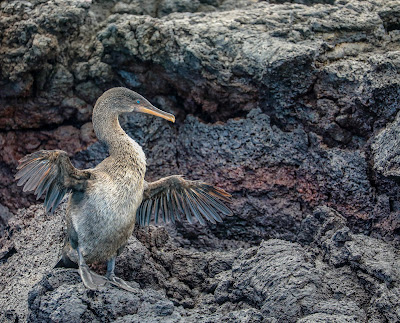
Flightless cormorant. 

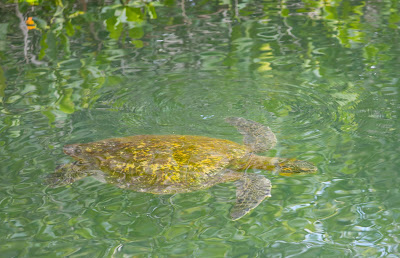
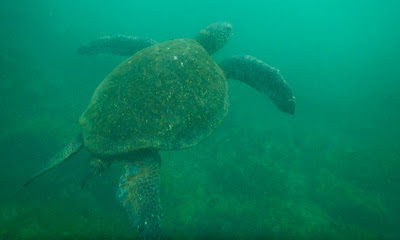
Green sea turtle


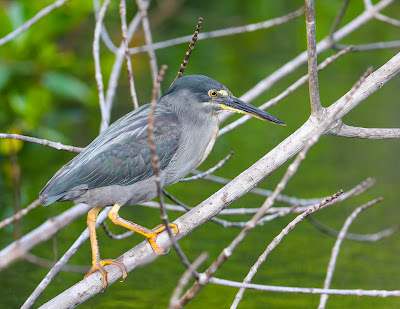
Striated (lava) heron. 

Sally lightfoot crabs.

Magnificent frigate birds photographed from the Alya.


Monday, July 4, 2022

Moreno Point, Isabela Island - Galapagos Islands

We got on our yacht, the Alya, in Puerto Ayora, on Santa Cruz Island, late Monday night, March 20, 2022. The Alya was anchored quite far out in the bay, so we were taken from the dock by panga (a small rubber boat with a motor) to the yacht. We ate dinner, then sailed during the night to Moreno Point, or Punta Moreno, on Isabela Island. Isabela is is the largest island in the Galapagos covering 1,792 square miles. It is more than half of the land area of the entire Galapagos archipelago and more than four times the land area of Santa Cruz Island, the next largest. As we sailed the waves were rocking the boat quite dramatically and many of us struggled to avoid sea sickness (some unsuccessfully). 
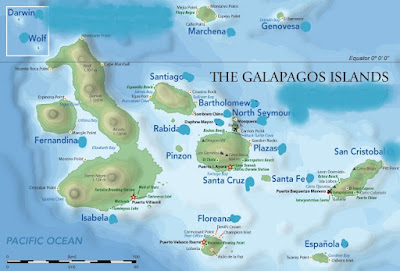
Tuesday morning, March 21, 2022, we got in two pangas (roughly 8 guests in each, along with a navigator in each and the naturalist in one of them) to explore Moreno Point. Moreno Point is on the southwestern coast of Isabela. It is at the base of a huge lava field leading up to the distant Cerro Azul volcano (at the far southwest end of Isabela), a shield volcano which is 5,531 feet in elevation, the second highest point in the Galapagos.  It last erupted in June 2008. It has brackish tidal lagoons, pools and mangroves and is a particularly good place for birds.  

We saw sea lions, striated herons, flightless cormorants, blue-footed boobies, marine iguanas, nesting brown pelicans, green sea turtles, penguins, shearwaters, brown noddies and ruddy turnstones.  Later that morning we went snorkeling and saw green sea turtles and orange rays. 

Following are some photos:
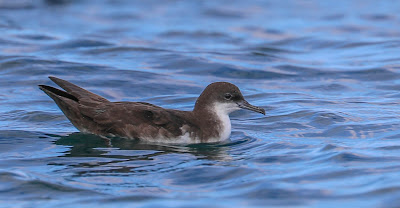
Galapagos shearwater

Flightless cormorant

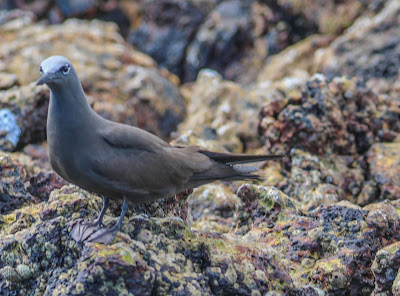
Brown Noddy

Blue-footed boobies


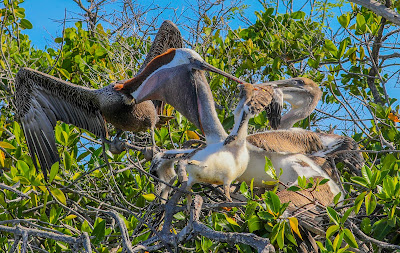
Galapagos brown pelican feeding its young. 


Galapagos penguins


Striated or lava heron. This one is an adult. The next photo is a juvenile. 


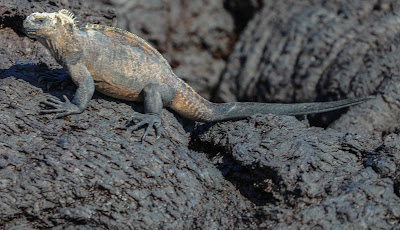
Marine iguanas


Green sea turtle

Green sea turtle while snorkeling.

Sunday, July 3, 2022

Galapagos Brown Pelican

 The brown pelican has five subspecies: (a) the Caribbean brown pelican, the nominate subspecies (occidentalis) breeds in the Lesser and Greater Antilles, the Bahamas, along the Caribbean coast of the West Indies, Colombia and Venezuela, and up to Trinadad and Tobago; (b) the California brown pelican (californicus) breeds along the coast of California and Baja California and goes as far north as British Columbia and as far south as Guatemala; (c) the Eastern brown pelican (carolinensis) breeds in the eastern U.S. from Maryland south along the Atlantic coast, along the Gulf Coast of the U.S. and down to Honduras, along both coasts of Honduras, Costa Rica and Panama, and non-breeding from southern New York to Venezuela; (d) the Pacific brown pelican (murphyi) is found from western Colombia to Ecuador and is a non-breeding visitor to northern Peru; and (e) the Galapagos brown pelican (urinator) is found only in the Galapagos Islands. 

I don't find anything that differentiates the Galapagos subspecies from the other subspecies. 

We saw lots of pelicans in the Galapagos. I give a smattering of photos:
In Elizabeth Bay on Isabela Island.

Feeding young pelicans from its pouch at Moreno Point on Isabela Island. We had our best viewings of pelicans, by far, at Moreno Point. Lots of nesting pelicans in mangrove trees. 


At Vicente Roca Point on Isabela Island.

On Santiago Island. 
 

Saturday, July 2, 2022

Galapagos Lava Lizard

The Galapagos lava lizard is also known as the Albemarle lava lizard (Albemarle is an alternate name for Isabela Island). There are 7 species in the Galapagos Islands and another 15 species along the Pacific coast of South America. Location is the best identifier as appearance alone is not enough to tell them part. 
Found at Tagus Cove on Isabela Island. 
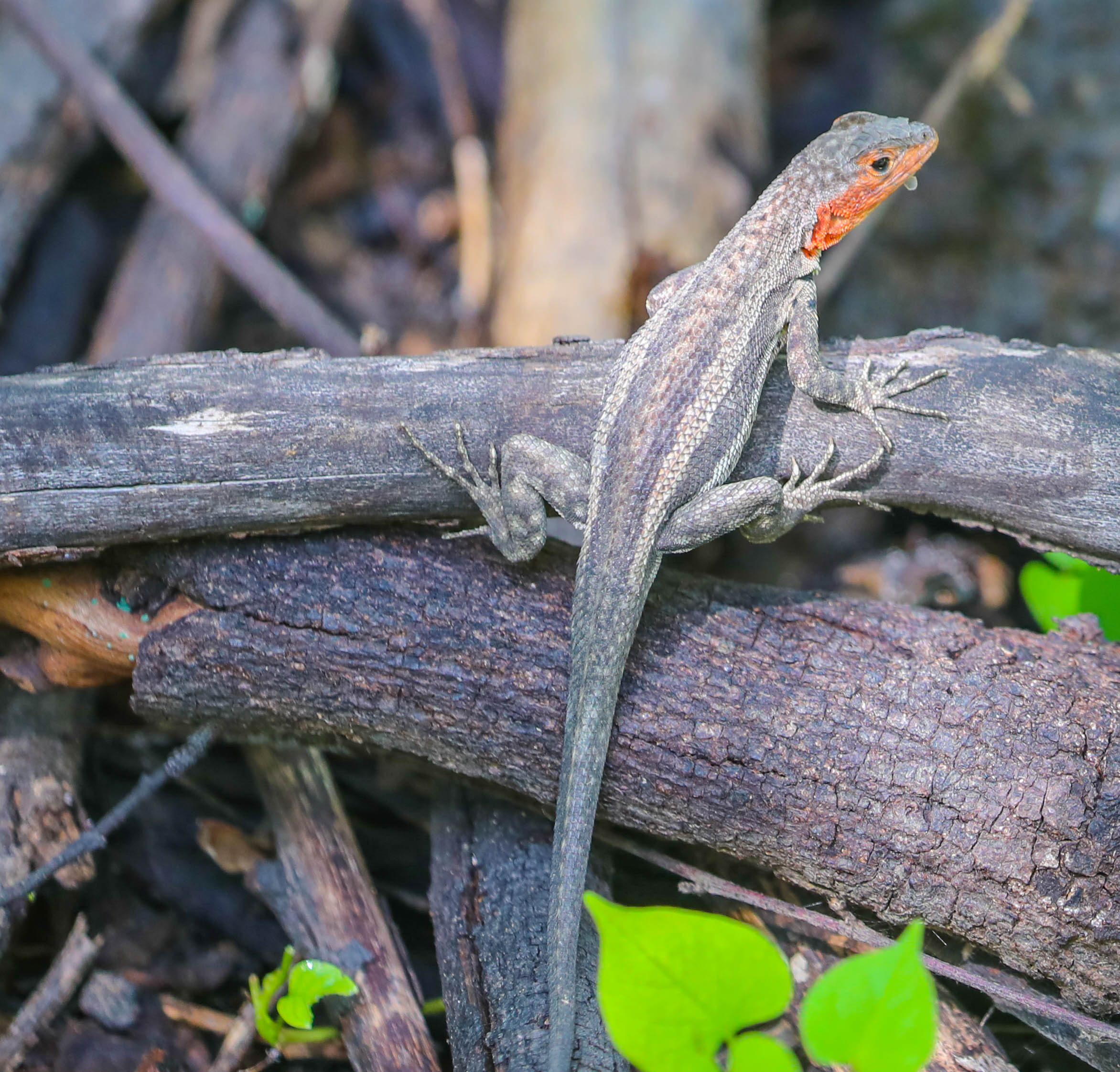
Males are 6 to 7 inches long and females are 4 to 7 inches long. The tail is often as long as the body. They are slim and have pointed heads. Individuals can be gray, green, brown and black and males tend to be more colorful, with yellow specks or gold stripes. Males also have a distinct spinal crest across the ridge of the back and rougher skin with more patterning. Females can have a red throat or head. 
Found at Espinoza Point on Fernandina Island.

Note the ridge along the back spine. I'm not sure if it is a male or a female, because the ridge is not as significant as the ridge on one below.  

I originally thought this one had very distinctive markings, but the flecks are all sand. 

They are found on all of the Galapagos Islands but Genovesa, Darwin and Wolf. The Galapagos lava lizard is found on ten of the central islands (Baltra, Fernandina, Isabela, Santa Cruz, Santiago, Santa Fe, Daphne Major, North Seymour, South Plaza and Rabida) and the other six species are named after the single islands they are found on (Espanola, Floreana, Marchena, Pinta, Pinzon and San Cristobal). 
The best selection was found at Urbino Bay on Isabela Island. We spent a good amount of time hiking there. This is a male with a greenish ridge and some rust red on the belly. 


A female with red on the head and neck. 

Friday, July 1, 2022

Small Tree Finch

My prior two posts are the medium ground finch and small ground finch, found in the Galapagos Islands and members of what are known as Darwin's finches. 
 
The small tree finch is the last of three Darwin's finches I saw. It is found on all the of main islands except Espanola, Genovesa, Marchena, Darwin and Wolf, but also absent on the most recent census in 2017 to 2018 from Rabida, Pinta and Santa Fe islands. It is most abundant on Santa Cruz Island, where I saw this one.
The Highlands of Santa Cruz Island.
Both males and females are born gray-brown, but males through annual moults attain a black crown and chin. I don't have to be concerned about it being a medium tree finch because that bird is limited to Floreana Island and is critically endangered, found only in a small range on that island.