Tuesday, February 2, 2021

Greater Scaup

On November 30, 2019 I did a post on the greater scaup, a bird I'd seen at Antelope Island in the Great Salt Lake. When I joined iNaturalist some time later I submitted photos of those birds and was informed by a number of identifiers that the birds were actually lesser scaup. 
Note the green sheen on the head of the male to the left and the yellow eyes of the females in the middle. They are greater scaup.


Several weeks ago I was at the Salton Sea SRA and got photos of birds I submitted to iNaturalist as lesser scaup (see above). Again I was wrong, identifiers came back with the identification of greater scaup.
These males, photos taken last Saturday, have a greenish sheen on the back of their heads and are greater scaup. 


This female has an amber iris, rather than a yellow iris, and I believe is a lesser scaup. 
I've decided I need to learn the difference. The male lesser scaup has a purple sheen on its neck and the female has an amber iris. The male greater scaup has a green sheen on its neck and the female has a yellow iris.  

Monday, February 1, 2021

Ross's Goose

Ross's Goose is basically a reduced version of the white morph snow goose (40% smaller). It also has a smaller bill in proportion to its body, the bill has a bluish base, and the bill lacks the black "grin patch." 

One of my goals was to find and photograph a Ross's goose on our recent visit to Salton Sea, my second visit in two weeks. In one photo, taken early in the morning near the Sonny Bono Salton Sea NWR off of Vendel Road, I got a less-than-perfect photo of several Ross's geese, primarily identified by the blue bases on their bills. In the photo below, note the front goose to the left of center which has a black horizontal line on its bill - that is the grin patch. The goose immediately behind it does not have the grin patch, but does have a dark patch at the base of the bill. To the right of the photo, behind a fuzzy brown goose, are the heads of two other geese lacking grin patches and with the dark patch at the base of their bills. The identified geese are the Ross's geese. 
I hope to get a better photo some day, but I'm happy I got at least one, though lacking in clarity. 

Sunday, January 31, 2021

Lesser Snow Goose - Blue Morphs and Other Variations

Several weeks ago I visited the Sonny Bono Salton Sea NWR and saw and photographed snow geese for the first time. I assumed they were snow geese, but knew nothing about them. Afterwards, in reviewing my photos and doing a post I learned that there are white morphs and blue morphs and I'd only seen white morphs. Further, in photographing the geese, except during flight, I had few good individual photos of specific geese. With a long 600 mm lense it lends itself to much of the photo being in a blur. I decided I needed to go back and see them again. My main goal was to find and photograph a blue morph. I also wanted to get better individual photos of geese, including snow geese in their various stages of  color and development and I wanted to see and photograph a Ross's goose, basically a smaller version of the snow goose (that will be another post). 

Blue morphs, instead of being mostly white, have gray plumage except head, neck and tail tip. All About Birds also notes an intermediate morph that has less gray and more white than the blue morph, particularly white on the belly. Judy accompanied me this time. We drove first to Unit 1 which is off the dirt Vendel Road, accessed by Bannister Road off Hwy 86, at the south end of the Salton Sea. I passed by on Bannister Road on my first visit and did not have time to stop. Driving in we saw snow geese foraging on the east side of the road in a field and stopped while Judy lowered her car window and took photographs while I also tried taking photos through the car through her window. I spotted a blue morph and focused on it, but none of my photos turned out well. Later at what I assume is Unit 2, near the visitors center, I saw two (or three at most) blue morphs mixed in among the hundreds of other white morphs. At least in that area at that time, the blue morphs are a rarity. 
This blurry photo of a blue morph (or at least intermediate morph) was taken off Vendel Road. The next photo is the same goose. 


This photo, taken near the visitors center, shows the blue (or intermediate) morph among the white morphs. The next three photos are of the same goose. 


This intermediate morph has much more white (much less gray). 


This juvenile is a blue morph, or at least intermediate morph. 
The next photos are of white morphs, including juvenile white morphs that have dusky gray on their head, neck and wings and dusky gray bill and feet. Their heads can be stained yellow, or rusty-brown, from minerals in the soil where they feed. The geese were closer to the Rock Hill Trail so that helped in getting better focused individual photoes. 


This photo has a closer view of the bill and reveals the black grin patch. 


Thursday, January 28, 2021

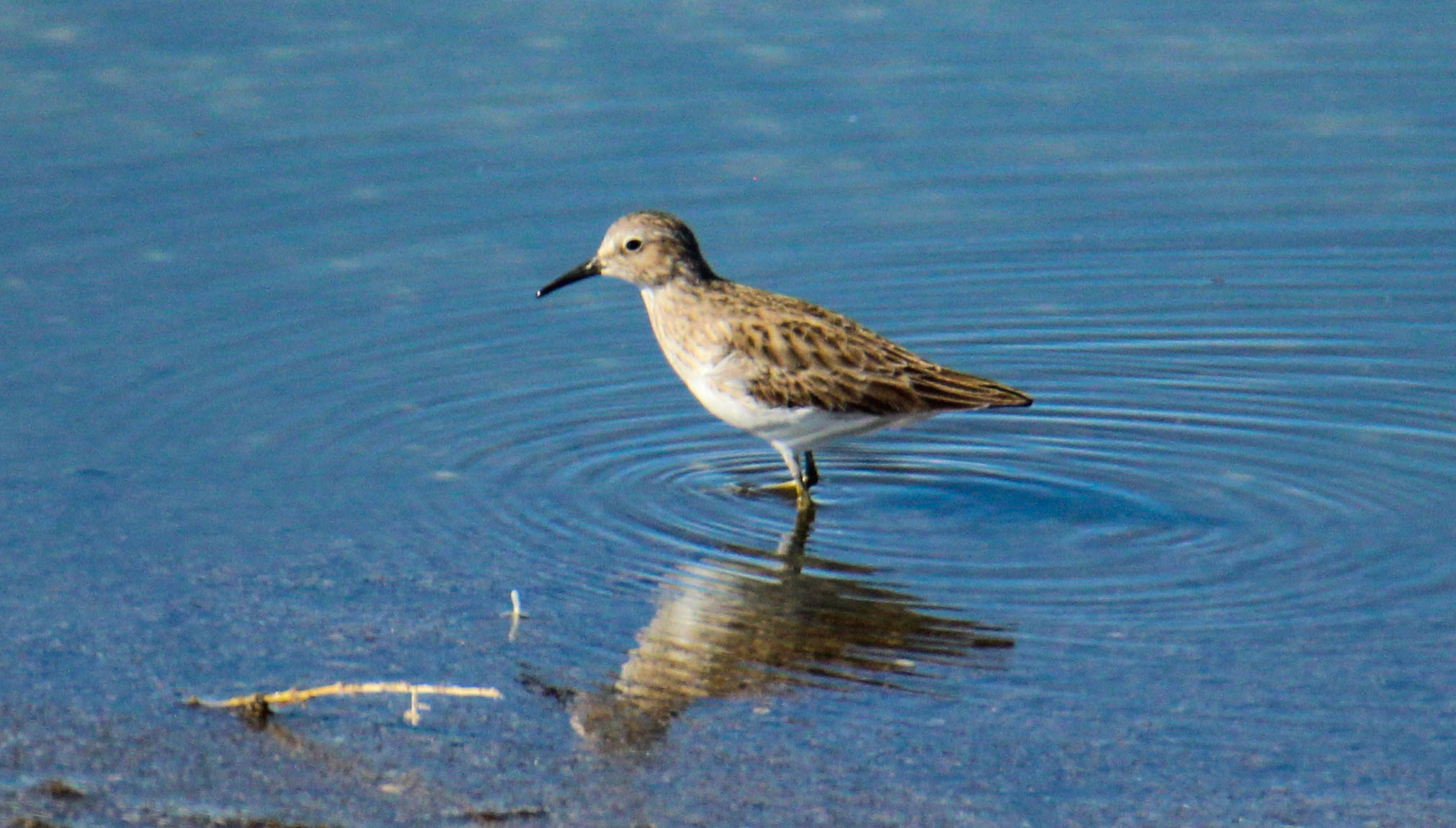
Least Sandpiper

The least sandpiper is a new bird to me. I saw one at the Salton Sea State Recreation Area in January 2021 foraging in a small pool.  Wikipedia calls it the "smallest shorebird." They breed in the extreme north of North America (Alaska, Yukon, Northwest Territories, Nunavit, northern Quebec), habiting the tundra and bogs, then migrate for the winter to the extreme southern U.S., Mexico, Caribbean and northern South America. 
It has yellow legs, a light white line above the eye, a thin and slightly drooped black bill and is white underneath. Winter plumage, that I saw, has a smudgy brown breast and is lighter brown with less definition. Breeding plumage is darker brown with more pronounced feathers lined in white. 

They forage on mudflats and eat small crustaceans, insects and snails. 


Tuesday, January 26, 2021

Black-Necked Stilt

I saw one black-necked stilt in Tule Lake NWR in northeastern California in August 2020 and did a post on it on September 13, 2020. Earlier in January this year, I saw a number of them at Salton Sea State Recreation Area in southeastern California and got better and closer views than my one sighting last year. 

Refer to the prior post for information on the black-necked stilt and my photos follow: