Thursday, June 11, 2020

Turkey Vulture

I recently saw some turkey vultures roosting in some trees near the dirt Corn Springs Road leading into the Chuckwalla Mountains. I got the best views of turkey vultures I've had in years. 
Seven vultures are visible in these two trees. There were several more in other trees. 
At first I thought they were ravens, then realized they were vultures. I got out of my car and slowly walked toward them. I got quite close before most of them flew, but several stayed put. 


Wednesday, June 10, 2020

Black-Tailed Jackrabbit

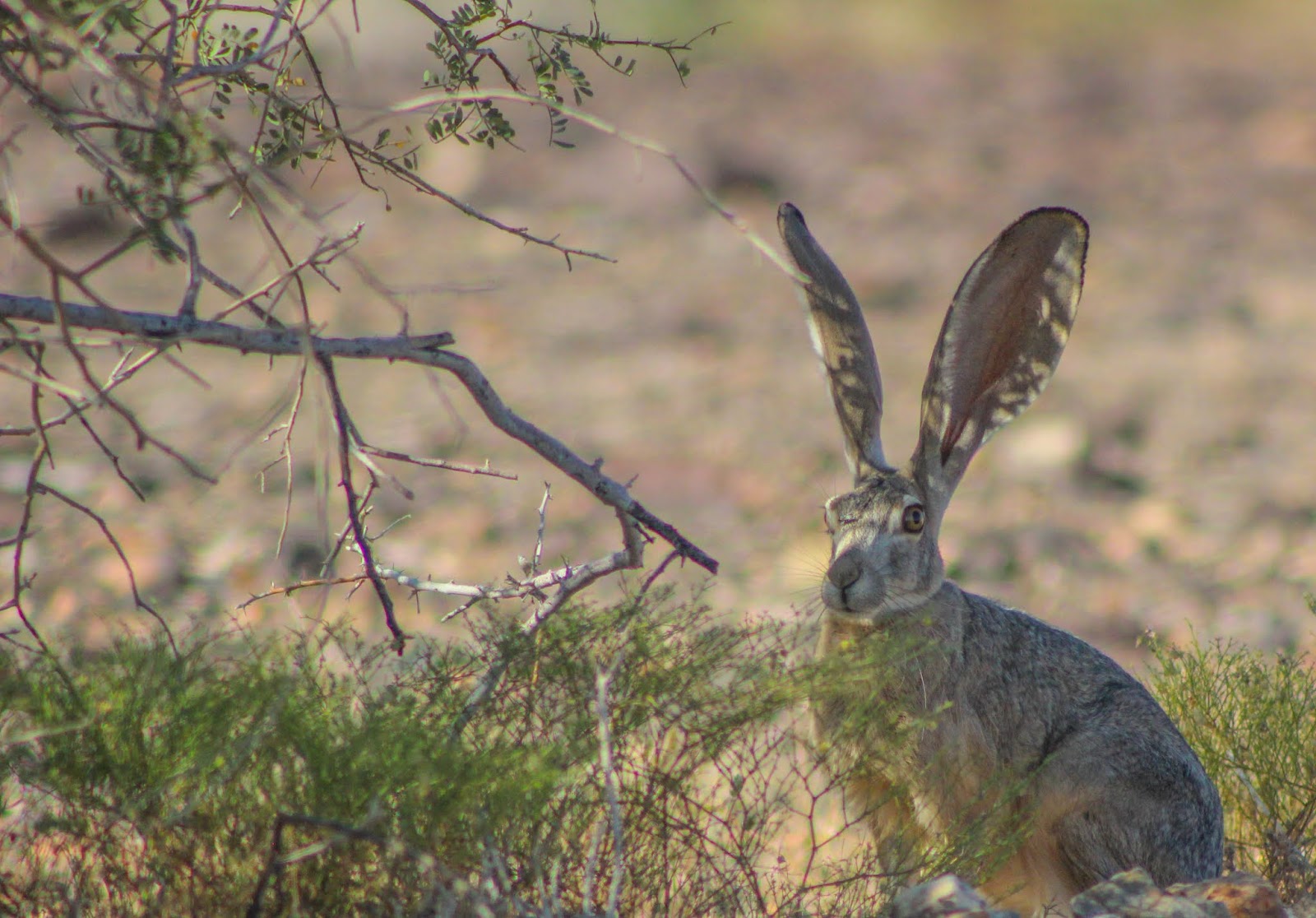
On May 30, 2020, near Corn Springs in the Chuckwalla Mountains, I had several other great encounters with jackrabbits, this time from my car. I was driving along the 8 mile dirt road from the I-10 to Corn Springs when I encountered several black-tailed jackrabbits and was able to get pretty good photos of them. 
This first jackrabbit was on the edge of some desert pavement.
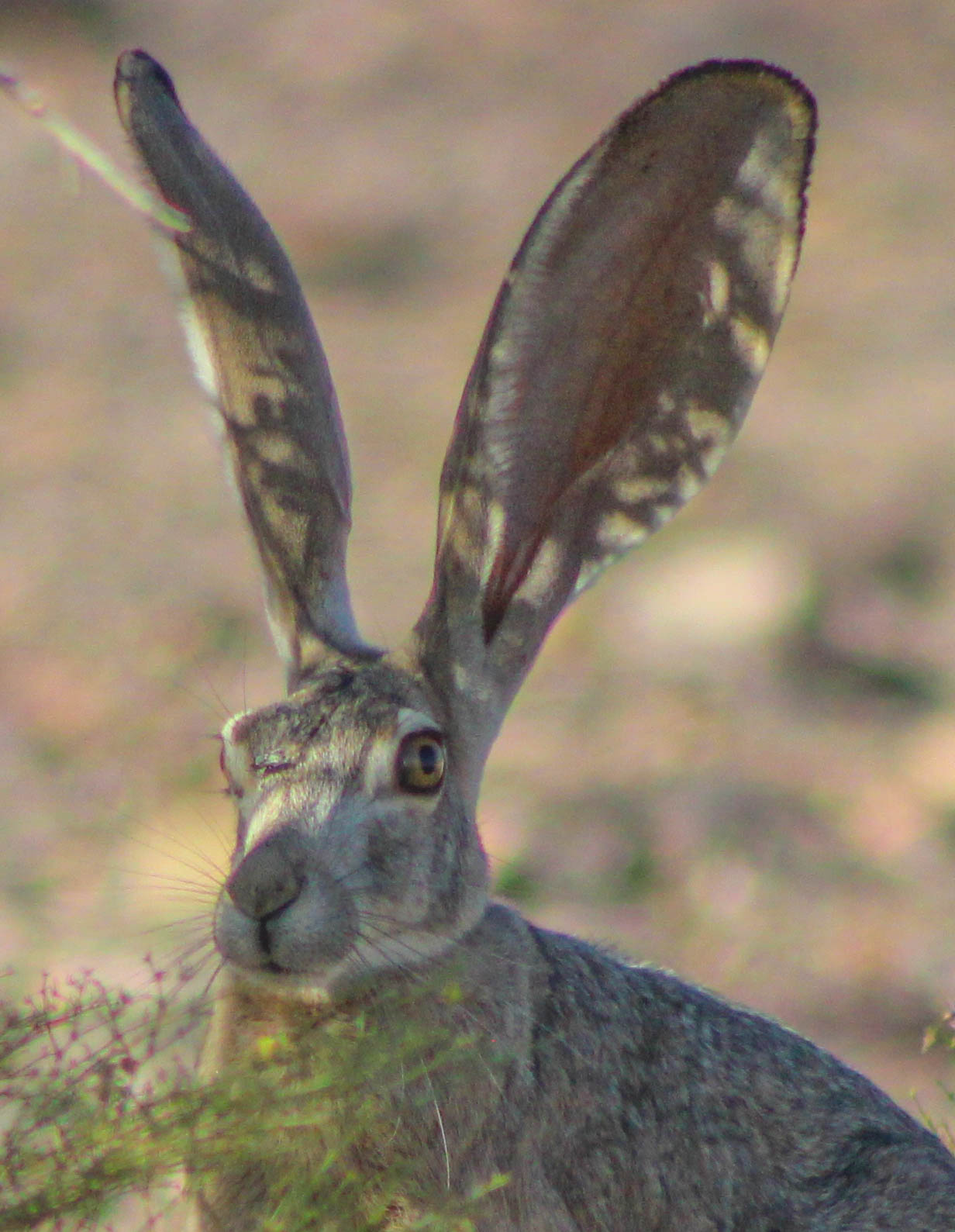
Such a wonderful snout and ears.
Its get-away over the desert pavement. 
Judy shared with me an article from the LA Times about a new rabbit hemorrhagic disease that hit California in May, found in dead rabbits in Palm Springs, which can decimate populations of jackrabbits and other rabbits. 
This second jackrabbit was quite close to Corn Springs. 

I've had the best view of jackrabbits I've ever had the last few months, and particularly the last few weeks, as I've gotten close-up views of jackrabbits I've never had before. 

Tuesday, June 9, 2020

Brush Rabbit

The brush rabbit, also known as the California brush rabbit or western brush rabbit, is a species of cottontail rabbit on the west coast of the U.S. from the Columbia River in Oregon south to the tip of the Baja California peninsula. It goes as far east as the eastern sides of the Cascade and Sierra Mountain ranges. 

It is small, with short legs, short ears and a short tail. The hair is evenly dark, It can be distinguished from the desert cottontail by their smaller, inconspicuous tail and uniformly colored ears (no black tips). There are eight subspecies of brush rabbit in California, 13 subspecies total, but I find nothing that helps distinguish the subspecies. 
Brush rabbit, found early in the morning in Live Oak Canyon, Redlands. 

Although I am less certain of this one, I believe it is also a brush rabbit, also found in Live Oak Canyon. 
They come out after sunset and are active until early morning, but emerge a few hours later until late morning. 
By contrast, this is a desert cottontail, also found in Live Oak Canyon. 
They are mostly solitary and have a very small range (an acre for males and a half acre for females). When threatened they tend to stay perfectly still. They tend to be found in heavy, brushy cover, thus the name. 

Monday, June 8, 2020

Schott's Indigo Bush

Schott's indigo bush (Psorothamnus shottii), also known as Schott's dalea, is found in the Sonoran Deserts of California (the Colorado Desert), Arizona and norther Mexico. 

It is a shrub with highly branching stems that are green to woolly gray-green and glandular. 

The flowers are a deep purple-blue and the fruit is a legume pod coated in glands and containing one seed.  

I never did see the flowers in their prime and I am not certain of this identification. 
What was fun was that I found the legume, assuming that is the seed (but it could be the pod). This is the first time I've seen an indigo bush legume, presumably because they take place later in the spring or summer when it is getting hot. 
I think the long green strips toward the top may be legume pods, although I have no certainty of that. I've also seen photos that make it look like the legume develops from the flower.


I assume these may be legumes drying up. 

Thursday, June 4, 2020

Mojave Desertstar

Some photos of the Mojave desertstar taken on April 18 and 25, 2020 off Hayfield Road in the Colorado Desert. These tiny plants with beautiful flowers are found in harsh, gritty terrain. 


Tuesday, June 2, 2020

Chuckwalla

On May 2, 2020, near Hayfield Road, off the I-10 freeway, I found a chuckwalla in a crack of a relatively small rock. 
Tail and hind legs of the chuckwalla near Hayfield Road. 
The side of the reddish belly and a front leg and claws.
Three weeks later, on May 23, 2020, I drove out to Corn Springs and drove the road looking for chuckwallas. I spotted three. 
This big beautiful chuckwalla was sunning itself on a rock. 
This second chuckwalla was also sunning itself. 

As I moved closer it scampered into a crevice, then stuck its head out to survey the scene. 
The third chuckwalla was sunning itself, then scampered into this crack when I approached. 
A week later, on May 30, 2020, I drove the Corn Springs road again and saw one chuckwalla, at quite some distance on a high rock cliff. 
This last chuckwalla was further away. I thought it was a spiny lizard while I was there, but knew it was a chuckwalla when reviewing my photos. 

Monday, June 1, 2020

Gambel's Quail

Gambel's quail is found in the deserts of Arizona (southern and western), California (southeastern), Colorado (portions of western and southwestern), New Mexico (southwestern), Nevada (southeastern), Utah (portions of southern), Texas (extreme southwestern) and the Mexican states of Sonora, Chihuahua and Baja California. 
The male has a comma-shaped forward-facing crest on a cinnamon-brown crown, and a black face with a white stripe outlining the black face. Much of their plumage is bluish-gray. It has a creamy buff belly with a black central patch and a chestnut patch on the sides. Females are plain gray on the head and neck (no cinnamon-brown crown or black face) and do not have the black belly patch. 


The word "quail" as a verb means "fear," "wince," or to "draw back in pain" and recognizes the quail's fear of both human and animal predators. When a human approaches they run quickly or take a short flight to get out of the way. This is largely why they are so difficult to photograph. The photos I took were near Corn Springs, in the Chuckwalla Mountains of California. They are of males, from my car, making it easier to photograph them because you can approach them quicker, but they were still running and flying away. I saw females and young chicks, but was not able to get even reasonably good photos of them. 

They are named in honor of William Gambel, who took the Santa Fe Trail to Santa Fe in 1841, then took the Old Spanish Trail to California later that year and engaged in botany and bird studies. Two birds are named after him: the Gambel's quail (Callipepla gambelii) and mountain chickadee (Parus gambeli). The genus of leopard lizards, Gambelia, is also named after him. He died of typhoid in a Yuba River mining camp in 1849 trying to treat ill miners.