Monday, January 20, 2020

Red Crossbill

While visiting Kaliningrad Oblast we drove out to the Curonian Spit which borders on the Baltic Sea. There we visited the Rybachy Biological Station which is run by the Zoological Institute of the Russian Academy of Sciences in St. Petersburg. It employs 10 biologists and other employees and undergraduate and graduate students. It was established in 1957 and studies migrating birds. They have a huge trap like a fishing trawl on land with a wide and tall open end and surrounded by netting. 

Because it is so large, birds don't perceive it as dangerous and fly in and get caught in the netting at the back. They can catch several thousand birds in a day and annually catch 30,000 to 40,000 birds. They weigh each bird, band it, record the sex and health and date and then release it. It is open from April 1 to November 1 each year and have cataloged 3 million birds of 200 different species. 

We were shown the area by a biologist and then taken to a little cabin where some birds were shown to us. Our guide got us in the cabin behind the biologist. 
The biologist shows a small yellow breasted bird.
One of the birds the biologist picked up was a red crossbill, also known as a common crossbill in Eurasia. Crossbills have distinctive bills (mandibles) which cross at the tip and give them leverage to extract seeds from conifer cones. Males tend to be red or orange and females green or yellow, but there is great variation. The crossbill the biologist was holding was female with a green coloration. 
Red crossbill

The biologist pulled out another small bird with a yellow underside and a black eye stripe that I have not been able to identify yet. 
Most fun was a bat that they'd caught the night before. He held it up for all to see and indicated they would release it that night. 

Sunday, January 19, 2020

Edible Frog

The edible frog, also known as the common water frog or green frog (Pelophylax kl. esculentus), is only found in Europe. The west end of its range is the northern half of France and the eastern end of its range is western Russia. The north end of its range is Denmark and Estonia and the south end of its range is Bulgaria and northern Italy. It has also been introduced to the United Kingdom and Spain. 
As you might guess from the name, its legs are considered a delicacy, particularly in France. 
Judy and I had just arrived in the city of Kaliningrad  and had a hotel near the Pregolya River. We went out on an evening walk which was to the side of the river and I could hear this frog making a huge noise. There was a big swathe of lily pads next to the river and I stopped for several minutes just surveying the pads until I located the frog. As shown and heard in this video (linked to Youtube), when the frog vocalized sacs projected from each side of its mouth. It was quite dark when I took this and the photo has been lightened up. 

Saturday, January 18, 2020

European Magpie - Kaliningrad

The Eurasian magpie (Pica pica) was considered to have 10 subspecies until recently. I previously did a post on the subspecies P. p. bactriana, also known as the Russian black-billed magpie. Since that post, four of the subspecies have been re-classified as separate species and there are now six subspecies of Eurasian magpie. One of those subspecies, P. p. pica, the nominate subspecies, is often referred to as the European magpie as it is found through most of Europe (see the light green shading in the map below - the British Islands to the west, southern Scandinavia to the north and the Mediterranean on the south (including most of the islands), and east to Russia. 
European magpie distribution - see light green shading covering most of Europe. From Wikipedia. 

I saw European magpies in Kaliningrad, a Russian oblast, just south of the Baltic Sea, sandwiched between Poland and Lithuana. I have not been able to find what distinguishes this subspecies from other subspecies. 

Friday, January 17, 2020

Common Murre - Iceland

In a prior post on the common murre, I noted that there are five subspecies and I featured Uria aalge inornata, the subspecies found in Alaskan waters which is also the largest of the subspecies. 

In Iceland, on a boat in the ocean outside of Reykjavik, we encountered a different subspecies, U. a. aalge, the nominate subspecies, found in eastern Canada, Greenland, Iceland, northern Ireland, Britain, and southern Norway. 
Those we saw were in the water and so the photos don't reveal as much of the bird as we saw in Alaska. Aside from size differential, I'm not sure what the differences are between these two subspecies. 

Thursday, January 16, 2020

Lesser Black-Backed Gull

The lesser black-backed gull (Larus fuscus) differs from the great black-backed gull as follows: (a) it has yellow, rather than pinkish legs; (b) smaller white mirrors at the wing tips; (c) it has a slimmer build; and (d) it is smaller. Like the great black-backed gull, the bill is yellow with a red spot. 

There are five subspecies, and L. f. graellsii, which is found in Greenland, Iceland, the Faroe Islands, the British Isles and western Europe has a gray mantle (the upperparts between the base of the nape and the rump). We saw these lesser black-backed gulls near Reykjavik, Iceland. 

Wednesday, January 15, 2020

Common Redstart - Kaliningrad

I took a photo of a beautiful bird in a park in Kaliningrad, which is city in an oblast of Russia by the same name, sandwiched between Poland and Lithuania. I have spent several hours trying to identify it and I think I've now done it. 
Common redstart in Kaliningrad. The white forehead is particularly pronounced. 
The common redstart (Phoenicurus phoenicurus) has two subspecies. The nominate subspecies, P. p. phoenicurus is found all over Europe and into Siberia. The male has a slate-gray head and upperparts, except the rump and tail, which are orange-red, as are the flanks, underwing coverts and axillaries. It has a white forehead and the sides of the face and throat are black. The wings and two central tail feathers are brown. The other tail feathers are orange-red. The orange on the flanks shades to almost white on the belly. The bill and legs are black. 

Tuesday, January 14, 2020

Prickly Pear Cactus Cookies

At the end of August 2019 I was with my nephew, John, in northeastern Mexico driving from Zacatecas to San Luis Potosi when he saw a sign for Pinos, which is a "magic" town, and he asked if we could take a detour and visit it. A magic town in Mexico is one that is being promoted by the Secretary of Tourism as one offering a "magical" experience because of natural beauty, cultural richness, traditions, folklore, historical relevance, cuisine, art crafts or great hospitality. Pinos is apparently known for its pottery. 

We drove about 15 miles south of Hwy 49 and took a slow drive through Pinos, not finding anything motivating us to stop. On the way back to Hwy 49 John mentioned there were signs for tuna cheese next to a truck pulled over to the side of the road. In Mexico the pads of the prickly pear cactus are known as "nopal" and the fruit is known as "tuna." John wondered out loud how cheese could be made out of prickly pear cactus blossoms (while I was still trying to figure out how cheese could be made of tuna, what he'd originally said). 

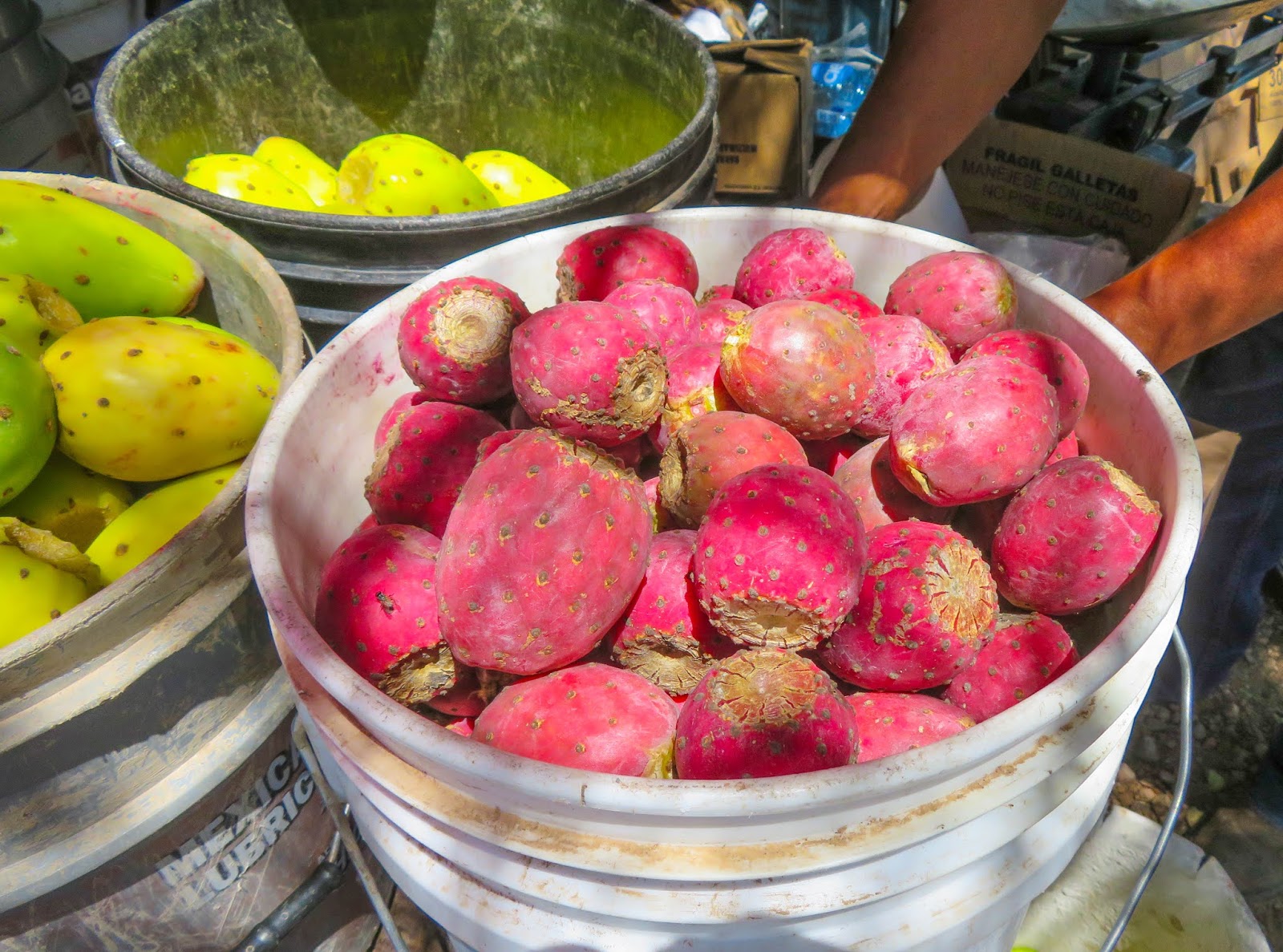
Behind the truck were huge prickly pear cacti with enormous fruit, much larger than any I've ever seen. The truck had large plastic buckets full of fruit, some of it green and some red. The green fruit, which is less ripe, is less sweet. The red fruit is riper and more sweet (although I did not realize it at the time).
Tubs of green fruit.
A tub of red fruit.
John ordered a green fruit for me and the man cut off both ends, then peeled the outer edges off using a knife. This gets rid of the glochids, hair-like spines that can be quite painful. The fruit was refreshing on a warm day, cool, and a little bit sweet, but very pleasing. However, the inside was full of seeds that were the consistency of hundred of bbs. They were too hard to chew and break, so I swallowed some and spit out most of them. They were very annoying. It is possible to strain the fruit and get rid of them and I think that is what I would do if I ate it on a regular basis. 
The outside peeled off.
Then we ordered brown cactus cookies. It was almost like fruit rollups, very concentrated fruit formed into a sticky round cookie. As I understood it, the fruit was cooked and cooked until it was a thick syrup and then made into the cookies. It was so concentrated and so strong that it was almost too much. The fruit was much more pleasant fresh and straight. 
A box full of cactus cookies.
A single cookies which I ate.