Tuesday, December 20, 2016

Emu Tenderloin - Sous Vide

The emu, found in Australia, is the second largest bird, after the ostrich, and is flightless, like the ostrich. We saw some at the Fossil Rim Wildlife Center outside Dallas and got to watch and feed them from our car. I fell in love with them. 
Emu at Fossil Rim.
Emu poking its head in our car window. 
Despite my interest in unusual meats for years, I'd never eaten emu meat until I recently tried emu salami. I was intrigued by the dark color of the salami and decided I needed to buy a good cut of emu meat to see if it really was that dark. So I got some emu tenderloins from Exotic Meat Market. Anshu Pathak, the proprietor, raises emus, but he is not currently harvesting the meat from his own emus, he's still building up his mob (yes, a group of emu is called a "mob"). 
Raw emu tenderloins.
The emu tenderloin is a thick strip of meat cut from between the emu's breasts. When the emu is alive the tenderloin does not get much of a workout and so the tenderloin is particularly tender. And like the salami, it is very dark. 
rub with love Triple Garlic, a gift from a friend, was a terrific marinade and went well with the emu.
The first site that comes up when googling "cooking emu", which I looked up after the fact, recommends  cooking emu meat to between 150 and 160 degrees F (66 to 71 C). That seems way too high to me. The picture of the cooked meat that site shows is a light pink. I cooked the tenderloins sous vide at a temperature of 53 degrees C for just a little under four hours. I coated the meat with olive oil, salt and pepper and added rub with love Triple Garlic Teriyaki Sauce, three pieces of pickled ginger and a spoon full of minced garlic. 
The tenderloins after cooking in the sous vide.
Frying the tenderloins in butter.
The fried tenderloin.
After removing the tenderloins from the sous vide bag, I fried them for a short period of time on each side in a hot skillet with butter. I loved the fried outer flavor and the inside was still very rare, which I liked. I think Judy would have preferred hers cooked to a higher temperature. 
Nice red center.
I really liked it. If I cook it again, and I would like to, I might soak it in a combined brine and marinade for an hour or so, which would loosen the meat up just a bit. 
Piece with extra marinade and garlic.

Wednesday, December 14, 2016

Wild Boar Frenched Ribs - Sous Vide Taste Test

I got a wild boar frenched rib rack from Exotic Meat Market and decided to do a taste taste using three different mixes of ingredients in the sous vide preparation and then comparing those sous vided ribs, as-is, with the same ribs then fried in butter. A "frenched" rib is a rib where the meat and fat have been cut off the bone so that it is exposed. I had my friend Jerry with me who hunts wild boar and his given me wild boar meat in the past. 
This is Jerry with a wild boar he shot in Central California. However, he was not the source of this meat. 
The frenched rib chops
It was an absolutely beautiful piece of meat. I used a large knife to cut the rack into individual chops. I did not marinade or brine the meat, it didn't need it.
The ribs sliced into chops and stacked on a plate.
My first packet of ribs was coated in olive oil, salt and black pepper, with added rosemary, oregano and minced garlic. I put it in the sous vide for 2 1/4 hours at 56 degrees centigrade. We ate one chop directly out of the sous vide. The sauce was nice tasting and the chop was good. I heated up a frying pan quite hot and added butter until it was getting dark, then added chops for about 30 seconds on each side. It was amazing what the frying did. The texture was more firm, but incredibly, the chop was more tender, easier to cut into and to chew. It was also juicier and had more flavor. Jerry and I both agreed that the fried chop was superior. It appears that frying causes several changes in the meat. First, if fried at a hot enough temperature (about 154 degrees), a chemical reaction between the amino acids in the protein and some sugars, called the maillard reaction, or caramelization, creates a crispy brown surface on the meat. Second, the frying melts the fat, beginning at about 130 to 140 degrees Fahrenheit. The sous vide was at 56 degrees Centigrade which is 132 degrees Fahrenheit, so the frying melted more of the fat.
These chops are just out of the sous vide.
Several of them were then fried in butter at a very hot temperature.
The fried chop is to the right.
A look inside each.
The second packet was cooked at the same temperature and the same length of time. The meat was coated with olive oil, salt and pepper, then Mirin sweetened saki, ginger and garlic sauce and chopped ginger were added. The resulting broth was very sweet. Again, we both liked the fried version best, but I fried this batch a little longer and did not like it as well as the first batch. The meat was a little less juicy.
The fried chop is below.
A look inside each (fried to the right).
The third packet was cooked at the same temperature, but 25 minutes longer. Olive oil, salt and pepper were added to the meat as well as cayenne pepper, Heinz 57 and Joe's Kansas City Bar-B-Que Sauce. Again, the fried meat was best and this was actually both of our favorite of the three batches, a surprise for me. I made sure not to fry it as long and the sauces worked real well with the meat.
Fried is above.
The inside (fried is to the right).
These were wonderful chops and I would love to have them again. The taste comparison was very helpful in terms of my better understanding how the frying changes the meat. 

Sunday, December 11, 2016

Emu Salami

I've been so impressed with the salami sold by Exotic Meat Market that I had to try some more. Next was a meat I've not tried: emu. I've had emu egg, but never emu meat. 
An emu at Fossill Rim Wildlife Center outside Dallas. The emu is the second largest bird and can weigh up to 130 pounds. 
I was shocked to see how dark it is. I anticipated light meat, like a turkey or goose. But it was nearly as dark and purply looking as the river otter salami
This is all part of one stick of emu salami. 
A few weeks later I had to buy some emu tenderloin to confirm that the emu meat was really that dark (a later post will cover that). 
Emu tenderloins.
The emu salami was stronger tasting than the emu tenderloin, par for salami in general, but the flavor is good and not over-powering. 

Thursday, December 8, 2016

Finger Lime

One of the most creative people we know is C. c. Claudia. Claudia grows unusual plants and different kinds of fruit and makes fruit and flower arrangements that are spectacular (see this beautiful box of yuzu she gave us). She recently gave me some finger limes, something I've never heard of. 
Finger limes in a small green bag - perfect for St. Patrick's Day.
I found that the finger lime is listed as one of the 1001 Foods You Must Taste Before You Die, a book edited by Frances Case, page 108.  It is called "lime caviar" because it has little caviar-like vesicals that look like fish eggs, but are little balls of citrus fruit that taste of lime juice, complete with the caviar-like "burst" when you crush them in your mouth. Their color can range from black, to purple, to green, to yellow, to red. 
The whole finger lime (mid-left), lime caviar (bottom-right) and a finger lime cut lengthwise (upper-right).
They originated in the coastal regions of Queensland and New South Wales, Australia and grow on a thorny shrub or small tree. I've seen video of cutting them in half and watching the lime caviar ooze out. These were not quite as ripe, but the lime caviar came out when the fruit was squeezed.  

Tuesday, December 6, 2016

Nutria - Sous Vide

Nutria, also known as coypu, is a semi-aquatic rodent native to South America. However, it has been introduced into many parts of the world, primarily by fur ranchers, and has become a pest in the process. For example, nutria were introduced to Avery Island in Louisiana in 1937 from South America by E. A. Mcllhenny of Tabasco fame. Some escaped during a hurricane in 1940 and they quickly spread across the Southern U.S. causing havoc to marshlands. 
We saw this nutria near the Jordan River in Jordan, very near the border of Israel. 
They are currently a pest in the U.S. and a bounty is paid in an effort to eradicate them. In 1909 to 1910, bounties were paid for 445, 963 nutria at $5 each. 
The same nutria swimming in the Jordan River. We did not know what it was at first, the initial thoughts being a beaver, but the tail was like a rat instead of a beaver. 
Efforts have been made in areas to try and get people to eat nutria as part of the eradication effort. The meat is lean and low in cholesterol. In Kyrgyzstan and Uzbekistan nutria is sold in stores as "poor man's meat." Wikipedia notes that a Moscow restaurant, Krasnodar Bistro, sells nutria as burgers, hotdogs, dumplings or wrapped in cabbage leaves. It is catching on as part of the "foodie" and "localvore" craze.

I got some nutria back strap, loin and flank from Exotic Meat Market. We were sharing Thanksgiving with some friends at their house and they asked me to bring some "unusual meat" appetizers. So I decided to serve the nutria along with some lion which I blogged on in my previous post.
I brined and marinated the meat for 9 hours, primarily with the lion in mind (I did them together). I'm not sure that the nutria needed it, but the brining would certainly help to get rid of any swampy taste the nutria might have (see the brining/marinade recipe in my last post).
The nutria in the brine/marinade.
The nutria meat after brining. Note that most of the blood has been extracted and it has turned a white/gray color. 
I put the nutria in vacuum packed sous vide bags with olive oil, salt, pepper and minced garlic and cooked it for 19 hours at 56 degrees centigrade. It did not need to cook that long, I did it primarily because I was cooking the lion that long. Some of the thinner meat pieces got a little mushy, a texture change when you sous vide too long. But the larger pieces were not mushy at all and I liked them the best. 
The sous vide bag with lots of minced garlic.
I believe this is a flank portion.
Cut up into smaller pieces for Thanksgiving appetizers.
There was no gamey taste whatsoever. It was very mild. All of the 12 guests at Thanksgiving ate some, not knowing what they were eating before-hand. Everyone liked it, most preferring it to the lion which we also ate. There is a layer of fat in the nutria, particularly the thicker pieces, and I think the nutria would be even better if the nutria was quickly fried to render and soften the fat. Otherwise, the texture and taste were great. 

Sunday, December 4, 2016

Lion Steak - Sous Vide

I've had some lion steak sitting in my freezer for awhile. I got it from Anshu Pathak of Exotic Meat Market who marketed it for some time, but no longer has it available. I'd tried lion meat previously, some stew meat and ribs. The taste was fine, but it was very tough, very chewy. 
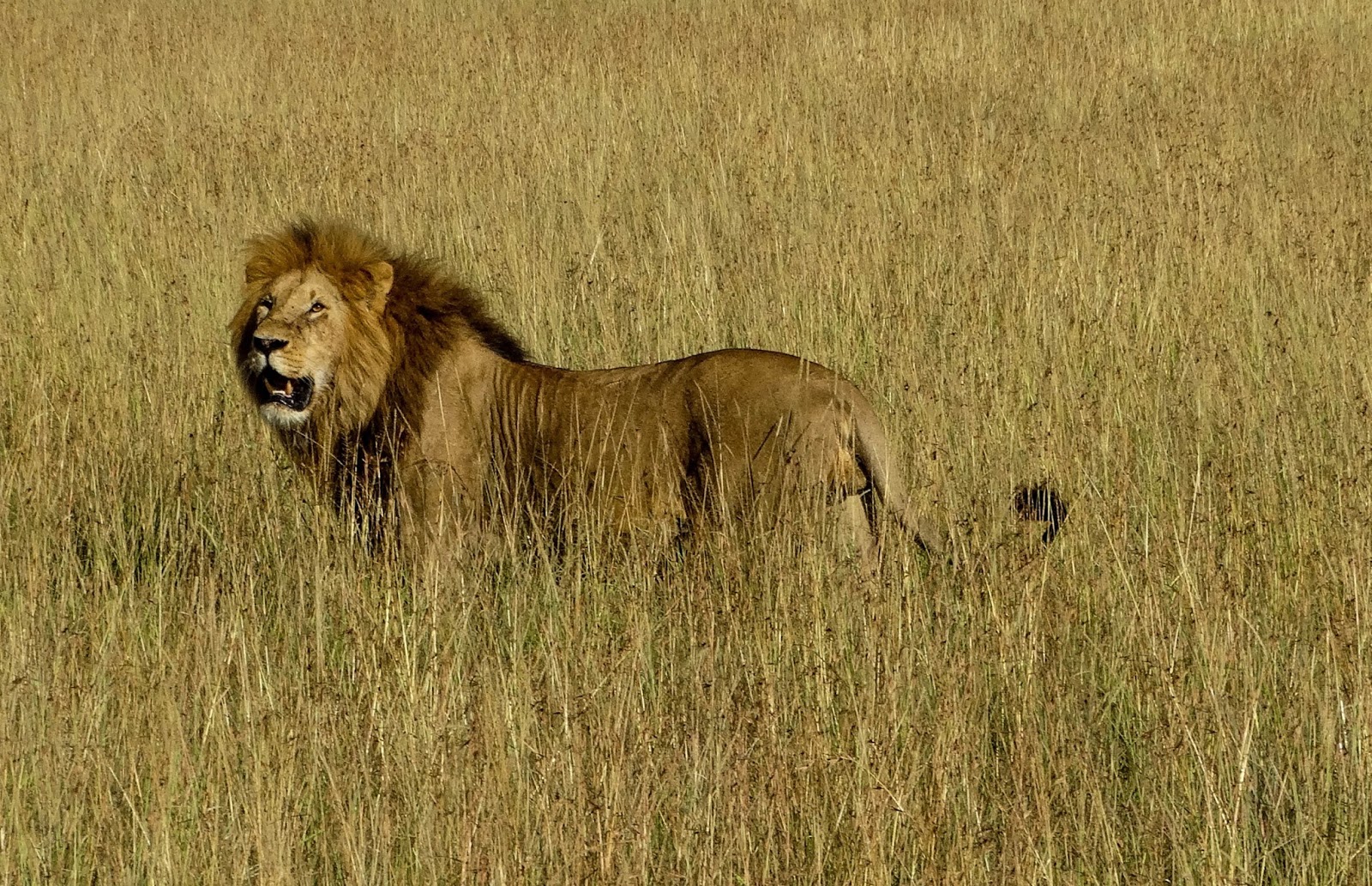
This is a lion photographed in Masai Mara, Tanzania. The lion steak I had was from a captive bred lion in the U.S.
This time I was determined to take steps to tenderize the meat by both brining and marinading it. Brine, which has a higher concentration of salt than the moisture in the meat, is absorbed into the meat by osmosis. It carries the flavoring into the meat and also causes the muscle fibers to hold more water, keeping the meat moister. The acid in marinade breaks down the texture of the meat and makes it more tender. My brine/marinade mix, which also included some nutria (the subject of another post), was one tablespoon of salt for each cup of water, the juice from four Meyer lemons, about 8 crushed juniper berries, pickled ginger and about four tablespoons of apple cider vinegar. 
The lion meat has very distinctive white lines going through it. 
After nine hours of brining note that the lion is now gray, the brining takes most of the blood out of the meat. Also note the cracks in the meat. The texture of the meat was broken down substantially, making it sort of floppy and falling into individual pieces. 
I put olive oil, salt, pepper and lots of minced garlic in the sous vide bag and cooked it sous vide for 19 hours. 
The final product could not have been much more different from my first experience. The meat had absorbed the garlicy flavor and was nicely spiced and very moist. Most importantly, the meat was pretty tender, not much of a chewing problem. 

The brining/marinading and sous viding transformed a meat that was almost inedible the first time I tried it, to something quite good. We shared it as an appetizer for Thanksgiving at our friend's home. There were 12 there for dinner and each person was given some meat and asked to eat it without knowing what they were eating. All ate it and enjoyed it. 
Cooked and cut lion meat.
This was a great test of the power of brine and marinade in dealing with non-traditional meats. 

Thursday, December 1, 2016

Delaware, New Jersey and New York

In April we went to New York City to visit our son, Andrew. While there, we spent some time exploring portions of Delaware, New Jersey and Upstate New York as well. This is a summary of our trip with links to Judy and my individual blogposts that go into more detail. 

We took a red-eye flight on Delta, leaving LAX on a Thursday at 10:45 p.m. and arriving Friday morning at JFK at 7:10 a.m. (flight time, 5 hours and 10 minutes). We like the red-eye flight out of LAX as it allows us to drive there in off-hour traffic and to get a full-day when we arrive. We rented a car with Dollar which required a tram ride and some sleuthing to find. I was upset when they tacked on an approximate $110.00 toll charge, but was later grateful as it saved us money as well as untold hassle. We immediately set out for Wilmington, Delaware. As we crossed the horribly crowded Verrazano-Narrows Bridge, between Brooklyn and Staten Island, I was shocked to see a $16.00 toll (and later a $15.00 toll each time we crossed over the Hudson River on the George Washington Bridge).  

Our first stop was Ebright Azimuth, 133 miles from JFK, the "high point" of Delaware with an elevation of 448 feet, in a suburb of Wilmington. A quick stop and a couple of pictures and we drove to Old Swede's Church, built in 1699, one of the oldest churches in the U.S. We drove to the Cathedral of St. Peter and found it closed, so continued on to St. Anthony of Padua Parish Church, a real gem. We ate lunch at the Big Fish Grill right next to the Christina River where we had a wonderful lunch. We headed back toward New York City and stopped in Princeton, New Jersey on the way. We made an unplanned visit to Trinity Episcopal Church and to the Princeton Battle Monument which was across the street. Then to the Princeton University campus for a brief walkabout before heading on to our hotel in Fort Lee, NJ, the Double Tree by Hilton, very near the George Washington Bridge. We found the hotels cheaper in NJ, across the river from Manhattan, and we had free parking as well. 
     Delaware: State High Point  (Judy)

Saturday morning we took Lyft for the first time (it was great) and met Andrew in Harlem at 10:00 a.m. at Red Rooster, owned by Marcus Samuelsson who wrote, "Yes, Chef," and had a great Southern breakfast. We walked to Grant's Tomb, then crossed the street to the Riverside Church, then on to Columbia University where we walked around the campus. We caught the subway to visit St. Patrick's Cathedral, then the subway again to Chinatown where we ate at Joe's Shanghai and then walked to Little Italy for some dessert at La Bella Ferrara Pastry Shop. We caught the subway back to the area near Columbia and then took Lyft back to our hotel across the George Washington Bridge.
     New York City: Eating at Red Rooster in Harlem  (Judy)
     Red Rooster - Harlem, New York  (Bob)
     New York City's Upper West Side: Sakura Park, Grant's Tomb, Riverside Park, and Riverside Church  (Judy)

Sunday morning we drove over to the Columbia area and found a free parking space and parked the car for the day. We met Andrew and took the subway to near the southern end of Central Park and began a walk that would take us all the way to the northern end. Part way through we exited to the east and visited the Neue Gallery which had the Klimt painting "Lady in Gold." It was only a short walk after that to the spiral-shaped Guggenheim Museum designed by Frank Lloyd Wright. Back into the park we made it to the north end and walked past St. John the Devine and ate nearby at Roti Roll, then had dessert at Hungarian Pastry Shop. We said goodbye to Andrew, got our car and then drove to Dover, New Jersey where we stayed the night at Homewood Suites.
     New York City; Central Park  (Judy)
     New York City: The Guggenheim Museum and a Fischli and Weiss Art Show  (Judy)
     New York City Miscellany: Street Art, the Hungarian Pastry Shop, St. John the Divine Doors, the Subway, Columbia University  (Judy)
   
Monday morning we left about 7:30 a.m. and drove 36 miles to High Point State Park, the highest point in New Jersey. It was raining and very cold. We were impressed with the New Jersey countryside, not something I anticipated. We drove another 62 miles to Hyde Park, New York and visited the home of Franklin D. Roosevelt. We stopped for a quick bite to eat at Clancy's Cafe and Creamery, then drove a short distance to Val-kill, the cottage of Eleanor Roosevelt, where we had to visit at a specific tour time. Then back to near the Roosevelt home to visit the Franklin D. Roosevelt Presidential Library and Museum, the first of the presidential museums. Afterwards we drove further into Upstate New York to Albany where we stayed at the La Quinta Inn & Suites in Latham.
     New Jersey: State High Point  (Judy)
     High Point - New Jersey  (Bob)
     Hyde Park, New York: Roosevelt's Home  (Judy)
     Hyde Park, New York: Eleanor Roosevelt's Val-Kill  (Judy)
     Hyde Park, New York: Roosevelt Presidential Museum and Library  (Judy)

Tuesday morning we hit busy traffic as we traveled 8 miles to downtown Albany to visit the New York State Capitol building. Afterwards we visited the nearby All Saint Episcopal Cathedral, then had lunch at Aashiana, an Indian food buffet. We drove south 129 miles to Valhalla where we visited the Kensico Cemetery and found the graves of such luminaries as Lou Gehrig and Ayn Rand. It was 36 miles from there to JFK where we dropped off our car and caught a flight at 6:30 p.m. for LAX.
     Albany, New York: State Capitol Building  (Judy)
     Albany, New York  (Judy)
     Valhalla, New York: Kensico Cemetery  (Judy)