The Sahara Desert is the third largest desert in the world after Antarctica and the Arctic. It is found in northern Africa and covers about 25% of the African continent, including large parts of Morocco, Algeria, Tunisia, Libya, Egypt, Mali, Mauritania, Chad, Niger, Western Sahara and Sudan. In Morocco, the Sahara covers much of the land south of the Atlas Mountains. Certain sections of the Sahara are known as ergs. An
erg is an area of desert that covers more than 48 square miles with windswept sand (sand dunes) covering at least 20% of the surface. Morocco has two ergs, one of which is Erg Chebbi, found in eastern Morocco near the town of Merzouga, very close to the Algerian border. Erg Chebbi covers an area of 31 miles north to south and 3 to 6 miles east to west and has sand dunes that reach 492 feet in height.
 |
| This photo is of a portion of a Michelin map of Morocco. My yellow high-lighting of place names has partially obscured the Erg Chebbi dunes which were high-lighted in yellow on the map. The "+++" border to the right is the Algerian border. Our tent camp was in the southern part of the dunes, south of Merzouga, and accessed from the east side. |
We made a reservation with
Bivouac Merzouga Experience, rated by
Trip Advisor as no. 1 in Merzouga for specialty lodging, for a custom three day, two night adventure. It included two nights in a luxury tent camp in the Erg Chebbi dunes (including a private toilet and shower in our tent), meals, a 4x4 tour of the desert region, including the Erg Chebbi dunes, to see the nomad's way of life and the changing desert contrasts, a visit to the Dayet Sriji, a salt lake that has a population of flamingos, a visit to the "black village" of Khamlia (Khemliya on the map) to see the Gnawa musicians and a camel trek into the Erg Chebbi dunes. I was as excited for this segment of the trip as Judy was not.
After an approximate 8 hour drive from Fez over the Middle Atlas Mountains to Merzouga, we met Hassan, a 29 year old Berber entrepreneur who runs Bivouac Merzuga Experience, about 5:30 p.m. Hassan invited our driver Aziz to stay in the camp and put our suitcases in his Toyota four-wheel drive and drove us directly into the sand dunes. I was stunned as Hassan put the vehicle into four-wheel drive low and drove directly into the dunes, fish-tailing a little bit to the left and then to the right, through the sand, up and up, until he got very near the top of the highest dune in that area. I never would have guessed a vehicle could traverse that terrain.
 |
| This picture of Hassan taken from the back seat of his vehicle was taken the next day. But it was during another fun four-wheel drive venture into the dunes. I could tell Hassan loved driving the dunes as much as I enjoyed experiencing it. |
He let us out with enough time to view sunset from the top of the dune. Judy had not put on her sunglasses and wind blown sand was hard on her contact lens covered eyes. She was also a bit chilly. The last 40 yards or so up to the top of the dune was very difficult to negotiate as each step resulted in slide-back that nearly equaled the step taken. Judy endured the blowing sand about 15 yards below the top of the dune while I reveled in the beauty of the sunset from the top. I found that when I went over the lip of the sand ridge in an attempt to get away from the blowing sand, I was immersed in a shower of falling sand that had lost its inertia from the dune-blocked wind. I quickly moved back up to the ridge again, feeling a thin layer of sand intermingling with my hair and covering my scalp. We noticed a Berber guide, dressed in a spectacular blue robe and orange head-scarf, leading two clients on camels up to the dune to join us for sunset.
 |
| Three people walk up the dune to join us while two camels are left behind, planted in the sand. |
 |
| My footsteps on the ridge of the dune reflect my traverse through the sand. Another person has now reached the ridge of the dune above Judy. The setting sun bathes the dunes in a wonderful changing reddish/orange light. |
 |
| From the top of the dune, the regular tent camp is visible in the center (the luxury tent camp is found in the depression immediately in front of it and is not visible in this picture) to the south. |
 |
Sand dunes to the north reflect pink. Sand dunes are visible well into the horizon.
|
 |
| The same dunes, now viewed a little more to the right, reflect more orange as the sun drops in the west. |
 |
The sun provides its own hues of yellow while reflecting reddish orange light off the dunes.
|
 |
| The sun nearing the horizon in the west. |
 |
| The sun going down over the horizon. The shadows in the foreground have been lightened to show more detail. |
 |
This spectacular red is reflected from the sun that has now gone down over the horizon.
|
In the interim, Hassan dropped our suitcases off at the luxury tent camp (which was in a small dune valley separated from the regular tent camp by a small dune) and returned to pick us up in his vehicle. I attempted to pet the camels and noticed their irritation. I was warned that I might get bit if I wasn't careful.
 |
| A Berber near two camels while his clients are up on the dune. His wonderful orange head-wrap glows in the evening light. |
We got to camp and found our tent to be one of about eight tents for guests in addition to a cook tent and a dining tent. Our tent had a large queen size bed resting on a wooden frame and covered with thick, heavy blankets. The floor, the walls and the ceiling were all thick blankets and we had a blanket divider which separated the sleeping area from a stand-alone toilet, a small sink and a small shower (that provided enough water to get wet and wash off, but not much of a spray). We found that we were the only guests in the luxury tents that night.
 |
| The two tent camps. The luxury camp where we stayed is in the foreground and the regular tent camp is in the background. While in our camp we could not see the other camp. |
 |
| Rugs are laid out to walk on in camp. The dining tent is in the middle at the far end. Our tent is the first to the right out of the picture (the orange rug leads to it). |
 |
| Judy in front of our tent the next morning. |
 |
| Our bed. |
 |
| The toilet and sink. The shower is to the right out of the picture. |
After getting situated we went to the dining tent and Hassan served us a soup called harira along with thick bread. The bread and harira were best eaten by breaking off a piece of bread and sopping that piece in the harira until it was fully saturated. Harira is a traditional Moroccan soup mostly served during Ramadan, but also popular as a meal starter. It can contain a variety of ingredients, but the most obvious ingredient was beaten eggs, similar to what you find in egg-drop soup. I'm guessing it also had lentils, chickpeas, onions, some rice and tomatoes. Next Hassan brought us a tagine of lamb with prunes and a hard-boiled egg. The lamb was wonderfully fatty and flavorful and accentuated by the sweet prunes, one of the better dishes we had in Morocco. He also brought us chicken kebabs on skewers and wonderful oily french fries. We found that the Moroccans consistently over-cooked chicken, but this was some of the best chicken we had (although it was still cooked a little more than I like). For dessert we got a bowl of fruit, including bananas, oranges and apples. We found that dessert everywhere in Morocco was pretty much the same thing. One recurring problem we had in Morocco was our Mormon prescription against drinking tea. Moroccans drink mint tea at every meal, and in between meals, and we found ourselves not wanting to offend or to cause inconvenience. In Fez we found a solution - warm milk with sugar - suggested by our hosts at Riad Laaroussa. From then on we asked for warm milk everywhere we went. Hassan accommodated us with warm milk and sugar at all of our meals which we appreciated.
 |
| Judy inside the dining tent. |
 |
| Harira |
 |
| Thick bread |
 |
| Lamb and prune tagine |
 |
| Chicken skewers and french fries. This picture was taken after the chicken from several skewers and many french fries had been eaten. |
We decided to go to bed and asked not to be woken up for sunrise. We wanted to sleep-in. Our adventure would begin the next day about 9:30 a.m. We could hear pounding drums and native singing emanating from the regular tent camp over the dune and saw some of the reflected campfire light.
We had a breakfast of fruit, bread, jam, hard-boiled eggs and plain yogurt. About 9:30 we got in Hassan's Toyota accompanied by our driver Aziz. We could tell that Hassan was more comfortable in French, Arabic, Spanish and Italian and was happy to let Aziz translate much of what he said to us into English. Hassan learned that Judy could speak Spanish and thereafter spoke to her in Spanish quite a bit.
We visited a compound in Khemliya and got an approximate 30 minute concert from
Gnawa musicians (more on this in a later post). They used several drums, a guembri (a guitar like instrument) and some metal clacking instruments to play us ancient African Islamic spiritual religious songs and rhythms. We learned that they came to Khemliya from Mali several hundred years ago and dominate this small village. The group was all men, but their women came and went as they played for us.
 |
| Gnawa musicians. |
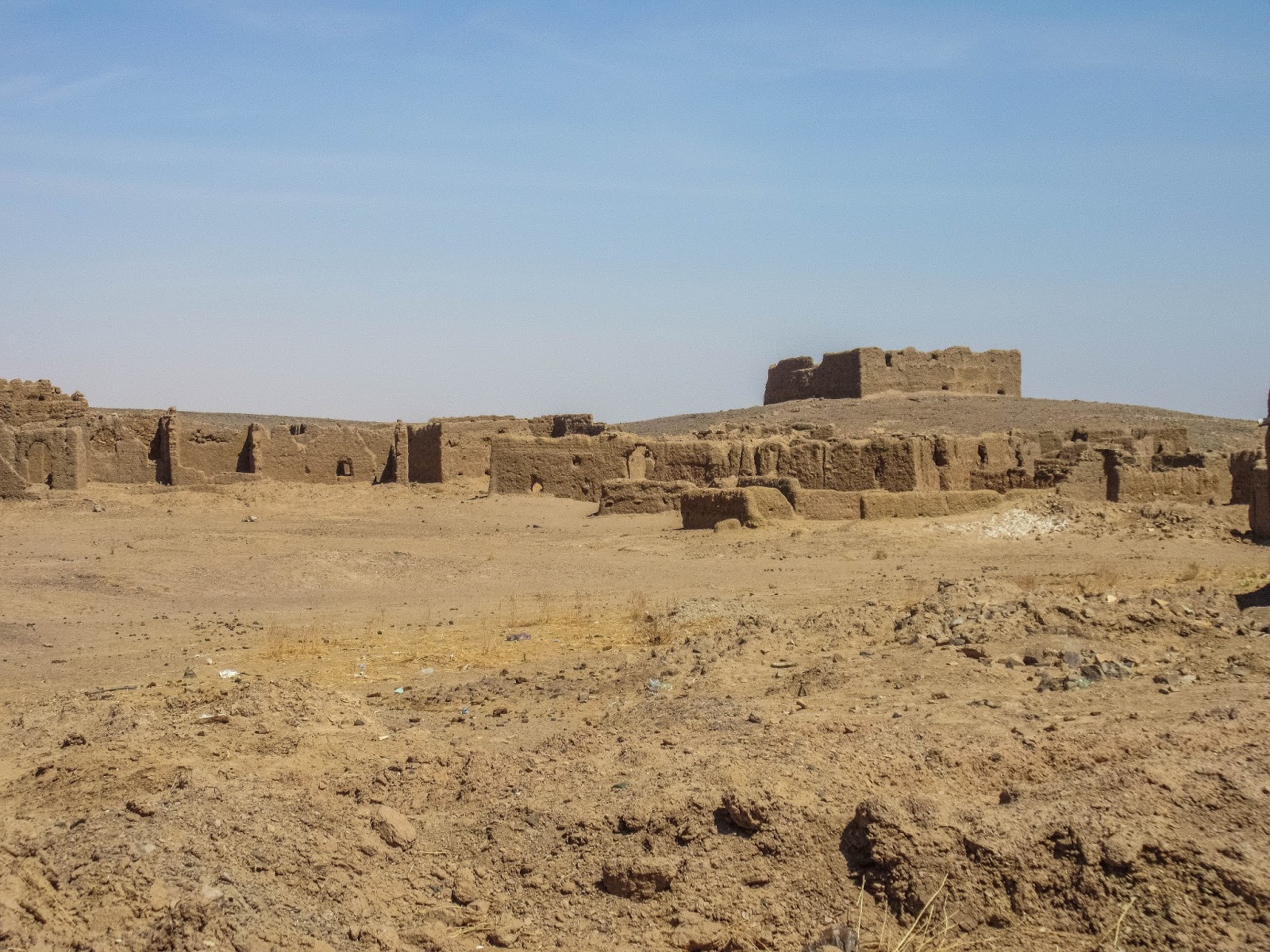
We drove into what Hassan called the "black desert" and found widely varying terrain, from flat black vistas going seemingly forever, to rugged, small mountains. One of the most mind-boggling stops was the little village of Mtis, from the 11th century, if I'm not mistaken. It consisted of mud buildings and I could hardly fathom that anyone lived there. We did find evidence of habitation, such as nylon lines with hanging laundry, and a mosque that was obviously still in use.
 |
| Beautiful, bleak desert. We were told that the distant mountains are in Algeria. |
 |
| Very little vegetation in this hard-scrabble country. |
 |
| Striations of black desert pavement, interrupted by golden vegetation and backed by reddish dunes. |
 |
| Some of the mud buildings of Mtis. These appear abandoned. |
We visited a very primitive mine with seams going down hundreds of feet. We were visited there by several Berber hawkers and ended up buying some small rock vessels with snail fossils in them. We skirted the east side of the Erg Chebbi dunes and were within about six kilometers of the Algerian border. Relations of Morocco and Algeria are not cordial and the Moroccan military has a heavy presence in the area, although this was not readily apparent to us - this came from Hassan. We stopped at a well and Hassan pulled water up in a plastic bucket which Judy drank from to my astonishment. We were both very thankful she did not get sick. We saw female Berber goat herders herding goats out on the hard, flat pan and saw several Berber tents and visited the tent of one of them (more on that in a later post).
 |
| Berber tents with a dune back-drop. |
 |
| A Berber woman herds her goats. |
 |
| A tied-up donkey forages on the sparse vegetation. |
 |
| Aziz, Hassan and Judy inspect water pulled up from the well. |
 |
| Hassan is about all that is standing when looking in the opposite direction. |
We then drove closer to and into the eastern edge of the dunes. We drove by a number of other tent camps. Hassan's camp is distinguished by the fact that his camps are completely encircled by dunes. The others are all on the outer fringes. This has apparently created jealousy from the other camps.
 |
| Black tents in a large tent (tourist) encampment. |
 |
| White tents in another (tourist) encampment. |
 |
| Round gourds we passed that looked like large grapefruit. |
 |
| The inside of one of these poisonous gourds. |
 |
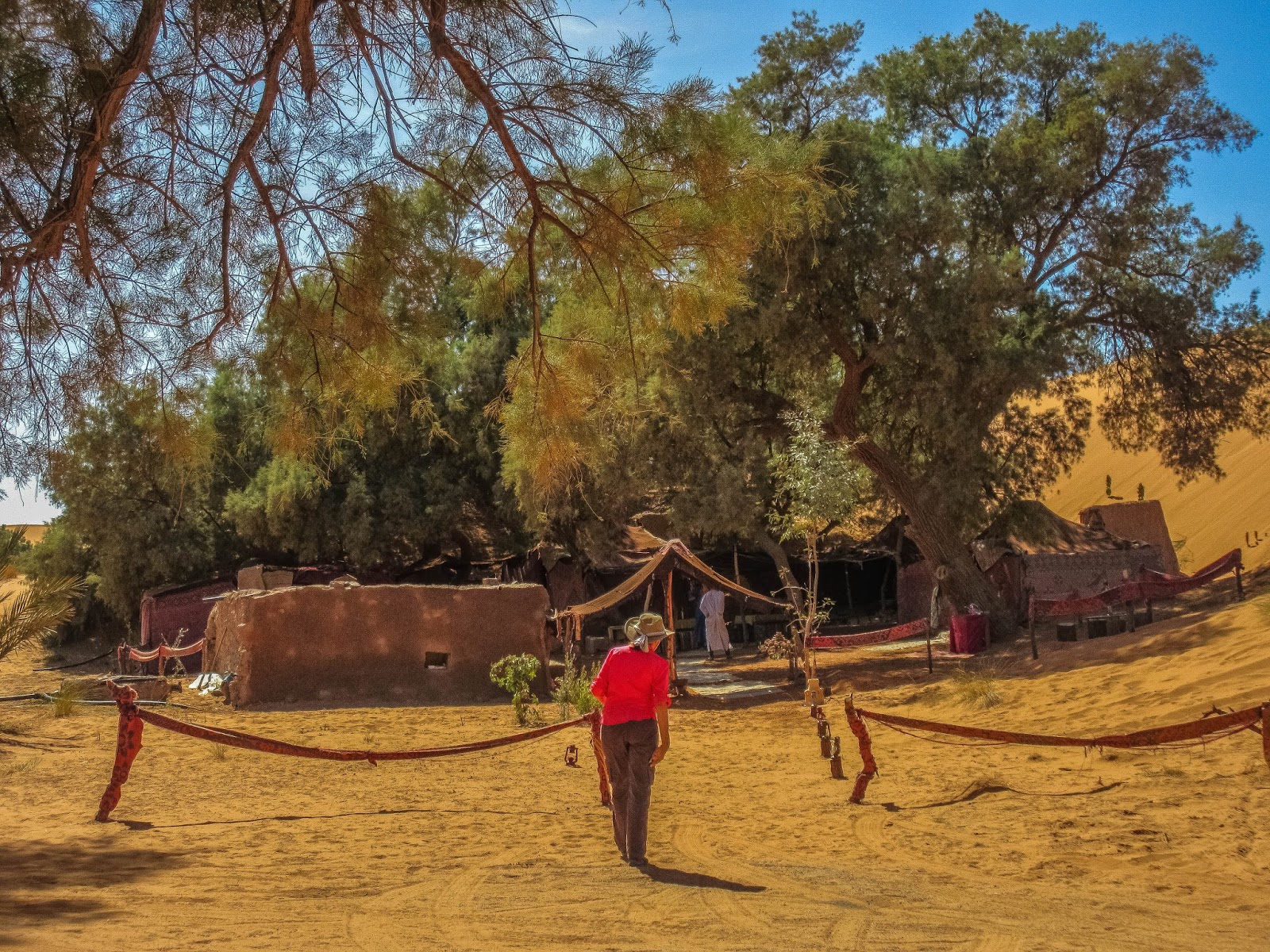
| Some trees growing incongruously among the dunes. |
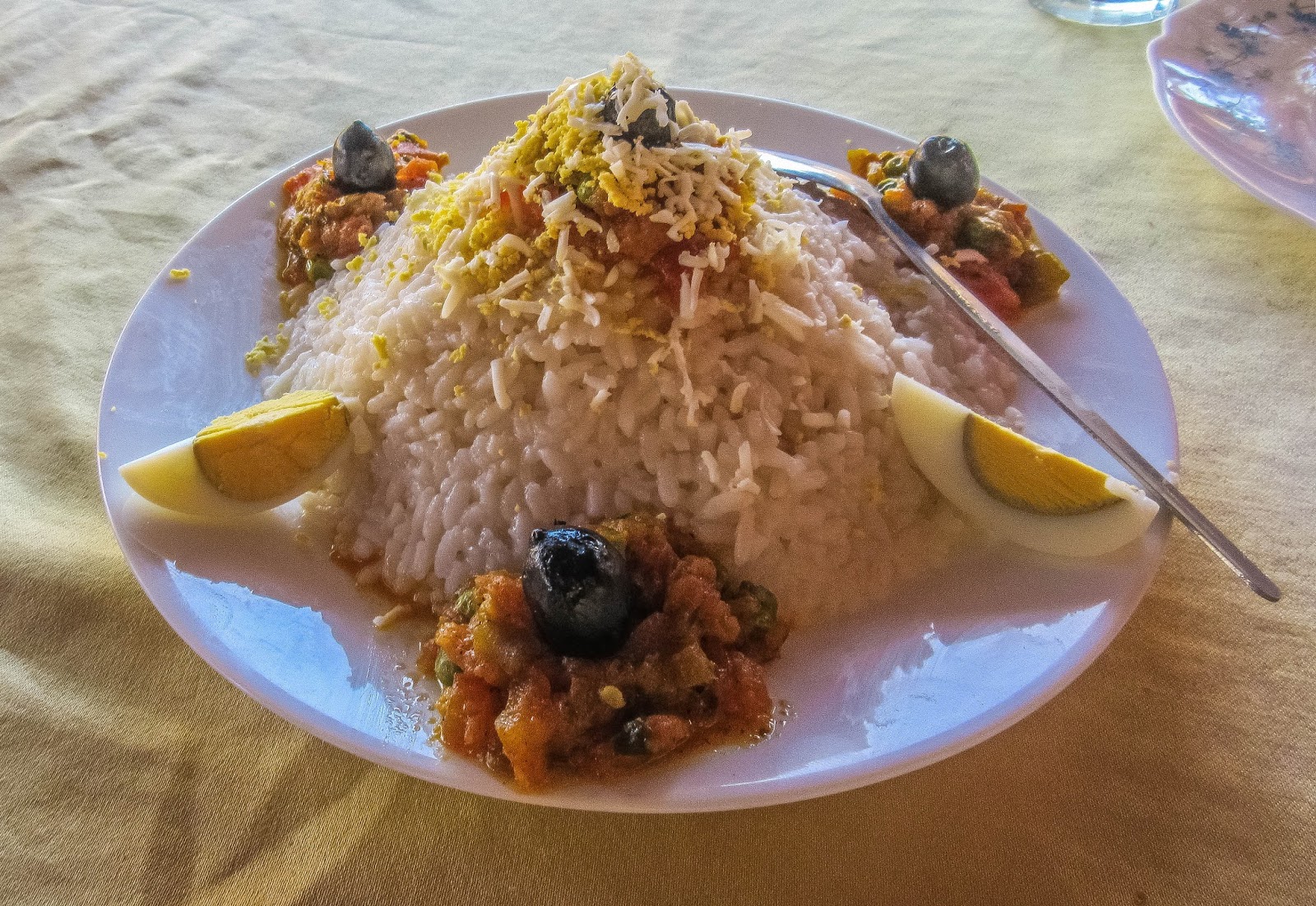
We drove to Lake Dayet Sriji, a salt lake west of Merzouga known for its flamingos. Because of drought the lake is dry and thus, no flamingos. Then we drove into Merzouga and walked through stands of date palms being irrigated, then walked the main street of town while Hassan and Aziz picked up some food. Then we drove back into the dunes where we stopped at a small tent restaurant that belonged to one of Hassan's friends and had a late lunch. First we were brought a salad consisting of soft, milky rice, olives and some tomato, peas, corn and saffron with herbs and spices. The rice by itself was plain, but with the sauce was good. There was not enough sauce for the amount of rice. Then we were brought what they called "Berber pizza," or Medfouna Rissani, a stuffed flatbread. It was marvelous. The middle of the bread was filled with chicken, herbs, spices, and hard-boiled eggs. I loved it - comfort food. Rissani, where it originated, is near Merzouga and where we drank
camel milk. For dessert we again got oranges, bananas and apples. These oranges were a little different than what we'd been having, more of a tangelo type.
 |
| A little oasis in the dunes. |
 |
| These yellow flowers on cones were found jutting out of the sand, particularly in the shadows of trees. |
 |
| Our lunch spot in a large tent. |
 |
| Looking out from our lunch spot. |
 |
| Rice starter dish. |
 |
| Berber pizza |
 |
| Filling of potato, chicken, egg, etc. |
 |
| The bread opened up to reveal the inner filling. |
 |
| Dessert |
 |
| Warm milk and sugar which I grew to love. |
After lunch, Hassan drove us to the west side of the dunes where we met with some of his other customers arriving that day, just off the main road. The previous night we were alone in the luxury camp. This night there would be 13 people, including us, in the luxury camp. We mounted camels for a camel trek into the tent camp, a journey of about three miles. There were about 25 camels lined up, all resting on the ground on their stomachs and legs, the legs bent at the knees. We were mounted on camels with another group of four from Europe, one of whom was from Cologne. They had one Berber handler for their four and Judy and I had a Berber handler for the two of us. Our handler was from a small village about 18 kilometers away. The handler walks in front of the lead camel, usually holding a lead rope, often clicking his tongue. It was similar to how the Bedouin handlers worked on our camel trip up
Mt. Sinai in Egypt. Groups are brought in to camp on the camels as they arrive. Because groups are driving a long distance, often from Fez or Marrakech, the tour companies are very flexible in handling the arrivals. If they arrive too late for a camel trip, they are taken in by vehicle like we were the night before. Our trip in took by camel took about an hour and 40 minutes. These camel saddles were much nicer than those used in Egypt. These saddles were heavily padded with blankets, were relatively flat and had an iron t-bar to hold on to where the typical horn would be on a horse saddle. The Egyptian saddles had two very large horns, one in front and one in back and were not padded nearly as well. The horns made getting onto the Egyptian saddles much more difficult (because you have to raise your leg high enough to get over the back horn) and the lack of padding made them much more damaging to the posterior. Kudos to the Moroccan saddles. It was a pleasant journey in. The sand dunes provide a soft walking surface. The only real excitement is when going down hill, you have to hold on tightly to avoid being thrown over the front of the saddle. And Judy survived her camel's decision to flop down on to its stomach without warning. We arrived at a spot and our handler had the camels lie down and we got off. Fortunately I recognized that our camp was just over the lip of the sand dune. Judy was wondering why we were getting off. The handler did not say that we were at camp. The group of four in front of us got off about 40 yards ahead of us for some unknown reason.
 |
| Some of the camels lined up for our camel trek. |
 |
| Judy ready to rumble. |
 |
| Camel shadows |


Camp was a little bit more dressed up for the evening. Little benches with sitting mats were brought out in front of the tents and a metal tripod carried an iron container with wood logs ready to light for a fire. We shared dinner in the dining tent with two other groups, each group seated at its own table. In addition to the group of four from Europe, there was a larger group, some of them from California, one of them from Portland. The other groups got the meal we had the night before. Hassan later said it was because we'd commented so favorably on our lamb and prune tagine. As a nice touch, Hassan provided us a completely different meal. In addition to providing us our warm milk and sugar, we got a different version of harira, a more watery soup with more of a tomato base. Our next course was a tagine of beef and prunes with a hard-boiled egg cut in half. The beef was moist and there were a lot of prunes that provide a nice sweetness when combined with the beef. Moroccans put hard-boiled eggs on many of their dishes. The next dish was unique to our experience in Morocco. It was almost like a
shakshuka, because it had eggs cracked and spread over the top, still quite soft with runny yolks. The rest of the dish was diced chicken, potatoes, chickpeas and other ingredients in a tomato base, with some lemon slices that added tartness. For dessert, of course, apples, bananas and oranges.
 |
| Sitting spots and stacked wood ready for a fire. |
 |
| Harira and bread. |
 |
| Beef and prune tagine with hard-boiled egg. |
 |
| Chicken and egg. |
After dinner we enjoyed lounging on the bench outside our tent. Moroccan lamps were lit and were throwing off beautiful light. We were looking forward to our entertainment that night. We could hear it going on in the regular camp over the dune, drums pounding, singing, lots of excitement. We waited and waited and it didn't come. We finally went into our tent about 10:15 p.m. and shortly thereafter the drums sounded outside and the entertainment began in our camp. It was too late for us, we decided to go to bed as we had a long drive the next day and I wanted to get up for sunrise pictures. This was my biggest disappointment of this part of the trip. I felt like the other camp got the benefit of the earlier entertainment. We had no trouble falling asleep despite the excitement going on outside the tent.
 |
| Desert light and color. I love Moroccan lamps and blankets. |
About 6:00 a.m. someone walked through camp telling us to get up if we wanted to see sunrise. Judy stayed in bed. I threw on some clothes and walked out in my sock-less sandals and enjoyed the cool sand against my feet. Most of the other guests were out for sunrise as well. We climbed up the dune just above camp and I was surprised to see our camels still there. They'd spent the night outside camp and I'd not heard them at all. This raised my hopes for a camel trip back out to our car that morning. I'd assumed we would be taken out by vehicle. I took the opportunity to get some camels in my sunrise shots. I followed one of the other groups up on the dunes and got some fun silhouette shots as they jumped into the air.
 |
| This is my favorite photo. The man on the right is from Cologne and they are jumping from the top of a sand dune. I believe the woman he is with is from Italy. |
 |
| Here they do a different type of jump. |
 |
| I like the symmetry of this shot - the bodies lined up in a triangle. |
 |
| The walking into the sunset (sunrise) shot. |
 |
| And the peaceful watch the sunrise shot. |
 |
| What could be better than finding camels outside the tents that morning? |
 |
| Surreal light bathed the camels and the dunes. |
 |
| People in the background provide context for how large these sand dunes are. The back dune is the one we visited the top of our first night. |
 |
| More fun light on the dunes. In addition to the woman in front, there are others on the dune in the background. |
 |
| This beetle showed where at least some of the markings in the sand come from. |
After taking lots of sunrise shots I walked back into camp and Hassan asked if we'd like to take camels out after breakfast. I conferred with Judy and gave him a thumbs-up. This more than made up for my disappointment of the night before. On the way out, it was just Judy and I, and our same handler from the night before. I had the same camel, named Timbuktu. I assume our handler spent the night in some spot provided by Hassan. It was very nice to have just the two of us, enjoying the early morning light on the dunes. And we made it out much faster than we went in, in about 50 minutes.
 |
| Camel shadows are fun. Judy has some better shadow photos because she was behind me. |
 |
| Different types of shadows in the morning. |
 |
| Where we got off. The dunes look like they've been tipped in mascara. |
At the end there was no one there to meet us. But no problem, our Berber handler pulled out his cell phone and called Hassan. Hassan arrived in about five minutes with our suitcases in his vehicle and quickly followed by Aziz in our van to begin our long drive that day.
I loved this segment of our trip. Of course, I love camels and enjoyed every minute of our two camel trips through the sand dunes. I loved sunrise and sunset. The light is magical in the desert. I loved the huge sand dunes. I loved the bleak foreboding desert that surrounds the sand dunes, the "black desert." And I was very impressed with the enterprising 29 year old Berber Hassan. We watched him juggling all of the pieces of supervising the camps for the other visitors as he spent the day with us touring the desert.