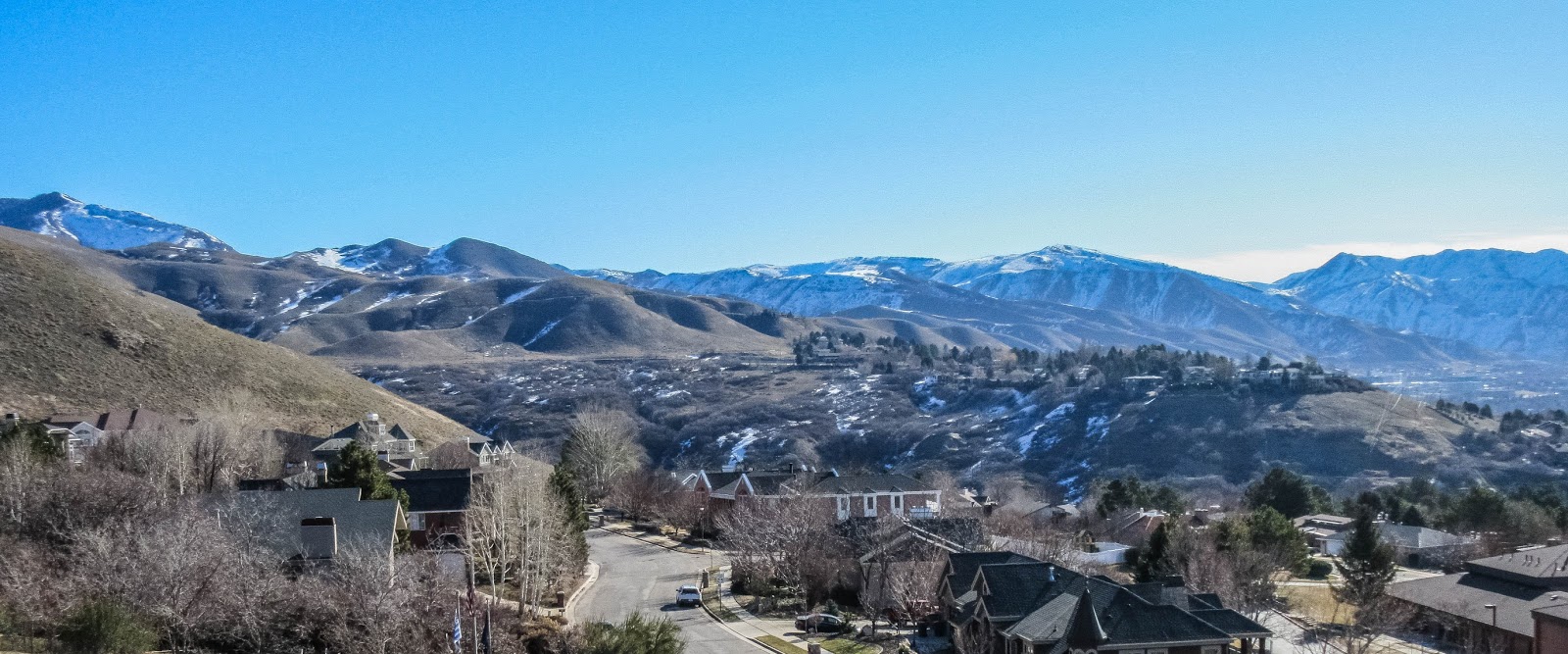
I recently read The Power of Myth by Joseph Campbell and came across a quote which grabbed my attention: "You can tell what's informing a society by what the tallest building is. When you approach an eighteenth-century town, it is the political palace that's the tallest thing in the place. And when you approach a modern city, the tallest places are the office buildings, the centers of economic life. If you go to Salt Lake City, you see the whole thing illustrated right in front of your face. First the temple was built, right in the center of the city. This is the proper organization because the temple is the spiritual center from which everything flows in all directions. Then the political building, the Capitol, was build beside it, and it's taller than the temple. And now the tallest thing is the office building that takes care of the affairs of both the temple and the political building. That's the history of Western civilization."
 |
| One of the few views of the Salt Lake Temple that is not marred by competing buildings in the skyline. It is breath-taking. It is ground zero in Salt Lake City. The streets surrounding it are West Temple to the west, North Temple to the north, South Temple to the south and Main Street to the east (which is now blocked off to traffic next to the temple block). Then the numbering system for the streets begins from there out into the entire Salt Lake Valley. The streets going west of West Temple are 200 West, then 300 West, etc. The same system to the north. To the south, the street south of South Temple is 100 South, then 200 South, etc. and to the east, after Main Street is State Street, then starts 200 East, 300 East, etc. |
 |
| The gold colored tablet embedded in the center tower reveals the starting date and the completion date - it took 40 years to construct. |
I am originally from Salt Lake City. My great-grandfather was part of the dedication of the Salt Lake Temple and four generations of my family have been married there.
 |
| The First Presidency of the LDS Church at the time of the dedication of the Salt Lake Temple on April 6, 1893. George Q. Cannon, first counselor, on the left; Wilford Woodruff, president, center; and Joseph F. Smith, second counselor, on the right. |
So it is a building I really love. I had noticed in succeeding visits to Salt Lake over the years that the temple is being swallowed by the buildings surrounding it, to the point that it is often invisible. It is very hard to get a view or a good picture without a high-rise of some sort filling the frame behind it. I'd never thought of this in terms of priorities. So with that in mind, why did the LDS church, which has great influence over local political matters and also owns most of the land around it, allow the temple to be swallowed up? I'm assuming that the reason relates to the value of the land, the need to maximize the value, and the desire to have these various functions close together, such as the office building, the temple and the conference center all within walking distance - but something has been lost by consigning the temple to a view inside a fish bowl.
I visited Salt Lake recently to visit my mother and took a diversion to look at the temple, the capitol building and the church office building in the context of Campbell's quote. I drove north of the church office building, to the capitol building, then further north still, to the vicinity of Ensign Peak, which is relevant to the discussion. Since I was last at Ensign Peak as a youth, a nature park has been created and a trail paved to the top. Ensign Peak is significant because Brigham Young saw it in vision in 1844 after the death of Joseph Smith. Joseph appeared to Brigham and showed him the peak, telling him to build beneath it. Young understood from the vision that the peak would be a sign to him that the westward exodus had reached the appointed destination. On July 24, 1847 when Young arrived at the edge of the Salt Lake Valley, below Emigration Canyon, he had another vision, "an angel standing on a conical hill [Ensign Peak], point[ed] to a spot of ground on which the new temple must be built." After the vision passed, Young responded, "It is enough. This is the right place. Drive on." After traveling into the valley, Young pointed at Ensign Peak and said, "I want to go there." He said the peak "was a proper place to raise an ensign to the nations." [See Isaiah 11:12] On July 26, 1847, just two days after their arrival, Young, Heber C. Kimball, Willard Richards, Ezra T. Benson, George A. Smith, Wilford Woodruff, Albert Carrington, William Clayton, Lorenzo Dow Young and possibly Parley P. Pratt climbed to the top of the peak. From there, Young determined the location of the temple which he announced two days later, on July 28, by planting his walking stick at the site and saying, "Here we will build the temple of our God." [From
"Ensign Peak: A Historical Review" by Dennis A. Wright and Rebekah E. Westrup]
 |
| Ensign Peak in the background, left of center. |
From a spot just above the nature park, well beneath the peak, I viewed the capitol building, the large church office building to its right and then I had to struggle to see the temple, overwhelmed and partially obstructed by the large buildings around it.
 |
| The Utah State Capitol building is in the left foreground, completed in 1912. The 28-story LDS church office building is the large white building to its right, completed in 1972. To its right is a much smaller white building with two wings and a beehive on top. It used to be the Hotel Utah, built in 1911, then renovated and reopened in 1993 as the Joseph Smith Memorial Building. Immediately behind the Joseph Smith Building is the 18-story Zions Bank Tower which is, or was, owned by the LDS Church. Then to the right is the new City Creek Center building, the 20-story Regent, also owned by the LDS Church, completed in 2012. Immediately in front of it is the Salt Lake Temple. Then in front of it are the 12-story Zion Summit Condominiums, built in 1976, which I'm guessing are also owned by the LDS church. Look at how flat the valley is everywhere but in the clustered downtown. The temple would stand out anywhere else in the valley. |
 |
| A closer view of the temple from a different angle. The Zion Summit Condominiums are in front to the right. Immediately in front of the temple is the rooftop of the LDS Conference Center, completed in 2000, with pine trees on the roof. |
 |
| From my vantage point below Ensign Peak, I could view where I grew up on the north bench, the relatively flat area covered with trees in the mid-horizontal part of the photo. The indentation in front of the bench is City Creek Canyon. |
The Conference Center, constructed in 2000, relates to the temple as well. When LDS Church president Gordon B. Hinckley spoke in General Conference in the Conference Center for the first time, he indicated that the building was a fulfillment of prophecy, as Brigham Young had prophesied that he saw the Mormons constructing buildings with trees and fish ponds on the roofs. That prophecy was in 1853 when construction of the temple began.
Brigham told the people, "[S]ome will want to know what kind of a building it will be. I scarcely ever say much about revelations, or visions, but suffice it to say, five years ago last July I was here, and saw in the spirit the temple not ten feet from where we have laid the chief cornerstone. I have not inquired what kind of a temple we should build. Why? Because it was represented before me. I have never looked upon that ground, but the vision of it was there. I see it as plainly as if it was in reality before me. Wait until it is done. I will say, however, that it will have six towers, to begin with, instead of one. Now do not any of you apostatize because it will have six towers, and Joseph only built one. It is easier for us to build sixteen, than it was for him to build one. The time will come when there will be one in the center of temples, we shall build, and, on the top, groves and fish ponds. But we shall not see them here, at present." The Conference Center, which is across the street from the temple, has trees and waterfalls on top of it.
 |
| The LDS Conference Center from the front. Note the Zion Summit Condominiums behind it which block the view of the capitol and Ensign Peak. Also note the vegetation hanging over the top of the roof. There is also water cascading down the front of the building which is not visible in this picture. |
 |
| The LDS Conference Center from the back. Note the varying terraces with trees. |
 |
| This side view of the Conference Center shows the temple peaking out from behind it. |
 |
| This view of the temple from ground level shows the six spires and the competing skyline behind it. The Joseph Smith Building is to the left, the City Creek Center is to the right, and the Zions Bank Tower is to the left of the City Creek Center. Temple Square has a wall around the entire block, the wall visible here in front. |
Utah became a state on January 4, 1896, but it was a struggle to get there. Joseph Smith believed in a theocratic government that involved both religious and political dimensions. Joseph was very involved in everything from president of the church, to mayor of Nauvoo and commander of the Nauvoo Legion. The same ideas continued on after his death under Brigham Young. Like Joseph, Brigham dominated all matters of Mormon life. After the Mormons first arrived in the Salt Lake Valley in 1847, they proposed a State of Deseret, the name for the word "honeybee" in the Book of Mormon and Brigham was the governor. Deseret covered a very large area, in fact almost all of the area brought into the United States as a result of the Mexican American War and the Treaty of Guadalupe Hidalgo, including most of current Utah, about a third of Colorado, small parts of New Mexico, Wyoming, Idaho and Oregon, most of Nevada, about two-thirds of Arizona and about a third of California, most of it in Southern California. In September 1850, Congress created Utah Territory which included all of current Utah, about a third of Colorado, most of Nevada and a small corner of Wyoming. and Brigham was named as the first governor of Utah Territory in February 1851. The Mormons did not give up on the idea of the State of Deseret. From 1862 to 1870, a group of Mormons under the leadership of Brigham Young met as a shadow government after each session of the territorial legislature to ratify the new laws under the name of the State of Deseret and attempts were made in 1856, 1862 and 1872 to write a new State of Deseret constitution based on the new boundaries of Utah Territory. Gradually the Mormons were forced to comply with standards dictated by the Federal government before Utah was allowed to become a state. On September 24, 1890, Mormon president Wilford Woodruff issued the Manifesto declaring that Mormons would no longer enter into polygamous marriages. In May 1891, national political parties were formed in Utah. The People's party was disbanded and advised members to join either the Republican or Democratic parties. In March of 1895 a new Utah constitution was framed and it had to "forever" ban the practice of polygamy.
 |
| The Utah Capitol building, up a road that leads from the LDS Church Office Building. |
 |
| The capitol building seen from the other side. |
In 1912 when the capitol building was completed, LDS Church membership was about 418,000. In 1972, when the Church Office Building was completed, membership had increased to 3,219,000. I believe the membership today is a little over 16,000,000. Campbell's quote above implies that the Mormons control both religious and political activities in Utah. There is no question that the LDS Church still has incredible political power in Utah, but that power has diminished over the years as the non-Mormon population of Utah, and particularly Salt Lake City, has increased and as the LDS Church hierarchy has shown more restraint in getting into political affairs.
 |
| This picture taken from the Conference Center, shows the Church Office Building to the far left, a portion of the temple at the far right and the Joseph Smith Memorial Building just right of center. |
Probably more of an issue for the LDS Church today, than its involvement in political affairs, is its involvement in financial affairs and its lack of financial transparency. Some Mormons have been unhappy with the LDS Church investment in the City Creek Center, estimated by some at $5 billion, although in fairness, it appears that the City Creek Center itself was about $1.5 billion and the $5 billion cost involves a much larger downtown redevelopment project and involves other parties putting in funds. Some members have called out for more of that money to be used in charitable causes and also for an accounting of how church tithing funds are spent.
 |
| Here is the temple against the City Creek Center immediately behind it, the Zions Bank Tower to its left and the Joseph Smith Memorial Building in front of it. |
 |
| Notwithstanding Campbell's quote above, which was intriguing to me, I love the Salt Lake Temple, both from the standpoint of my own history, and from the standpoint of it as a religious symbol. My marriage, my daughter's marriage, my parents' marriage and my grand-parents' marriages all took place in that building. Our younger children were able to go inside and participate in vicarious ordinances in the temple with my parents when our daughter was married, shortly before my father died and I have been inside for the marriages of a number of my siblings. |
 |
| From a purely aesthetic standpoint, it is difficult to get a good picture of the temple without a big office building intruding. I tried. |
 |
| This angle, looking upward works, as does the view from the east side, as long as you get close enough. |
 |
| And pictures of bits and pieces of it work. |
 |
| The Angel Moroni on a central spire. |
 |
| Beautiful wooden doors on the outside. |
 |
| A simple, but beautiful window. |
The Salt Lake Temple will always hold a very special place in my heart, both as a sacred edifice for me and my family, and also as a symbol of the struggle and triumphs of my people who built a stronghold from the ground up in a desert of the mountain west.