Wednesday, November 28, 2012

Oslo Cathedral

Oslo Cathedral, or Oslo Domkirke, is the main church of the Church of Norway and the Diocese of Oslo. 
The Church of Norway was established after the Lutheran reformation broke ties with the Catholic Church in 1536 to 1537. It is a Lutheran church and a member of the Porvoo Communion (we have visited other churches that are part of the Porvoo Communion, including Copenhagen Cathedral, in which post I give more detail on the Porvoo Communion, Porvoo Cathedral in Finland, and St. Mary's Cathedral in Tallinn, Estonia). The King of Norway is the constitutional head of the church and must profess to be a Lutheran. The church is supported by the government and has 11 dioceses and 1,284 parishes. About 76% of Norwegians are members of the church, but only about 3% of the population attends church more than once a month. 
Oslo Cathedral - west entrance
bronze dome
southwest side
east side
north side
Bazaar at the eastern side
Beautiful wood outer door
An unusual granite corner sculpture that looks like it is out of Norse mythology
Oslo Cathedral was built between 1694 and 1697 (a date on the back of the church says 1696). 
It is located just off Stortorvet Square. Stained glass windows, of which there are only a few, are from 1910 to 1916, 

bronze doors at the west portal are from 1938, 
western bronze doors
Adam and Eve panel 

a wonderful silver sculpture of the Last Supper, one of my favorite decorations, is from 1930 


and ceiling decorations, very modern and perhaps the most unusual part of the cathedral, are from the late 1990s. 
They have the look of being painted on fabric

Ceiling decorations and organ pipes


The Church of Norway practices infant baptism and the baptismal font has an inlaid snake in front of it, representing, I presume, original sin which is washed away by baptism.
baptismal font

faux marble benches
altar piece
I'm not sure what the main course is at the Last Supper, but it the head of it looks like a  mountain lion.

pulpit
old organ

header above a door
another door header
It is used by the Norwegian Royal Family and Norwegian Government for public events. We visited Oslo on June 27, 2011, just before the massive killings on July 22, 2011 by Anders Behring Breivik, who set off a car bomb outside the prime minister's office in Oslo, which killed 8 people, then went to the island of Utoya and killed 69 more, as well as injuring many more than that. A memorial service was held on Saturday, July 23, 2011, at Oslo Cathedral, attended by King Harald V, Queen Sonja, Prime Minister Jens Stoltenberg and many other dignitaries and family members of massacre victims. 
Photo from LA Times
Judy did a post on Oslo, with a big section on Oslo Cathedral, on July 24, 2011, right after the massacre. 

Monday, November 26, 2012

Baked Eastern Wild Turkey

The wild turkey is native to North America. 
However, its name comes from the country Turkey because  in the 1500s, turkeys shipped from the Americas to Britain went through Constantinople and the British associated the bird with that country.  The eastern wild turkey is a subspecies of turkey that is found in the eastern United States, from Maine to northern Florida and extending west to Michigan, Illinois and Missouri. This is the kind of turkey found by the Puritans who founded Jamestown. Our domesticated turkeys actually come from the South Mexican wild turkey, a different subspecies, which were taken by the Spaniards back to Europe in the 1500s. They spread from Spain, to France and then to Britain as farm animals and eventually to the U.S. Wild turkeys can fly and run very fast and their feathers are dark colored. Domesticated turkeys can't fly or run fast. Their neck skin or wattles are heavier, and their breasts are much larger, so large that they can't mate and must be artificially inseminated. They commonly have white feathers. 
These wild turkeys were found near Mount Nebo, in central Utah, outside of Nephi.
For Thanksgiving this year we ordered an eastern wild turkey, raised in California. It came fresh with the neck and head still attached 
Eastern Wild Turkey
and weighed about 13 pounds. 
We decided to cook it the way we would a domestic turkey, with stuffing, in a bag, in the oven. Judy used a pound of wild boar sausage we had in the freezer as an ingredient for the stuffing, 
Beginnings of stuffing with a pound of wild boar sausage.
and also put slices of butter under the skin of the turkey to give it added flavor and moisture, something she read about. 
Butter slices under the skin and paprika on the outside.
I noticed that the skin was thinner than a domestic turkey and it had much less fat. The wings were also larger and I ate and enjoyed them (they are often just tossed from a domestic turkey). 
The cavity of the bird seemed smaller and the whole structure seemed different, although I could not tell you why - perhaps because of the smaller breasts. I really enjoy the tail and I found that the tail of the wild turkey, although quite large, was much less fatty. 
Plate of carved turkey.

Sunday, November 25, 2012

Rahel Ethiopian Vegan Cuisine

We recently took another foray into Los Angeles to meet Andrew and Lauren for lunch. This time the venue they chose was Rahel Ethiopian Vegan Cuisine, located at 1047 South Fairfax Ave, Los Angeles, CA 90019 (323-937-8401), in the heart of Little Ethiopia. 
We have eaten in Little Ethiopia before, at a place across the street called Merkato Ethiopian Restaurant. The most distinguishing feature about Merkato was that we ate without utensils. Instead we used a sour, spungy flat bread, called injera, to pick up the food and accompany it down our gullets. Merkato also had some unusual dishes, the most memorable being bloody raw meat with kind of a bitter sauce. Rahel, by contrast, was much tamer and less unusual. We had utensils, which I liked, but the option of using injera if we wanted it (I didn't). The ingredients were all familiar, but what was unusual was the different combinations of these common ingredients and their amazing colors. The interior of Rahel is roomy 
and there are wonderful pictures and African artifacts to give an Ethiopian feel. 
We had the option of picking from a number of great looking menu items, or a buffet. We all decided to do the buffet because the offerings looked great and it would allow us to try more dishes. Interestingly, virtually all of the dishes were seasoned with onions, garlic and ginger, something I would not have guessed  based on taste. I think it may be the most colorful food I've ever eaten, lots of yellow, orange and green. 
The yellow item with a green pepper, on the bottom left, is steamed split pea stew. Next to it, on the right, was one of my favorites, zucchini stew, which also included chili pepper. Above the split pea stew, on the left, is cooked and seasoned kale, which was surprisingly good. The orangish item to the right of the kale is steamed cabbage with tomatoes. 
The same plate, just looking from the opposite side, has more yellow to the left, which is steamed cabbage, potatoes and carrots. To the right is steamed string beans, carrots and potatoes, and below is boiled orange sweet potatoes, and kind of covered up to the right, some salad with beets. I went back for another plate and stocked up on my favorite items, the two cabbage dishes, the zucchini stew and also some steamed buckwheat with onions, one of the few items without garlic and ginger. 
At least Andrew, and maybe Judy, ate their food with injera, a spongy, sour Ethiopian flatbread. I am not an injera lover, so I was happy to use a fork and spoon. For a drink, I got a strawberry banana drink which was very good. 
We all left stuffed. I wish this was close to work. If it was, I would eat there regularly. As Judy said, it is disgustingly healthy, and it is good tasting. On the other hand, I did not find any one of the items that stood out as outstanding, something I would crave and drive many miles to specifically get again.  

Saturday, November 24, 2012

Hen of the Woods Mushroom

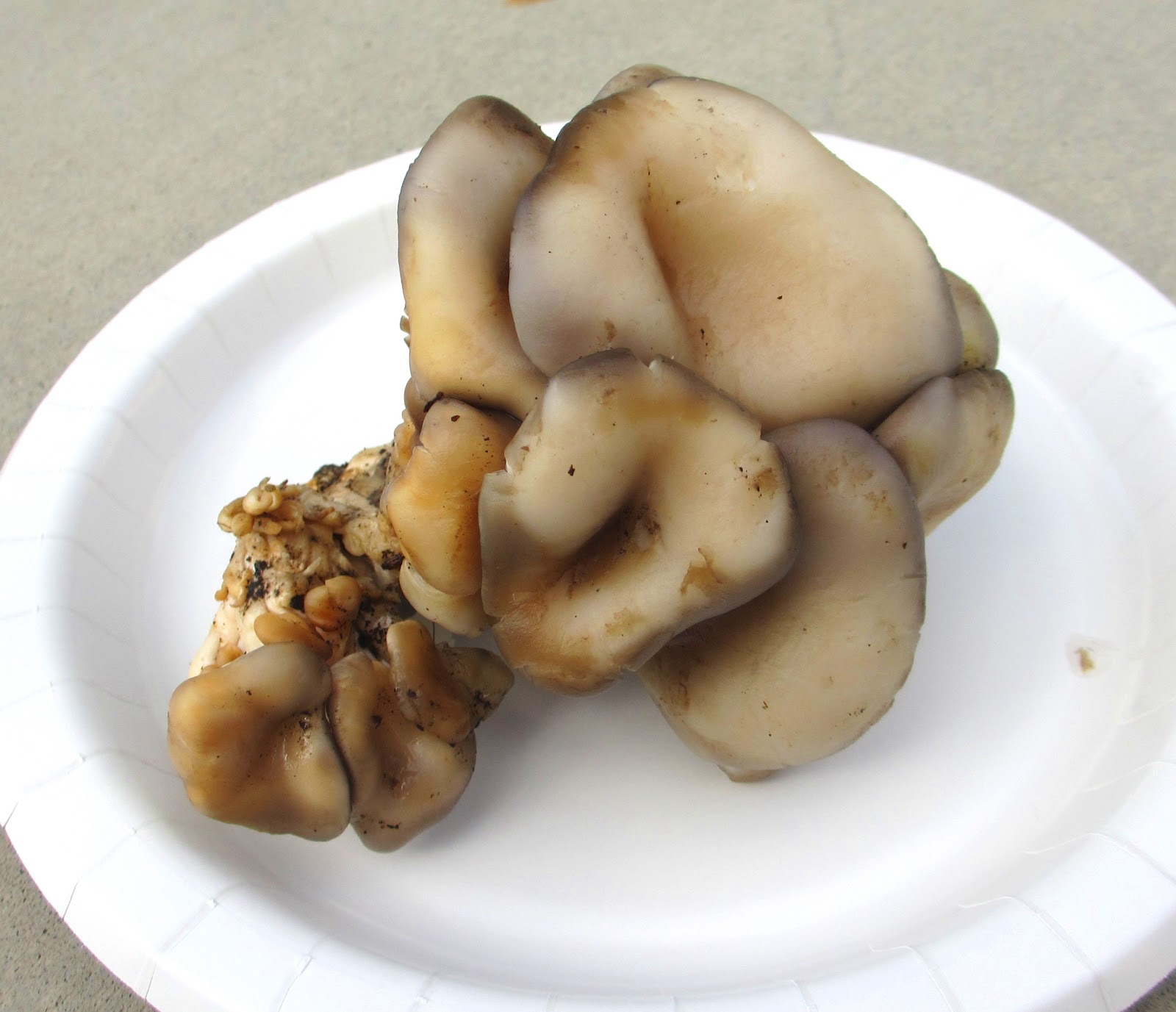
I noted in my last post that Judy picked up some morel mushrooms for me from Whole Foods before I went vegan. At the same time she picked up a hen of the woods mushroom as well. 
hen of the woods mushroom
I did a post three years ago that covered several kinds of mushrooms, including the maitake, which is the Japanese name for the hen of the woods. At that time I was not really impressed. Compared to the chanterelle and king oyster mushrooms we were also eating, they came in decidedly last in terms of taste and texture. However, on our anniversary last year, we ate at a restaurant in Waterbury, Vermont, called Hen of the Wood, a very high-end, locally grown vegetables and meat restaurant. Their signature dish is called the "hen of the wood," which was hen of the wood mushroom, poached egg, bacon crisped in maple syrup, all on toast. It was the best thing we ate out of a wonderful meal. So when Judy brought me this hen of the wood mushroom, 
I had a different thought process about it and a new appreciation for it. Attitude can make a huge difference in how we appreciate and enjoy food. Further, now that I have been on a number of mushroom forays with Andrew, I understand more the thrill of the mushroom hunt, and the excitement of finding an unusual type of mushroom. So I was able to really enjoy and appreciate the intricate beauty of this mushroom, 
how it was packaged and pulled apart. 
And after frying it in oil and butter, 
I really enjoyed the plumpy moistness and fullness of the flesh. 
And this time, instead of comparing it to chanterelles, probably my favorite mushroom, I was comparing it to morels, which I have not learned to appreciate as much yet. This time, my appreciation for the hen of the woods was much greater, I thought of Vermont, I thought of mushroom hunting with Andrew and Sam, and goodness came to life. 

Friday, November 23, 2012

Morel Mushrooms

Some time back, before I went vegan, Judy visited Andrew in Los Angeles and stopped at Whole Foods. She brought me home a wonderful surprise, some fresh morel mushrooms. 
morel mushrooms
I've only eaten morels once before, a package of dried morels I re-hydrated. I was not all that impressed and wanted to try fresh ones. Two years later, I got my chance. I think that what makes morels so intriguing is their appearance. The cap looks very woody, like bark, or a small pine cone, 
or even a piece of wood chewed up by termites. 
They are not appetizing looking in the least. Surprisingly, they are hollow inside, 
unlike other mushrooms I've tried, and they feel like plastic or vinyl. A cut cross-section looks like an intestine. 
Even cut-up and cooking in a frying pan with butter, they look like frying tripe. 
I am sad to say that I was not much more impressed with the fresh morels, than I was with the re-hydrated morels. They still had the plastic/vinyl texture, although the cooking mitigated it somewhat. One of the things I love about cooked mushrooms is the pleasing, moisture saturated, plump texture. The morels remained thin and somewhat stiff.
I guess I am going to have to go up several levels and have morels in a French dish, cooked by a master chef. However, the French can make cardboard taste good, so long as they add plenty of butter and cream. I kind of think that must be the solution.  

Thursday, November 22, 2012

Wild King Trumpet Mushrooms

Last Sunday Andrew and Lauren visited us after a mushrooming trip in the San Bernardino Mountains with a Los Angeles mushroom club. Andrew found a king trumpet mushroom, 
Wild king trumpet mushroom
which is also known as a king oyster mushroom, which he harvested and brought with him. It had been i.d.'d by two mushroom experts in the club, so we felt comfortable eating it. Andrew washed it and cleaned off the dirt, then separated out the individual pieces. 
I was surprised to see it separate like it did - it had looked like one big blob. He cut the mushroom into small pieces and put just a bit of canola oil in a frying pan. 
He indicated that the goal of the cooking is to get most of the moisture out of the mushroom and that it would cook into a texture similar to abalone  He put on a little truffle salt and then served it. The texture was very similar to abalone, very firm and meaty. 
I believe this is the first time I've eaten wild mushrooms picked by someone I know. I hope there will be many more opportunities. 

Wednesday, November 21, 2012

Grilled Llama Porterhouse

Our children were all headed for different destinations this Thanksgiving weekend and we thought we were going to be doing Thanksgiving alone. Then Judy got a call from my mother and a nephew (and his family) asking if they could come stay with us while they were attending another family event later in the week. Judy got excited, said "yes," and invited them all for Thanksgiving as well. Not too much later, Judy said, "We need to eat something a little unusual, it is a family tradition." Well, that is all it took for me. I decided I was non-vegan for Thanksgiving and we ordered an eastern wild turkey for our meal. Then I discovered that llama 
Llamas graze at Machu Picchu in Peru.
was available and ordered a 16 oz. porterhouse llama steak. I decided to prime my pump for Thanksgiving and eat the llama the night before. We visited Peru three years ago and saw quite a few llama while there, especially at Machu Picchu where they wandered wild on-site. 

We also had an opportunity to eat alpaca, a relative of the llama, at a restaurant in Cusco, and found that it was very good. The llama meat is very, very lean, 
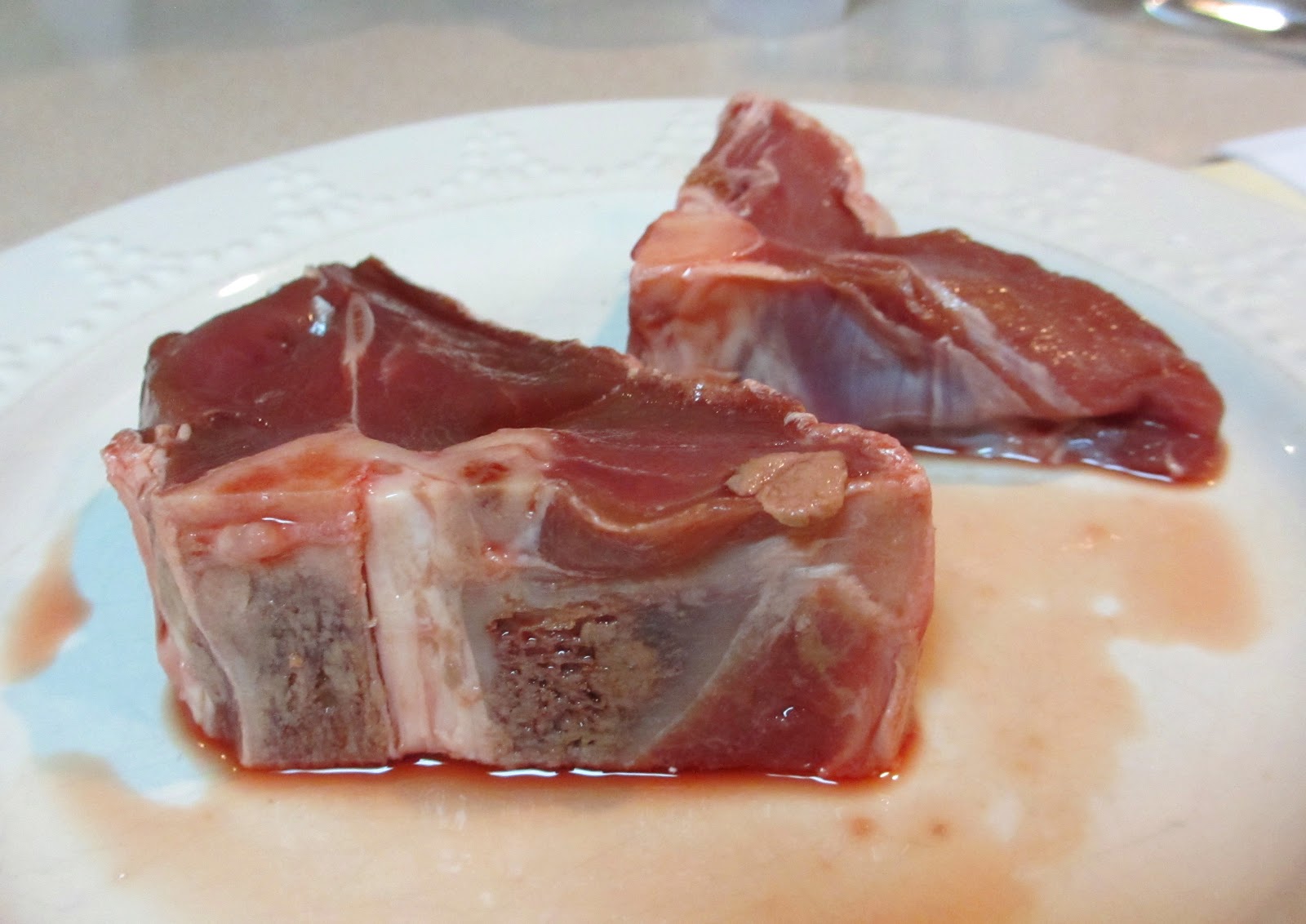
Llama porterhouse steaks
so I figured the meat needed to be cooked on high heat for a short time. I heated up our outdoor gas grill, which has been under-utilized the last six months, cooking corn-on-the-cob and poblano peppers, and was as excited as the grill to try something more substantive.  I cooked the steaks about 7 minutes on one side and 2 minutes on the other. 
The larger steak was quite rare in the middle, but that's how I enjoy it, particularly for lean meats. 
It was very, very lean, and had very little blood. 
It was quite tough and hard to cut, but it had a very pleasing flavor, although I can't think of anything to compare it to, other than alpaca. It had more flavor than beef, but was not gamy. It was a very nice way to warm-up for tomorrow.