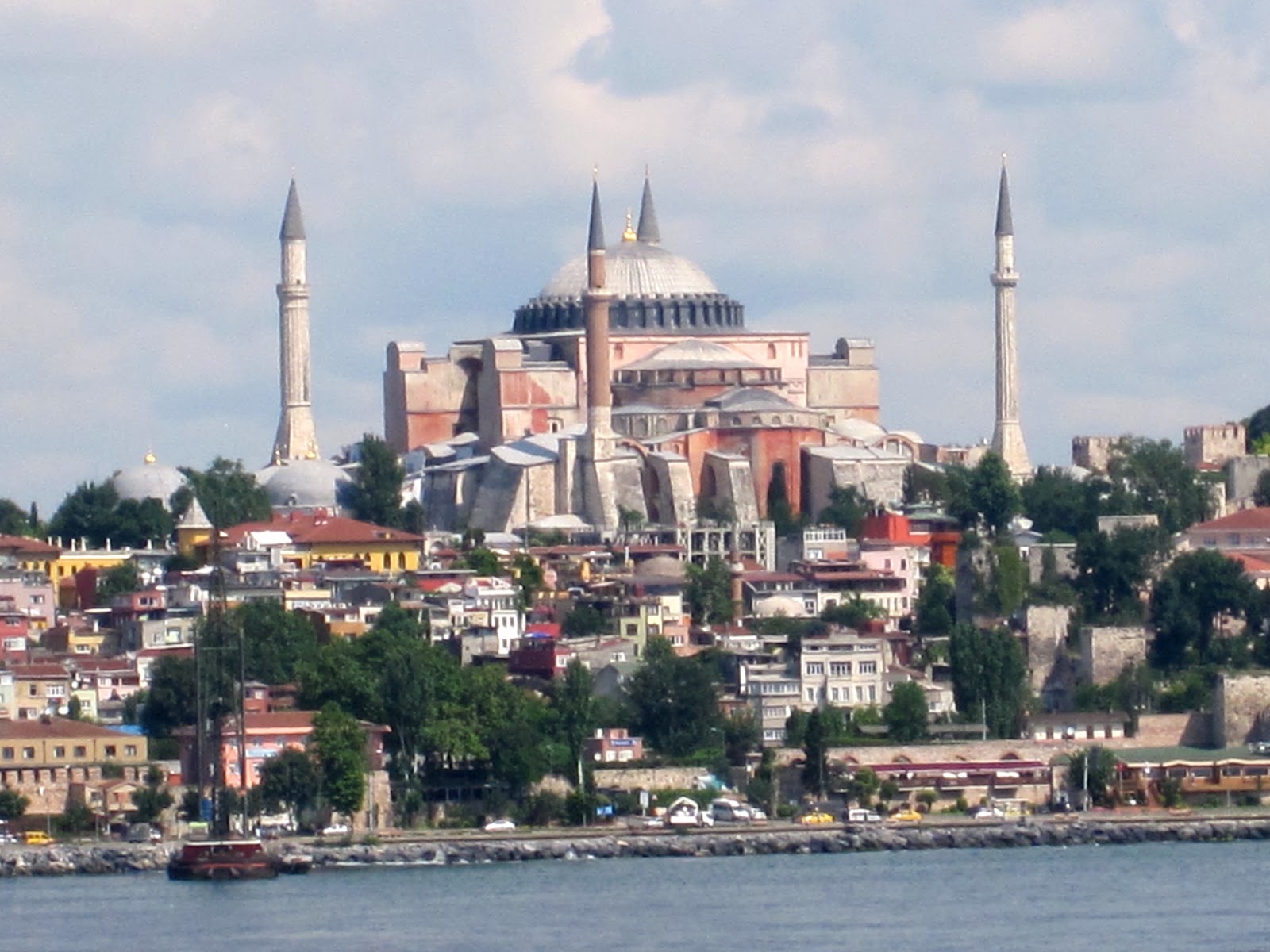
Hagia Sophia in Istanbul, Turkey, has amazing history behind it. Hagia Sophia means "Holy Wisdom."
The current building, the third, was started on February 23, 532, at the behest of the Emperor Justinian, when the prior structure, the second, burned to the ground a month earlier.
The second structure, ordered by Theodosius II, lasted 117 years. The name Hagia Sophia was actually first applied to the second structure around 430. Prior to that it was known as Megale Ekklesia, or Great Church. The first structure, which lasted 44 years, was completed in 360 during the reign of Constantius, son of Constantine, but construction may have started during the reign of Constantine, who died in 337. In 404, when the Patriarch of Constantinople, John Chrysostom, came into conflict with the Empress Aelia Eudoxia, he was sent into exile and the resultant riots (the Nika Revolt) led to the burning of the first structure.
For the current building, Justinian had materials brought in from many places. Hellenistic columns came from the Temple of Artemis at Ephesus, Corinthian columns came from Lebanon, porphyry from Egypt, green marble from Thessaly (Greece), black stone from the nearby Bosporus and yellow stone from Syria. The church was inaugurated on December 27, 537 and Justinian declared that he had outdone Solomon. It is today considered one of the greatest surviving examples of Byzantine architecture. It took another three or four decades to complete the inside mosaics, while Justin II was emperor. Hagia Sophia was the seat of the Orthodox patriarch of Constantinople. An earthquake in 558 caused the main dome to collapse and its replacement, the current ribbed form of dome, was completed in 562.
The high central dome rests on four arches,
which rest on a series of tympana and semi-domes, which rest on smaller semi-domes and arcades.
This is best seen from aerial views. The building is so big and it is surrounded by so much vegetation, that it is difficult to get any sense of the whole except from some distance.

During the Fourth Crusade, Constantinople was captured by the Latin Christians in 1204, led by Enrico Dandolo, the Doge of Venice, and Hagia Sophia was ransacked. Relics from the church, such as a stone from the tomb of Jesus, the Virgin Mary's milk, the shroud of Jesus and bones of several saints, were sent to churches in the west. During the Latin occupation of 57 years, Hagia Sophia was a Roman Catholic cathedral. It was recaptured by the Byzantines in 1261.
In 1453, the Ottoman Sultan Mehmed II captured Constantinople and transformed Hagia Sophia into a mosque. Aya Sofya Mosque became the first imperial mosque of the re-named city of Istanbul. Because Islam banned representational imagery, many of the mosaics were covered with plaster. The direction of Mecca is indicated by the mihrab, a niche in the wall, and the area over the mihrab must be roofed.
 |
| The mihrab in Hagia Sophia. |
 |
| Stained glass above the mihrab. |
Several decades later, a minaret was erected on the southwest corner and shortly later another minaret was added to the northeast corner. In the mid-1500s, they were both replaced by minarets at the east and west corners.
During the reign of Selim II (1566-1567), two large minarets were added at the western end. Murad III (1574-1595) had two large alabaster Hellenistic urns, carved from single blocks of marble, brought in from Pergamon and placed on two sides of the nave.
 |
| Marble urn from Pergamon. |
The Sultan Ahmed Mosque, popularly known as the Blue Mosque, was built near Hagia Sophia from 1609 to 1616. It has many of the elements of the Hagia Sophia. We got a good view of both together as we sailed past on our cruise ship. They make quite an imposing pair.
 |
| Blue Mosque to the left and Hagia Sophia to the right. |
In 1740, a Sadirvan, a fountain for ritual ablutions, was added on the outside by Sultan Mahmud I.
 |
| Sadirvan: fountain for ritual ablutions. |
Between 1847 and 1849, Sultan Abdulmecid had gigantic circular-framed disks hung on columns, inscribed with the names of Allah, the Prophet Mohammad, the first four caliphs, Abu Bakr, Umar, Uthman and Ali, and the two grandchildren of Mohammed, Hassan and Hussain.
The minarets were also altered so that they were of equal height and the exterior stucco was tinted yellow and red.
In 1935, the founder of the Republic of Turkey and the first Turkish President, Mustafa Kemal Ataturk, turned Hagia Sophia into a museum. Carpets were removed and white plaster from many of the mosaics were removed.
Giant six-winged angels or cherubs were painted on the four pendentives (a constructive device which allows a circular dome to be placed over a square room) during the reign of Basil II (958 to 1025). The Ottomans covered the faces of the angels with a golden halo.
 |
| Angel with golden halo. |
Just a few months before our visit in 2010, the golden halo of one angel was removed and the face was restored to its original state.
 |
| Angel with restored face (golden halo removed). |
The mosaic in the tympanum of the southwestern entrance dates to 944.
 |
| Justinian I, Mary and Christ, and Constantine. |
The Virgin Mary sits on a backless throne. The Christ Child sits on her lap holding a scroll in his left hand. On the right side, Emperor Constantine, presents to her a model of the city of Constantinople. The inscription says, "Great emperor Constantine of the Saints." To her left, emperor Justinian offers her a model of the Hagia Sophia. The medallions on both sides of Mary's head carry monograms which mean "Mother of God."
Some details I don't have specific commentary on, but enjoyed.
We were on a tour when we visited Hagia Sophia and did not have the time to visit the upper levels. That is probably my single biggest regret of our whole trip. Istanbul was my top trip destination, one of the reasons we took the cruise that originated from there, and Hagia Sophia was the reason I wanted to visit Istanbul. The place just oozes history. It was dark inside, only natural light. I was primarily interested in it because of its early Christian history. One of the problems we found in Istanbul is that the guides are naturally Islamic and don't have the depth of knowledge about Christianity. I would love to have a tour of Hagia Sophia with someone who has a real depth in that area. A reason to hopefully go back some day.