Tuesday, May 11, 2010

Spiny Senna

Spiny senna, senna or desert senna (Senna armata)
is an uncommon shrub, a member of the legume family,
with yellow-green striped stems
that are leafless and dead looking most of the year
until March to July when it has yellow to salmon-red flowers
and
with five petals.
It has spines, but they are soft and bend to the touch.
Leaves will have two to four pairs of distantly-spaced, opposing, oval leaflets.
The fruit is a cylindrical pod, a little over 3/4" long, which falls off and contains few seeds. It is found in the deserts of southeastern California, Nevada, Arizona and Baja California. I found these plants on the bajada south of the Eagle Mountains off the Hayfield Road exit of the I-10.
The photos above were taken on April 17th. I went back out on May 1st and was blown away by the difference as the shrubs had fully flowered.
They were shockingly beautiful. In the early morning light they glowed.
The two photos above and the next one were taken with my digital point and shoot.
This final photo was taken with my digital SLR and came out much more orange.

Monday, May 10, 2010

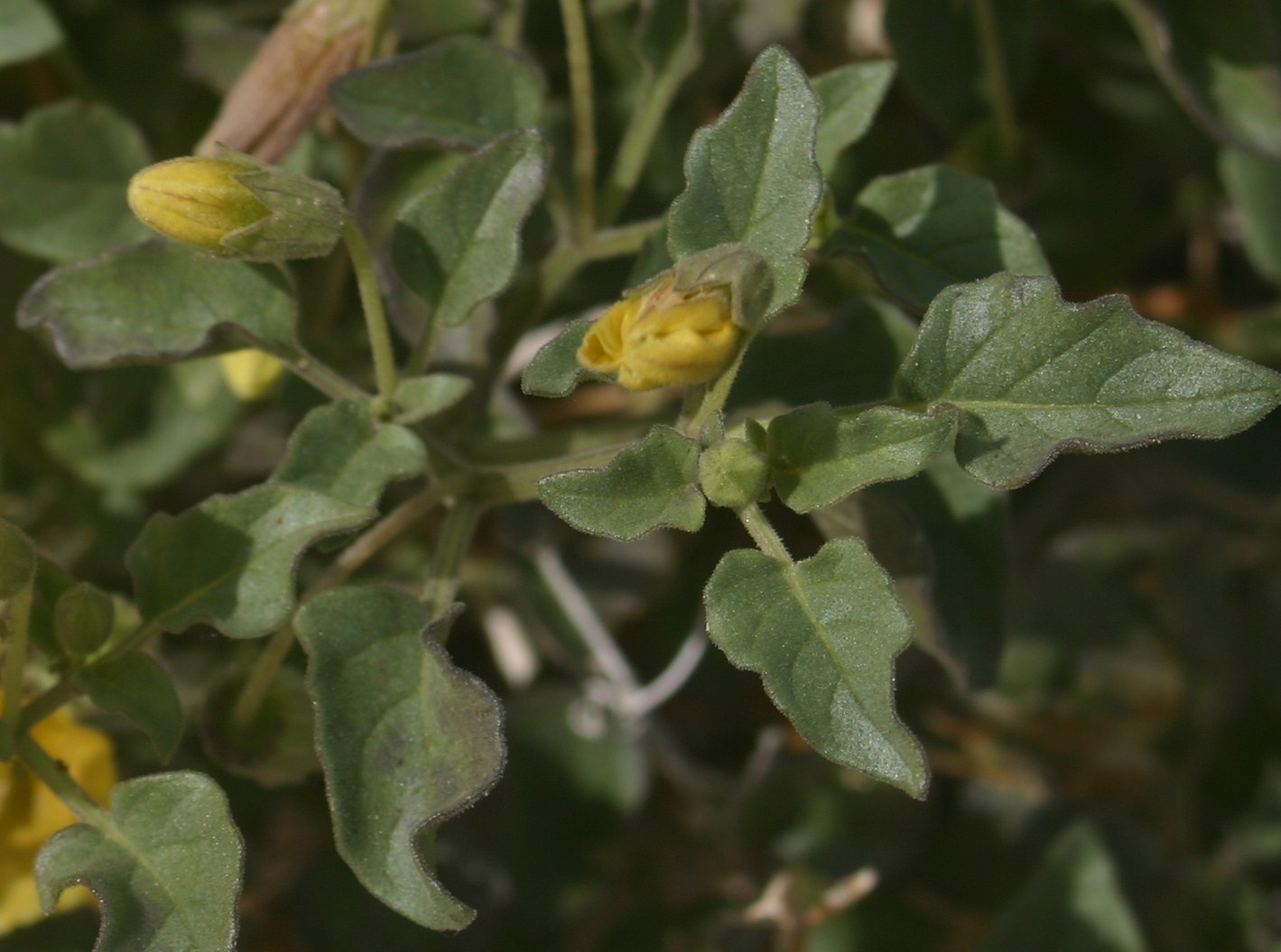
Yellow Nightshade Groundcherry

Yellow nightshade groundcherry,
also known as thick-leaved groundcherry 
and ground cherry (Physalis crassifolia) is a member of the nightshade family.
It has a ridged, angular, branching stem and can have a clumped, matted or erect form. The oval leaves can have smooth, wavy or bluntly toothed edges.
The flowers are yellow
and widely bell-shaped
and vaguely five-lobed
and are open from March to May. The star-shaped sepals at the base of the flower
enlarge as the fruit develops, becoming an inflated, angled, lantern-like structure which contains the berry.
The Jepson Flora Project of the University of California states that some species of ground cherry have unripe fruit that can be toxic and further study is needed in the western United States. It can be found in the peninsular ranges, east of the Sierra Nevada Mountains and in the deserts of southeastern California.
It can also be found in Nevada, Arizona and northern Mexico. These particular plants were photographed on the bajada south of the Eagle Mountains off the Hayfield Road exit of 1-10.

Sunday, May 9, 2010

Browneye or Brown-Eyed Primrose

The browneye or brown-eyed primrose (Camissonia claviformis ssp. claviformis)
is another subspecies of the brown-eyed primrose. I previously blogged on the Peirson's brown-eyed primrose, a subspecies with a yellow flower. It grows from a basal rosette of long oval leaves.
Each flower has four white petals.
The pistil is longer than the stamens and has a bulbous stigma at the tip.
The stamens have long hairy anthers.
The base is brown (thus the name brown eye).  
These plants were found in the southern portion of Joshua Tree National Park on the bajada below the Eagle Mountains off the Hayfield Road exit of the I-10 freeway.
I saw quite a few of them, whereas two weeks earlier I saw none.
I think the difference was that on my April 17th trip I got there at 6:00 a.m., quite a bit earlier than my April 3rd trip. I believe it is a night blooming flower and that later in the day, when I was there previously, the flowers had already closed up.

Saturday, May 8, 2010

Desert Tobacco

Desert tobacco (Nicotiana obtusifolia)
is part of the nightshade family.
It is one to three feet in height and large plants have multi-branched stems. It has tubular, five-lobed, cream-colored, greenish-white to pale yellow flowers
that form at the end of the branches that are about 3/4" long.
It has dark green, smooth-edged, oval to lance-shaped leaves up to 6" long.
The entire plant is sticky and covered with small hairs.
It is usually found in sandy washes. All parts of the plant are poisonous and it is considered highly toxic to livestock.
It is found east of the Sierra Nevada and into the southeastern California deserts, to Nevada, Utah, over to Texas and south in to Mexico.
The plants in these photographs were found on the bajada at the edge of the Eagle Mountains off the Hayfield Road exit off the I-10, the southern edge of Joshua Tree National Park.

Friday, May 7, 2010

Ghost Flower or Mojave Flower

The ghost flower or Mojave flower (Mohavea confertiflora)
is found in the Mojave and Sonoran Deserts of southeastern California, southern Nevada and western Arizona.
It is relatively rare.
It was first catalogued along the Mojave River by John C. Fremont from which it gets its scientific name (Mohavea) and one of its common names (Mojave flower). It is found in washes and on rocky slopes below 2,500 feet. It has translucent cream to yellow flowers from which it gets its other comon name. 
that bloom from February to April.
It has pink to purple dots on the inside surface of five lobes which form a cup.
The lower petal has a reddish to purple spot with two yellow stamens curving up over it. It has long, hairy, light-green leaves.
It grows from 4 to 16 inches high.
The ones I found, in the Eagle Mountains in the southern part of Joshua Tree National Park, off the Hayfield Road exit of the I-10, were way toward the smaller end of the height scale and were cream rather than yellow.