I was in Kansas City, Missouri last week with Judy while she was attending a work conference. I did some things on my own while she was in meetings. One afternoon I visited the Kansas City Zoo & Aquarium and really loved it. It is very large, the exhibits are spread out, which helps alleviate crowding, and many of the exhibits are very life-like. It also had a lot of animals I've not seen in other zoos, or rarely see in other zoos.
Now that I've been to quite a few places in the world I find that I really enjoy seeing animals in the zoo that I've seen in the wild. My focus on this post is comparing animals I saw in the zoo, that I've not seen in other zoos, and that I've seen in the wild.
From that standpoint, my favorite zoo animal was the hamerkop. I've seen it twice in the wild, once in Shaba NR in Kenya where I'd never heard of it before
-1.jpg) |
| Hamerkop with sacred ibis along the Ewaso Nyiro River in Shaba NR, Kenya |
and a second time in Botswana, but I'd never seen one in a zoo.
 |
| Hamerkop in Botswana. |
It is a very unusual bird with a hammer-head. Neither of my wild sightings were very good, but in the zoo I was in a walk-in cage and had two walk right by me, almost touching my leg. I was very excited to get such a good look.
I've seen one saddle-billed stork in the wild in Hwange NP in Zimbabwe. Like the hamerkop, until we saw it, I'd never heard of it before.
 |
| Saddle-billed stork in Zimbabwe. |
I'd not seen one in a zoo until seeing two in an exhibit in Kansas City.
 |
| I was able to get very close to the saddle-billed stork in Kansas City. |
I've seen yellow-billed storks in two places in the wild. The first was in the Okavanga Delta in Botswana
and the second was on the Zambezi River on the border of Zambia and Zimbabwe. Until the first sighting, I'd never heard of it before.
I saw them for the first time in Kansas City. However, unlike the first two birds, my views in the wild of this were better than my views at the zoo. The platform looked down on them.
We saw a bateleur, a type of eagle, on a nest in Buffalo Springs NR in Kenya. Like the others above, I'd never heard of it before.
 |
| Bateleur in Buffalo Springs NR. |
Kansas City has two bateleurs, the first I've ever seen in a zoo.
We saw a hadada ibis on the grounds of our lodge in Shaba NR in Kenya. I'd never heard of it before.
There were several hadada ibis in the same exhibit with the hamerkops in Kansas City, also a first in a zoo for me. It was appropriate to see them together, as we also saw them very near each other in Kenya.
The secretary bird is a bird I learned about as a little boy and have always wanted to see. I've been fortunate to see them several times in the wild and they are one of my favorites. We saw them first in Buffalo Springs NR in Kenya,
then Etosha NP in Namibia,
and again in Hwange NP in Zimbabwe.
Kansas City had two in an exhibit. The natural settings are much more fun where their personalities shine.
We've seen two southern ground hornbills in the wild, one in Hwange NP in Zimbabwe and another along a road in Zimbabwe not in a NR or NP.
 |
| A poor photo but the best we got. |
Kansas City has a large, natural exhibit with what appears to be four or five. The only others I recall seeing in a zoo were in Tracy Aviary in Salt Lake City where you can get much closer to them, but it is not a natural terrain exhibit.
We've seen kudu in Etosha NP in Namibia
 |
| Male and female kudu. |
and in Hwange NP in Zimbabwe.
I may have seen them in other zoos, but not before I really knew what they were. I saw a female in Kansas City in a huge African grassland enclosure with lots of different animals.
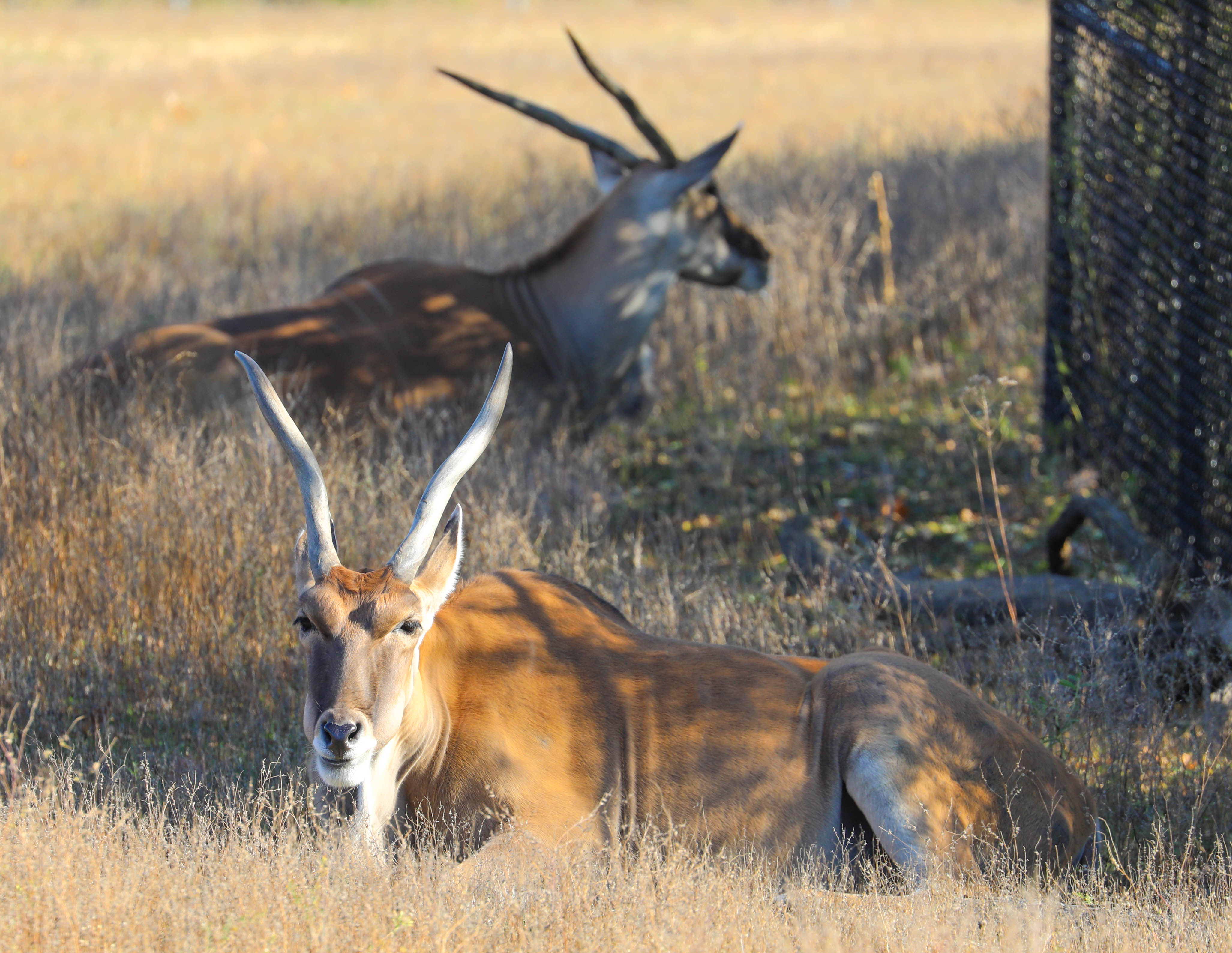
We've seen eland in Nairobi NP in Kenya
and at the Kansas City Zoo. I might have seen them at other zoos, but not before I really knew what they were.
We've seen black rhinos in Etosha NP in Namibia
 |
| Black rhino, giraffes and zebras at Okaukuejo waterhole at night. |
and they have two in Kansas City. I may have seen them in other zoos, but not before I understand the differences in rhinos.
There were other animals at Kansas City I've seen in the wild, but much more common in zoos, like the hippo, African elephant, cheetah, plains zebra and Bornean orangutan. The ones I've shared are the ones I felt were most significant. I also loved the Sumatran tiger which I've not seen in the wild, have seen in other zoos, but is extremely rare.



-1.jpg)