Tuesday, October 7, 2014

Traveler's Chapel - Wall Drug in South Dakota

Wall Drug in Wall, South Dakota, the gateway to Badlands National Park, bill's itself as a traveler's way station. It was a lonely small town in 1931 when Ted and Dorothy Hustead opened a drug store there. After five years of little business the Husteads were about ready to call it quits when Dorothy had an epiphany: they needed to get all of the travelers passing by on Route 16A to stop for some reason. She came up with the idea of offering free ice water and putting up signs along the highway, spaced out at intervals, to advertise that fact. The idea worked beautifully and Wall Drug now occupies a full city block in Wall and employs a good portion of the town.

One of the big incongruities we experienced as we walked through Wall Drug, was a Traveler's Chapel set in between stuffed animal heads hanging on walls, carved Indian statues, a candy store, a book store, a boot store, etc. It seemed completely out of place and contrary to everything this block of kitschy merchandise stands for.
The Traveler's Chapel is proclaimed to be a replica of the chapel at New Melleray Abbey, a Cistercian (Trappist) monastery 15 miles south of Dubuque, Iowa. The New Melleray chapel is long, narrow and simple with red oak used in the choir stalls, doors, Eucharistic chapel and other furnishings. The altar is made of granite quarried in Minnesota. I look at a picture of New Melleray chapel, and compare it to the Traverer's Chapel and the similarities don't seem to me to go much beyond the long, narrow shape and the wooden beam ceiling. The wood may also be red oak. The altar is a wooden desk, not granite, and the light coming in from the outside is substantially diminished by many fewer windows.
The altar and front of the chapel as seen from the back.
The back of the chapel and entrance as seen from the front.
The desk/altar, cross and stained glass window.
Stained oak ceiling.
I would have expected St. Christopher, the traveler's saint, to be on exhibit, but I didn't see St. Christopher's presence. There are several plaques that mention Bill and Marjorie Hustead and their children. Bill is the son of Ted and Dorothy, the founders of Wall Drug, and apparently the one who established the chapel. There are some Byzantine style pictures of Jesus and Mary, a large wooden cross on the wall above the altar and a smaller wooden cross on the wall above the door.
Stained glass window above the altar.
One of the few side stained glass windows.


Open Bible on the altar/table.

One very nice thing about the chapel was that it was empty and quiet - very different from the bustling hordes of humanity milling about in the stores and halls surrounding it.

I've not been able to find anything about why the chapel was established. I find it intriguing. 

Monday, October 6, 2014

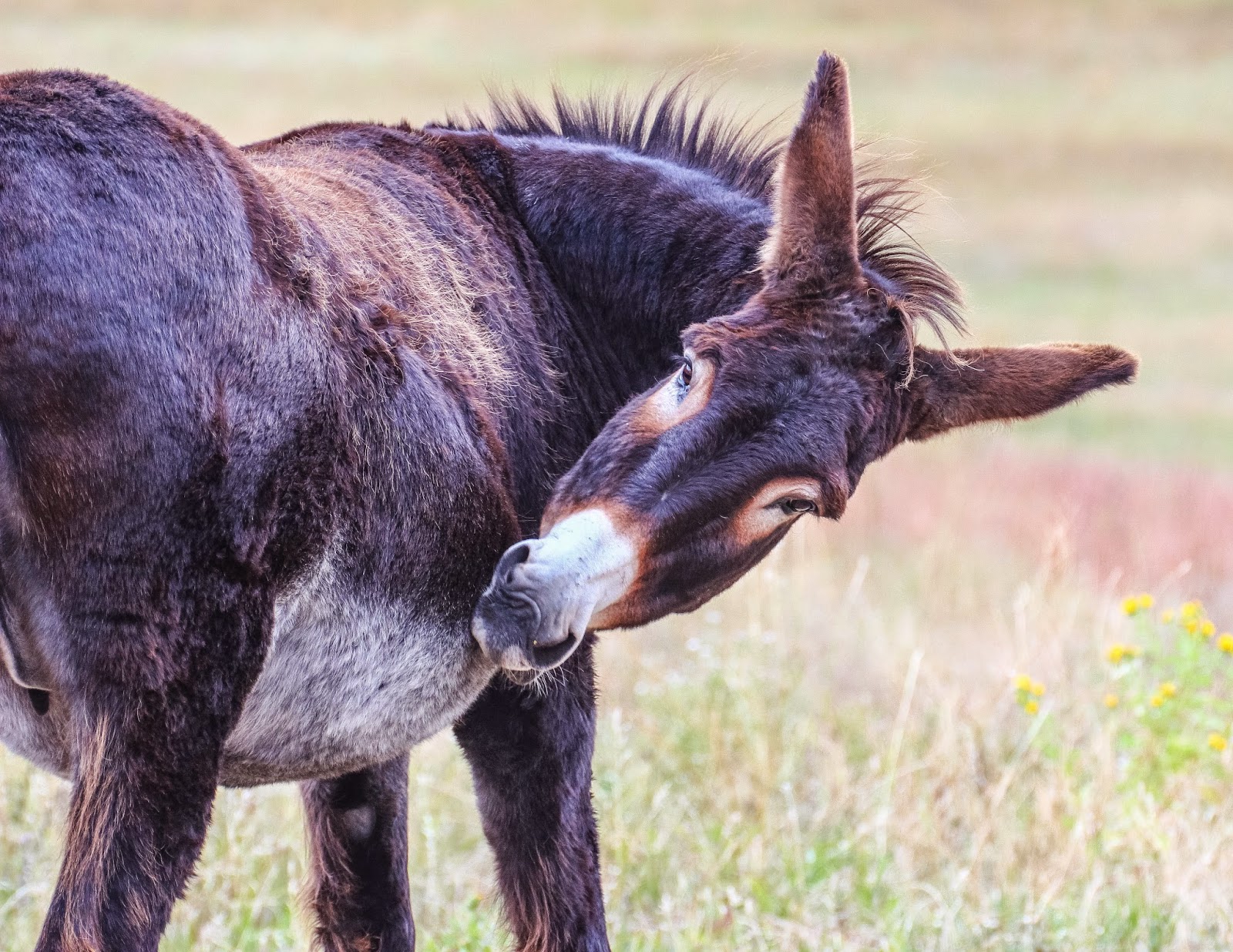
Wild Burro - South Dakota

I've done a previous post on wild burros in Nevada.  They looked quite uniform: white muzzle, underside and around the eyes; gray coat; black stripe down the back and tail, black stripes on the lower legs and a black stripe on the shoulder.

I recently saw two wild burros in Custer State Park, South Dakota, which look much more like mules than the burros I saw in Nevada and are more variable in look and color (this is determined from the two I saw as well as pictures of other burros photographed there). The burros in Custer State Park are feral and descend from pack animals used for treks to Harney Peak years ago. I saw these burros along the Wildlife Loop Road northeast of the Buffalo Corrals. I stopped to view one that looked more like the burros in Nevada, although much larger, with a darker coat, a darker underside and lacking the black stripes. 
Wild burro in Custer State Park.
While I watched this burro another burro from down the road saw me and began to approach.  It was a lighter gray, more the color of the Nevada burros, but larger, with more white on the underside and face and lacking the black stripes. 


The two burros together.
We also saw some earlier at a great distance. I was a little disappointed we did not see more of them to get a better feel of the variability. These burros were also less friendly than those I encountered in Nevada, although we did talk to several people that mentioned feeding them. 

Sunday, October 5, 2014

Everest Cuisine - Rapid City

Per custom, while in Rapid City, South Dakota looking for a place to eat, we scanned Yelp and Trip Advisor for recommendations. Everest Cuisine was rated no. 1 out of 207 restaurants on Trip Advisor and no. 3 on Yelp. It focuses on Nepalese and Indian food. 

I immediately thought of the Nepalese restaurant we visited in Manchester, New Hampshire, Cafe MoMo, rated no. 1 on Yelp in Manchester. We had a great experience there - fresh vegetables from the garden right next to the restaurant, goat and lamb on the menu. The proprietors from Nepal. For the most part Nepalese food is Indian food with a few twists. One of the twists seems to be goat. We have a very similar restaurant locally, Gul-Naz in Colton, which is Pakistani and Indian food. The Pakistani twist seems to be beef which is not found on traditional Indian menus. 

Everest Cuisine is relatively small with some fun Nepal related pictures on the wall, including a beautiful picture of Mt. Everest. The proprietors are from Nepal. The focus for lunch is their buffet. They did have a regular menu and goat was on it, no surprise given our experience at Cafe MoMo. Judy quickly volunteered us for the buffet and I went along with it. I think if I had to do it over again I would try one of their more unusual dishes, like the goat. 
The buffet offering was fairly limited. They had tandoori chicken, a typical Indian dish, which was very dry. I was happy I only had one piece. I can love tandoori chicken when it is moist, but I find most places over-cook it. The chicken tikka masala, another typical Indian dish, was okay. Not the best I've had, but certainly not the worst. I'm not a huge tikka masala fan unless it is very good. 
Chicken tikka masala was dry.
They had other dishes that I did not write down. One was a chicken dish with green peppers, onions and a nice sauce. The chicken was very tender and not-overcooked - it was the best dish on the buffet and I went back for more of it. A cauliflower and potato dish was also pretty good. A salad had iceberg lettuce with huge pieces of carrot and cucumber in it. It was very ordinary, but we'd had so few vegetables for several days that I enjoyed it, after I cut up the carrots and cucumbers so they would fit in my mouth. I had a mango lassi which was pretty good, a little more of a sour taste which I'm guessing is traditional.  
The chicken with peppers and onions was quite good.
Cauliflower and potato dish was okay. The salad was nice because our vegetable intake had been in short supply. 
I'd read a comment about South Dakota before-hand to the effect that they do not know how to season their food there - everything is bland. I would add that good fresh vegetables are in short supply. Vegetables tend to be out of an imported package. I guess I shouldn't be surprised by that. Despite the fact they are surrounded by a great landscape, the growing season has to be pretty short because of the harsh weather. 

So what is it that propels these ethnic restaurants, like Cafe MoMo and Everest Cuisine, to the top of the list in these small towns? I think it is because there is not a lot of variety in the local cuisine. MoMo and Everest stand out because they are very different, a revelation. They fill a nice niche. I read several reviews of Everest Cuisine that talked about how highly spiced the food is. Seriously? Everest Cuisine in the Los Angeles area would struggle. The Los Angeles area has much more variety in the types of cuisines and many Indian restaurants with much better food and food choices. 

For me, if I go to South Dakota again, I'll focus on what they do well there - buffalo and other game meats. We initially tried to go to a traditional steak house that offered that type of food, but it wasn't open for lunch. 

Saturday, October 4, 2014

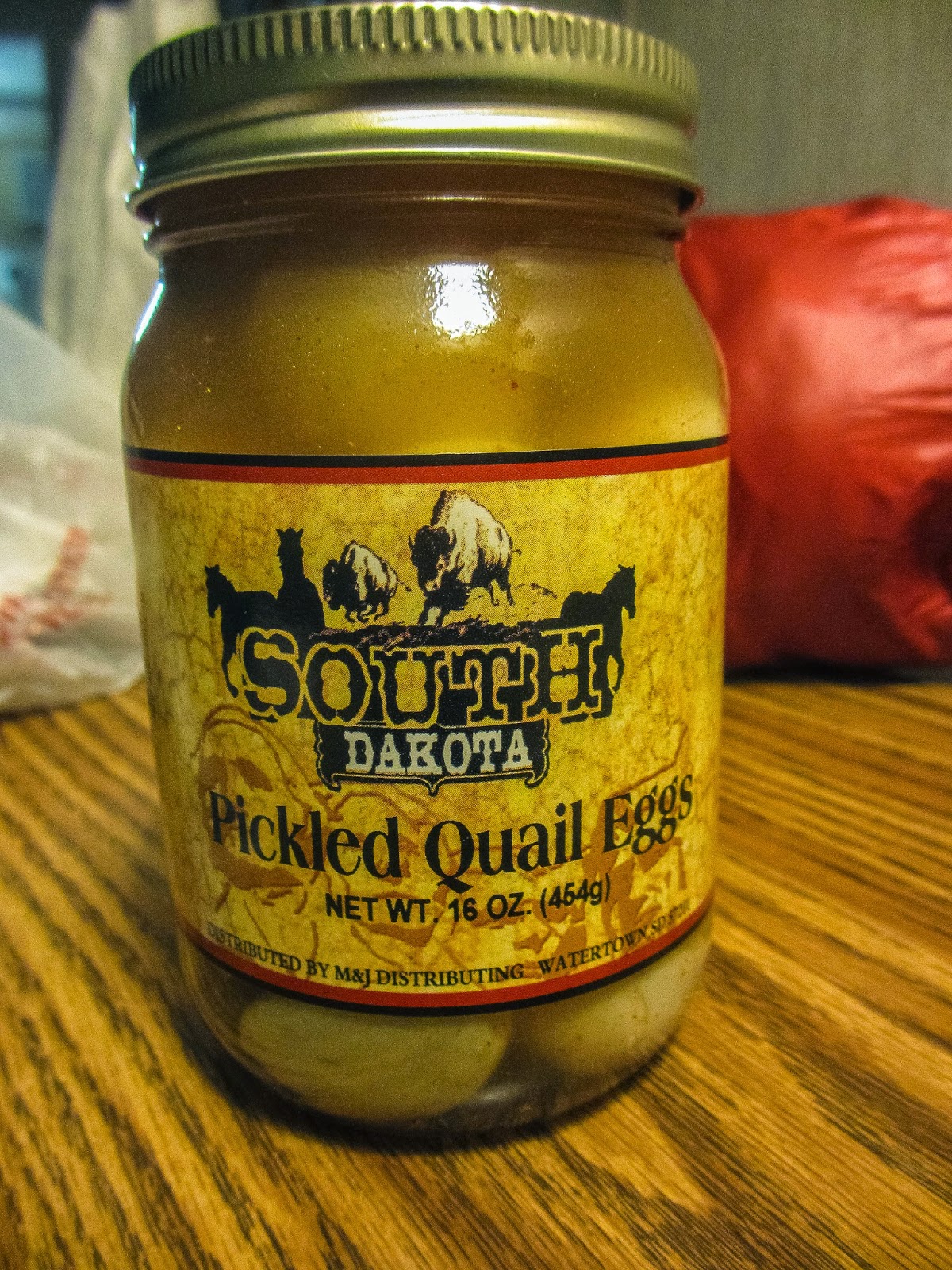
South Dakota Pickled Quail Eggs

I'm always on the lookout for unusual food items and while we were visiting Reptile Gardens outside Rapid City, South Dakota I found South Dakota pickled quail eggs for sale in the gift shop. I've eaten quail eggs many times, but the ingredients looked good: quail eggs, water, vinegar, salt, jalapenos, garlic, black pepper and cayenne. 
I opened the jar in our hotel room that night and was surprised how good they were. Pickled eggs I've eaten in the past, including quail eggs, usually have a hard yolk, and the pickling does not seem to impact much beyond the outside. These eggs were quite soft with a soft yolk and the pickling had penetrated them allowing the vinegary cayenne and jalapeno taste to season it through. 
You can see the cayenne floating around in the jar.
We had a refrigerator in our room to preserve them that night and polished them off the next day, eating them occasionally as we drove around inside Custer State Park. These were good enough that I would have them in the refrigerator to eat at home to add to salads, etc. if they were available. 
You can see the mushiness in one of the eggs inside. 

Friday, October 3, 2014

American Pronghorn - South Dakota

The pronghorn, also known as the pronghorn antelope, is not a true antelope. There are five subspecies: (1) the Oregon pronghorn, found in a small area near the border of Oregon, Idaho, California and Nevada; (2) the Sonoran pronghorn found in southern Arizona and the Sonora province of Mexico; (3) the Mexican pronghorn found in the Mexican provinces of Chihuahua and Coahuila; (4) the peninsular pronghorn, also called the Baja California pronghorn, found in Baja California, Mexico; and (4) the American pronghorn found in the Great Plains. 
Pronghorn in Custer State Park, South Dakota, near the Oak Draw Road.
A closer view of the same male. Note the black on the neck which is not present on a female and also substantially more black on the nozzle than on a female.  
A female in the same area. Note the white forehead which is missing on the male. The male has substantially more black on the face. 
Frontal view of the male. Missing the white on the forehead that the female has.
I've previously posted on the pronghorn, but in our recent visit to Custer State Park and Buffalo Gap National Grassland in South Dakota we had the best exposure to pronghorns I've ever had. The pronghorn is the second fastest animal in the world, second only to the cheetah. However, it can sustain high speeds far longer than the cheetah. The pronghorn can run 35 mph for 4 miles, 42 mph for 1 mile and 55 mph for a half mile.
Females in Custer State Park.

I love the white on the throat and face. Note the teats between the hind legs.

The pronghorn has white fur on the rump, side, breast, belly and across the throat. The horn is a blade of bone that grows from the skull that forms a permanent core. Skin that covers the core develops a keratinous sheath which sheds each year and is regrown. The horns are branched with a forward-pointing tine which gives it the name pronghorn. Females have horns, but they are often barely visible and only rarely have prongs. 
These pronghorn were in Buffalo Gap National Grassland outside Badlands National Park. Note the juvenile on the far right that has a reddish fluffy mane. 
This male was also in Buffalo Gap near the females above

Thursday, October 2, 2014

Desert Cottontail

The desert cottontail, also known as Audubon's cottontail, is a species of rabbit found in the southwestern U.S., most of Mexico, and a swath of the U.S. from Montana and North Dakota, near the Canadian border, to Texas at the Mexican border. There are 11 subspecies and I was not readily able to find the differences of the subspecies to try and identify the subspecies of this particular desert cottontail.  
Desert cottontail in Badlands NP, South Dakota.
They are: 13 to 17 inches long, weigh up to 3.25 pounds, have ears that are 3 to 4 inches long, are light gray and brown with a whitish belly, and have a rounded tail that is white underneath. 
We saw this particular rabbit in Badlands National Park in South Dakota. Cottontails are very common, but it is unusual to get as close to one of them as we got to this one. 

Wednesday, October 1, 2014

Moffitt's Canada Goose

I previously did a post on the Atlantic Canada goose and noted that there are seven subspecies of Canada goose and a goose that used to be considered a Canada goose and is now known as the cackling goose, its own distinct species, which is smaller and has four subspecies of its own. The size of these geese and their long necks eliminated the cackling goose. 
Moffitt's Canada geese near Alamosa, Colorado.
The pictured Canada geese were photographed in August near Alamosa, Colorado near the Rio Grande River. Because identifying Canada geese is so difficult I went to a Colorado publication to try and winnow down the number of subspecies. I used Separation of Canada and Cackling Geese in Colorado by Lawrence S. Semo and Robert Righter published in October 2006 and found here. Page 209 describes Moffitt's Canada goose. Moffit's Canada goose is large; has a long, dished bill; a white cheek patch which is often hooked toward the rear crown (and unlike the Lesser Canada goose, the white patch does not extend forward to meet the bill); a long neck; few have a white neck collar; and most have a clean break between the breast and the neck (without the white neck collar).  It is one of the two most common Canada geese in Colorado, the other being the Lesser Canada goose which is a migrant and winter resident, usually arriving in the fall. 
The white cheek patches are hooked toward the rear crown and it has a clean break between the breast and the neck.