Sunday, September 26, 2021

Western Willet

Several weeks ago at San Elijo Lagoon in San Diego County I got my best looks at western willets. They were in non-breeding plumage. There were quite a few of them and I was able to get relatively close. 

Photos follow:


Thursday, September 23, 2021

Belding's Savannah Sparrow

Belding's savannah sparrow is one of 17 subspecies of the savannah sparrow and one of 6 subspecies that live at least part of the year in wetlands such as salt marshes. It has heavily black-streaked underparts and dark olive-tinged upperparts. It is endemic to the coast of southern California and northern Baja California and nonmigratory. It is endangered because of loss of habitat and San Elijo Lagoon, in San Diego County, where I photographed one, is a known area for them. 


Saturday, September 18, 2021

Hudsonian Whimbrel

At San Elijo Lagoon I got my second look at the Hudsonian whimbrel and had much better views. A good-sized bird, the bill is not as long as the long-billed curlew, but it is almost ibis-sized. I really enjoy the long-billed shorebirds. 
This and the next few photos are of the same bird. It provides different looks, including use of the bill to probe holes. 


A different bird with several photos. 


This and the next couple of photos are of different birds. 


Friday, September 17, 2021

Long-Billed Curlew

The long-billed curlew is bizarrely cool. Its bill is one of the longest for a shorebird and has a distinctive downward curve that ends in a point, looking more like a shoot coming off a limb than a bill on a bird. It uses it to probe in holes and surgically insert it into mud to pinch out crabs and other delectable tidbits. 

But what is amazing is I was watching one the other day in San Elijo Lagoon in Cardiff and was admiring the tannish body with washed cinnamon colored sides. Then a shock as I finally noticed the long bill. The bill is so long and so thin that it can actually be quite difficult to see. 


I saw my first long-billed curlew near the Salton Sea in February of this year. Many of them were walking through green fields feeding on something, I know not what, but they kept their heads down and fed and fed. I didn't get a very good look at them. 
At San Elijo Lagoon I got much closer and enjoyed watching them continually probe with that bill. Beautiful, beautiful. 

Thursday, September 16, 2021

Semipalmated Plover

One of the challenges of finding new birds is knowing what to look for. Some bird species look amazingly alike and have only small differences that are not readily evident, particularly if you are not aware of them. For example, last weekend I was at San Eliju Lagoon and was taking a photo of a brown bird with a curved bill that turned out to be a long-billed curlew. I'd seen and photographed one at a distance about a year ago, but I wasn't sure that was the bird I was photographing. Then as I looked at my photos later I noticed I skipped to a different bird that looked very similar and that I probably thought was the same bird, or one right next to it. Then I noticed in the photo that the bird had a straight bill and had to be a different species. It turned out to be a marbled godwit, a bird I'd never seen before. 

A couple of weeks ago I was at the Salton Sea seawall and afterwards happened across an on-line eBird survey taken at the seawall the same day I'd been there. The survey mentioned a bunch of birds I didn't see when I was there, including birds I'd never seen before. So I looked up photos of each bird and was surprised at some of them. One of the surprises was the semipalmated plover, a bird I'd never heard of before. It looked like a small, immature killdeer. If I'd seen one, I probably would have thought it a killdeer. But now armed with that new knowledge, I specifically looked for the semipalmated plover at San Elijjo and saw a number of them. They are very small and my photos were at great distance, so getting good photos of them was difficult, particularly as I was shooting without a tripod. 
The semipalmated plover has a brown/gray back and wings, a white belly and breast, a black neckband, a brown cap, a white forehead, a black mask around the eyes, orange legs, and a short orange and black bill. 
They breed in northern Canada and Alaska and winter in the coastal areas of the southern U.S., the Caribbean and much of South America. 
This is a range map for the semipalmated plover from Wikipedia. Orange is breeding (summer), yellow is migration, and blue is non-breeding (winter). 

Tuesday, September 14, 2021

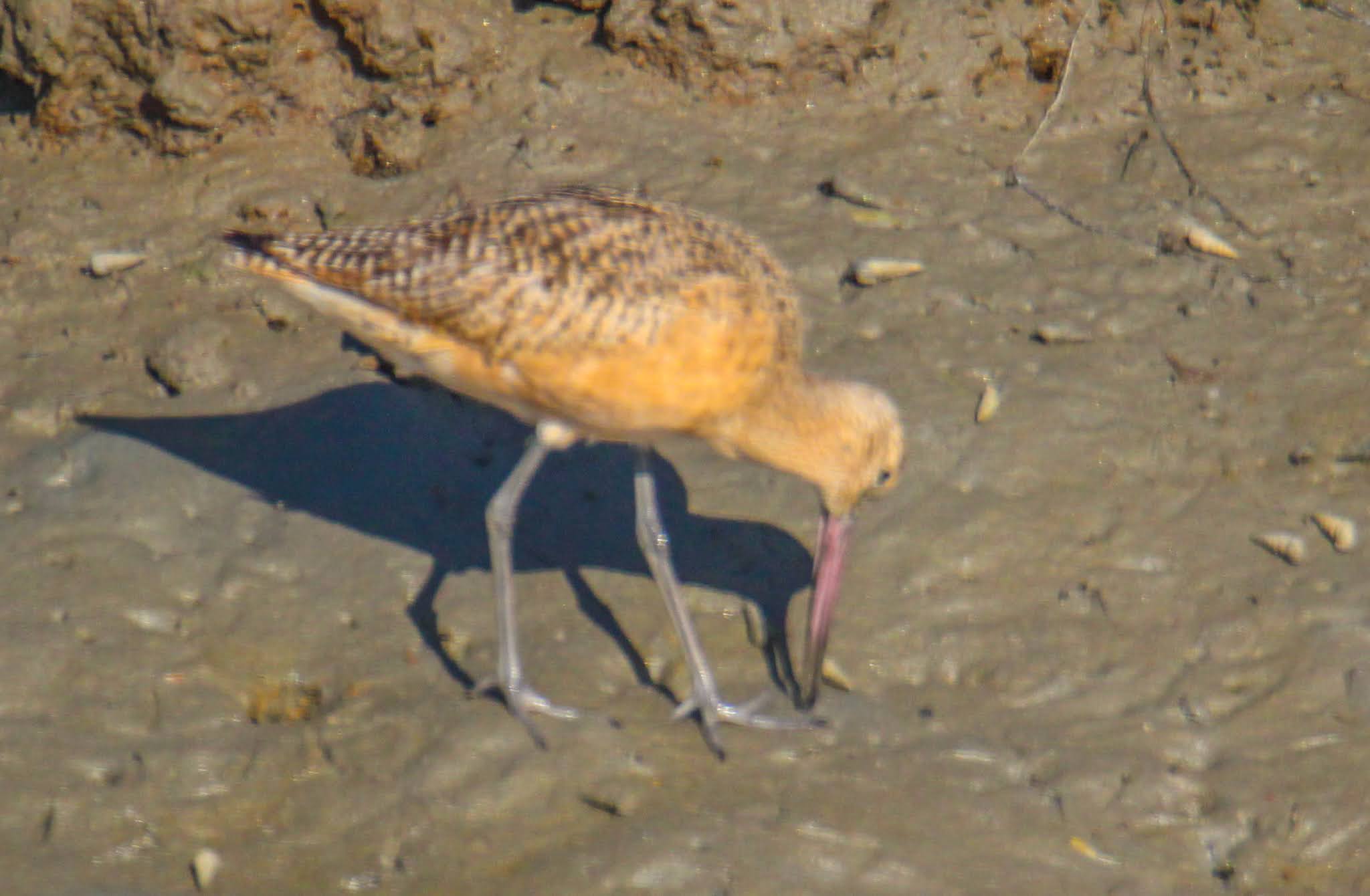
Marbled Godwit

There are four species of godwit, a bird I'd probably not heard of until fairly recently: (a) the bar-tailed godwit; (b) the black-tailed godwit; (c) the Hudsonian godwit; and (d) the marbled godwit. They are distinguished from curlews by their straight or slightly-upturned bill. In fact I was taking a photo of a long-billed curlew last weekend and then started taking photos of a nearby godwit and did not recognize the difference between them until I was reviewing my photos. Godwits are distinguished from dowitchers by their longer legs. 
The marbled godwit is the largest godwit with long blue/gray legs and a long pink bill with a dark tip and slight upward curve. Non-breeding birds, which I saw, have washed cinnamon underparts without streaking and breeding birds have streaked underparts that are not cinnamon. 


They forage for insects and crustaceans on mudflats, marshes and beaches when the tide is out. When the tide is in they roost, often standing on one leg with the bill tucked in to the body.  

We were at San Elijo Lagoon in Cardiff when I saw several of them for the first time. They look and behave a lot like long-billed curlews and were only distinguished by me by the bill. 

Monday, September 13, 2021

Ridgway's Rail

Ridgway's rail is found primarily along the Pacific coast from San Francisco Bay to southern Baja California. It has a slightly downward curved bill, is grayish brown above with dark streaking down the back, has pale barring on the flanks with a pale chestnut breast and neck, and a short white tail.  
It is usually concealed in marsh vegetation, but occasionally seen in open wetlands with its tail up and head pushing forward. 


It forages for mussels, clams, snails, worms and small fish on mud flats or very shallow water where there are taller plants nearby to provide cover. 


We visited the San Elijo Lagoon in Cardiff, California several times over last weekend and they had several signs talking about this area which was a breeding ground for this near threatened species. It was only when I left the water ways where most of the birds were and walked along the bare mud surrounded by vegetation that I saw one going in and out of the vegetation. I waited it out and ended up getting some good photos.