Tuesday, July 20, 2021

Caspian Tern

I saw Caspian terns for the third time on Saturday. The first time was at Orlando Wetlands Park, Florida, in January 2018. They were in non-breeding plumage, which means that the black cap had lots of white in it and the black tip at the end of the bill was very feint. The second time was near South Padre Island in southern Texas. The black cap on these birds was a little darker and the black at the end of the bill more pronounced. On Saturday, at the man-made mitigation swamp between McDonald and Hazard Roads in Niland, I saw several Caspian terns in breeding plumage. The black cap was completely dark and the black tip at the end of the bill more pronounced. This bird, in breeding plumage, is one of my favorites.


A non-breeding Forster's tern is to the left. I believe it is a breeding Forster's term to the right, or perhaps a young Forster's tern. 


The Caspian tern is the largest tern. The size differential between it and the Forster's tern on the right is substantial. 

Monday, July 19, 2021

Forster's Tern

On January 14, 2018 I saw some non-breeding Forster's terns at Merritt Island, Florida, although I only saw them after-the-fact in photos I'd taken.  On May 29, 2021 I saw a Forster's tern in breeding plumage near the Salton Sea at the man-made mitigation swamp between McDonald's Road and Hazard Road in Niland. On Saturday, July 18 I saw quite a few Forster's terns, both in breeding plumage and non-breeding plumage at the mitigation swamp in Niland. 
This Forster's tern is in non-breeding plumage. It is far better than my photo in Florida. The photo below is of the same bird. 


I'm assuming it is just leaving breeding season and this one still has a bill that is a little bit red. 


The rest of the photos are of Forster's terns in breeding plumage. 


Sunday, July 18, 2021

White-Faced Ibis

After seeing the white-faced ibis several times, here and here, I thought they were the ugly cousins of more beautiful ibis like the sacred ibis, American white ibis and glossy ibis. However, now that I've discovered them near the Salton Sea and seen them quite a few times, they've become one of my favorite birds. In the right light, they are spectacularly beautiful. 

In April I saw them filling the skies and got the most spectacular views of any ibis I've ever had. Yesterday I saw lots of them flying around south of the Salton Sea, not in the same great numbers as in April, but consistent small groups. 
The light was bad for detail of the plumage. 

Then in Niland at the man-made (mitigation) swamp between McDonald and Hazard Roads, I saw lots of them and took quite a few photos which I share below. 


With a black-necked stilt. 


The sun was hitting this one just right. I love the pink and light blue in some of the feathers. 

Saturday, July 17, 2021

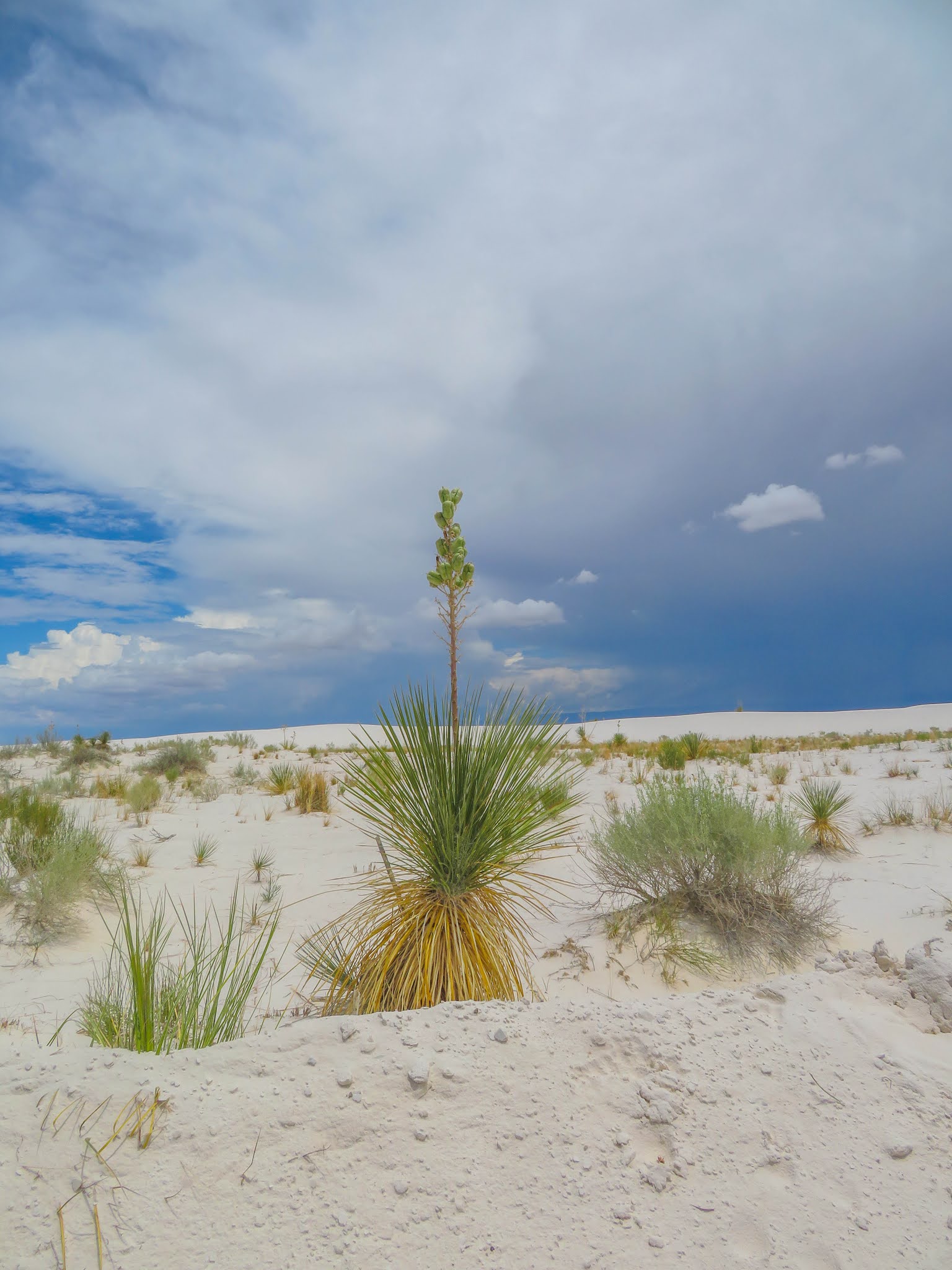
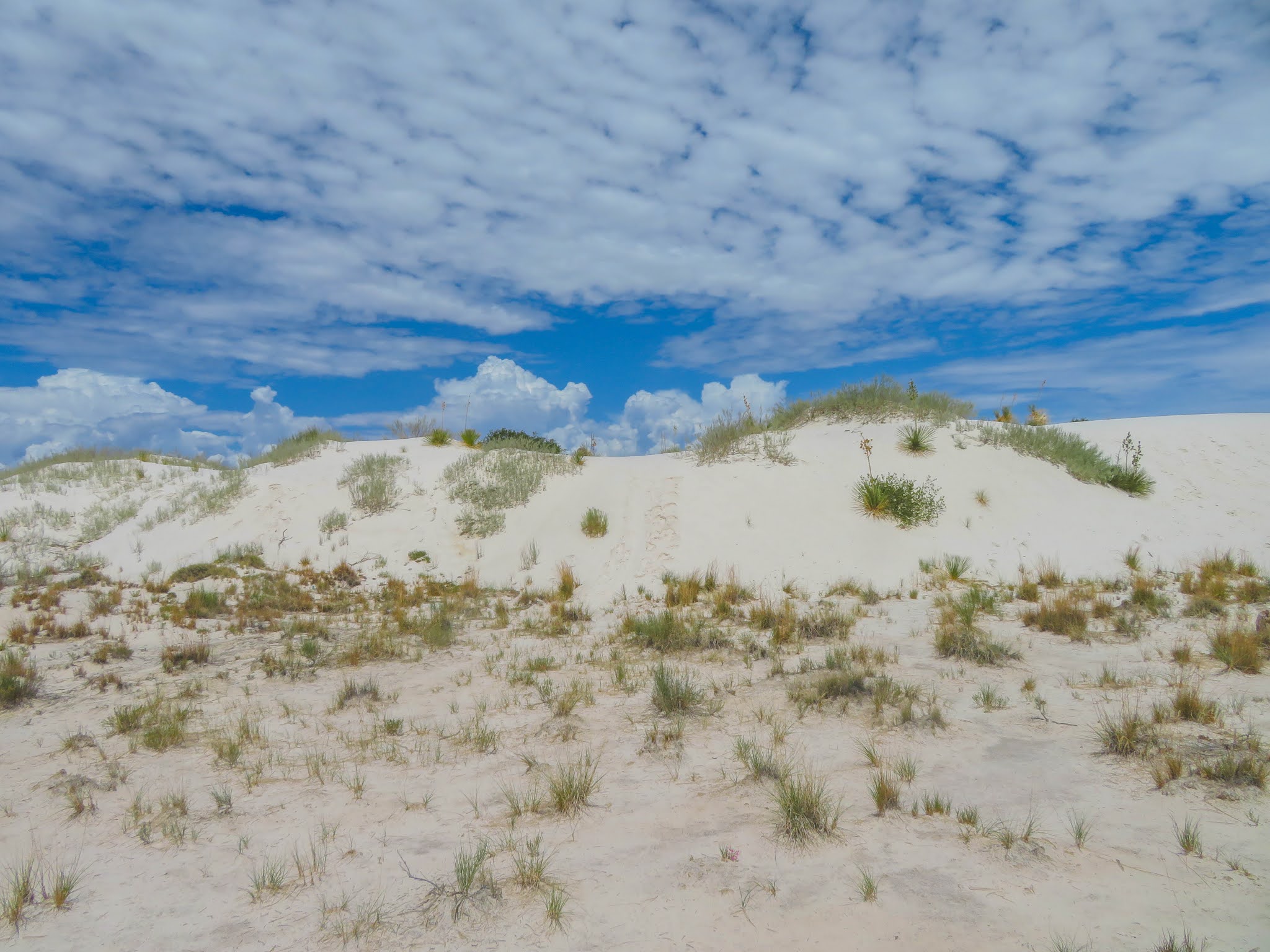
White Sands National Park - New Mexico

White Sands National Park in southern New Mexico is surrounded by the White Sands Missile Range. The White Sands Missile Range is the largest military installation in the U.S. encompassing 3,200 square miles. The first nuclear devise tested as part of the Manhattan Project was tested at the Trinity Site on July 16, 1945 at what was then Alamogordo Bombing and Gunnery Range but is now a part of the White Sands Missile Range. 
White Sands National Park, at 228 square miles, is just a small fraction of the surrounding Missile Range. The white sand dunes that it contains are composed of gypsum crystals and these are the largest gypsum dunes in the world. They have a depth of 30 feet and dunes as tall as 60 feet. 

I was not ready to be wowed. I expected to drive in, take a quick look around, and leave. As it turned out, I would like to have stayed longer. We visited during a time of widespread storm activity and the cloud cover was gorgeous and made the photos we took there much better than they would have been otherwise. I would like to go there again and try to get photos of some of the reptiles that live there that have developed a whiter skin to blend in better with the surroundings. 

Following are some more of my photos:
Relatively close to the entrance, before we got into the gypsum dunes, we found this pond. I saw a young whitish whiptail lizard near here that I was not able to photograph. 


Soaptree yucca


Arizona centaury

Purple three awn

Jujube

Frosted mint in foreground.