Tuesday, June 20, 2017

Zebra-Tailed Lizard - Organ Pipe 2017

The zebra-tailed lizard loves open sandy gravel and heat. In two of my visits to Organ Pipe Cactus NM this year I've visited Quitobaquito Spring, a rare oasis in the Sonoran Desert, and found zebra-tailed lizards both times in the sandy gravel near the foliage generated by the spring water. 
On the sandy gravel near Quitobaquito. Note that the tail and the toes on the hind feet are in the air. 
Note the front toes are in the air as are the back toes as well as the rest of the body. 
In looking closely at my pictures it becomes apparent that one of the lizards is minimizing its contacts with the ground. Its tail is in the air, its torso is in the air and the toes on all four feet are in the air. It makes sense that the lizard is minimizing contact with the ground to reduce the amount of heat it is absorbing.

Another of the lizards is resting on a rock and I was able to get photos of it from a number of different angles. It is a male with two black belly stripes and some yellow and turquoise blue near those stripes, as well as some orange.  
The belly colors are stunning.
From the front it almost looks like Kermit the frog. 

I visited OPCNM in August and found the zebra-tailed lizard below resting on a post at the Bates Ranch. Beautiful.

Monday, June 19, 2017

Coues Deer

The Coues or Arizona white-tailed deer is a subspecies of the white-tailed deer found in southern Arizona, mostly the southeastern part, southwestern New Mexico and Mexico, including all of Sonora and portions of Chihuahua, Sinaloa, Nayarit and Durango. It is named after Elliott Coues, a naturalist, pronounced "cows," but almost always said "coos." It is the second smallest subspecies of white-tailed deer, after the Key deer of the Florida Keys, with bucks rarely weighing more than 100 pounds and does averaging about 65 pounds. Their eyes have white halos around them, their muzzle a white band across it, and a broad tail with a white underside and gray to reddish-black on top. 
Coues deer between Diablo Mountains and Ajo Mountains in southern Arizona. Note the white eye halos, white line on the muzzle and reddish flag tail. 
They inhabit "desert islands," the mountain ranges of the region, usually from about 3,000 to 9,000 feet elevation. Some consider it the hardest big-game animal to hunt and call it the "grey ghost," because of its ability to vanish from view in a small amount of cover. Jack O'Connor, the Shooting Editor of Outdoor Life magazine for 31 years, which I subscribed to as a youth, called the Coues deer the "most difficult of all deer to kill" because it is so wary and is found in such difficult and inhospitable habitat.  
Examples of them using ground cover to hide. 


Good luck spotting this one. It is to the left of the photo. 
I was in Organ Pipe Cactus National Monument in mid-June where the daytime temperature was 108 degrees. I took the Ajo Mountain Drive at about 6:00 a.m., when the temperature was in the high 70s or low 80s, and had just crossed over the Diablo Mountains and was heading up toward Arch Canyon in the Ajo Mountains when a deer spooked in front of me and ran for cover in the thick creosote bushes, interspersed with saguaro cactus and chain-fruit cholla. I stopped the car and got out with my camera and got intermittent views of two does hidden in the creosote, often looking at me and usually quite hidden by vegetation. They did not spook, but ambled away quite casually, but also quite well camouflaged. I've been to Organ Pipe about 15 times and these are the first deer I've ever seen there. 
Raised white flag as the Coues deer ambles beneath a chain fruit cholla. 
Another shot of the flag.
A short drive forward, maybe a quarter mile, I spotted a coyote off the side of the road. I only got a very poor, blurry picture of it. 
Poor picture of a coyote. 

Tuesday, June 13, 2017

Elk Rib Chops - Sous Vide

I've eaten a little bit of elk in the past, but only once had I eaten a choice cut, an elk chop at the Blue Bell Lodge in Custer State Park, South Dakota. It was a great piece of meat, but it was a little tough and a little bit more rare than I would have preferred. 
Some wild elk in Custer State Park, South Dakota.
Recently I was at Exotic Meat Market in Grand Terrace and found a rack of elk chops that was imported from New Zealand - pasture raised and grass fed. I've been experimenting with my sous vide and I'm getting pretty confident at cooking steak with it. I decided to get the elk chops and give them a try. 
The elk chops out of the package.
The elk chops sliced into individual steaks.
I vacuum sealed the elk chops after I'd added salt and pepper and some butter. I cooked them at 55 degrees Centigrade for 2 and a half hours. 
After being cooked sous vide. 
After I cook them sous vide I put them in a sizzling hot frying pan and browned them on each side, then ate them. The first batch I browned in camel fat and served them with fried shishito peppers, fried garlic cloves, baked and fried potatoes and fried onions. The chops were cooked perfectly, still nice and rare, but not as tough or stringy as the South Dakota elk I had. 
Frying the chops in a hot skillet to brown them and create a nicer outer texture. 
Elk chops - nice and rare in the middle. 
A chop by itself. 
The next night I warmed up another bag of elk chops in the sous vide, at the same temperature, and fried the end product in a frying pan with butter. One of the nice things about sous vide cooking is that you don't over-cook the meat, so warming it up again does not de-grade or over-cook the meat. For this meal I had some more shishito peppers, some of my left over potatoes, cut into slices and fried in butter, and a steamed artichoke with butter and mayonnaise. The elk chop was as good as the night before and I did not notice any significant difference between the frying in camel fat verses butter. 
Elk chops fried in butter.
The sous vide is a marvelous way to cook leaner cuts of meat, like elk. 

Monday, June 12, 2017

Goat Head Soup

Some time back one of Anshu Pathak's workers at Exotic Meat Market gave me the head of a goat that they'd slaughtered at Anshu's farm. Judy went out of town last night so I thought it an opportune time to try goat head soup, something I don't think she would have appreciated. 
The head was already skinned, leaving very little preparation. 

Googling recipes for goat head soup I learned that the Rolling Stones had an album, "Goats Head Soup," that included one of their number one songs, "Angie." That album dominated the search results. The next search result with the most hits was Jamaican Mannish Water which is a goat head soup that also includes the feet, testicles and other parts of the goat. It is supposed to be a powerful aphrodisiac and what the Rolling Stones album was named after. The third topic in terms of hit results was for a Nigerian spicy goat head dish. Ultimately, I was able to find bits and pieces that were helpful in what I wanted to prepare, such as an article in The Prairie Star. 

The basic concept was to put the goat head in a pot of water and get it boiling, then lower it to a simmer for three hours. Remove the goat head, extract the meat from it, then put the meat back in the pot with various root vegetables for another 30 minutes. 

I initially planned to break open the skull with a mallet before cooking it. I hammered away for awhile and decided it was not going to work well (I think they used an ax or a saw in Morocco to split the sheep heads). However, I did create a hole in the head which later provided access to the brain that would have been more difficult without it.  
For root vegetables, I used 7 potatoes, 3 large yellow beets, 3 onions, half of a butternut squash, corn cut off two ears of white corn, and some carrots. I added beef bouillon, dried roasted garlic slices and granulated garlic. 
After simmering for three hours, the goat head separated quite easily. The jaws came apart with hardly a pull and I was able to pull the brain out through the hole I'd made with the mallet. 

The eyes were large and intact and pulled right out. I salted one and plopped it in my mouth. It was just as good as the lamb eye I ate in Morocco last year. It had a pleasant mouth feel and nice taste, but the mental challenge of eating it is substantial. Eating the eye of the lamb in Morocco last year helped the mental aspect a lot. This time it was not a problem. I saved one eye for the soup.
The tongue pulled right out of the skull. I cut the outer skin off the tongue with kitchen shears and the skin pulled right off. I sliced up the tongue and added it to the pile of meat I was creating. The brain came out in sections and I pulled it into smaller pieces and added to the meat pile, which by the time I finished was quite significant. 
The tongue and both eyes.
The tongue, after the skin has been removed, and one eye.
The pile of head meat ready for the soup. 
By the time I got the meat in the pot the root vegetables were soft, so I only left the meat in for about 10 minutes before dishing up a bowl of soup. 
Goat head soup.
The final result was quite good. The vegetables were soft and plentiful, I particularly liked the sweet corn that still had a pop to it. The meat separated into the soup quite well and had a decent texture and a nice taste, nothing off-putting about it. 

Eating sheeps head in Morocco last year really helped me with the mental aspects of eating head meat (brains and eyes particularly). The goat head really was not much of a problem for me mentally. 

Sunday, June 11, 2017

Capitol Hill and We, The Pizza - Washington, D.C.

After our visit to Mt. Vernon we drove back into Washington, D.C. to visit Capitol Hill. First, we visited the Library of Congress which is just east of the U.S. Capitol Building. The inside is stunning, with beautiful Corinthian capped columns holding up vaulted ceilings painted in bright orange, yellow, red and green. 

We viewed the reading room, from a glassed in viewing platform, with garishly colored columns and walls surrounding  a circular floor of lamp-lit desks. Judy, a library rat from a young age, was enthralled. The Library of Congress is the largest library in the world, the modern version of the Library at Alexandria which had such a profound impact on the intellectual development of our civilization. 

We walked north, just next door, to the U.S. Supreme Court Building. A news crew, which apparently waits there in perpetuity for breaking news, was munching on sandwiches and trying to stay out of the searing sun. 
U.S. Supreme Court
We crossed the street to the west and walked up to the U.S. Capitol Building, surrounded by security. Some sort of protest group, I believe against abortion, had a loudspeaker and spoke to virtually nobody, while they filmed themselves. 
The U.S. Capitol Building from Pennsylvania Avenue, near the Newseum.
The U.S. Capitol Building from the other, east, side.
We walked south to Independence Ave SE and then followed a diagonal turn onto Pennsylvania Ave SE toward our car. There we encountered We, The Pizza, an amazing looking pizza joint, which coming from me is unusual, because I do not really like pizza. They had 10 to 15 large pizzas on a glassed in counter, most of which I would like to have tried. These were not the typical pepperoni and cheese pizzas that dominate the market. They were awash in ingredients: big pieces of meat and vegetables and thick with cheese. Just go to the website and look at the menu and put your cursor over the individual pizzas, you'll see what I mean. Judy, still agog that I was interested in pizza, let me choose a large slice that we had cut into halves. I picked the Capitol Supreme, which was covered in mozzarella, pepperoni, mushrooms, green peppers, onions and sausage. We each also got a soda, which they made in front of us. She got pineapple and I got strawberry lemonade. It started with a spritz which I believe consisted of club soda and the base ingredients we each ordered, then fruit was added and it was combined in a blender. Very, very good. I would actually go back again if we lived in D.C. It was good. 

Saturday, June 10, 2017

Barney Greengrass: The Sturgeon King - New York City

We'd just eaten breakfast on Amsterdam Avenue on the Upper West Side of Manhattan. We were walking to our car when we walked past "Barney Greengrass: The Sturgeon King." Of course, I had to go in. It was part deli, with tables, and part take-out, with glass covered display cases featuring beautiful, expensive, fish. 

One I'd not heard of was schmaltz. Schmaltz (Yiddish) herring is caught just before spawning when the fat (schmaltz) content of the fish is at its height. It is usually pickled in brine. I bought two small strips and a while later pulled over on the sidewalk and pulled it out for a taste. It was powerful. It was very, very soft, almost like moldy on the outside (although it wasn't), with a taste like anchovies. Judy took one bite and it was enough for her. I probably had three or four bites and had enough. The combination of texture and taste made this really tough stuff to eat plain. 
Schmaltz herring.
The other delicacy we purchased was lox salad: lox mixed with mayo and onion. Unlike the schmaltz, this was mild, smokey and delicious. 
Lox salad.
The history section of the Barney Greengrass website is fun. In 2009, it was Zagat rated and New York's no. 1 deli for 12 straight years. The London Times, in 2003, noted that Anthony Bourdain recommended it as the best breakfast in New York and the best chopped liver in the universe. It was a 2006 James Beard Award winner for excellence as an "American Classic." It has been in five television shows,  including Seinfeld, Sex in the City and 30 Rock, and a number of movies, including You've Got Mail in 1998. 

Friday, June 9, 2017

Mike's Crab House - Riva, MD

From a source I don't remember, I got Mike's Crab House in Riva, MD on our agenda following our visit to Annapolis. I read that Mike's offered great steamed blue crabs. Riva is on the South River tributary of Chesapeake Bay, seven miles south of Annapolis which is on the Severn River tributary of Chesapeake Bay (which is north of the Patuxent and Potomac River tributaries of Chesapeake Bay). 
Mike's has a great menu, offering mussels, oysters, cherrystone clams, soft crab, lump crab cake, scallops, shrimp, and many types of fish. 

We arrived early, shortly after 5:00 p.m.. Mike's is just off the south east side of the South River Bridge and right on the South River. It is a large place with plenty of seating, but by the time we left it was packed and people were lining the reception and waiting outside to get in. 


We started with a pretty ordinary salad bar with large-chunk potato salad being the most unusual ingredient, and it was not particularly good. But it was nice to get some greens. 

I felt like Charlie who'd won a ticked to visit Willy Wonka's Chocolate Factory. So much seafood variety and right off the world famous Chesapeake Bay. Judy indulged my way-too-ambitious ordering. We started with a steamed combo including mussels, oysters, cherrystone clams and large steamed shrimp. Surprisingly to me, my favorite of the combo items was the steamed shrimp, which we had to remove the shell and legs from. They were a good size and I utilized some butter to dip them in. I prefer raw oysters (which we also had), but it was fun to try them steamed. The mussels for the most part were plump and moist, but the broth was weak. Mussels can rate right up there with my favorite foods when they are accompanied with a great garlic broth and sourdough bread and butter. This was okay, nothing to get too excited about. 
We got a dozen fresh-shucked oysters for $14.95, half the price we pay in California. The oysters were stacked on ice and were large and meaty. I occasionally go to King's Fish House and part of what makes their oysters so good is the they are chilled and the shell is brimming with oyster liquor, a clear liquid inside the shell which is filtered sea water in which the oyster lives and is packed with salty flavor.  I add a slathering of cocktail which is pre-made and a perfect blend of horseradish. These oysters were not as chilled, did not have much oyster liquor and the cocktail sauce was a mix-your-own version with separate horseradish and sauce and I can never get as satisfying a mix, partly I think because the pre-made cocktail sauce usually has creamed horseradish and perhaps other ingredients in it as well. However, the oysters were still enjoyable. 

We got two soft-shell crabs which were breaded and fried and very large. The soft-shell crab is a blue crab which has just shed its old exoskeleton and is served whole, minus the mouthparts, gills and part of the abdomen. The breading was a little thicker than I would have preferred, but the crab was thick and very juicy. Very nice to eat these where they originate. 


What really set this meal apart were the six steamed blue crabs we got. They were not on the menu, but I asked about them because of the article I'd read. The server came to prep our table, removing everything and laying down a layer of thick brown paper. At that point I realized we would be making a mess. The crabs came heavily coated in what looked like a rub of some sort, along with a knife and a wooden mallet. About that time I started to notice the noise of mallets around the restaurant pounding on what I assume must have been blue crab. 
Our server showed us how to prepare the crabs. First, we pulled off all of the legs.  
Second, we turned the crab over to its under-side and looked for the space-needle shaped section of the shell and then grabbed the tip of the needle and pulled it up and back. This section functions like a door-latch on a  hotel room. Once it was dis-engaged, we could insert the knife and pry the upper half of the shell away from the lower half and separate them. Then a very interesting concoction of colors, shapes and textures confronted us.
The space-needle part of the crab is in the center of the shell.
The yellow crab "fat" is visible on several sections of the shell.  
We removed the gills, which were soft, and I figured, correctly, that the gross looking yellow substance, which looks like excrement, was actually the equivalent of lobster tomalley. In a crab it is known as crab "fat," or muster or mustard. Then it is a matter of getting into the innards of the shell chamber to get to the crab meat, like trying to remove the individual contents of niches from a crypt. It was a long, tedious process with very little meat-yield for the effort. The process speaks volumes for why crab meat is so expensive. I learned through the experience of pounding on the shell, that the mallet is primarily for the legs. I covered the front of my shirt in crab "fat" and other liquidy contents while trying to pound out the niche barriers inside the main shell. I was in serious need of a bib.  We ultimately left several of the crabs untouched. It was fun to experience the process, but we'll let someone else do the shell excavation in the future and enjoy lump crabmeat from now on. 
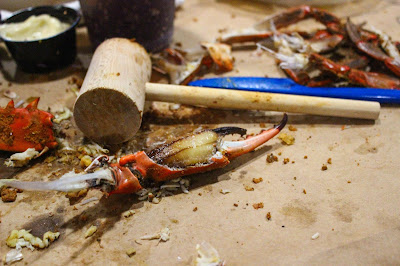
A section of claw that has been removed by a number of mallet whacks. 
Some hard-earned crab meat covered in crab "fat" and sitting in a small container of butter. 
It was an event-meal. One I'll remember both because of the volume and variety of seafood and because of the unique experience of dissecting and eating a blue crab. Judy was a good sport. She at least tried the soft-shell crab as it had a bite or two out of it (I ate part of what she left, although I was hitting my limit) and she did go through the process of dissecting and pounding out the blue crabs, probably doing as much or more than I did.