Tuesday, October 27, 2015

Eastern Wild Turkey

The Eastern wild turkey has the largest range of all of the six subspecies of wild turkey. It covers the eastern half of the U.S. from Maine to northern Florida and west to Minnesota and eastern Kansas, Oklahoma and Texas. Its range is in blue below.
Range map from the National Wild Turkey Federation.
In a recent visit to Minnesota we were in Fort Snelling State Park, relatively close to the Minneapolis-St. Paul Airport. There we encountered a rafter, crop, dole, gang, posse and raffle (all names for a group) of Eastern wild turkeys. 
There are at least 9 turkeys in this picture and there were many more than this.
There are about 5.3 million Eastern wild turkeys and they are the most heavily hunted of all the turkey subspecies. 
Their upper tail coverts are tipped with chestnut brown. These are the turkeys encountered by the first European settlers to the U.S. and the turkeys used at the first Thanksgiving. 

They can reach 30 pounds in weight. We had an Eastern wild turkey for Thanksgiving in 2012, raised on a farm in California. 

Sunday, October 25, 2015

Minnesota Varying Hare

While in Minnesota I saw my first snowshoe hare. We were driving inland from Grand Marais, on the north shore of Lake Superior, to Eagle Mountain, the tallest mountain in Minnesota. We were on a good dirt road and I saw an otter cavorting around in a field off to my right. The field was somewhat clear of vegetation and had a bunch of fallen logs. I stopped the car, got out my camera and wandered into the field. I didn't find the otter, but I did see a snowshoe hare, distinctive because it was in the process of changing from its brown summer coat to its white winter coat. It had white feet and ears. The color change takes about 10 weeks. As seen in this rabbit, the white first appears on the ears and feet and then moves toward the body. 
Minnesota varying hare, a subspecies of the snowshoe hare or varying hare.
The "snowshoe" title comes from its furry feet that give it buoyancy in deep snow, as well as protection from the cold. It is also called the varying hare because of its variations in color from season to season. It is larger than a cottontail and smaller than a jackrabbit, reaching two to four pounds and 15 to 20 inches in length. Their large hind legs enable them to stand upright to feed on branches.  
The white on the feet and ears stands out as it runs in the opposite direction.
During the summer they eat plants, including grass, clover, dandelions, ferns and shoots of raspberry and blackberry. They don't hibernate, so they have to switch to less appetizing fare in the winter, such as twigs, buds, tree bark (aspen, willow, birch, maple, alder) and needles from conifers such as fir, cedar, hemlock, spruce and white pine. They will even eat meat, such as dead rodents and mice. They feed at night, prime time being about 11:00 p.m., at least in Wisconsin
They are only found in northern North America, from Alaska, through the Canadian provinces, and in geographic fingers that protrude into the United States, as low as the Sierra Nevada in California and a small area of northern New Mexico. They are found in portions of central Utah, although I never saw one there, portions of Wyoming, Colorado, Montana, Idaho, Washington and Oregon and in portions of the Appalachian Mountains in the eastern U.S. They are also found in the northern half of Minnesota, where we were, a subspecies known as lepus americanus phaeonotus Allen, or the Minnesota varying hare. This particular subspecies is found in Minnesota, large portions of Wisconsin, northern Michigan, and most of Saskatchewan, Manitoba and Ontario. 

They are a major prey for predators including the lynx, bobcat, fisher, marten, long-tailed weasel, mink, coyote. wolf, mountain lion, great horned owl, and golden eagle, among others. 

Friday, October 23, 2015

Russ Kendall's Smoke House - Knife River, MN

Reading ahead for our trip to the North Shore of Lake Superior, it became apparent that fish reigned supreme as the king of local cuisine. Many restaurants offer fresh lake-caught fish and smoked fish is also prevalent. Russ Kendall's Smoke House stood out among the latter and then I learned that Andrew Zimmern had featured it in one of his Bizzare Foods episodes on Minnesota. That cemented it as a stop on our North Shore drive (I didn't actually watch the episode until the time of writing this). Somewhere on-line, I read that Zimmern called Russ Kendall's smoked whitefish the best he'd ever tasted and that made it a must buy. I also read many comments on Yelp and Trip Advisor raving about their brown sugar cured salmon, so that became a must-buy as well.

Russ Kendall's is in the small town of Knife River on the edge of Lake Superior. It took a detour off the main North Shore road to get to it.
Russ Kendall's Smokehouse in Knife River, MN
I did not keep notes, so hopefully I correctly identify the fish we got. We purchased four different kinds and had some for lunch right after buying it, then put the balance in a cooler Judy's sister Angie got for us, and ate the fish the next day on our hike to Eagle Mountain, the tallest mountain in Minnesota.

I was most anxious to try the brown sugar cured salmon, the most expensive of the various smoked fishes. Everything about it sounded incredible. I love salmon, and a little bit of sugar and smoke can't do anything but help it, right? The smoke and the sweetness came through, but it was a tad bit dry - still very good. I would like it better a little less cured. My favorite part was the skin which still had a thin film of underlying fat and the fattier parts of the fish that were the most moist.
Brown sugar cured salmon
The beautiful pink flesh and the wonderful, fatty skin.
My least favorite was the smoked trout which was the driest of the fish we tried. The flavor was decent, but the mouth-feel was not there.
One side of the smoked trout.
The other side.
By far the best were the two fish that were still encased in their skins - I'm not sure if that is the reason for their moistness, but they were moist and the mouth-feel was wonderful. Taste-wise, it was probably a toss-up for me between the whitefish and the herring. The whitefish was the funkiest looking because we got a whole fish which retained the head and had a nuclear reactor looking yellowish glow about it, as in fresh from Fukushima. But inside was a beautiful moist white meat with a stripe of pink reminiscent of the pink stripe in barbecued pork. It had a slightly smoky flavor, but was mild and absolutely wonderful.
Smoked whitefish
Opened up to the beautiful, moist, white and pink flesh. 
Smoked kippers and pickled herring, both ocean fish, are favorites of mine. I learned on the Bizzare Foods episode that this herring was fresh water out of Lake Superior. It had a little stronger smoked-flavor than the whitefish and was not quite as moist, but still really excellent.
Grill marks on the outside of a smoked herring.
Some of the moist inner flesh.
I noted in my Eagle Mountain post that we saw a wolf on our hike and the thought did occur to me that the wolf may have been lured in by the smell of the smoked fish we were carrying. If that is the case, a stop at Russ Kendall's is mandatory for any further hiking in Minnesota. 

Wednesday, October 21, 2015

Sea Salt Eatery - Minneapolis

One of the things I loved about the Twin Cities of Minnesota was their intersection with nature. Fort Snelling State Park, where we saw a flock of Eastern wild turkeys, and which contains the confluence of the Minnesota River and Mississippi River, was just a few minutes drive from the Mall of America and the Minneapolis-St. Paul Airport.  
An Eastern wild turkey in Fort Snelling State Park.
Just a few minutes drive from there was Minnehaha Park, which contains the Minnehaha River and the beautiful Minnehaha Falls, immortalized in Henry Wadsworth Longfellow's poem, "The Song of Hiawatha." 
Angie and Judy in front of Minnehaha Falls.
This painting of Minnehaha Falls was by Albert Bierstadt in 1886. He painted this while a guest of a friend in Minneapolis. The friend's child is in the middle foreground. Minneapolis is also an amazing area for the arts. This painting was in the Frederick R. Weisman Art Museum on the University of Minnesota campus.
Fall colors in Minnehaha Park.
Just a stone's throw from an overlook of Minnehaha Falls was Sea Salt Eatery, a restaurant specializing in fish and seafood. It was rated number 68 out of 1,440 restaurants in Minneapolis on Trip Advisor. As we wanted to visited Minnehaha Falls and it would be about lunchtime, we decided to eat there. 
Minnehaha Falls from an overlook.
Looking at Sea Salt Eatery from near the overlook.

We were visiting Judy's sister, Angie, and Angie's husband Pete, who live in Anoka, a 30 minute drive northwest of Minneapolis. Angie met us at Mall of America in the morning and spent the day with us. It was a perfect time of year to be there, fall colors and temperatures in the 60s. 

With the Mississippi River so close and Lake Superior a few hours drive away, I figured fish was a local dish we needed to try. Judy ordered a fish soup which she was not too impressed with, not much flavor and not much fish in it. Angie ordered I dish I don't recall well, I think it was a cajun type stew or soup.

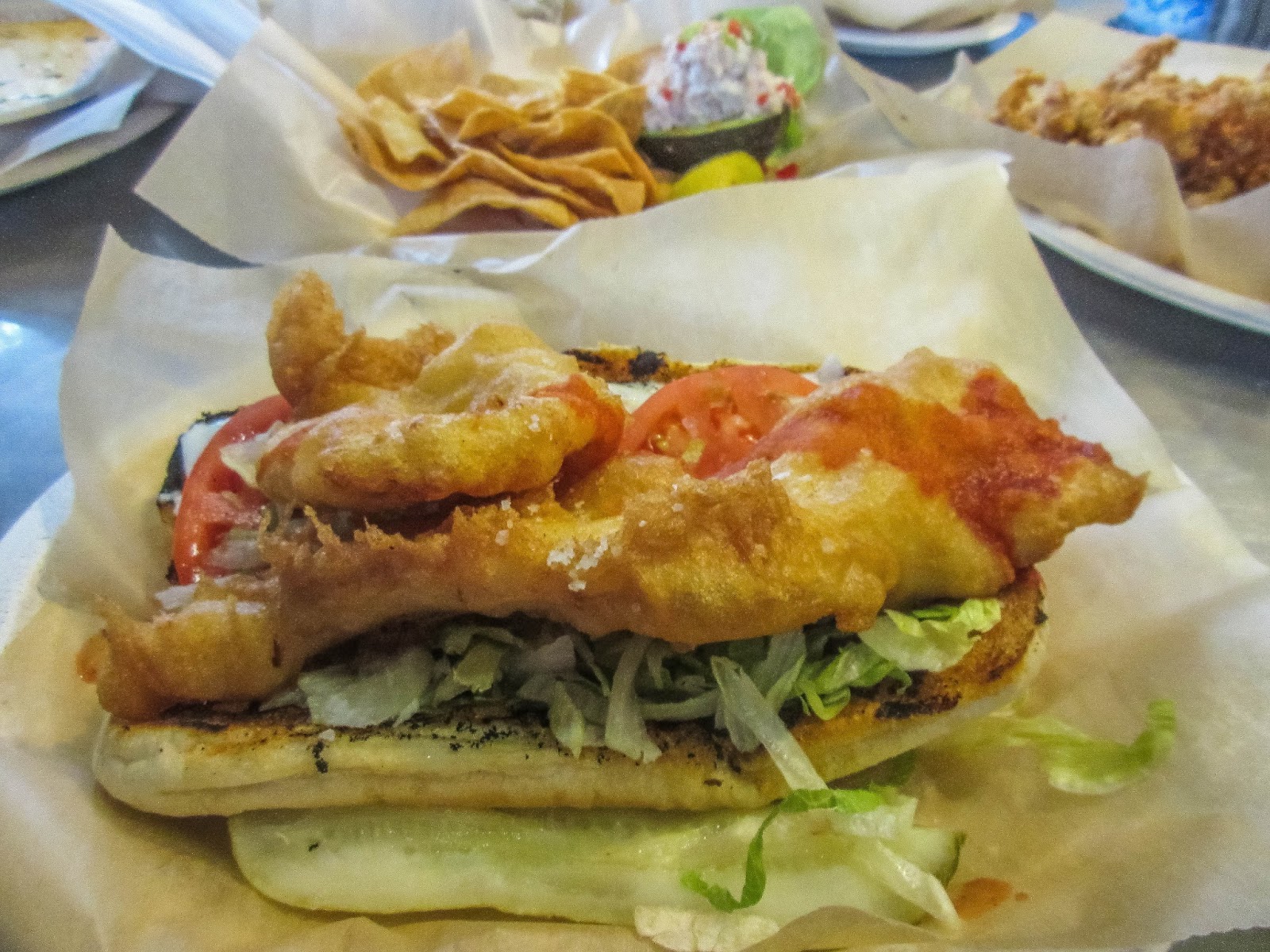
I got a poh boy fried fish sandwich and it was fantastic, some of the best fried fish I've ever had. The fish was fresh, it had a nice batter coating, not cooked too long, and it was slathered in tarter sauce with a few squirts of Sriracha sauce.
Fried fish poh boy sandwich. The tarter sauce is hidden underneath the fish in the lettuce.
Wanting to experience more of the menu, I ordered a bunch of "appetizers" as well. The clam fries, which I envisioned as french fries with sprinkled clams, were actually battered and fried clams. They were nothing special, mostly just lots of fried batter with some spongy insides that were allegedly clams. I would have liked them better had they been french fries sprinkled with clams and garlic. Anything they had going for them went downhill as they started to get cold.
The crab-stuffed avocado had quite a bit of crab, just a little bit of pepper garnish, and no dressing or seasoning. Meh. Some mayonnaise, some paprika, some something, could have transformed this dull dish into something worthwhile. At least it was healthier than the fried clams.
The pickled herring was quite good. Most pickled herring I've had is fairly soggy and mushy, the tissues broken down by the pickling juices. This herring was more firm, less infused with the transforming pickling juices, and thus not as strong tasting. I liked it, and Judy and Angie did as well.
I love the location of the restaurant in the park and the proximity to Minnehaha Falls. I love the proximity of the park to downtown. If I lived or worked nearby, that fried fish poh boy would occasionally draw me back, perhaps to a leisurely lunch overlooking the falls, particularly in the fall, when the leaves begin their magical transformation before they die and drop.

Finally, although having nothing to do with downtown or the park, but in keeping with the proximity of nature to the Twin Cities, I present an evening photo from Angie and Pete's backyard in Anoka, a view of the mighty Mississippi, in its northern infancy, in a glow of northern light, not Aurora Borealis or northern lights, but serene, lavender, purplish light. Beautiful, beautiful place.
The Mississippi River in Anoka.

Sunday, October 18, 2015

Piccolo - Minneapolis

On a recent visit to Minneapolis we visited Piccolo with Judy's sister, Angie, and Angie's husband, Pete. I looked on Trip Advisor and some other sources for restaurants and Piccolo caught my attention, even though it was rated only #60 out of 1,493 restaurants in Minneapolis. I wrote it down as one of six or seven restaurants to consider. Then I stumbled across a post by Andrew Zimmern, a Twin Cities resident, who recommended Piccolo as one of his ten favorite restaurants in the Twin Cities. This is what Zimmern had to say about it, "Doug Flicker is one of the most underrated chefs in the country, and I wish I could dine at Piccolo weekly. Doug operates with a 'less is more' mentality. That means a small dining space (I think it has fewer than 30 seats) and a menu boasting only 3-to 5-bite servings. It sounds as though it wouldn't be enough, but the small portions keep things exciting and void of any unnecessary filler. I've never left hungry, and I'm a big guy. Order a bunch of things and create your own pseudo-tasting menu. I routinely order 2 servings of his pickled pig feet with truffles and scrambled egg. It's that good." Zimmern's recommendation sealed it for me, I wanted to go there. 
Piccolo Restaurant in Minneapolis
Since getting home I've watched Anthony Bourdain's "No Reservations" television show on Amazon Prime. In 2010, season 6, episode 10, he visited Piccolo in his "Heartland" episode. It was the last restaurant featured and he said the following about Piccolo, "Far and away the best and most inspired and inspiring meal in my trip across America." On this clip, Anthony Bourdain calls Doug Flicker the best chef in the Midwest. Finally, here is a short clip about Piccolo on traveloutsidelines featuring an interview with Doug Flicker. 

We had reservations for 5:30 p.m., when Piccolo opened.  The dining room is quite small and we were seated at a table for four. We decided to do their tasting menu, which allows you to choose one item from each of five courses. It was a slow meal, with quite a bit of spacing in between courses. That gave us plenty of time to talk and much of the talk was about the meal itself. 

We were initially given a basket with various types of bread, my favorite being a sourdough with olives in it. The bread was accompanied by two large round slabs of butter and a white fuzzy substance which we were told was dried olive oil. It appears that the dried olive oil is made using tapioca maltodextrin which absorbs more than its weight in liquid and transforms the olive oil into a powdery substance that melts on the tongue. It is supposed to provide "an extremely rich feel in the mouth", but my palate was not discerning enough to really notice it. But dried olive oil or not, the sourdough with olives was excellent. 
The white stuff at the top of the butter is dried olive oil. 
For the first course, I got smoked eel torchon with cauliflower, horseradish and maitake mushrooms. Torchon is a cooking technique where food is wrapped in a cloth and secured tightly with a string. The food is then marinated, or poached, or both. For this particular item, it appears that cauliflower was bundled together with smoked eel and then simmered in water for a few hours. The two round "wheels" on the plate are the smoked eel/cauliflower combination. It had a distinctive smoked eel flavor, but not as strong as smoked eel, which I just had about a week previous at home. The maitake mushrooms were marinated and quite salty and the dabs of white liquid were a horseradish sauce. 
Smoked eel and maitake mushrooms
Judy's first course was roasted onion with Epoisses cheese, prune puree, chicken liver crumble and nasturtiums. Epoisses cheese is a pungent cows milk cheese made in France. It is usually served with a spoon because it has an extremely soft texture. In this case, the cheese filled the inside of the roasted onion. The dabs of brownish/purple are the prune puree and the crumbled brown crunchies were chicken liver. Biting into the onion and getting a mouthful of liquidy cheese was very nice. The chicken liver crumble was very crunchy and did not have a livery taste. I would love to know how it was made. Nasturtium is a plant similar to watercress and mustard with a peppery, pungent flavor. Both of these first course dishes were nice, very different, but the onions probably won the first round. 
Roasted onions.
Most of us were influenced by Andrew Zimmern's comment above and ordered the scrambled brown eggs with pickled pig's feet, truffle butter and parmigiano-reggiano cheese for the second course. Our waiter told us that this particular dish is always on the menu. The dominating texture was the very moist and mushy egg, the pig's feet was in small chunks and also very moist, so merged texture wise with the egg, and the salty cheese completely changed the flavor profile in those bites that contained it. This was a very pleasing texture, taste dish.
Pickled pig's feet sounds weird, but there was nothing weird about this dish.
Angie bucked the crowd and ordered roasted cauliflower agnolotti with king crab, n'djua, jalapeno and mint. Agnolotti is a pasta typical of the Piedmont region of Italy and is flattened dough folded over a filling, in this case of cauliflower. N'djua is Calabrian (southern Italy) variation of salami, a spicy spreadable sausage made with pig parts such as the shoulder, belly and jowl, as well as a mixture of spices. I did not get a taste of this dish, but anything with king crab can't be bad.
Agnolotti with king crab
The third course had three offerings. Pete and I both chose Guinea hen with swiss chard and egg yolk ravioli, sunchokes and delicate squash jus. I've had Guinea fowl on two occasions previously, once at Au Cinquieme Peche in Montreal and one that I cooked on my own at home. It is very similar in taste and texture to chicken. Sunchoke is another name for the Jerusalem artichoke, which we've cooked at home. Its tuber is very nice, but eaten in large doses gives massive gas (fortunately there was not enough there to cause this particular malady). There was nothing particularly different about the Guinea fowl, other than that it is an uncommon restaurant dish, but the sunchoke with delicate squash gravy on the ravioli had a very pleasing texture and nice taste.
Guinea fowl. The roundish ravioli is in the center topped by sunchoke.
Angie and Judy both chose sturgeon with crab apples, fennel, ham hock glaze and Yukon gold potatoes. I was initially thinking of getting the sturgeon, a fish I've never had before, other than caviar which is sturgeon eggs, but was discouraged from doing so by the waiter who said that the sturgeon was kind of bland. The sturgeon was actually quite salty and overrode any blandness that might otherwise have existed.
Sturgeon
For the fourth course, Judy ordered 48 hour Peterson Farms beef short rib with smoked black walnuts, crispy morcilla and prune. Morcilla is another name for blood sausage and I assume the dark crispy pieces are the morcilla and the yellowish/brownish crispy pieces the black walnuts. The short rib was cooked sous vide for 48 hours and this is the only dish I thought was a little subpar. The short rib was rather tasteless and hard.
Short rib
I got the rabbit loin and crispy leg with chestnut polenta, cipollini onions and chestnut honey. For the most part, the rabbit loin was extremely succulent, juicy and flavorful, although I did have a little section that was a little spongy. The waiter told us that the rabbit loin was laid out, rolled up and cooked sous vide at 60 degrees for about 50 minutes.
One side of the rabbit.
Another view of the rabbit with the polenta and onions visible. I'm not sure where they crispy leg was, except perhaps rolled in with the loin and providing the different texture I noticed. 
For me, the sixth course, the dessert, was the star of the evening. I had foie gras torchon with cashew butter, Concord grapes and yeast ice cream. Foie gras is duck or goose liver that has been specially fattened. According to Serious eats, foie gras torchon is the "king of all hors d'oeuvres" and takes three days to make. Apparently, there are only two farms in the U.S. that make foie gras, both in the Hudson Valley in New York, made from ducks. The liver is cured in a mixture of salt, sugar, pepper, and perhaps a splash of liquor such as brandy or Sauternes, before being rolled up tightly into a cylinder with a kitchen towel (torchon in French). After it hangs for several days it is gently poached, chilled and then served sliced. The foie gras was cold, creamy and rich, and had a few crunchy pieces in it, I have no idea what they were. The round wheel of gelatinous purple is Concord grape and it was a flavor wallop of grapeness that was incredible. So, so good. The only thing better were the crispy purple nuggets underneath the ice cream which were crunchy Concord grape kernals. I have no idea how they are made, but those grape nuggets are magical, just loaded with crispy sweet flavor that is unsurpassed by anything else I think I've ever eaten. Cashew butter held the foie gras wheel in place and a couple of whole cashews were on the plate. Finally, the yeast ice cream had a very different yeasty, but good taste. This plate was just loaded with different textures and tastes and was an adventure in every bite. I Looooooved it. Pete also had this dish and agreed that it was the best of the evening.
Foie gras
Judy and Angie got parsnip panna cotta with butterscotch, yuba, crab apples and crisp parsnip. Yuba is the thin veil that forms on the surface as cream rises in heated soymilk, also called "bean curd sheet." Panna cotta is an Italian dessert of sweetened cream thickened with gelatine and moulded. This was also good, weird to think of parsnip as a dessert, but it worked.
Parsnip panna cotta
Our meal was long, about 2 and 1/2 hours. But it was one of my favorite kinds of meals, creative combinations, unusual ingredients and processes and styles I have to look up to understand. In other words, real chef magic, food as art. Very fun to enjoy it with Angie and Pete, one of the highlights of the trip for me. 

Thursday, October 15, 2015

Eagle Mountain and Northeastern Minnesota Waterfalls

The Minnesota shoreline on Lake Superior between Duluth and the Canadian border at Grand Portage covers 150 miles and is known as the North Shore. We recently visited a number of waterfalls along the North Shore and hiked to the top of Eagle Mountain, the tallest mountain in Minnesota, about 20 miles inland from the North Shore. 

Gooseberry Falls State Park

43 miles northeast of Duluth is a series of three waterfalls on the Gooseberry River. The Upper Falls, just north of Highway 61, has a 30 foot drop. The water then glides under the Highway 61 bridge and goes over the Middle Falls and then the Lower Falls. The hike to visit the falls is minimal and the three waterfalls in close proximity to each other provide a spectacular viewing opportunity for very little effort. 
Upper Falls 
From Upper Falls, looking down the Gooseberry River past the bridge to the Middle Falls.
Middle Falls. The Highway bridge is visible to the upper left. 
A side view of Middle Falls.
Lower Falls
Below the three falls, the Gooseberry River empties into Lake Superior. Fall was showing off its plumage.
Split Rock Lighthouse State Park

We made a brief visit to the Split Rock Lighthouse. It was quite beautiful as a sentinel over Lake Superior, the largest fresh water lake in the world.
Split Rock Lighthouse as viewed from Highway 61.
Tettegouche State Park

High Falls in Tettegouche State Park, is 60 miles northeast of Duluth and involves more effort to get to than the Gooseberry Falls. From the campground, it is about a half-mile hike in to the top of the falls, then a little bit more distance to cross the Baptism River on a bouncy footbridge and hike down to near the base of the falls. The 60 foot drop makes these the second tallest falls in Minnesota. The reward is fewer people and an opportunity to get up close to some great fall colors. This was my favorite waterfall because of its height and the opportunity to see it from every direction. 
Red and yellow leaves combined for a spectacular display.
Yellow leaves of aspen stand out against the green pines.
Leaves turning various colors.
Bright red leaves with some yellow and green in the background.
The churning water from a side view at the top of the falls.
A look down the Baptism River below the falls.
Judy on the foot bridge over the Baptism River above the falls.
The bridge itself was an adventure - it was quite bouncy.
A view of the top of the falls from the other side of the river.
A view up-river from the falls.
View from below the falls.


Grand Portage State Park

At the very end of the North Shore Drive, just on the south side of the Canadian border, is Grand Portage State Park with the tallest waterfall in Minnesota, 120 foot High Falls, twice the height of High Falls in Tettegouche State Park, the next tallest waterfall (shouldn't they be a little more creative with waterfall names than High Falls?). High Falls is on the Pigeon River which is the U.S./Canadian border. One side of the river/falls is in Canada and the other side is in the U.S. High Falls is a one-half mile walk each way, on a beautiful handicapped accessible trail. We could hear the roar of the falls well before we saw it - the sound was concussive and loud.
The Pigeon River well below High Falls.
A red squirrel along the trail.
High Falls
The massive impact of the falling water.
Looking downstream from the falls on the Pigeon River.
View of High Falls from further back. 
Fall colors above the falls.

Judy in front of the falls.
Eagle Mountain

Eagle Mountain is the tallest mountain in Minnesota with an elevation of 2,301 feet. To get there we followed a series of roads about 20 miles west of Grand Marais, which is on the North Shore Drive. The roads were paved much of the way, then turned to dirt. Along the drive I spotted a river otter cavorting in a field among a bunch of fallen logs. I stopped the car, took my camera into the field and couldn't find the otter, but I did get a photo of a snowshoe rabbit. Both the river otter and snowshoe rabbit were firsts for me.
Snowshoe hare. Note the white ears and white feet.
When we arrived at the Eagle Mountain trailhead we had some gray jays feasting on a dead bird in the dirt parking lot.
Gray jay
It started to sprinkle very lightly as we started our 3.5 mile hike (7.0 mile roundtrip) and about 20 minutes in started to drizzle fairly constantly. Judy, who was leading, saw a gray wolf straddling the trail about 30 yards in front of us. She motioned for me to look and I saw the wolf as it turned and started to lope ahead and then veered into the trees. Its beautiful silver and gray coat and bushy tail will be forever imprinted in my mind. This was definitely a first for me. I'd read some information about the state parks along the North Shore Drives and several mentioned they had wolves. I never dreamed we'd see one. A special, special experience. A short time later we crossed over into the Boundary Waters Canoe Area Wilderness as we crossed over a bog on boards placed along the ground for that purpose.
A boggy area. It looks like this may be part of Whale Creek.
The bogs were the only time we really could see any distance. Otherwise visibility was severely limited by the heavy tree growth. Eventually we reached Whale Lake and a knob directly ahead appeared to be Eagle Mountain. But I recalled a summitpost comment for Eagle Mountain which indicated that the photo posted there was incorrect.
Whale Lake and a knob on the other side.
After following the trail near the shore of Whale Lake, a sign pointed to the trail heading to the left up the side of the mountain. It was not extremely steep, but much steeper than anything we'd encountered so far. We gained about 600 feet of elevation. The trail was quite rocky and we had to be careful of foot placement, making sure that we did not slip on slick rocks.
We eventually reached an open spot on the trail which provided a panoramic view of the Wilderness Area and several lakes below. Lots of yellow leaves from aspens or birches. I couldn't help but think of that wild country that supported the wolves, one of which we'd seen. I read subsequently that the wolves in northern Minnesota were the last bastion for wolves in the U.S. before their populations started to recover and spread into other states.
Panoramic view from Eagle Mountain. Several lakes and lots of yellow leaves below.
Judy commented that the summit looked straight uphill from us and it appeared that way to me as well. But I thought I'd read there was a trail and continued forward for some time down a much lesser trail before giving up and going back to the panoramic view. Then we headed straight up the hill, found several rock cairns and the trail and within five minutes were standing near a rock with a bronze plaque. The summit is remarkably unimpressive.
From the panoramic spot - looking uphill.
Judy on top of Eagle Mountain - wet, but triumphant.
The USGS marker on the rock above the plaque.
The plaque.
We found a nice tree that provided cover from the rain and broke out some smoked fish we'd purchased at Russ Kendall's Smokehouse in Knife River and some funky tasting aged goat/cow milk cheese we purchased at a farmer's market in St. Paul. We couldn't eat it all and left the balance for our wolf-friend. I'm sure the smell will draw him to it.
Enjoying smoked whitefish, salmon, herring and some cheese.
We encountered one other hiker on our way in and several groups of hikers on our way out. I was impressed with the number of hikers willing to brave the rain.

I came away astounded at the beauty of northern Minnesota along the North Shore Drive and in the Boundary Water Canoe Area Wilderness, particularly in the fall with the changing colors, and immensely grateful that this area has been preserved for wolves and other wild animals as well as humans like us.