The Roman emperor Constantine the Great fascinates me because of the profound secular and religious impact he had on the world. In the last few years we've had an opportunity to visit some of the places he lived and I've gained an even greater appreciation for his importance in history.
Constantine was born in Naissus on February 27, 272. Naissus was the precursor to Nis, in modern day Serbia. His father was Flavius Valerius Constantius, a junior Roman army officer, part of the Emperor Aurelian's imperial bodyguard, and his mother was Helena, daughter of an innkeeper.
In 285, Constantius was named governor of Dalmatia and in 288 he was appointed as praetorian prefect to Maximian, who was co-emperor in the west while Diocletian was co-emperor in the east. In 293, Diocletian formed the tetrarchy (a rule of four), with Maximian as Augustus in the west, Constantius as his junior Augustus, or Caesar, in the west, Diocletian as Augustus in the east, and Galerius as his Caesar in the east. Each was responsible for a different geographic area. At this same time, Constantine was directed to go east to the court of Diocletian located in Nicomedia, now Izmit, Turkey, to separate him from his father and potential future dynastic claims.
In 303, Constantine was present as Diocletian and Galerius began what is known as the "Great Persecution" of Christians after an inquiry on the matter, by Diocletian and Galerius, to the oracle of Apollo at Didyma. On February 23, 303 the newly built Christian church in Nicomedia, the city where Diocletian lived, was destroyed, the scriptures burned and the treasury seized. The next day Diocletian issued an empire-wide edict ordering the destruction of Christian places of worship and scriptures, prohibited Christians from gathering to worship, and deprived Christian civic leaders of their ranks. Successive edicts, effective only in the east, ordered the arrest and imprisonment of all bishops and priests, then later, for all persons to gather in a public place to offer a collective sacrifice to the gods - and those that refused (the Christians) were to be executed.
In 305, due to the illness of Diocletian, Diocletian and Maximian jointly resigned as Augusti and Constantius and Galerius became Augusti, in the west and east, respectively, with Septimius Severus and Maximinus as their respective Caesars. Constantine, much to the consternation of Galerius, immediately left Nicomedia to join his father in the west and eventually ended up in Britannia to campaign with his father against the Picts, beyond Hadrian's Wall. Constantius died of illness on July 25, 306, and the western army immediately proclaimed Constantine as his successor Augustus in the west. This took place at Eboracum, now York, England, likely at the principia or headquarters building at the fortress which now lies beneath York Minster. This elevation of Constantine was contrary to the established protocol that required Severus, the Caesar, to replace Constantius as the western Augustus. Galerius was furious, but under the circumstances, where he could do nothing to stop it, Galerius "allowed" Constantine to keep his command, but in the reduced capacity as Caesar to Severus who was named as the western Augustus.
 |
| Statue of Constantine outside York Minster, York, England, where he was proclaimed Augustus by the western armjy. |
Constantine controlled the area of Britain, Gaul and Spain with his headquarters in Augusta Treverorum (Trier, Germany). Maxentius, the son of Maximian (who had been co-emperor with Diocletian and resigned with him) was jealous of Constantine's elevation to Caesar. Located in Rome, Maxentius seized the title of emperor on October 28, 306. Severus, the western Augustus located in Mediolanum (Milan, Italy), sent an army against Maxentius. However, Maximian came out of retirement to support his son, and the army, which Maximian had led for many years, defected over to his side and Severus was captured and imprisoned and later killed. In late 307, Maximian visited Constantine and offered his daughter, Fausta, in marriage and also offered to elevate Constantine to Augustus. In return, Constantine was to recognize Maxentius as an emperor over the territory Maxentius had taken over from Severus (Italy and North Africa).
In November 308, Galerius, Maximian and Diocletian (briefly out of retirement) met and again demoted Constantine to Caesar in the west and selected Licinius to replace Severus as Augustus in the west. Constantine refused to accept the demotion. In July 310, after Maximian tried to take over Constantine's troops claiming that Constantine was dead, and then later tried to kill Constantine, Constantine encouraged Maximian to commit suicide which Maximian did. When Galerius died in May 311, Licinius and Maximinus (who had been Caesar to Galerius in the east) agreed to share the eastern provinces between them, giving Licinius control over both some eastern and western provinces.
Constantine decided to move against Maxentius. After a series of victories over forces of Maxentius, they met in a decisive battle at the Milvian Bridge over the Tiber, north of Rome, where Maxentius had double the number of troops of Constantine. Accounts vary as to details, but before the battle, Constantine had a dream or a series of dreams and visions, including one where Christ appeared to him, where he was told to use the first two letters of the Greek spelling of Christ, Chi (X) and Rho (P), placed over the X, on the shields of his soldiers and on his labarum (military standard) and that if he did so he would be victorious. On October 28, 312, Constantine's forces were victorious over Maxentius. During the battle, Maxentius fell into the Tiber and drowned. Constantine marched into Rome the next day and was met with jubilation. The Roman Senate proclaimed him the "greatest Augustus."
 |
| Milvian Bridge over the Tiber, where Constantine defeated Maxentius. |
 |
| 337 A.D. coin with Constantine on one side and the labarum on the other. Note the Chi and Rho attached above the standard. |
Shortly after, Constantine introduced the solidus, a gold coin which replaced the aureus as the gold coin of the Roman Empire and was a standard currency for more than a thousand years.
In February 313, Constantine and Licinius met in Milan to secure their alliance by having Licinius marry Constantine's half-sister, Constantia. At this meeting they issued the Edict of Milan, which legalized Christianity, proclaiming that "Christians and all others should have liberty to follow that mode of religion which to each of them appeared best."
As a result of the alliance between Consantine and Licinius, Maximinus attacked Licinius and Maximinus was defeated, dying in August 313.
At the direction of the Roman Senate, to commemorate Constantine's victory over Maxentius at Milvian Bridge, the triumphal Arch of Constantine was built in Rome over a period of three years. It was completed in 315.
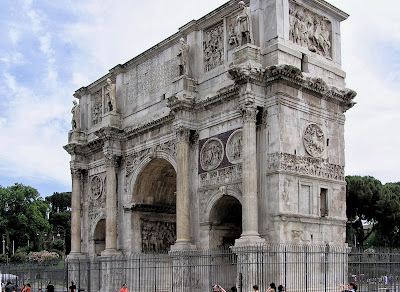 |
| The Arch of Constantine in Rome, Italy |
Over the next ten years things deteriorated between Licinius who now controlled the east completely, and Constantin, who now controlled the west completely. On July 3, 324, at the Battle of Adrianople, Constantine defeated 170,000 troops of Licinius, then ultimately got Licinius to completely submit following the Battle of Chrysopolis near Chalcedon, on September 18, 324. Constantine had Licinius hanged in 325.
After the victory over Licinius, Constantine decided to make the capitol of the empire at Byzantium, at the crossroad of the land route between Europe and Asia and the sea route between the Black Sea and the Mediterranean. That location also provided good access to the frontiers on the Danube and the Euphrates. He called it the New Rome (as a practical matter, Rome had not been the headquarters of the emperors for many years), but the name didn't stick. It came to be called the City of Constantine, or Constantinople, which of course is now known as Istanbul, Turkey. Over six years the small town was transformed into a city and consecrated on May 11, 330.
 |
| Constantine ordered the Tripod of Plataea, now known as the Serpent Column, transferred from the Temple of Apollo at Delphi to Constantinople, at the Hippodrome. This is what remains of it today. |
 |
| The Obelisk of Thutmose III was ordered brought from Egypt to Constantinople by Theodosius the Great in 390. It also is found at the Hippodrome. |
 |
| Constantine began construction of a wall around Constantinople in 324 which was completed by his son, Constantius. The original walls don't exist today. The Theodosian Walls, above, were built by Emperor Theodosius II (408-450) and are farther out than Constantine's wall as the city had expanded. |
 |
| Coin issued by Constantine to commemorate the founding of Constantinople. |
In 325, while Constantinople was under construction, Constantine called the first ecumenical council of the church at Nicaea, modern day Iznik, Turkey, southeast of Constantinople. It was to decide a controversy of that day which erupted in the church in Alexandria concerning the relationship between Christ and the Father: (a) whether the Son was begotten by the Father from his own being, advocated by Bishop Alexander of Alexandria, or (b) whether the son was created out of nothing, a view advocated by Arius, a priest in Alexandria. Constantine invited all 1800 bishops of the church to attend (about 1,000 in the east and 800 in the west) and somewhere between 250 and 318 attended. As recorded by one participant, on May 20th, "Resplendent in purple and gold, Constantine made a ceremonial entrance at the opening of the council,...but respectfully seated the bishops ahead of himself." The council decided on the view pushed by Bishop Alexander. The council also created a creed, known as the Nicene Creed, which was to be a summary of Christian faith. What is now known as the Nicene Creed was the creed determined at Nicaea, as amended by the second ecumenical council which was held in Constantinople in 381. The council at Nicaea also established the method for determining the date of Easter each year.
 |
| An icon showing Constantine with the bishops at the Council of Nicaea and holding the Nicene Creed. |
Also in about 325 (dates vary, but in the time frame of 325 or 326 to 327 or 328), Constantine gave his mother, Helena, use of the imperial treasury to locate the relics of Christianity, and she traveled to Palestine. In 327, Helena commissioned the building of the Church of the Nativity in Bethlehem, over the cave that was the birthplace of Jesus (it was completed in 339, destroyed by fire in the sixth century and subsequently rebuilt). In 325 or 326, she ordered the temple of Aphrodite, built on Golgotha or the Hill of Calvary in Jerusalem, demolished and a new church, the Church of the Holy Sepulchre, built on the site. The Emperor Hadrian built the temple of Aphrodite as part of the reconstruction of Jerusalem (which he renamed Aelia Capitolina) following its destruction in the Jewish Revolt of 70 and the Bar Kokhba revolt of 132 to 135. During the excavation, Helena, claimed to discover the cross and tomb of Jesus, the nails of the crucifixion and the holy tunic (worn by Jesus shortly before or during his crucifixion). The Church of the Holy Sepulchre is now the headquarters of the Greek Orthodox Patriarch of Jerusalem and it has been a pilgrimage destination since that time as the site of the resurrection of Jesus. When Helena returned from the Holy Land she took the relics to Rome to what is now called the Basilica of the Holy Cross in Jerusalem (Santa Croce in Gerusalemme). The basilica floor was covered with soil scraped from Golgotha after the temple of Aphrodite was demolished and the church in Rome is deemed "in Jerusalem" as part of Jerusalem was moved to Rome for its foundation.
 |
| Coin with Helena struck at the mint in Trier, Germany, in 325 or 326 |
As emperor, Constantine did not forget his birthplace. He built a residence in a suburb of Naissus known as Mediana, where he sometimes stayed.The central part of Mediana was occupied by a villa which I understand to have been Constantine's residence, with columns, frescoes and floor mosaics. He passed laws from Naissus in 315, 319, 324 and 334. Mediana was also used by later Roman emperors as a temporary residence. For example, in 364, the emperors Valentinian and Valeria met at Mediana to divide the Roman Empire.
 |
| Mediana, outside Nis, Serbia |
 |
| Mediana, outside Nis, Serbia |
Constantine, who had been ill, realized that he might by dying. While in Nicomedia, he requested baptism. He asked Eusebius, Bishop of Nicomedia (an Arian), where he was at the time, to baptize him. Constantine died soon after, on May 22, 337. His body was taken to the Church of the Holy Apostles in Constantinople where he was buried. The Church of the Holy Apostles was demolished by the Ottomans in 1461 and replaced by the Fatih Mosque.
 |
| The baptism of Constantine, as depicted by the school of Raphael. |
 |
| Fatish Mosque in Istanbul, on the site where the Church of the Holy Apostles was located, where Constantine was buried. |
Constantine left the empire to his sons, replacing Diocletian's tetrarchy with dynastic succession. His sons Constantine II (his first), Constantius II (his second), and Constans (his third) succeeded him as co-emperors upon his death, along with a couple of nephews. Constantine II ruled over what is today Britain, France, Spain and Morocco; Constans ruled over Italy, Slovenia, Croatia and much of the coast of central North Africa; and Consantius II ruled over Turkey, the Levant and Egypt. The brothers quickly had the army kill the nephews and other potential rival family members. Then Constantine II, in an effort to exert his right of primogeniture over his brother, Constans, invaded Italy in 340 and was killed. So Constans took over Constantine II's realm. In 350, Constans was assassinated in a rebellion by his general Magnentius, a result of Constans' cruelty and misrule. Constantius II, the last living son of Constantine, was not willing to accept Magnentius as a co-ruler and defeated him at the battles of Mursa Major (in 351 in Croatia) and Mons Seleucus (in 353 in Southern France) after which Magnentius committed suicide. This left Constantius II as sole Emperor until his death in 361.
Nicene Christianity was named as the state church of the Roman Empire on February 27, 380, when Theodosius signed the Edict of Thessalonica.
Constantine is revered as a saint by the Catholic and Eastern Orthodox Churches and "equal-to-the-apostles" in the Eastern Orthodox Church. His mother, Helena, is also revered as a saint.
 |
| A mosaic in Hagia Sophia in Instanbul (Constantinople), Turkey, shows Justinian, at left, holding a model of Hagia Sophia, Constantine, at right, holding a model of the city of Constantinople, and the Virgin Mary and Christ child, center. |
It is hard to even consider what Christianity would be like today without Constantine. By legalizing and legitimizing Christianity, Constantine propelled huge growth and acceptance. Roman political structure impacted the structure of the church. For example, the term diocese originated with Diocletian and the tetrarchy. Dioceses were political divisions within the empire. Easter, saints, feast days, and other church activities had their origin in pagan Rome as part of the process of syncretism, that is, making Christianity more familiar and acceptable to pagan Romans converting to Christianity. He established the precedent for ecumenical councils at Nicaea. By proclaiming the New Rome, he paved the way for the Patriarch of Constantinople to claim equal status with the Pope of Rome. This was part of the impetus for the split of the church into Roman Catholicisim and Orthodox Christianity. By sending his mother to the Holy Land, sacred places were identified and relics obtained which still impacts us today.
If I could meet certain people from the pages of history, Constantine would be on my short list.