Tuesday, March 14, 2023

Jamaican Oriole

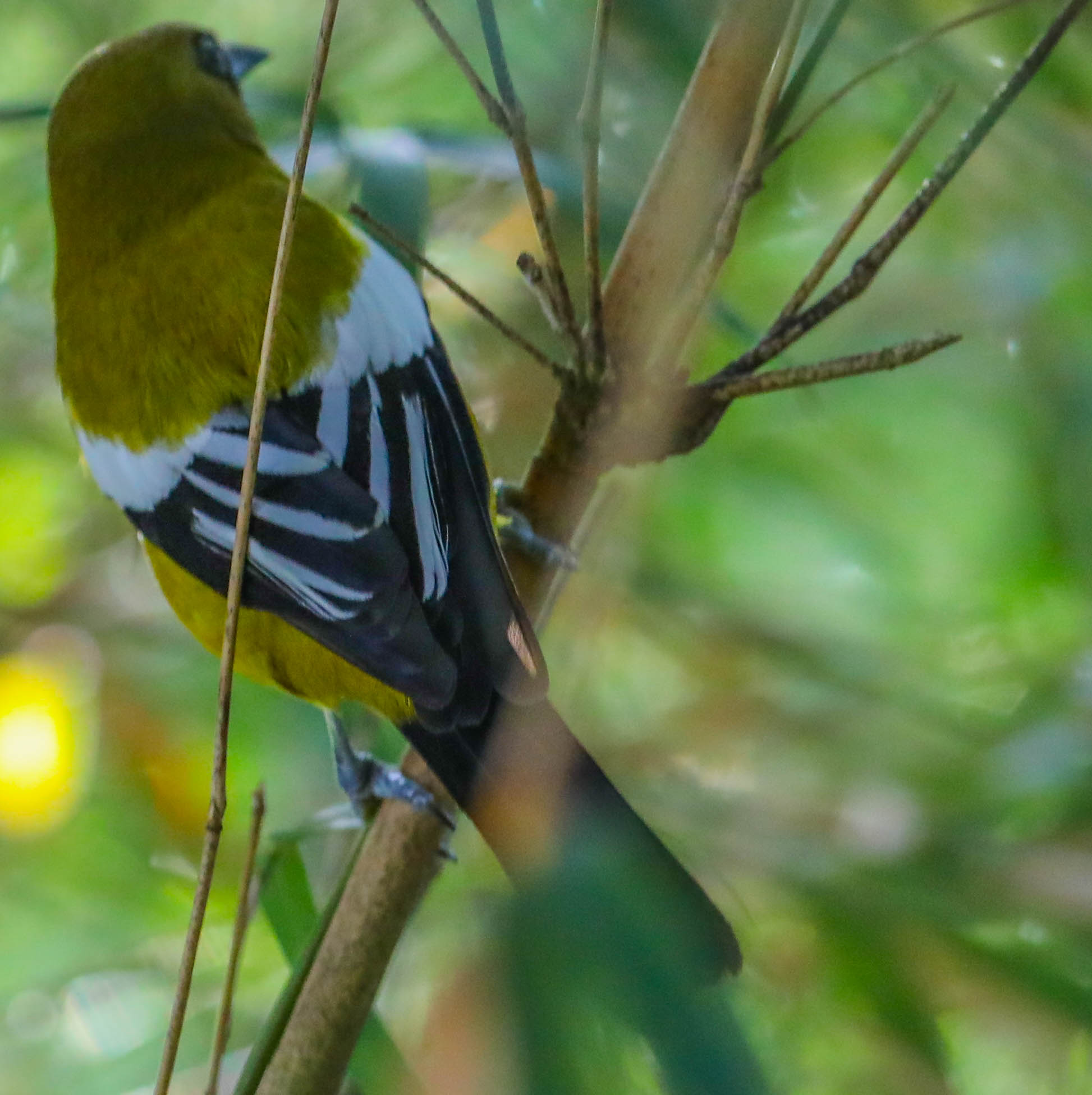
The Jamaican oriole is almost endemic to Jamaica. It used to be found in the Cayman Islands but was last seen there in 1967. The only other place it is found is on San Andres Island which is a part of Colombia. It is widespread and common in Jamaica, including in gardens, and I saw it several times: first at Rocklands Bird Sanctuary outside Montego Bay and then in San San, east of Port Antonio. 
At Rocklands Bird Sanctuary.


It is yellow on the crown, neck, back and underparts, black on the face and bib and a mixture of white and black on the wings and tail. Females are similar to males, but slightly duller. 
In San San.

It is a beautiful bird I'd hoped to see and was thrilled to see it twice.

Monday, March 13, 2023

White-Chinned Thrush

 The white-chinned thrush is endemic to Jamaica and also known there as the "hopping Dick." It is mostly a slaty gray with a pale belly. It has a bright orange bill and legs. The white chin, which gives it it's name, is difficult to see, but it does have a white slash on the wing which is usually visible. 
At Hotel Mockingbird Hill feeding on berries.


It feeds on insects, worms, snails, frogs, small mice, fledgling birds and lizards. Lizards are a substantial part of its diet. 
At Hotel Mockingbird Hill

It is widespread and common. 
At Rocklands Bird Sanctuary.


I saw one at Rocklands Bird Sanctuary outside of Montego Bay and several at Hotel Mockingbird Hill outside Port Antonio. 

Sunday, March 12, 2023

Sad Flycatcher

The sad flycatcher is another bird endemic to Jamaica where it is also known as the "little Tom fool." It is widespread and common. 
It has a dark crown, a broad bill,  little or no rufous in the tail, a white throat and yellow lower parts. 


I saw one sad flycatcher at Hotel Mockingbird Hill east of Port Antonio. 

Saturday, March 11, 2023

Rufous-Tailed Flycatcher

The rufous-tailed flycatcher is endemic to Jamaica where it is fairly widespread. Wikipedia has three sentences on it and no description; eBird has one paragraph with six sentences, 1,914 observations and 195 photos. Birds of the World has a much more extensive discussion. It has a smoky brown crown, neck and back; the tip of the bill and iris are black; the throat and breast are dark gray; the belly and undertail coverts are yellow; and the outer wings and tail are rufous with bands of smoky brown. 
It feeds on fruits and insects, including cicadas, moths and butterflies and perches in dense vegetation beneath the canopy. It is of Least Concern by the IUCN and is fairly common. 


I saw several on the grounds at Hotel Mockingbird Hill in Drapers, east of Port Antonio. 

Friday, March 10, 2023

Chestnut-Bellied Cuckoo

My most extensive experience with a bird in Jamaica was with the chestnut-bellied cuckoo. I was with Lyndon Johnson, my birding guide, in the garden at Hotel Mockingbird Hill east of Port Antonio. He heard its call and got quite excited. He played its call on his cell phone to get it to come closer and for what was probably 20 minutes or so we followed it around the garden. We would catch a glimpse, I'd go close for a photo, it would fly, we would locate it, I'd go close for a photo, it would fly, and so on. I took more photos of it than any other bird on our trip, by far. What stood out was its tail, particularly when it was fanned out - it was gigantic and beautiful! 
This image stands out in my mind. The huge tail fanned out like a commercial hand-held fan and a glimpse of its chestnut belly above, otherwise obscured by the vegetation. 
It is endemic to Jamaica, widespread, but "uncommon and not well known..." 


Like the Jamaican lizard cuckoo, half the length of this cuckoo is its tail. The tail is black with large white tips and a purple gloss. It has dull brown upperparts, a light gray face and breast with a pale throat and a dark rufous or chestnut belly. 


Thursday, March 9, 2023

Jamaican Lizard Cuckoo

With a name like lizard cuckoo, I really wanted to see this bird! It gets its name from its diet which includes anole lizards and the food it feeds its young is primarily lizards. It also eats mice, nestling birds, tree frogs and insects. 
It is endemic to Jamaica and widespread, but uncommon. 
What really stands out is the tail, which is as long as the body. The underside, the only part I saw, is very white with black tips. It has a brown forehead, crown and nape. The eye is surrounded by bare red skin. The upperparts are gray with rufous primaries. The throat is white and the rest of the underparts are rufous. 
I saw this with my bird guide, Lyndon, in the seven acre garden at Hotel Mockingbird Hill, east of Port Antonio. I got quite close to it, but it was always above me and my view was of its underparts. 

Wednesday, March 8, 2023

Green-Rumped Parrotlet

Parrotlets are the smallest New World parrot species and resemble the lovebirds of Africa in size, body shape and behavior, but are not closely related. 

The green-rumped parrotlet is found in tropical South America, from the Caribbean regions of Colombia, Venezuela and Trinidad, south and east to the Guianas and Brazil on the lower Amazon River. It has been introduced to Jamaica, Curacao, Barbados, Tobago and Trinidad. 

Its plumage is bright green with duller-grayer napes. The eyes are dark brown and the beak and feet are light peach. Males have purplish-blue primaries, secondaries and coverts and bright turquoise feathers on the leading edges of their wings. Females lack the blue, but are more yellow-green on the head. 

The yellow-green on the head indicates this is a female. 


We saw a number of them in San San on the northeast side of Jamaica. Our guide, Lyndon, noted that they were not native, but introduced to the island.