Tuesday, December 7, 2021

Whooping Crane

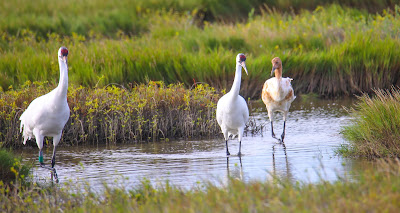
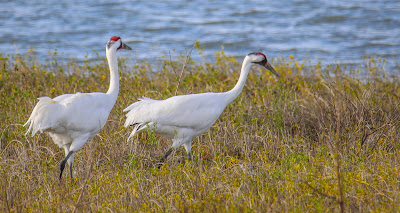
The whooping crane population was down to 21 wild birds and 2 captive birds in 1941. There are now more than 800 living whooping cranes, the tallest bird in North America and we recently visited Aransas NWR in Texas where the vast majority of them winter. The whooping crane can be as tall as 5 feet, 3 inches and its wingspan can reach 7 feet, 7 inches.

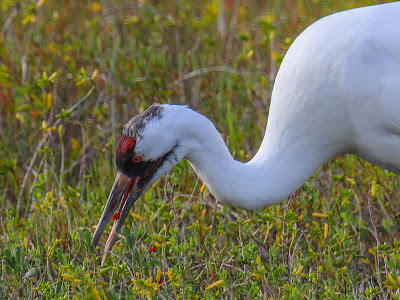
Adult whooping cranes are white with a red crown and mustache stripe, yellow eyes, a long, dark, pointed bill and black legs. 
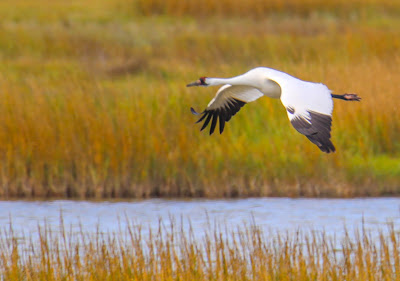
They fly with legs and neck extended and black wing tips that are only visible in flight. 


Immature whooping cranes are white with a rusty brown head and mottled back. 


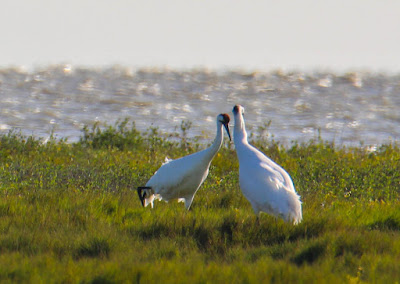
Their loud calls, for which they are named, can be heard for more than a mile. 
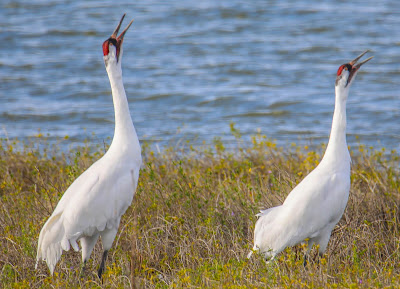
These whoopers began calling when we were quite close and it was loud and magical. 
Most of them spend the summer and lay their eggs and hatch chicks in the Wood Buffalo NP in the Northwest Territories of Canada. About 75% of them have a migratory stopover in Salt Plains NWR in Oklahoma and the breeding populations winter along the Gulf Coast of Texas. 
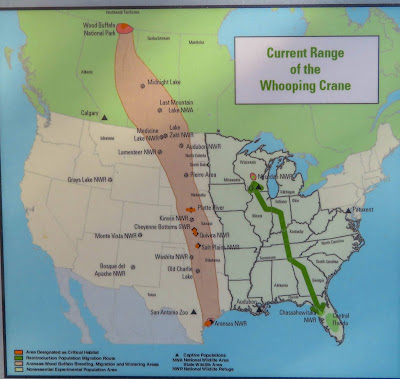
The tan stripe shows the migratory route of the vast majority of whoopers. Note Aransas NWR at the southern tip of their range. 
In an effort to protect the species in the event of a catastrophic event, such as a hurricane, that could wipe out the species, efforts are being made to introduce them to new areas, including Necedah NWR in central Wisconsin, as an alternate summer range, and Florida for migratory and non-migratory birds and Louisiana for non-migratory birds. 

In their Texas wintering grounds they favor crustaceans, mollusks, fish, small reptiles and aquatic plants. Several studies at Aransas NWR showed that blue crabs were 90% of their energy intake during the winter. 
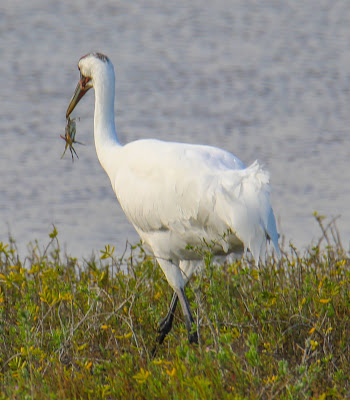
This whooper is eating some sort of large water insect or crab.

This whooper is eating berries. 
During the summer they enjoy frogs, small rodents, small birds, crayfish, clams, snails, aquatic insects, aquatic tubers and berries.

Early on a Friday morning in late November we drove to Aransas NWR. It was chilly and Judy stayed in the car while I took the 1.4 mile roundtrip Heron Flats Trail. As I was near the end of the trail and on my way back, I encountered a woman that told me she thought she could see some whooping cranes. She walked a short distance and showed me two large white birds quite a distance away, across a water channel and on a small island. They were not gray, so they were not sandhill cranes, so we determined that they must be whooping cranes. They were making a racket. I nudged out into the swampland beyond the trail about 30 yards in order to get better photos and got my sandaled feet wet and muddy, but got much better photos.  


I could hear the whoopers making noise even as I got back to my car more than a half mile away. 
Later in the day we took a Whooping Crane and Coastal Birding Tour with Rockport Birding and Kayak Adventures out of Rockport, Texas, along with about 35 other people on a large boat across Aransas Bay and into the Aransas NWR. We saw 30 whooping cranes during the course of our three hour tour, with the last sighting being the very best: an immature whooper with its parents that got within about 20 yards of our boat! Our guide, who has been doing these tours for years, said that there were about 500 whoopers in Aransas NWR last year and he is anticipating about 550 this year. He was giddy about the number of immature whoopers we saw on our excursion - it must have been 5 or 6 and we were early in the wintering cycle.

I share some more of my photos below:


Sunday, December 5, 2021

Brazoria National Wildlife Refuge - Texas

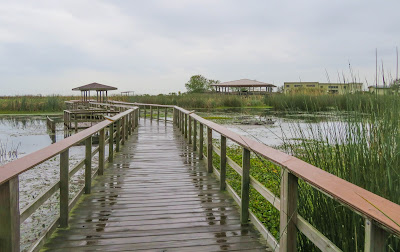
Brazoria NWR was established in 1969 on 44,414 acres southwest of Galveston Island, Texas. It is east of Hwy 288 and the towns of Angleton and Lake Jackson, and west of the Gulf of Mexico, separated by Follett Island and Christmas Bay. It has a freshwater slough that runs through salt marshes, with a 1.2 mile loop trail over and near the slough and a 7.5 mile auto route on a gravel road that goes through part of the refuge. We visited on a very rainy and wet day when getting out of the car for any length of time was not an option we were willing to give much consideration.  


This board walk goes over the Big Slough and is the beginning of the 1.2 mile loop trail. It was two rainy to consider doing the walk. 
Following is some of the wildlife we saw in our short visit:
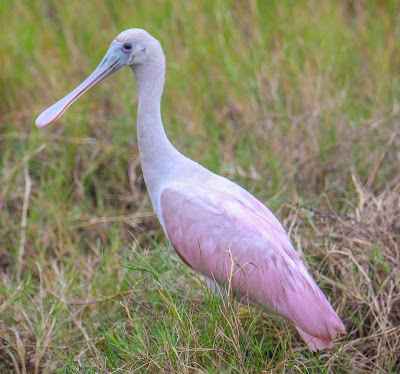
We saw this roseate spoonbill just inside the refuge which gave Judy her first good look at a bird she'd been admiring from some distance previously. 

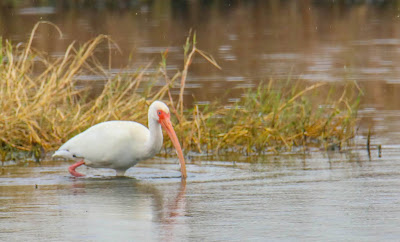
White ibis

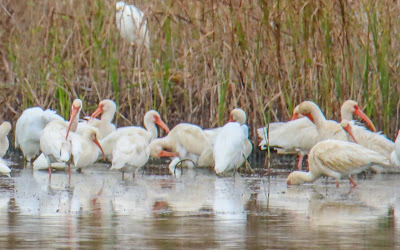
Much of the bird life was at a great distance, such as these white ibis...

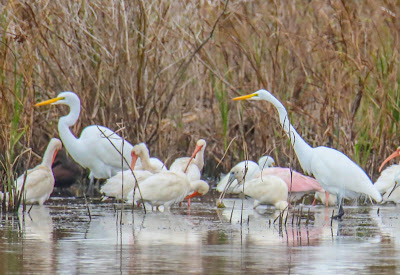
and these white ibis and great egrets. 

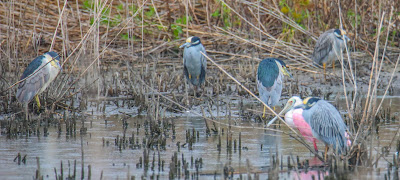
Judy was excited to see this roseate spoonbill. I was excited to see the surrounding yellow-crowned night herons, only the second time I've seen a yellow-crowned night heron. 


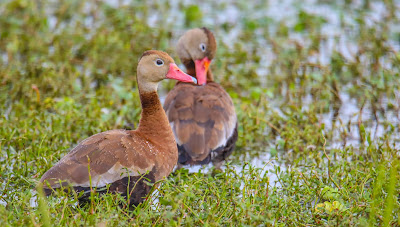
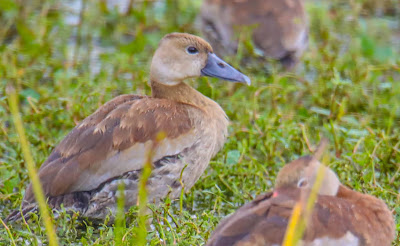
I was also excited to see these black-bellied whistling ducks, also only the second time I've seen them. I spotted them from the trail over the Big Slough which I walked just a small portion of because of the rain. 

This is a juvenile black-bellied whistling duck. 
This is a great place for birding and I wish we'd visited under better weather conditions. As it was, I was excited to see some of the birds we were able to see.  

Sunday, October 24, 2021

Belted Kingfisher

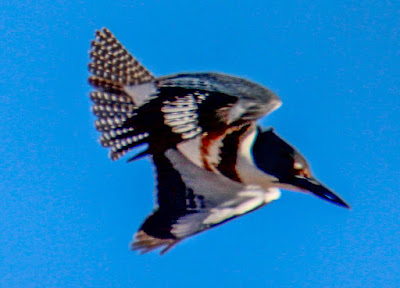
I saw my first belted kingfisher in Niland on McDonald Road (near the Salton Sea) in mid-October. It was standing on a telephone wire and I followed it as it flew several times to different parts of the wire. 
It has a large slate-blue head with a shaggy crest, heavy black bill with a gray base, a white collar, a blue band on the breast and white underparts. The back and wings are slate blue, with black feather tips and little white dots. Females have a rufous band across the upper belly that extends down the flanks. 
The map (from Wikipedia) shows purple as year-round, orange as breeding and blue as non-breeding. The Salton Sea would be blue which makes sense as I've not seen them before in my summer visits. A very distinctive and fun bird to see.   

Wednesday, October 20, 2021

Northern Harrier

The northern harrier is a hawk-like bird I've seen before but had no familiarity with and so knew nothing about it. It was not until seeing them several times in the last year at Bear River Migratory Bird Refuge (but got no photos), then seeing migratory birds near the Salton Sea that I've gotten photos and gotten to know what they look like. 
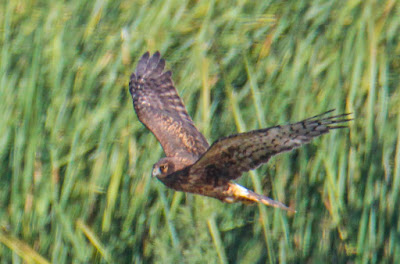
This is probably my best photo. Note the white patch on the rump and the owlish face. 
Females are heavier and larger than males. It has the longest wing and tail relative to its body size of any raptor in North America. They hunt primarily small mammals like voles, cotton rats and ground squirrels, but will also prey on birds, amphibians, reptiles and insects. 
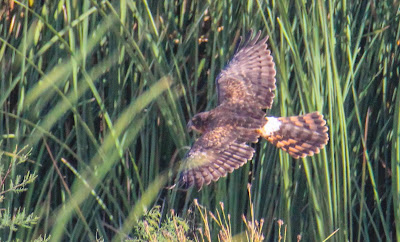
Flying near cattails gave it a nice contrast and gave a better photo. 


They have a white rump and an owl-like face that helps them detect prey by hearing. Adult males are more grayish above with a dark trailing edge on the wings and are pale below. Females are pale below, but have brown streaking. 
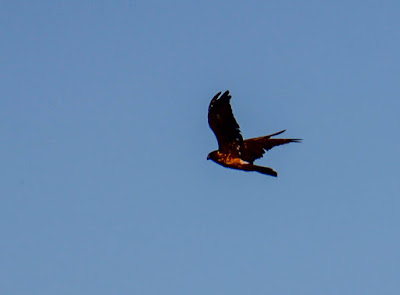
These poor photos taken in September provide coloration and the white rump stands out. 


They breed in the northern part of the northern hemisphere in Canada and the northern U.S., then migrate to the southernmost U.S., Mexico and Central America. They are year-round residents of milder regions in the southern U.S. I'd never seen them before near the Salton Sea and saw a couple of them in early September and 6 or 8 of them in October 2021.