Friday, April 14, 2017

Reticulate Gila Monster - 2017

Lightning struck twice. I saw another Gila monster in Estes Canyon, in Organ Pipe Cactus National Monument, the same canyon I saw my first Gila monster in nine years ago. 


There are two subspecies of Gila monster, the reticulate Gila monster found in the Sonoran and Chihuahuan Deserts of southern Arizona, southwestern New Mexico and northern Mexico and the banded Gila monster found in the Mojave Desert of extreme southeastern Utah, southern Nevada, southeastern California and northeastern Arizona. The total population is guesstimated as "at least several thousand," by the IUCN Red List of Threatened Species. When you consider that in Arizona they spend 98% of their time underground, it is amazing to see one and I feel very fortunate to have seen two. 

I was walking off-trail up the Estes Canyon wash, not too far from the trailhead from the Ajo Mountain Drive. It was 11:00 a.m. and about 90 degrees in early April. I saw some movement to my right at the base of a rock and my initial thought was a rattlesnake. But the orange color quickly gave it away. I was so excited that my pulse quickened and I started to breathe heavily. I was concerned that it was going down a hole beneath the rock and I wouldn't see it again. But it was just wedged under the rock and I coaxed it out with a hiking stick and was able to take some more pictures before it lodged itself under a different rock where I left it. The area was shaded from direct sunlight by large bushes and small trees. 

I heard some people talking on the trail not too far away, so I called over to them and asked if they'd like to see a Gila monster. They were a couple from Nuremberg, West Germany, and had just arrived in the U.S. that morning. They had hiked up Arch Canyon earlier and caught a brief glimpse of a Gila monster crossing the trail there (not too bad to see two Gila monsters in one morning when many people have spent years in the desert and never seen one). 

The thrill of seeing one of these creatures is palpable. I'm sure if my vitals had been measured they would be off the charts. All of my senses were heightened at the thrill of the sight and the concern not to get bit. I was sweating and out of breath at the end of the encounter. It is scene I will replay many times in my mind. 
Wedged under a boulder where I left it.
These Gila monster encounters rank right up there with any other animal sightings I've had.  

Thursday, April 13, 2017

American Bakery - Basseterre, St. Kitts

While visiting St. George Church in Basseterre we caught a whiff of a beautiful smell wafting in from a bakery across the street. When we finished at the church, the smell functioned as a fishing line to drag us in for a visit. We ordered two items, both of which were unusual and wonderful. 
American Bakery in Basseterre, St. Kitts. 
First, we got a bun with a salt fish filling. Salt fish is white fish, usually cod, preserved by salt-curing and drying until all of the moisture is preserved. When used in cooking, it is rehydrated and most of the salt is removed by soaking in hot water and boiling. The bun was moist and fresh and the salt fish filling added a subtle fish taste that was very nice. I loved it. 
Salt fish bun
Next, we got a big slice of thick pizza with broccoli, carrot, cauliflower and cheese and it had a sweet, spicy taste I've never had in pizza before. I'm not a big pizza fan, but this was great. 
This little bakery epitomizes what I love about travel, about trying new things. It was one of my favorite stops of the day. 

Wednesday, April 12, 2017

Camel Sausage Hotdogs

The other day I was visiting Anshu Pathak at Exotic Meat Market and he had me try some new camel sausage he'd recently had made. I had camel sausage about four years ago and it was the consistency of a regular hotdog. These new camel sausages were longer, stiffer, heavier and more fatty. Anshu made a point of telling me that it was all camel, including the fat. 
Camel sausage after it has been microwaved.
Anshu's wife, Claudia, introduced me to a Facebook group called Exotic and Adventurous Foodies. It basically is a site where a picture of beautifully prepared exotic meat is showcased. I've prepared and eaten lots of exotic meat, but I pay very little attention to the side dishes and the garnishes that make it look great. With that in mind, I decided to see if I could make some picture worthy hotdogs using this camel sausage. 

My first attempt started with open-face hotdog buns spread with melted butter and grated 12 month aged Fior Delle Alpi raw milk cow cheese. It tastes like an aged gouda. The hotdog buns were roasted in the broiler until the cheese was melted and the buns were slightly crispy. After broiling, I slathered Genova pesto, a basil and parmesan blend, onto one of the buns and then added microwaved camel sausage the length of the bun, butterflied open so that it spread over the entire bun, then I spread Dijon mustard with white wine on the camel sausage. Earlier I'd sauteed some diced sweet onion in chili oil and olive oil with a sprinkling of cayenne pepper and that was placed over the top of the sausage. 
Camel sausage hotdog with sauteed onions. 
On the other toasted bun I put sliced yellow and green heirloom tomato and chopped avocado. I took a photo before I combined them because I figured it was going to make a mess, and it did, but it was fantastic. Despite all of the ingredients the camel sausage held its own and was readily discernible, both from a texture and taste standpoint. As far as something to post on the Facebook site, it fell short, but it was really, really good. 

A day or two later I decided to try a variation. Everything remained the same except I eliminated the sauteed onion and substituted it with a grilled Anaheim chile that covered the length of the bun. I also prepared a side drink of fresh squeezed blood orange with added Squirt. This hotdog was pretty good, but did not compare to the first one. The sauteed onion really makes a difference. 
Freshly juiced blood orange and some Squirt that I added to it.
The Anaheim chile is underneath the camel sausage on the closest bun. 
The put-together hotdog with a glass of blood orange juice and Squirt.
I'm not sure I'm chef material. These fell-short from a photogenic standpoint, although they did taste very good, particularly the first one. I'll probably make some more attempts at beautiful exotic food, particularly as I prepare exotic meats that I've made before. 

Tuesday, April 11, 2017

Spanish Hogfish

The Spanish hogfish is a member of the wrasse family. The main body is bright yellow, to what almost looked orange on the ones we saw, with a blue/purple to reddish upper body (the ones we saw were very purple). They have a piggish looking snout that gives them their name. 
Spanish hogfish in Carlisle Bay, Barbados, swimming with sergeant major fish. 
They are found in the western Atlantic from southern Florida through the Caribbean and Gulf of Mexico to southern Brazil. They have little commercial importance, but can be found in the aquarium trade. 
We saw a number of them in Carlisle Bay, Barbados, in an area where ships were sunk to provide a platform for a reef. Unlike the sergeant major fish which were all around us, the Spanish hogfish we saw were always well below us. But their colorful orange and purple bodies really stood out. 
There are two in this photo, one to the left and one in the far bottom right. 

Monday, April 10, 2017

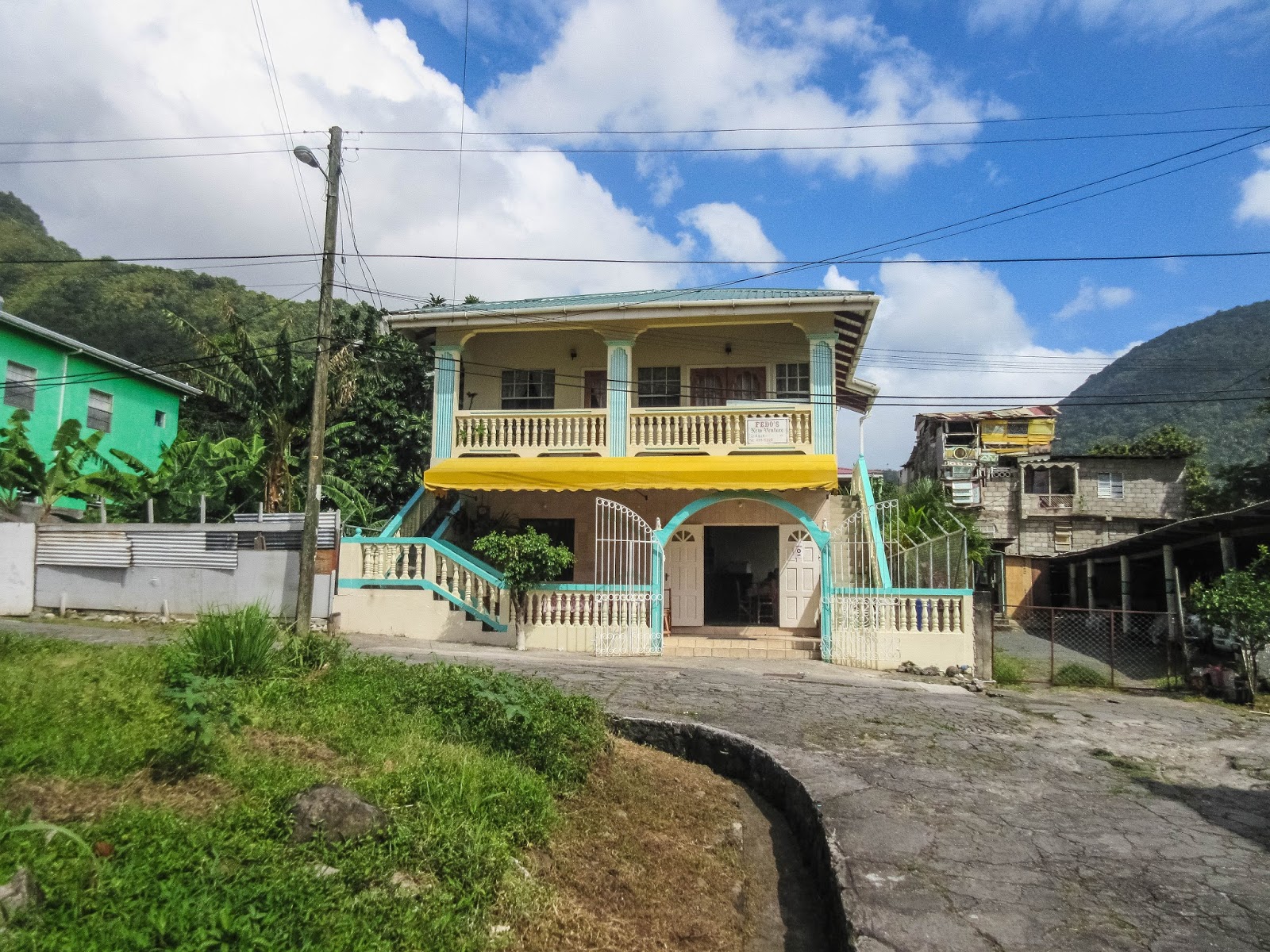
Fedo's New Venture - Soufriere, St. Lucia

Fedo's gets its name from its owner and chef, Frederick "Fedo" Vite. It is known for offering good local cuisine. We were brought to this location in Soufriere, very close to the twin pitons (mountains), by our driver upon request that we find some good local food. 

Judy and I shared a tamarind drink which was fabulous. It was more sweet than sour, was cold and perfect on this relatively warm, humid day. 
I ordered cajun style mahi mahi (caught in local waters), cooked rare, anticipating some heat. What I got was cooked rare, as ordered, nice and juicy, but the orangish/yellow sauce on it had no heat at all, but was very mild. I have no idea what was in the sauce, but it was unlike anything I can recall. Mahi mahi is very mild and not my favorite fish, which is why I was hoping for some heat. 
The fish came with a collection of vegetables that was amazing. It included breadfruit (which I guess is a fruit but seems like a root vegetable), which maybe was a first for me. It had kind of a starchy, fake texture and a spit-inhibiting blandness that caused me to rejoice in having tried it and having no obligation to try it again. For the life of me I can't understand why anyone would eat it if something else was available. Next was dasheen, or what is called taro in other parts of the world. It has a nicer texture than breadfruit, but is not much superior on the taste side. It was nice to try and even better not to have to finish it. Next was christophene, or chayote, which is bland but has a nicer texture. Okay, but nothing to relish. Cassava, or yuca, is another vegetable I've tried, but do not love, except when in the form of fries. Purple sweet potatoes was decidedly better. The sweet plantain was not particularly sweet and I only nibbled on it. The shredded cabbage, carrots and rice and beans were less unusual. 
The other side of the plate. You can see it was loaded.
Overall I was thrilled to have eaten the meal, even though I did not particularly love it. It was and felt authentic. 

Sunday, April 9, 2017

Houndfish

The houndfish, also called the crocodile needlefish, can get up to five feet long. They have a stout cylindrical body, dark blue backs, silver/white sides and a plain white belly. The caudal (tail) fin is deeply forked. They feed mainly on smaller fish. The beak of the houndfish can cause injuries (in 2010 an ocean kayaker got a collapsed lung when the beak of a jumping houndfish stabbed her in the back). 
These houndfish, in the foreground of the sea turtle, were in Carlisle Bay, Barbados. 

Saturday, April 8, 2017

Atlantic Tarpon (fish)

While looking at green sea turtles in Carlisle Bay, Barbados, we saw a school of fish swimming around them. I've been trying to identify them and have tentatively decided they are tarpon, although I do not have any certainty in that identification. 

The tarpon has a bluish or greenish back and has shiny silvery scales that cover most of its body. They have large eyes with adipose (transparent) eyelids. They have broad mouths with prominent lower jaws that jut out farther than the rest of this face (it is this last characteristic which is hardest to identify in my pictures).  
Tarpon swimming around a green sea turtle. 
It is found along the western Atlantic coast from Virginia to Brazil, throughout the Caribbean, along the Gulf Coast and along the eastern Atlantic coast from Senegal to Angola. 
They are able to go between fresh and saltwater. The young are usually found in the ocean, near the surface. As they grow they inhabit salt marshes, tidal pools, creeks and rivers. As adults, they usually return to the ocean, although some stay in fresh water. 

They have a unique swim bladder that helps them breathe. The respiratory surface is coated with blood capillaries with a thin epithelium over the top. They must surface for air and will die if they cannot. 
They follow baitfish schools and feed on week or dying fish. I believe they were following the sea turtle to feed on the errant fish fish pieces that were being fed to the turtle to attract it. 

They are bony and their meat is not desirable. But they can get up to 8 feet in length and are fighters when caught on a fishing line, so they are considered a great game fish.