Friday, April 7, 2017

Live Sharksucker (fish)

The live sharksucker is a member of the remora family. Remoras prefer manta rays and sharks, while sharksuckers prefer large fish and sea turtles. They do not attach to the host permanently, rather they scoot around the host's body. They have a suction cup on the top of the head. They are not eating the host, like sucking its blood, but are feeding on parasites on the host's body. 
Sharksucker attached to a green sea turtle.
The body is dark gray to dark brown and it has a longitudinal stripe along the axis of the body that is darker than the background color with a whitish margin. 
Free-swimming sharksucker beneath a turtle.
We saw sharpsuckers attaching to and swimming near green sea turtles in Carlisle Bay, Barbados. 

Thursday, April 6, 2017

Ballyhoo (fish)

The ballyhoo is found on both sides of the Atlantic Ocean in tropical-warm temperate waters. It has a short upper jaw and an elongated lower jaw and a cylindrical elongated body. Its lower beak is very long and has an iridescent red tip. Their bodies are silver with a blue sheen and they have forked tails with a yellow upper lobe. They are found in quiet bays. 
Ballyhoo in Carlisle Bay, Barbados.
We saw these ballyhoo off Barbados in Carlisle Bay in the vicinity some ship wrecks used as the beginnings of coral reefs. They always seemed to swim just below the surface of the water in groups. 
The red tip can be seen on the ballyhoo to the mid-right. 
Ballyhoo swimming among lots of sergeant major fish.

Wednesday, April 5, 2017

Yellowtail Snapper

The yellowtail snapper is found in the Atlantic and Gulf of Mexico, from Florida to the West Indies and as far as Brazil. It is usually found along coral reefs and is a commercially caught fish with flaky meat, considered some of the best among the snapper family. 
Yellowtail snapper at Trunk Bay.
It has a large yellow body stripe from the all-yellow, deep-forked tail, to the eye. Sometimes they have a blue sheen and sometimes they have yellow spots on the body above the mid-line. 
This yellowtail snapper was found at Trunk Bay off St. John Island in the Caribbean.  

Tuesday, April 4, 2017

Stoplight Parrotfish

The stoplight parrotfish is found among the coral reefs of Florida, Bermuda, the Caribbean, the Gulf of Mexico and as far south as Brazil. In its initial phase it has white spots and a red belly. 
The red belly in the initial phase is very visible.
It has a carp-like head.

In its terminal phase, when it has become a sexually mature male, it becomes a psychedelic looking iridescent greenish blue with a yellow or orange crescent and spot on its tail and a yellow stoplight in front of its pectoral fin (where it gets its name). 
In its terminal phase it is one of the most beautiful fish. 
This photo is less clear, but the yellow "stoplight" spot behind the head is visible. 
I saw these stoplight parrotfish at Trunk Bay on St. John Island, U.S. Virgin Islands. I was shocked in researching for this post that both phases were the same fish. 

Monday, April 3, 2017

Flying Fish Sandwich - Bridgetown, Barbados

In Barbados we spent some time on a catamaran and I was talking to one of the crew members about unusual food in Barbados. He recommended that I try a dish called cou cou and flying fish, the national dish of Barbados. Cou cou is a mixture of corn meal and okra which is then served with fried or steamed flying fish. He told me any taxi could take me to a place that prepares it.
An illustration of a flying fish from Wikipedia. 
When we got back to the cruise ship terminal a taxi driver told me she could drop us off at a place that serves flying fish sandwiches. That sounded great. When she dropped us off at Chefette, which looked like a local version of Burger King or McDonalds, I thought the driver was pulling my chain, particularly when, at first glance, I did not see flying fish on the menu. However, one of the employees confirmed that they did have a flying fish sandwich, pointed it out to me on their menu, and I ordered one. 
Chefette, in downtown Bridgetown, Barbados. 
Menu advertises flying fish.
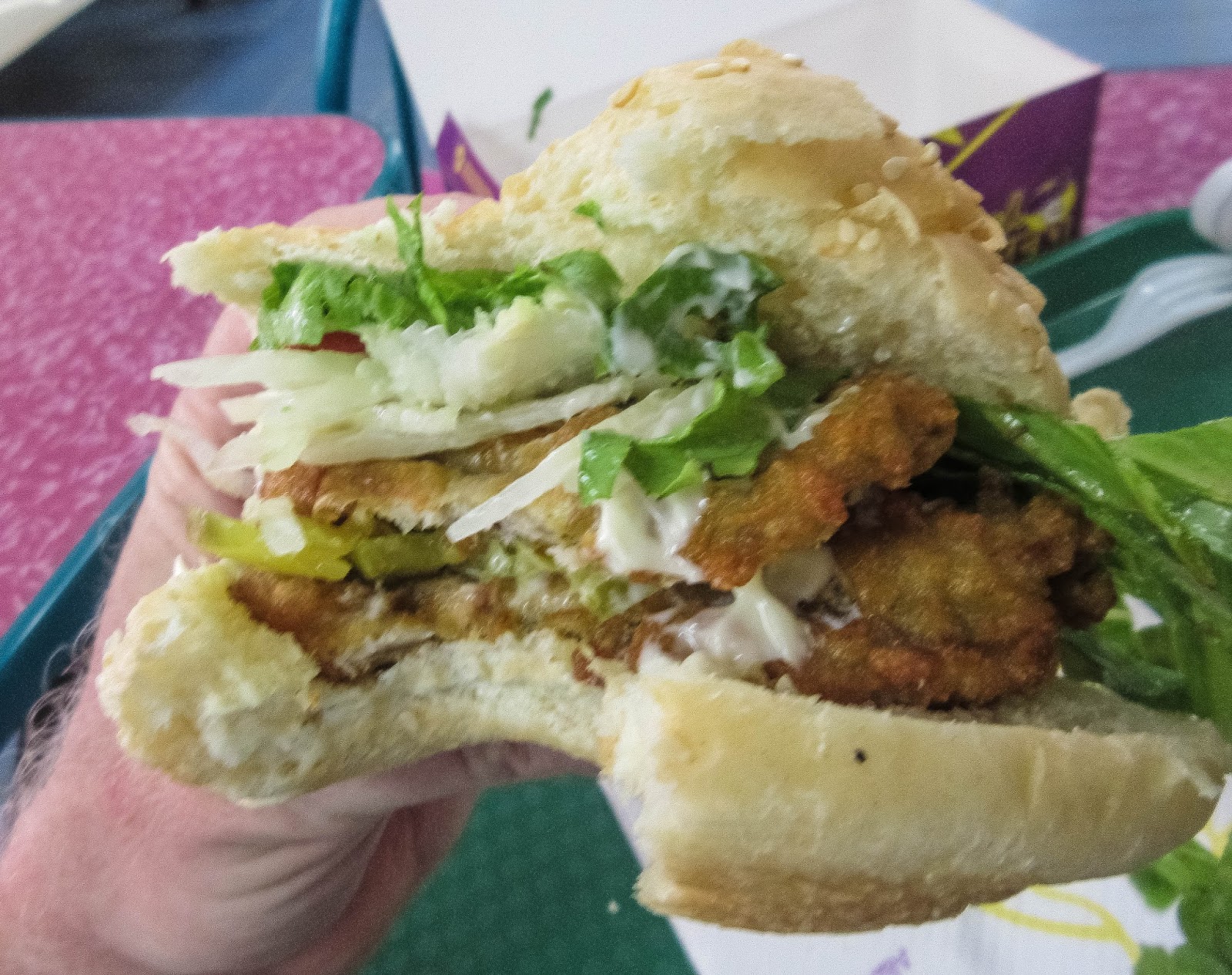
My sandwich looked as good as this picture, not something that happens very often. 
I was completely blown away to get a marvelous looking sandwich with lots of lettuce and onions, pickles, tomato and fish. I took a bite and was instantly impressed. I rarely eat fish sandwiches, but if fish sandwiches tasted like this, I'd eat more of them. The flying fish, more of a dark meat, tasted great, and the sauce and other ingredients were ample and complemented each other. If this were in California, I would get again. 
Flying fish sandwich with top bun removed.
Sandwich after a couple of big bites.
Later, when we passed KFC, Judy pointed out to me that they offer a flying fish sandwich as well. That's when I realized that flying fish is a big deal in Barbados. 
KFC flying fish ad. Reflections make it hard to see.
I noticed a flying fish on the $1 dollar Barbados coin as I got change at Chefette.  
A Barbados dollar with a flying fish. The receipt is in Barbados currency, not U.S. dollars. 

Sunday, April 2, 2017

El Kampestre - Levittown, Puerto Rico

Before our trip, Judy sent me an article, "Ten Must-Try Puerto Rican Foods." I listed them in our itinerary and we were able to eat five of the listed items. Three were at Los Pinos, a previous post (lecon, arroz con gandules and tembleque), and two were at El Kempestre in Levittown (mofongo and asopao), a restaurant within walking distance of our hotel, west of San Juan. 
One of my favorite aspects of traveling is trying foods of the local culture and Kampestre was a great spot for that. None of the items we ordered were things I would normally try, except lecon (roast pork), but because of the desire to eat the local food we branched out and had our food vocabulary and Puerto Rican cultural knowledge expanded. 

Mofongo is described as Puerto Rico's "quintessential dish," the dish to try if you can only try one of the ten dishes. It is mashed fried green plantains with pork cracklings mixed in. Mofongo relleno, or stuffed mofongo, has added ingredients within it. This restaurant offered mofongo relleno with beef (carne), chicken (pollo) or shrimp (camarones). We picked shrimp. It came with tostones, fried green plantains. The nearest thing I've ever eaten to it was a breakfast tortillo I ate in Ajo, Arizona about a month ago, very heavy and thick with corn. This was that on steroids. It was very thick, very heavy and very bland (we had some mofongo later in the trip which was less dense and I liked it much more). The only thing that saved it for me was some good vinegary local hot sauce, El Jibaro que Pica (I think it means something like the stinging mountain peasant - perhaps some kind of a hot sauce equivalent of moonshine). I applied it liberally and it moistened up the mofongo and gave it some flavor. I liked the mofongo with this transfusion. 
Shrimp mofongo. About five or six pieces of shrimp were embedded in the corn mixture. The tostones were pretty bland. The whole heavy corn culture would take some getting used to. 
The hot sauce moonshine. 
Asopao is described as the equivalent of Puerto Rican gumbo. It is described as a chicken and rice soup with garlic, onion, sofrito (a tomato based sauce), ham and other seasonings. Kampestre offered asopao with chicken (pollo) or shrimp (camarones). We opted for the traditional chicken. The soup was good, but bland. I'd already learned that the hillbilly hot sauce could cure all ills and it helped the asao pollo too. I quite liked it with the vinegary and spicy addition. The dish also came with soggy vegetables which I enjoyed, even though I wish they'd retained a little more texture. 
Asopao pollo.
The best food of the night was the drink Judy and I shared. It was a combination of orange, pineapple and grenadine (a pomegranate base, but often made with blackcurrant). It was quite thick and sweet. 
This was the beginning of our indoctrination into Caribbean food culture, meaning relax and enjoy, this meal is going to take two hours. 

Saturday, April 1, 2017

Lechonera Bruny's - Puerto Rico

After visiting Lechonera Los Pinos, we drove back along Route 184 toward Hwy 52, the main road back to San Juan. I'd been looking for El Rancho Original, another lechonera that had good reviews, but saw that Lechonera Bruny's was the last chance to quickly sample another lechonera before getting back on the equivalent of a freeway. 
Lechonera Bruny's
So I pulled over for a quick stop. There were things I liked about this lechonera better than Los Pinos. The roasting pig was out front and easy to see. The "lechon master" was standing in front of it and I was able to ask for specific parts of the pig and have him cut it right there in front of me. 
I asked for two pig cheeks and a half-pound of rib meat. When he went to the pig with his large carving knife, juices splattered on the fire below and created lots of steam and heat. The lechon master recoiled because of the heat when he was trying to carve off the cheek.  
Carving off cheek meat. Steam sprays up from the dripping juices. 
The pig now missing a cheek.
With help, the lechon master goes for the cheek on the other side. 
Here the lechon master carves a chunk out of the ribs.
The cheek meat was incredible. Very soft and fatty. Unlike the skin from the pig at Los Pinos, this skin was much softer and edible. This pig was also more seasoned. The pigs at the lechoneras are marinaded with some combination of salt, pepper, garlic, oregano, cilantro (and other secret ingredients) that are rubbed into the carcass and incisions made in the skin. The spices were particularly prevalent in the rib meat and in some cases were too much. 
The cheek meat.
Carving up the rib meat.
I'm glad we stopped at this second lechonera for a comparison. The differences were striking and there were aspects of each that I liked. I would love to go back to this area of the world again and do some more sampling. Food just doesn't get much better than this.