I recently did a post on
L'Ma Lodge in Skoura, Morocco, where I wrote about riads in general, and indicated that in many ways L'Ma was my favorite of the places we stayed in Morocco. Now that I am doing a post on Riad Laaroussa I can indicate that in many ways it was my favorite of the places we stayed in Morocco. Both were wonderful. I would recommend a stay at both to anyone traveling to Morocco.
Riad Laaroussa was where we spent our first three nights. We flew into Casablanca, were picked up by our driver, Yousef, then driven to Fez (also spelled Fes and pronounced "Fess" in Morocco). It was a four hour drive and we arrived about 7:30 p.m. in the dark. Fez is primarily known for its walled medina, called Fes el Bali. No automobiles are allowed in the medina, so Yousef dropped us off at the gate nearest our riad and a baggagiste was sent from the riad with a little cart to carry our suitcases and show us the way. We entered the medina, characterized by narrow alleys and high walls, and quickly lost any sense of where we were going. After five minutes of walking we were standing outside a very high non-descript gray wall and a large metal door with "Riad Laaroussa" on it. I was a little stunned. We appeared to be in a gritty area and the outside bore no evidence of being the wonderful place I'd read about, currently
rated no. 1 out of 92 hotels in Fez on Trip Advisor. The large door creaked open and we were led up a couple of stairs through a hall and then a gorgeous atrium or courtyard opened up before us with orange trees bathed in soft night light and the building around it with colorful wood doors and beautiful Andalusian style tile.
 |
| Narrow alleys and high walls in the medina. |
 |
| Metal front door and label on riad. |
 |
| Courtyard with night lights. |
 |
| Sitting area off the courtyard. |
We were led up steep stairs, with a very large step required to purchase each new step, then turned left through some wood doors into a small hallway and then through another wood door into our enormous room. We were informed that we'd received a room upgrade and I was astounded by the beauty of where we would stay. We had a large bed on one end, a loft with a ladder going up to it, on the other, a bathtub and shower underneath the loft, with two sinks, then even further back, the toilet and another sink. In a corner of the room near the bathroom door was a fireplace and a beautiful fire was going, taking the bit of chill out of the night air. Several windows in our room, one edged by stained glass, viewed out onto the courtyard. Stunning.
 |
| Steep stairs with Andalusian style tile. |
 |
| Judy in our bedroom. |
 |
| In the bedroom, looking back at the loft, the fireplace and the open door to the bathroom. |
 |
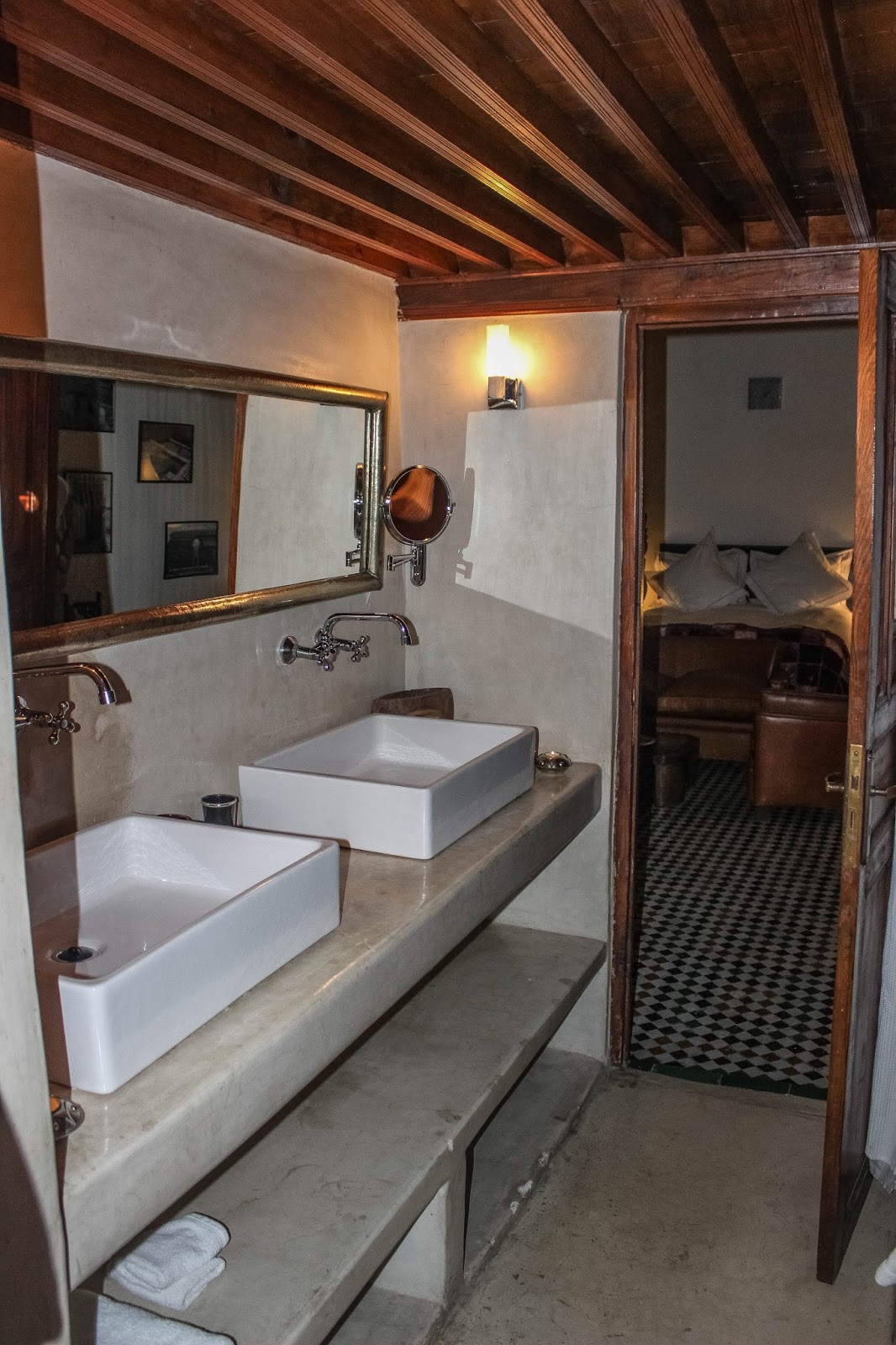
| Two bathroom sinks (bath/shower to the right out of the picture) and bedroom straight ahead. |
 |
| Sink in toilet room with more wonderful Moroccan light. |
 |
| Bedroom window looking out onto the courtyard. |
Dinner, which we'd ordered ahead of time, was waiting for us, so we left our room, went up some more stairs and found ourselves at the top of the riad, a kitchen to our left, a rooftop terrace straight ahead, and a dining room to our right. Because it was cool, we opted to eat in the dining room and they quickly had a nice fire going in the fireplace. Amazing.
 |
| Dining room. |
One other couple was already there, from Columbia. While we waited I sat in front of the fire and enjoyed its warmth and the light. I learned that night, and had it confirmed again and again, that light is magical in Morocco. One of the decorations in the room was a series of tagine tops hanging from the ceiling.
 |
| Nice fire in the dining room. |
 |
| Hanging tagine lids. |
 |
| Lamp on our dining table. More wonderful Moroccan light. |
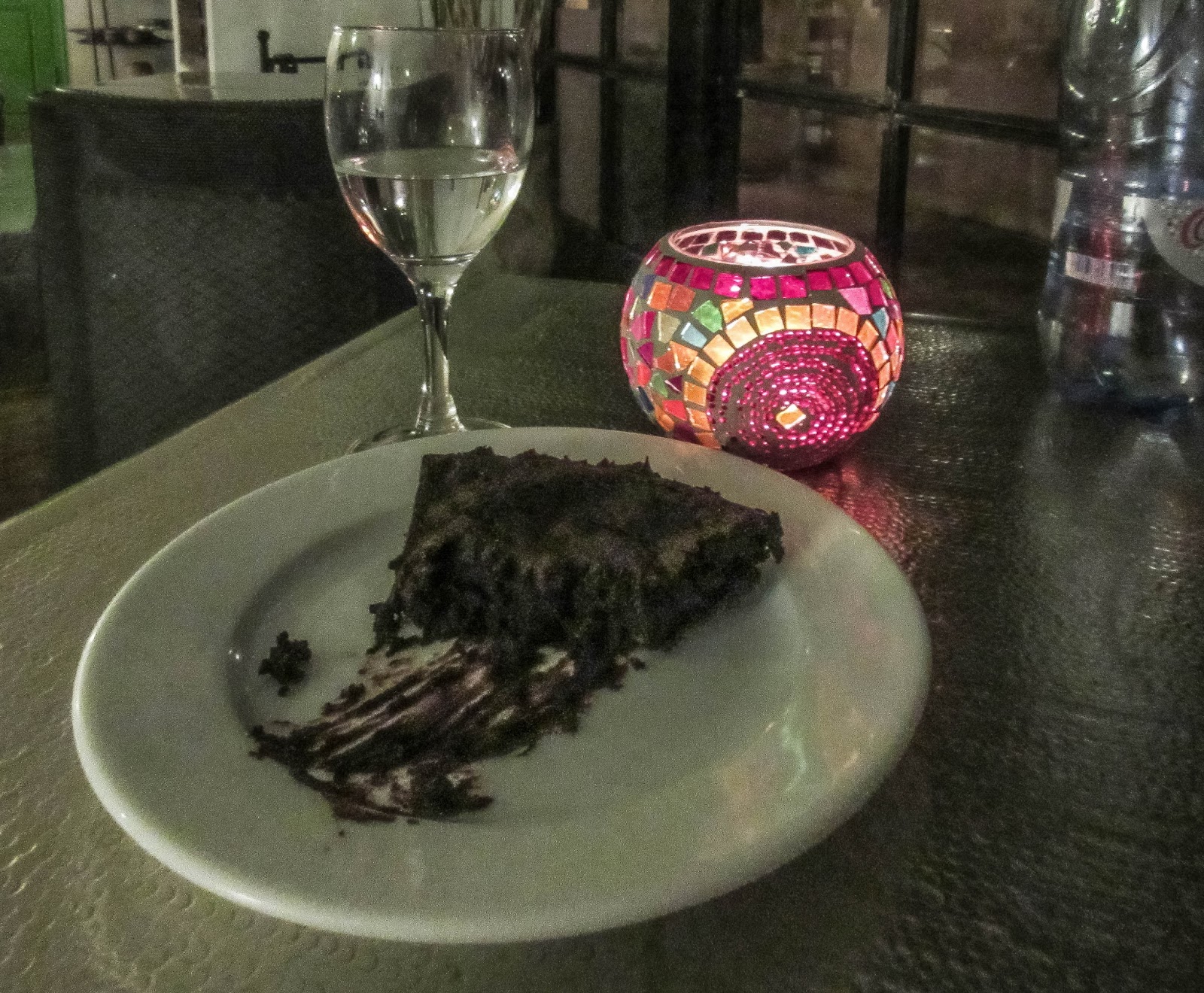
We were soon to be fed a tagine meal, the first of many on our trip. But before it arrived, we were each given three small glasses of colorful liquid. The white liquid was cauliflower soup - fantastic. If regular cauliflower tasted like this it would outsell oranges. Perfect for a cool evening. The green liquid was pea soup, also very good, but just a bit behind the cauliflower. The orange-ish liquid was squash soup, decent, but a distant third behind the other two. We were off to a great start. Next came a lamb tagine with couscous, carrot, squash, potato, caramelized onion, chickpeas, raisins and light gravy. Wonderful lamb, and the best couscous I've ever eaten. I was thinking, "I could really get used to this." Finally we got a chocolate tart that was extremely rich and creamy - Judy announced it to be the best chocolate tart she's ever eaten. This meal was right up there as one of the best meals we had in Morocco.
 |
| Bread and three kinds of soup (cauliflower, squash and pea). |
 |
| Lamb tagine with chickpeas, onions, carrots, couscous, etc. |
 |
| Partially eaten chocolate tart. |
That night we luxuriated in the coolness of the night with the edge taken off by the fire in our room fireplace.

Hassan, our guide, was going to pick us up at 9:00 a.m. the next morning for a tour of Fez, so we sauntered up to breakfast about 8:20 a.m. and wandered about the rooftop terrace in the cool morning air with the bright March sun beginning to take the cold edge off. Fez was visible all around us, with old Berber ruins on a ridge above us. I was taken back by how large the medina was. Below us was the beautiful riad courtyard - we, now saw it bathed in natural light for the first time. Breakfast included banana, pear, kiwi, strawberries, eggs over-easy (that turned out over-hard), a heavy pancake/crepe and some thick bread. Then of course, fresh squeezed orange juice, which became a staple at virtually every meal in Morocco. We had a three-headed tagine at the table with salt, pepper and cumin. This was how we found most of the spices presented in Morocco, rather than in shakers. Just take a pinch and sprinkle it on. We learned that cumin was served a lot. I had to get used to it.
 |
| The courtyard of the riad. |
 |
| The inner courtyard (center), Judy sitting down for breakfast to the mid-right, and Fez visible in the distance. |
 |
| The courtyard (center and right) and Fez proper (outside the medina) at the top and the old Berber walls, top right. |
 |
| Lounge area on the upper terrace. |
 |
| Far side of upper terrace, looking back toward dining area (the courtyard opening is just visible in the center). |
 |
| Riad Laaroussa (pink walls - center) as photographed from the Berber walls outside the medina. |
 |
| Breakfast orange juice, pear and thick crepe. |
 |
| Kiwi, strawberries, pear and banana. |
 |
| Over-hard eggs and tagine holders for salt, pepper and cumin. |
 |
| The courtyard from below. |
 |
| The courtyard from a different angle. |
 |
| A beautiful door off the courtyard. |
That evening, after touring Fez, we decided to eat at the riad again because our first meal was so great. In an email when we first signed up about a year before, Cathy and Fred, the owners, asked if we had any preferences for meals. I'd seen pictures of camel meat in the market and said I would love to have a meal with camel meat. They responded that camel is not normally something they do, but that they would try to do it when we visited. Our first night we were told that the cook had gone into the medina that day and had been unable to find any camel meat. I was thrilled that they'd remembered my request. The second night after we trudged in after dark, we were informed they'd obtained some minced camel meat from a restaurant that serves camel burgers and that it would be part of our meal. Our first course was samosas, something I didn't associate with North Africa, but now know it is part of the cuisine. They are triangular pastry, either fried or baked, with fillings that can vary from meat to vegetarian. We had some with meat and with just vegetables, none of the fillings really stood out. The minced camel meat was cooked in small patties. I've had camel before and had visions of meat stalls filled with various camel cuts and trying some camel hump, filet or ribs. I was extremely pleased that they'd gone to the effort to get the mincemeat, but it was not what I'd been hoping for. Next we had a chicken tagine with olives. As with all the chicken we ate in Morocco, it was overcooked, but it had some nice gravy. I found myself disappointed every time we got chicken. On the other hand, I was always excited when we got lamb, as we had the night before. Finally, we had a lemon tart that was very good. The graham cracker crust was pretty thick and the topping quite tart - I loved it. Judy couldn't help but compare it to the chocolate tart and anything but chocolate tart was going to fall short. So this meal, though good, didn't measure up to our first night.
 |
| Vegetable and meat samosas. |
 |
| Camel patties |
 |
| Chicken tagine with olives. |
 |
| Lemon tart |
The next morning we got started earlier. Hassan picked us up at 8:30 a.m. for a trip to Volubilis, Moulay Idriss and Meknes. We were a little early for the normal breakfast, but they put out a nice simpler breakfast of raspberries, oranges, pears, bananas, fresh-squeezed orange juice, a spongy pancake, jam and thick bread.
 |
| Breakfast. The spongy pancake and jam not shown. The bananas were small and often looked kind of dark, but they were always perfect inside. I loved the Moroccan bananas. |
That was our last meal at the riad. We ate a large lunch and did not eat dinner that night. We left Fez at 8:00 a.m. the next morning for an 8 hour drive to Merzouga. The riad provided some fruit for us to go. Riad Laaroussa was amazing. I would love to go back and I would recommend it to anyone going to Morocco.